• Get involved.
    We want your input!
    Apply for Membership and join the conversations about everything related to broadcasting.

    After we receive your registration, a moderator will review it. After your registration is approved, you will be permitted to post.
    If you use a disposable or false email address, your registration will be rejected.

    After your membership is approved, please take a minute to tell us a little bit about yourself.
    https://www.radiodiscussions.com/forums/introduce-yourself.1088/

    Thanks in advance and have fun!
    RadioDiscussions Administrators

New Life for REELRADIO

Circling back to this because I just got a classic example---90 minutes of KTWV, Los Angeles from August of 1997.

That late, it should be a very good quality stereo aircheck, but it's not---it's mono, and this is the noise floor, audible before the recording begins and in pauses in the programming:


Cheap cassette recorder, cheap tape, or both. This is SO common among 80s and 90s airchecks, but '97 is probably the latest I've encountered it.
And Michael, that aircheck was likely uploaded by me. It came from a friend, who wasn't in the business, who lived in Los Angeles. The tapes were low-fi, and came from a cheap tape machine. In 1997, streaming was years away from CBS/Infinity stations, and for a person interested in the station living in the midwest, getting these tapes were gold.

There was a lot more rumble and noise in those original tapes that what you're hearing.
 
And Michael, that aircheck was likely uploaded by me. It came from a friend, who wasn't in the business, who lived in Los Angeles. The tapes were low-fi, and came from a cheap tape machine. In 1997, streaming was years away from CBS/Infinity stations, and for a person interested in the station living in the midwest, getting these tapes were gold.

There was a lot more rumble and noise in those original tapes that what you're hearing.

Wow!

I didn't find this online, and there is no online match for it---I got it in a trade with another collector.

It illustrates something I think a lot of people don't realize----the vast majority of mid 1950s-early 1960s airchecks were of high quality---because they were recorded on reel to reel tape, using either professional studio or high-fidelity consumer tape recorders.

That started to get watered down in the mid-late 60s as kids got cheaper tape machines to play with (including some battery-operated reel-to-reel machines), and as those kids became teens and young adults, some bought higher-quality gear---but some opted for cheap cassette decks and cheap cassettes.

And as high-quality unscoped airchecks from the jocks and stations themselves became less common, that left listeners rolling tape.

I think a lot of people think that once digital came in, quality was just a given, but that's really not the case and it's why finding a high-quality unscoped aircheck of a station (and recording off a stream has its own issues) is less common than one might expect.
 
I think a lot of people think that once digital came in, quality was just a given, but that's really not the case and it's why finding a high-quality unscoped aircheck of a station (and recording off a stream has its own issues) is less common than one might expect.
And, for the last quarter century, at least, where we have had digital systems, many of us had "the computer" do airchecks by recording only the open studio mike(s). Once we had either done an aircheck session with the talent or given enough time for legal to consider it safe to erase, the airchecks and even the full audio log was "written over" base on management saying how long to keep it.

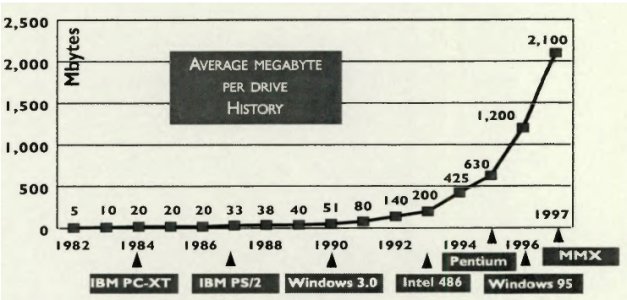
I was doing airchecks for my KNTQ talk staff going back to 1996. That is nearly 30 years, and we were using the AudioVault back when hard drives were expensive: I remember buying my own 200 meg drive around 1993 for nearly $400. By 1996 we had 1 gb drives and they were about that same price. But expensive to store audio and on the music station (KLVE) we still used CDs for music.

I mention the cost of hard drives because we could not store a lot of "history" as it was very expensive.

1751247103871.jpeg

Credit: History (1997): Average Capacity per HDD From 1.2GB in 1996 to 2.2GB in 1997
 
Wow!

I didn't find this online, and there is no online match for it---I got it in a trade with another collector.

It illustrates something I think a lot of people don't realize----the vast majority of mid 1950s-early 1960s airchecks were of high quality---because they were recorded on reel to reel tape, using either professional studio or high-fidelity consumer tape recorders.

That started to get watered down in the mid-late 60s as kids got cheaper tape machines to play with (including some battery-operated reel-to-reel machines), and as those kids became teens and young adults, some bought higher-quality gear---but some opted for cheap cassette decks and cheap cassettes.

And as high-quality unscoped airchecks from the jocks and stations themselves became less common, that left listeners rolling tape.

I think a lot of people think that once digital came in, quality was just a given, but that's really not the case and it's why finding a high-quality unscoped aircheck of a station (and recording off a stream has its own issues) is less common than one might expect.
Michael,

Sending you a PM.
 
So does the RIAA want an archive or would they rather the history get erased?
As was said to me once, "this is a business, not a museum." They don't spend money unless it makes them money.
 
They don't own any masters of any recordings. So they wouldn't be a party in any lawsuit.

Also Universal Studios isn't related to Universal Music. Two different companies. One is owned by Comcast, the other by Vivendi.

Vivendi continued to rent vault space in the vault for master recordings. It was their masters that went up, along with some of Universal's film and videotape.
 
Vivendi continued to rent vault space in the vault for master recordings. It was their masters that went up, along with some of Universal's film and videotape.

However, everything there was backed up in multiple places. Record labels don't always retain the rights to their masters. Quite often, after time, the rights return to the artists, and they're the ones responsible for the archives. In recent years we've heard about Bob Dylan and others selling the rights to their recordings. The labels didn't share in any of that payout.
 
However, everything there was backed up in multiple places. Record labels don't always retain the rights to their masters. Quite often, after time, the rights return to the artists, and they're the ones responsible for the archives. In recent years we've heard about Bob Dylan and others selling the rights to their recordings. The labels didn't share in any of that payout.

Since you didn't do @Theater of My Mind the courtesy of reading the article, here's a pull-quote:


UMG maintained additional tape libraries across the United States and around the world. But the label’s Vault Operations department was managed from the backlot, and the archive there housed some of UMG’s most prized material. There were recordings from dozens of record companies that had been absorbed by Universal over the years, including several of the most important labels of all time. The vault housed tape masters for Decca, the pop, jazz and classical powerhouse; it housed master tapes for the storied blues label Chess; it housed masters for Impulse, the groundbreaking jazz label. The vault held masters for the MCA, ABC, A&M, Geffen and Interscope labels. And it held masters for a host of smaller subsidiary labels. Nearly all of these masters — in some cases, the complete discographies of entire record labels — were wiped out in the fire.

The scope of this calamity is laid out in litigation and company documents, thousands of pages of depositions and internal UMG files that I obtained while researching this article. UMG’s accounting of its losses, detailed in a March 2009 document marked “CONFIDENTIAL,” put the number of “assets destroyed” at 118,230. Randy Aronson considers that estimate low: The real number, he surmises, was “in the 175,000 range.” If you extrapolate from either figure, tallying songs on album and singles masters, the number of destroyed recordings stretches into the hundreds of thousands. In another confidential report, issued later in 2009, UMG asserted that “an estimated 500K song titles” were lost.

The monetary value of this loss is difficult to calculate. Aronson recalls hearing that the company priced the combined total of lost tape and “loss of artistry” at $150 million. But in historical terms, the dimension of the catastrophe is staggering. It’s impossible to itemize, precisely, what music was on each tape or hard drive in the vault, which had no comprehensive inventory. It cannot be said exactly how many recordings were original masters or what type of master each recording was. But legal documents, UMG reports and the accounts of Aronson and others familiar with the vault’s collection leave little doubt that the losses were profound, taking in a sweeping cross-section of popular music history, from postwar hitmakers to present-day stars.

Among the incinerated Decca masters were recordings by titanic figures in American music: Louis Armstrong, Duke Ellington, Al Jolson, Bing Crosby, Ella Fitzgerald, Judy Garland. The tape masters for Billie Holiday’s Decca catalog were most likely lost in total. The Decca masters also included recordings by such greats as Louis Jordan and His Tympany Five and Patsy Cline.

The fire most likely claimed most of Chuck Berry’s Chess masters and multitrack masters, a body of work that constitutes Berry’s greatest recordings. The destroyed Chess masters encompassed nearly everything else recorded for the label and its subsidiaries, including most of the Chess output of Muddy Waters, Howlin’ Wolf, Willie Dixon, Bo Diddley, Etta James, John Lee Hooker, Buddy Guy and Little Walter. Also very likely lost were master tapes of the first commercially released material by Aretha Franklin, recorded when she was a young teenager performing in the church services of her father, the Rev. C.L. Franklin, who made dozens of albums for Chess and its sublabels.

Virtually all of Buddy Holly’s masters were lost in the fire. Most of John Coltrane’s Impulse masters were lost, as were masters for treasured Impulse releases by Ellington, Count Basie, Coleman Hawkins, Dizzy Gillespie, Max Roach, Art Blakey, Sonny Rollins, Charles Mingus, Ornette Coleman, Alice Coltrane, Sun Ra, Albert Ayler, Pharoah Sanders and other jazz greats. Also apparently destroyed were the masters for dozens of canonical hit singles, including Bill Haley and His Comets’ “Rock Around the Clock,” Jackie Brenston and His Delta Cats’ “Rocket 88,” Bo Diddley’s “Bo Diddley/I’m A Man,” Etta James’s “At Last,” the Kingsmen’s “Louie Louie” and the Impressions’ “People Get Ready.”
1751417180845.gif
The list of destroyed single and album masters takes in titles by dozens of legendary artists, a genre-spanning who’s who of 20th- and 21st-century popular music. It includes recordings by Benny Goodman, Cab Calloway, the Andrews Sisters, the Ink Spots, the Mills Brothers, Lionel Hampton, Ray Charles, Sister Rosetta Tharpe, Clara Ward, Sammy Davis Jr., Les Paul, Fats Domino, Big Mama Thornton, Burl Ives, the Weavers, Kitty Wells, Ernest Tubb, Lefty Frizzell, Loretta Lynn, George Jones, Merle Haggard, Bobby (Blue) Bland, B.B. King, Ike Turner, the Four Tops, Quincy Jones, Burt Bacharach, Joan Baez, Neil Diamond, Sonny and Cher, the Mamas and the Papas, Joni Mitchell, Captain Beefheart, Cat Stevens, the Carpenters, Gladys Knight and the Pips, Al Green, the Flying Burrito Brothers, Elton John, Lynyrd Skynyrd, Eric Clapton, Jimmy Buffett, the Eagles, Don Henley, Aerosmith, Steely Dan, Iggy Pop, Rufus and Chaka Khan, Barry White, Patti LaBelle, Yoko Ono, Tom Petty and the Heartbreakers, the Police, Sting, George Strait, Steve Earle, R.E.M., Janet Jackson, Eric B. and Rakim, New Edition, Bobby Brown, Guns N’ Roses, Queen Latifah, Mary J. Blige, Sonic Youth, No Doubt, Nine Inch Nails, Snoop Dogg, Nirvana, Soundgarden, Hole, Beck, Sheryl Crow, Tupac Shakur, Eminem, 50 Cent and the Roots."

And here's a follow-up the Times did to its original reporting:

 
And here's a follow-up the Times did to its original reporting:

I read the original, and have commented on it many times. That original reporting has been disputed in multiple lawsuits since then, including the Tom Petty estate lawsuit. I don't have time to dig up all of the many articles since 2019. As I said, the tapes had been copied and preserved in many other places.

And as I also said, the RIAA has no basis in any lawsuit, since they don't own any masters. It's strictly between the artist and the label.
 
However, everything there was backed up in multiple places. Record labels don't always retain the rights to their masters. Quite often, after time, the rights return to the artists, and they're the ones responsible for the archives. In recent years we've heard about Bob Dylan and others selling the rights to their recordings.
"Rights to recordings" does not specify "masters". There may be other copies, but not the masters. In an analog world, any copy is a degraded master.
 
I read the original, and have commented on it many times. That original reporting has been disputed in multiple lawsuits since then, including the Tom Petty estate lawsuit. I don't have time to dig up all of the many articles since 2019. As I said, the tapes had been copied and preserved in many other places.
Analog copies are just that: copies. There is only one master for most recordings.
 
"Rights to recordings" does not specify "masters". There may be other copies, but not the masters. In an analog world, any copy is a degraded master.
Analog copies are just that: copies. There is only one master for most recordings.

There were digital copies made.

Actually in the last 50 years or so, there are multiple "masters" made from the multi-track. Not just one master.

Then you have all the remastering that has been done. It gets very complicated.
 
There were digital copies made.

Actually in the last 50 years or so, there are multiple "masters" made from the multi-track. Not just one master.

Then you have all the remastering that has been done. It gets very complicated.
But the pre-late-70's there were many recordings that were one or two tracks. Most of the references here are to that era.

And there is a question as to whether the master is the multi-track original or the mixed copy from that tape.
 
Huh? There have been digital originals since the 1980s. But it depends on the recording.
Late 80's. And not everything, even then, was done digitally. I was at the first Miami Sound Machine English language recordings, and they were very much on analog tape.

I was at lots of Fania All Stars sessions even in the later 80's and they were analog, just to name one huge group.

And the vast majority of names being mentioned here did not record digitally. Digital was not something that went from zero to 100 in a single year. Many artists, in fact, did not like the "sound" of digital and refused to record any way but analog.
 
But the pre-late-70's there were many recordings that were one or two tracks. Most of the references here are to that era.

And there is a question as to whether the master is the multi-track original or the mixed copy from that tape.

Legally there's no question. The final mix is the one called the master. Over the last 50-60 years, studios rolled multiple "masters" off the original multitrack. The label got one, the artist got one, the studio held on to one, and I believe one is sent to the Library of Congress. A friend of mine bought a historic studio about ten years ago. The basement was filled with boxes of studio masters from historic sessions from the 60s.


Back
Top Bottom