• Get involved.
    We want your input!
    Apply for Membership and join the conversations about everything related to broadcasting.

    After we receive your registration, a moderator will review it. After your registration is approved, you will be permitted to post.
    If you use a disposable or false email address, your registration will be rejected.

    After your membership is approved, please take a minute to tell us a little bit about yourself.
    https://www.radiodiscussions.com/forums/introduce-yourself.1088/

    Thanks in advance and have fun!
    RadioDiscussions Administrators

560

I live in an unincorporated area of Harris County, so the constable’s officers are a familiar sight and who you call if there are “problems” needing law enforcement. The county is divided up into multiple constable precincts.

There are hundreds of thousands of people who live in such unincorporated areas. Little practical difference in our lifestyles, and the neighborhoods look the same as any others. Big difference is that water/sewage/trash services are overseen by Municipal Utility Districts (MUDs) and fire and EMS are part of Emergency Services Districts (ESDs). We pay taxes into both, as well as general county taxes. School districts are all run the same way, regardless of whether they are in or out of any city limits.

There has been some discussion in the past about merging Harris County law enforcement with that of the City of Houston, but nothing has ever come of it. Isn’t that what Miami-Dade County did in Florida?

Enough civics lessons, back to actual broadcasting discussion.😆
I was getting to a point, since law enforcement jurisdictions are called more and more into question:

Where I have seen broadcasting issues involving sheriff and police departments is in "who gives press passes or credentials?" If you have cops, sheriff's deputies and constables, where is the line of authority regarding press access?
 
I was getting to a point, since law enforcement jurisdictions are called more and more into question:

Where I have seen broadcasting issues involving sheriff and police departments is in "who gives press passes or credentials?" If you have cops, sheriff's deputies and constables, where is the line of authority regarding press access?
The line of authority is the line of jurisdiction. That is sometimes as simple as "within the city limits" and "unincorporated areas of the county."

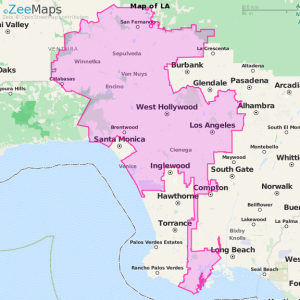
For example, David, since you and I both know Los Angeles well, the LAPD is responsible for the city limits of L.A. That's everything in purple on this map:

ZeeMap-595069.png


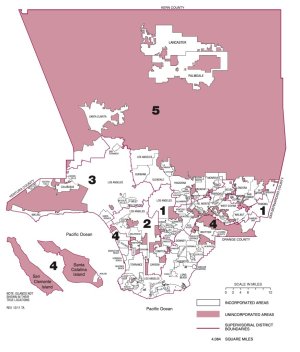
The places not in purple are a mix of cities that have their own police departments (Santa Monica, Inglewood, Long Beach), and unincorporated areas of the county that are not within a city limit. Those unincorporated areas are in pink on the map below:


Screenshot 2025-07-06 at 4.01.43 PM.jpeg

The L.A. County Sheriff's Office is responsible for law enforcement in the unincorporated areas.

But it's more complicated than that, because there are 40 incoprated cities in L.A. County that have chosen not to have their own police departments, but to contract with the Los Angeles County Sheriff for law enforcement within their city limits:


Again, though, the agencies know what's their jurisdiction and what's not and in a situation where LASO might be a block away from an emergency not in their jurisdiciton, mutual aid agreements allow them to respond.

They might be first on the scene, but as soon as the city police arrive, the PD assumes jurisdiction and thus control in terms of media access.

Beyond that, I just want to say that @cc333 , @Weiserguy and @Mediafrog+ all are correct, but there is one other distinguishing feature of County Sheriffs---they are elected officials.

Most city police chiefs are appointed by the City Manager, Mayor or City Council, but Sheriffs run for office. As @Weiserguy pointed out, Sheriffs run the jails---and federal funding only goes up with the jail population, so many believe there is an immediate inherent conflict of interest. Incarceration benefits a sheriff.

County sheriff's offices are much more frequently targets of corruption and brutality investigations than municipal police departments. A CBS News investigation last year found county sheriff's officers are three times more likely to kill a citizen than municipal police officers:

 
I should point out, before someone asks "why?" that the strip going south toward the Pacific Ocean exists because the Port of Los Angeles is in the "community" of San Pedro (actually part of L.A.), and has to be connected in order for the City to have a contiguous boundary.
 
Being in Texas I won’t attempt to explain “constables” to you.🤣
Aside from being elected in districts in an individual county, constables can also contract with neighborhood associations or similar entities in an incorporated area to provide patrol services that augment services from that city. That's been controversial from time to time, as I recall.

I was getting to a point, since law enforcement jurisdictions are called more and more into question:

Where I have seen broadcasting issues involving sheriff and police departments is in "who gives press passes or credentials?" If you have cops, sheriff's deputies and constables, where is the line of authority regarding press access?
When I was a reporter for KTRH, my Houston Police Department press card was usually good enough, at least within Harris County. Being in a vehicle that screamed out "KTRH 740" also helped. In my time as a reporter in Missouri, I had a Civil Defense ID because I was the volunteer PIO for the local city-county emergency management agency.
 
Aside from being elected in districts in an individual county, constables can also contract with neighborhood associations or similar entities in an incorporated area to provide patrol services that augment services from that city. That's been controversial from time to time, as I recall.


When I was a reporter for KTRH, my Houston Police Department press card was usually good enough, at least within Harris County. Being in a vehicle that screamed out "KTRH 740" also helped. In my time as a reporter in Missouri, I had a Civil Defense ID because I was the volunteer PIO for the local city-county emergency management agency.

My understanding of Constables is that they are elected, as are sheriffs, but each works within a district instead of countywide. They also serve summons and other legal paperwork, both civil and criminal.
 
Aside from being elected in districts in an individual county, constables can also contract with neighborhood associations or similar entities in an incorporated area to provide patrol services that augment services from that city. That's been controversial from time to time, as I recall.


When I was a reporter for KTRH, my Houston Police Department press card was usually good enough, at least within Harris County. Being in a vehicle that screamed out "KTRH 740" also helped. In my time as a reporter in Missouri, I had a Civil Defense ID because I was the volunteer PIO for the local city-county emergency management agency.

I answered David's question about access and totally forgot the press pass question.

Here in California, the California Highway Patrol, because of its statewide authority, used to be the go-to for press credentials, which were usually honored by local law enforcement.

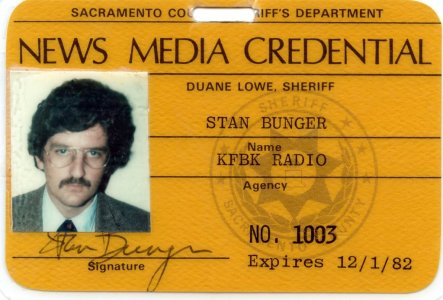
But not always---it appears that former KCBS morning anchor Stan Bunger, in his days at KFBK in the 80s, had to get one from the Sacramento County Sheriff:


PressPasses012.jpg


In the last decade or so, officially issued press passes have fallen by the wayside and news organizations issue their own. If it's a recognized outlet, like (in my case) KFBK or Capital Public Radio, there's rarely a question.

The only place I'm aware of that requires a separately-issued press credential that is good year-round, rather than on a one-time event basis, is the California State Legislature.
 
Yes, that's what I meant (the "49 square miles"). The East Bay, Peninsula, and North Bay cities are more spread out.

By the way, if you want to get super formal about the name of the city, it's the "City and County of San Francisco". So, for example, San Francisco has both a police department and a sheriff's department.
The inference appears to be that 100% of the city of San Francisco is within the county of San Francisco and vice-a-versa. If that is the case, why is it necessary to have both police and sheriff departments?
 
The inference appears to be that 100% of the city of San Francisco is within the county of San Francisco and vice-a-versa. If that is the case, why is it necessary to have both police and sheriff departments?

In this case, because there are specific functions unique to a county sheriff's department. Jails are one of them, but also things like executing eviction notices and other legal duties.

Just because the county in this case is coterminous with the city doesn't mean there aren't still county functions that have to be carried out.
 
And just to add a few more wrinkles, here in western NY we have some of the most complicated municipal structures anywhere.

There's a county level with a sheriff's department (jails for the whole county, but also road patrol and other "police" duties in areas that don't have their own local police force).

But there are also local police departments at three different municipal levels. The city of Rochester has its own PD, which is the largest and most militarized law enforcement agency in the county. Some towns (which for us are incorporated levels of government somewhat similar to what would be "townships" in the Midwest) have their own PDs. Others depend on the county sheriff's department to provide local policing services.

But wait, it gets worse! Within some towns are incorporated villages, which provide yet another level of municipal services. If you live in a village, you pay taxes and vote at three levels: village, town and county. And some villages have THEIR own police departments.

And there's also the NY State Police, who also run road patrols and investigate crimes. If you're getting pulled over for speeding, it could be a town/village/city cop, a county sheriff's deputy or a state police patrol, as long as each of them is within their jurisdiction.

There is, thankfully, a centralized county 911 center so that you don't have to know what level you're at - you call and they figure it out.

To bring this back around to broadcasting, when I was a TV assignment editor and reporter, I had to know about all those levels and departments to figure out who to call about what. It was a constant headache.
 
Oh, and then there's New England, where several states (especially Connecticut) have essentially dissolved any county government functions. Every municipality has its own PD, assisted by the state police. In Massachusetts, the counties exist mostly for court systems and a sheriff's department but otherwise have very little function.
 
Oh, and then there's New England, where several states (especially Connecticut) have essentially dissolved any county government functions. Every municipality has its own PD, assisted by the state police. In Massachusetts, the counties exist mostly for court systems and a sheriff's department but otherwise have very little function.
Its interesting that in most of "the Americas" those nations that were Portuguese or Spanish have a system where cities that grow simply annex those rural areas around them. Cities grow.

Only where established cities are grown into by expanding ones is there a conflict. For example, Mexico City grew out of the Federal District (now renamed with state status) and surrounding State of Mexico towns became part of the metro area, and those, being in other states, remain separate.

But in Ecuador, where I had stations in several cities, as housing was built outside the city limits, the city expanded. I had two transmitter sites go from "rural" to "urban" when I was there. This was an issue as the radio laws required AM stations to be "outside" urban areas. Many of us had the same issue, and had to get that rule revised.
 
In this case, because there are specific functions unique to a county sheriff's department. Jails are one of them, but also things like executing eviction notices and other legal duties.

Just because the county in this case is coterminous with the city doesn't mean there aren't still county functions that have to be carried out.
At one time, though, both the San Francisco police and sheriff's departments ran different jail systems.

Within the unique configuration of a combined City and County government the responsibilities of the county Sheriff’s Department and city Police Department have sometimes been convoluted and at odds. In the case of San Francisco’s jails, the Police Department had traditionally managed the booking and intake of newly arrested persons in a series of separate “booking” jails for over a hundred years; at various police stations, in both versions of the Kearny Street Hall of Justice and now at the Bryant Street Hall.

The Sheriff’s Department was responsible for managing the City’s “housing” jails.
The sheriff's department finally took over all the city's jails in 1975. From the department's website:

Sheriff Richard Hongisto, the Notable Exception | History of the San Francisco Sheriff's Department - scroll down to
Hongisto Engineers the Merger of the City’s Dual Jail Systems
 
There are plenty of areas in the US where cities can still grow through annexation. I've watched the city limits of Fort Wayne, Indiana sprawl way out from downtown in the 35 years I've been visiting the in-laws there.

The Northeast is different, because in most states there are no unincorporated areas into which a city can expand. It doesn't mean there's not still sprawl and growth, it just means it's happening in incorporated suburban towns, townships and villages instead of within fixed city limits.
 
The Northeast is different, because in most states there are no unincorporated areas into which a city can expand. It doesn't mean there's not still sprawl and growth, it just means it's happening in incorporated suburban towns, townships and villages instead of within fixed city limits.
Same around Cleveland. I had to drive through 7 different cities to get to my high school and each had their own peculiar traffic regulations... and attempts to trap drivers. It seemed that many such cities were created by real estate developers as they built large communities.

Of course, it offered lots of options for City of License and First Service to radio people.
 
So there are really millions and millions of people who are neither rich not in utter poverty who are not being targeted by most ad campaigns.

And I learned from a very wise man on this board years ago (you) that the reason is that it takes a greater expense on advertising to get a senior's attention, much less result in a sale.

The juice, as they say, is not worth the squeeze.
 
Same around Cleveland. I had to drive through 7 different cities to get to my high school and each had their own peculiar traffic regulations... and attempts to trap drivers. It seemed that many such cities were created by real estate developers as they built large communities.

Of course, it offered lots of options for City of License and First Service to radio people.
St. Louis County (Mo.) is often cited as the prototypical example. St. Louis City hemmed itself in by voting in 1876 to separate from the county and become an "independent city"...meaning it also has county functions. That vote also froze the city's boundaries to the present day. The result in the county is 95 separate municipalities, some substantial, some the size of a few city blocks. Interestingly, though, there are relatively few examples of any of those cities becoming a city of license, and most of those are on FM.

KSIV(AM) - Clayton (the county seat of St. Louis County; not sure why there, wouldn't have been a first service because KFUO arrived much earlier)
KFUO(AM) - Clayton (because that's where the Lutheran Church-Missouri Synod had its headquarters)
KSHE(FM) - Crestwood (because Ed Ceries lived there and ran the station out of his basement when he put it on the air)
KFTK(FM) - Florissant (dates to the 1970s; an allocation that should have gone to St. Charles but the FCC slapped the applicant for that suburban city for an excessive number of pleadings; plus it was height-restricted to 500 feet under the rules of the time)
KLJY(FM) - Clayton (originally KFUO-FM, same reason as the AM)
KATZ-FM - Bridgeton (a move-in from Alton, Illinois)
KMOX-FM - Hazelwood (a move-in from Jerseyville, Illinois)

Part of the reason for the relatively small numbers is the availability of Illinois cities in Metro East (East St. Louis, Granite City, Belleville, Edwardsville, etc.) which were used as cities of license.

No one has, for example, so far proposed Country Life Acres, one of those tiny St. Louis County municipalities, as a city of license!
 
And I learned from a very wise man on this board years ago (you) that the reason is that it takes a greater expense on advertising to get a senior's attention, much less result in a sale.

The juice, as they say, is not worth the squeeze.
That is the reason that is most often expressed. It takes more ad impressions to change long-time buying habits. But that should not extend to new brands and products, new brand extensions and, of course, products that we did not need when we were 21.
 
Okay, like what?
Obvious are the health-related products that we did not need or think we needed.

Next are things that help in retirement planning or enjoyment: investments and travel / leisure.

And then the broadest field is with things that did not exist when we were young adults. The first thing that comes to mind is the field of computers and electronic devices. Many older people need encouragement to learn how to use and enjoy some of these,too.

And then there are new brands that offer a better execution of old concepts. That can range from "no synthetic dyes" to "organic" content and the like.


Back
Top Bottom