• Get involved.
    We want your input!
    Apply for Membership and join the conversations about everything related to broadcasting.

    After we receive your registration, a moderator will review it. After your registration is approved, you will be permitted to post.
    If you use a disposable or false email address, your registration will be rejected.

    After your membership is approved, please take a minute to tell us a little bit about yourself.
    https://www.radiodiscussions.com/forums/introduce-yourself.1088/

    Thanks in advance and have fun!
    RadioDiscussions Administrators

I was wrong

I’ve been critical about KRTH 101 over the years. Every time I have ever been in Los Angeles (and tried to listen to KRTH), I’ve been disappointed by the station as a whole. My biggest gripe is that it seemed to be a rotation of the same songs over and over again (with an extremely limited library to choose from). Obviously, every major radio station needs to stick to the core tracks that test well, but it almost felt like the same 20 songs on repeat.

I haven’t been in Los Angeles for a while, but am visiting this week. Of course, I tuned into KRTH 101. I was very pleasantly surprised. The music selection was much better, the presentation was on-point, and it felt live and local all of the time. I’m not sure if they’re made some adjustments since they last did a bit of a refresh to their branding and image, but I certainly noticed a positive difference. The playlist still focuses on the core tracks, there are other songs mixed in as well (some which don’t see as much airplay).

So kudos to KRTH and Audacy for making classic hits fun to listen to.
 
KRTH is known for ongoing music research, so I am 99.99% certain that the changes you hear in the library are the result of that. Given the ethnic breakdown of the market, I'm sure they are playing some "accent" songs which test well with the Hispanic demos ... and if they are smart, they re protecting those by playing powers on both sides.

Branding and imaging are, for most stations, an ongoing process. There are, however, stations that don't need to do that as much. KRTH, being in a competitive market, likely pays attention to that and perhaps conducts the occasional focus group to get ideas.

But all of that means you couldn't just drop KRTH into any other market and have it work as well. If Audacy is to be congratulated, it should be for recognizing that and creating a "flavor" of Classic Hits that works here instead of just importing another market's playlist and imaging ... or vice versa.
 
KRTH is known for ongoing music research, so I am 99.99% certain that the changes you hear in the library are the result of that. Given the ethnic breakdown of the market, I'm sure they are playing some "accent" songs which test well with the Hispanic demos ... and if they are smart, they re protecting those by playing powers on both sides.

Branding and imaging are, for most stations, an ongoing process. There are, however, stations that don't need to do that as much. KRTH, being in a competitive market, likely pays attention to that and perhaps conducts the occasional focus group to get ideas.

But all of that means you couldn't just drop KRTH into any other market and have it work as well. If Audacy is to be congratulated, it should be for recognizing that and creating a "flavor" of Classic Hits that works here instead of just importing another market's playlist and imaging ... or vice versa.
I think their research is working better than it was before. What I heard before was not pretty difficult to listen to on a regular basis. The approach was very stale, and seemed about as cookie cutter as it can possibly get.

What I’m hearing now is a massive upgrade. Sure, this style probably won’t translate to every market (as some of the songs are tailored for the LA market), but I’m finding the format meets my taste pretty well. Gangster’s Paradise by Coolio probably wouldn’t make my Classic hits playlist, but it’s a good song overall and a fine pick for the market. And frankly, what they do in LA shouldn’t translate to every market, since using the cut and paste approach seemed to be exactly what made KRTH hard to listen to before.

We talk a lot about “burnt to a crisp” songs on radio discussions. The thing is, I’m perfectly fine hearing those tracks all day as long as something else is thrown in too. The two classic hits stations I listen to the most (KJEB in Seattle, and KOSF in San Francisco) do this very well, and strike a good balance.

It was a nice surprise to see KRTH following this strategy. You’re going to hear the typical “welcome to the jungle” and “like a prayer,” [just examples, nothing against these tracks] but unlike last time I listened, there are plenty of other nuggets in the playlist to keep it interesting.

I complete understand that Audacy is struggling, but I absolutely respect them for putting TLC into their assets. They took a bit of a cookie cutter approach on many of their stations for a few years, but they seem to have really walked that back and focused on what listeners want. I respect that.
 
We talk a lot about “burnt to a crisp” songs on radio discussions. The thing is, I’m perfectly fine hearing those tracks all day as long as something else is thrown in too. The two classic hits stations I listen to the most (KJEB in Seattle, and KOSF in San Francisco) do this very well, and strike a good balance.

It was a nice surprise to see KRTH following this strategy. You’re going to hear the typical “welcome to the jungle” and “like a prayer,” [just examples, nothing against these tracks] but unlike last time I listened, there are plenty of other nuggets in the playlist to keep it interesting.

I have taken a lot of flak over the years over this issue, and I think you've hit the nail right on the head.

This is what David, BigA, Mike Hagerty, and I mean about "consensus favorites". Those are absolutely necessary, else listeners start thinking their favorite Classic Hits stations aren't playing them enough (contrary to those who use that phrase "burnt to a crisp" who can't see the forest for the trees). What makes the audience stick around and continue to come back are the songs we program in-between those power songs.

I doubt the naysayers have listened to how I do it, but there are a couple of programming strategies that anyone should be using so they aren't "secrets". One: Every other song on my hot clock is a Power, with an occasional Power-to-Power if the automation hits the top-of-the-hour time reset (and that's the one place where that strengthens, rather than weakens the overall flow). Two: I have two secondary categories; because I'm 80's-focused, one consists of the stronger New Wave crossovers. Three: I have found a way to bring in a lot of lesser hits to add variety without overplaying them ... the hourly "Forgotten 45" feature, which has 500+ titles in that category ... none of which are activated for more than three weeks at a time, no more than 12 spins across all dayparts and hours in that span, and with a six month rest period between active play periods.

Still faithful to the concepts that make Classic Hits work, but enough of those "nuggets" (good choice of words) to make it interesting.

And both KJEB and KOSF are stations that I monitor the playlists of via Mediabase. Good choices.
 
I have taken a lot of flak over the years over this issue, and I think you've hit the nail right on the head.

This is what David, BigA, Mike Hagerty, and I mean about "consensus favorites". Those are absolutely necessary, else listeners start thinking their favorite Classic Hits stations aren't playing them enough (contrary to those who use that phrase "burnt to a crisp" who can't see the forest for the trees). What makes the audience stick around and continue to come back are the songs we program in-between those power songs.

I doubt the naysayers have listened to how I do it, but there are a couple of programming strategies that anyone should be using so they aren't "secrets". One: Every other song on my hot clock is a Power, with an occasional Power-to-Power if the automation hits the top-of-the-hour time reset (and that's the one place where that strengthens, rather than weakens the overall flow). Two: I have two secondary categories; because I'm 80's-focused, one consists of the stronger New Wave crossovers. Three: I have found a way to bring in a lot of lesser hits to add variety without overplaying them ... the hourly "Forgotten 45" feature, which has 500+ titles in that category ... none of which are activated for more than three weeks at a time, no more than 12 spins across all dayparts and hours in that span, and with a six month rest period between active play periods.

Still faithful to the concepts that make Classic Hits work, but enough of those "nuggets" (good choice of words) to make it interesting.

And both KJEB and KOSF are stations that I monitor the playlists of via Mediabase. Good choices.
Thanks for sharing your unique perspective of how you approach classic hits! I’m very interested in this topic, as I know there’s a very specific science to the programming. I also appreciate that you’re trying to incorporate the “nuggets” into the playlist in a way that’s reasonable and makes sense.

I’ve never worked in classic hits radio (I’ve always wanted to, but never found the opportunity to do so). I have, however, worked quite a bit in AC and hot AC. In each of these cases, the station I worked for also had a strategy for incorporating some of the more interesting (nugget) tracks around the core songs that we needed to play. While I wasn’t involved with the programming itself, it was clear that these songs were usually sandwiched between the core songs we needed to play.

Typically, most on-air interaction was scheduled to hit after every three songs (usually following a gold track or recent popular song and leading into a new popular song). I believe this was done to sound more “current.” Obviously, this scenario doesn’t really apply to classic hits, but I appreciated that we made the effort to incorporate other tracks/gold based tracks that weren’t burnt to a crisp. We didn’t always get to acknowledge them, but they were there.
 
In each of these cases, the station I worked for also had a strategy for incorporating some of the more interesting (nugget) tracks around the core songs that we needed to play.

You hit on something I failed to include. The "Forgotten 45" has its own produced intro, to help make it special, and it is always followed by a Power.

And if anyone reading thinks I just choose F45s randomly, or by personal preference, erase that thought. I track the airplay on every one of the songs in that category on 17 Classic Hits stations in the top 40 markets which I know to be conducting active music research, another 24 CH stations in the top 60 markets which are strong performers in the ratings, and 44 stations in lesser markets. Songs have to achieve a minimum number of plays during the "off" weeks to come back into rotation right away; others are held until they either hit that threshold or reach lower "markers" but have rested long enough to be brought back in right away.

All told, I spend about an hour per week working on that category alone.

It sounds like your stations had a similar philosophy on "nuggets".
 
And both KJEB and KOSF are stations that I monitor the playlists of via Mediabase. Good choices.
I love KJEB and KOSF, and stream both regularly. I also enjoy iHeart’s KLTH in Portland. As a whole, I personally feel iHeart (and even Cumulus) does a much better job with the classic hits format than Audacy…although Audacy’s KRTH and KXSN in San Diego are exceptions.
 
I love KJEB and KOSF, and stream both regularly. I also enjoy iHeart’s KLTH in Portland. As a whole, I personally feel iHeart (and even Cumulus) does a much better job with the classic hits format than Audacy…although Audacy’s KRTH and KXSN in San Diego are exceptions.
I’m with you on all of that. In general, the iHeartMedia approach to classic hits fires on all cylinders for me. Sure, you’re going to hear the core songs, but the overall variety of what you hear is dialed in well. Not to mention, the presentation is solid.

I can’t say the same for Audacy as a whole. Though, I definitely give them credit for making some very obvious improvement to KRTH. This was absolutely necessary, as KRTH is one of their flagship stations. I was in town about two years ago or so, and was surprised by how bland I found KRTH to be. Fast-forward to today, and it’s a big difference.

I’m not sure I really understand what they’re going for with some of the song choices, but in general, there’s a better variety. Playing “somebody that I used to know” isn’t really my cup of tea, but it’s not the end of the world if there are other 80’s songs in the mix that also keep the format feeling fresh (outside of the core songs). I also appreciate that the hosts seem to get to interact more with the audience. I’ve heard phone calls, references to what people are writing on social media, etc. It’s not perfect, but the improvement is obvious.
 
You hit on something I failed to include. The "Forgotten 45" has its own produced intro, to help make it special, and it is always followed by a Power.

And if anyone reading thinks I just choose F45s randomly, or by personal preference, erase that thought. I track the airplay on every one of the songs in that category on 17 Classic Hits stations in the top 40 markets which I know to be conducting active music research, another 24 CH stations in the top 60 markets which are strong performers in the ratings, and 44 stations in lesser markets. Songs have to achieve a minimum number of plays during the "off" weeks to come back into rotation right away; others are held until they either hit that threshold or reach lower "markers" but have rested long enough to be brought back in right away.

All told, I spend about an hour per week working on that category alone.

It sounds like your stations had a similar philosophy on "nuggets".
These are all very interesting insights to have. I’m not entirely sure how your station is structured in terms of hosts, but am I right to assume you provide them some latitude for how to speak and comment on the music? It sounds like you do indeed emphasize these “special” tracks, which I think is important. One thing that I learned from a PD I had before is that if we’re programming in a song that’s a little bit out of the regularly structured format, it should receive special emphasis to reflect on why it’s there. That’s something that’s stuck with me.

I appreciate you sharing this information. I’ve always been pretty passionate about the classic hits format, but never got a chance to work in the format since I’m on the younger side. This information gives a clear picture into how a PD might approach it!
 
These are all very interesting insights to have. I’m not entirely sure how your station is structured in terms of hosts, but am I right to assume you provide them some latitude for how to speak and comment on the music?

The answer will surprise you. We operate KRKE as a jukebox ... just music, imaging, and commercials. The only songs that get a back-announce are the Forgotten 45s and the deeper tracks on Flashback Weekend.

Your question therefore mostly applies to FW, where I give Freddy Snakeskin the widest possible latitude. He's professional, he's knowledgeable, and he has a witty/snarky sense of humor. In almost three years of doing the show, he has yet to say anything that either I or the station owner objected to.

It sounds like you do indeed emphasize these “special” tracks, which I think is important. One thing that I learned from a PD I had before is that if we’re programming in a song that’s a little bit out of the regularly structured format, it should receive special emphasis to reflect on why it’s there. That’s something that’s stuck with me.

That is precisely my thinking. It also makes the feature stand out, so that the listeners will stick around to hear what we play the next hour.
 
I have taken a lot of flak over the years over this issue, and I think you've hit the nail right on the head.

This is what David, BigA, Mike Hagerty, and I mean about "consensus favorites". Those are absolutely necessary, else listeners start thinking their favorite Classic Hits stations aren't playing them enough (contrary to those who use that phrase "burnt to a crisp" who can't see the forest for the trees). What makes the audience stick around and continue to come back are the songs we program in-between those power songs.

I doubt the naysayers have listened to how I do it, but there are a couple of programming strategies that anyone should be using so they aren't "secrets". One: Every other song on my hot clock is a Power, with an occasional Power-to-Power if the automation hits the top-of-the-hour time reset (and that's the one place where that strengthens, rather than weakens the overall flow). Two: I have two secondary categories; because I'm 80's-focused, one consists of the stronger New Wave crossovers. Three: I have found a way to bring in a lot of lesser hits to add variety without overplaying them ... the hourly "Forgotten 45" feature, which has 500+ titles in that category ... none of which are activated for more than three weeks at a time, no more than 12 spins across all dayparts and hours in that span, and with a six month rest period between active play periods.

Still faithful to the concepts that make Classic Hits work, but enough of those "nuggets" (good choice of words) to make it interesting.

And both KJEB and KOSF are stations that I monitor the playlists of via Mediabase. Good choices.
Sorry if this seems like a dumb question, but what is meant by a hot clock?
 
Sorry if this seems like a dumb question, but what is meant by a hot clock?

It would be a dumb question if someone in the business asked it, but not for a listener.

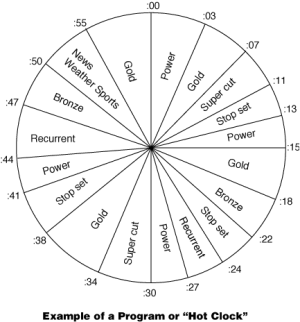
The "hot clock" is a visual representation of an hour's programming, showing where in the hour each category of music is scheduled, where the commercial stopsets (breaks) fall, and where jingles, produced imaging, and liners go.

Here is an example:
1752540306852.png
 
but what is meant by a hot clock?
Before the days of scheduled music logs, there would often be a clock in the studio that indicated what categories of songs should be played when.
For example, there might be a "Gold" at the top of the hour, followed by a "Current Power" then a "Secondary Gold" or a "New Current", so on and so forth.
Records in the studio would typically filed by their category, and the jock would pull the first record up in the category and play it, then put it back at the back of the stack. That was generally how records were rotated before computerized music logs.
 
Before the days of scheduled music logs, there would often be a clock in the studio that indicated what categories of songs should be played when.

I also provide a hot clock for The Eighties Channel™ as a visual representation of what station management and personnel should expect to hear if the format is executing properly.
 
It would be a dumb question if someone in the business asked it, but not for a listener.

The "hot clock" is a visual representation of an hour's programming, showing where in the hour each category of music is scheduled, where the commercial stopsets (breaks) fall, and where jingles, produced imaging, and liners go.

Here is an example:
View attachment 9651
Thanks! After reading the explanation and looking at the KRTH playlist on Online Radio Box, I can see that they're essentially doing what you're doing with your hot clocks, playing a power every other song. Seeing as how KRTH is so successful in the ratings, it seems the system clearly works.

Getting back to your point about naysayers, I think the reason some of Audacy's Classic Hits stations (including KRTH) have received so much criticism is because they have a more limited number of powers that rotate every 4-5 hours, whereas I recall a post of yours from a few years back stating that your station had well over 100 powers that typically only played once a day. While many of us here don't like that the powers on KRTH rotate so often, I'm sure they have the vertical and horizontal rotations oprimitimzed to limit burn rate, and again, it's clear that what they do works in Los Angeles, so I have to show them respect for doing what's right for the market. And though the KRTH playlist may be tighter comapred to other Classic Hits stations, even I have to admit that many of the songs they are playing are songs I like! If I had to guess, I'd assume that the Classic Hits stations owned by Cumulus and iHeartMedia are closer to your station in terms of how many powers they have and how often they rotate. From my sampling, I definitely think their Classic Hits stations are well programmed, iHearMedia's WMJI and aforementioned KLTH are among my favorites in the format.

I love KJEB and KOSF, and stream both regularly. I also enjoy iHeart’s KLTH in Portland. As a whole, I personally feel iHeart (and even Cumulus) does a much better job with the classic hits format than Audacy…although Audacy’s KRTH and KXSN in San Diego are exceptions.
While I also prefer the Cumulus and iHeartMedia owned Classic Hits stations to Audacy's, not all of the Audacy Classic Hits stations are the same and most are currently doing well. The only real underpfromers are KSPF and WOGL, which are both operating under the KRTH formula despite the fact that it doesn't seem to be working in those markets. However, both KSPF and WOGL dedicate a smaller percentage of spins to songs from the 1980s than KRTH and KXSN, so that could also be a factor.
 
Before the days of scheduled music logs, there would often be a clock in the studio that indicated what categories of songs should be played when.
For example, there might be a "Gold" at the top of the hour, followed by a "Current Power" then a "Secondary Gold" or a "New Current", so on and so forth.
Records in the studio would typically filed by their category, and the jock would pull the first record up in the category and play it, then put it back at the back of the stack. That was generally how records were rotated before computerized music logs.
When stations stopped using those visual clocks, the makers of those colored stick-em dots almost went out of business. They had already taken a big hit when we quit putting those dots on the carts with songs recorded on them, but with the end of format clocks, it was over.
 
Last edited:
I think the reason some of Audacy's Classic Hits stations (including KRTH) have received so much criticism is because they have a more limited number of powers that rotate every 4-5 hours, whereas I recall a post of yours from a few years back stating that your station had well over 100 powers that typically only played once a day. While many of us here don't like that the powers on KRTH rotate so often, I'm sure they have the vertical and horizontal rotations oprimitimzed to limit burn rate, and again, it's clear that what they do works in Los Angeles, so I have to show them respect for doing what's right for the market.

In the larger markets, there tends to be a lot more frequent tune-in/tune-out, so KRTH is being smart by having a smaller Power rotation and then set the scheduling rules to optimize placement across dayparts, hours, and position within the hour.

Smaller markets can do what I do because fewer listeners, even if tune-in/tune-out is at similar levels, tend to hear those consensus favorites at similar intervals to the larger market listeners, because they also tend to listen longer.

And though the KRTH playlist may be tighter comapred to other Classic Hits stations, even I have to admit that many of the songs they are playing are songs I like!

That's why we call them consensus favorites.
 
Thanks! After reading the explanation and looking at the KRTH playlist on Online Radio Box, I can see that they're essentially doing what you're doing with your hot clocks, playing a power every other song. Seeing as how KRTH is so successful in the ratings, it seems the system clearly works.

Getting back to your point about naysayers, I think the reason some of Audacy's Classic Hits stations (including KRTH) have received so much criticism is because they have a more limited number of powers that rotate every 4-5 hours, whereas I recall a post of yours from a few years back stating that your station had well over 100 powers that typically only played once a day. While many of us here don't like that the powers on KRTH rotate so often, I'm sure they have the vertical and horizontal rotations oprimitimzed to limit burn rate, and again, it's clear that what they do works in Los Angeles, so I have to show them respect for doing what's right for the market. And though the KRTH playlist may be tighter comapred to other Classic Hits stations, even I have to admit that many of the songs they are playing are songs I like! If I had to guess, I'd assume that the Classic Hits stations owned by Cumulus and iHeartMedia are closer to your station in terms of how many powers they have and how often they rotate. From my sampling, I definitely think their Classic Hits stations are well programmed, iHearMedia's WMJI and aforementioned KLTH are among my favorites in the format.


While I also prefer the Cumulus and iHeartMedia owned Classic Hits stations to Audacy's, not all of the Audacy Classic Hits stations are the same and most are currently doing well. The only real underpfromers are KSPF and WOGL, which are both operating under the KRTH formula despite the fact that it doesn't seem to be working in those markets. However, both KSPF and WOGL dedicate a smaller percentage of spins to songs from the 1980s than KRTH and KXSN, so that could also be a factor.
You’re spot on with all of this, I’d say. As for KRTH, it’s definitely not perfect. Like I said, the approach that iheart takes with their stations in Seattle, Portland, and San Francisco sound almost perfect to me. But with that being said, I feel like the improvements that Audacy has made have made a huge difference. The playlist is still a bit on the narrow side, but it’s acceptable.

I’d argue that what is being done on many other Audacy-owned Classic hits stations is more reminiscent of what KRTH was doing before making these tweaks (which is pretty bland). With the changes that have come to KRTH, I am cautiously optimistic that many of their other assets could also make tweaks of their own, in an effort not to sound so bland.

I totally agree that WOGL seems to be going off on a different branch. I can’t comment accurately on that, as I’m not in the Philadelphia market, but the flavor of classic hits they serve definitely wouldn’t be appealing to me. I like the idea of incorporating some more African American artists to reflect the demographics of Philadelphia, but a lot of the music skews way too new or just seems unfocused. If I were in that market, I’d probably just listen to WGMK 102.9 as an alternative since I’d be put off by hearing Foster the People and other new tracks.
 
Last edited:
WOGL's approach seems to lean a bit softer with the music, but much of the imaging and presentation is similar to KRTH. However, on WOGL's "Totally 80s Friday Night, the playlist sounds like it's coming from the KRTH database, right down to some of the KROQ type of gold cuts that were less heard in the Philly market in the 80s.
 
WOGL's approach seems to lean a bit softer with the music, but much of the imaging and presentation is similar to KRTH. However, on WOGL's "Totally 80s Friday Night, the playlist sounds like it's coming from the KRTH database, right down to some of the KROQ type of gold cuts that were less heard in the Philly market in the 80s.
Ironically, Friday night would probably be the only time I’d listen to WOGL. I caught KRTH’s 80’s Friday night (and felt like it was very well done). The regular core drive hours are more stale, but as a whole, I was still noticed that it was much better than last time I listened. More variety, and more focused overall.


Back
Top Bottom