• Get involved.
    We want your input!
    Apply for Membership and join the conversations about everything related to broadcasting.

    After we receive your registration, a moderator will review it. After your registration is approved, you will be permitted to post.
    If you use a disposable or false email address, your registration will be rejected.

    After your membership is approved, please take a minute to tell us a little bit about yourself.
    https://www.radiodiscussions.com/forums/introduce-yourself.1088/

    Thanks in advance and have fun!
    RadioDiscussions Administrators

Time-line help requested.

My memory, and a look at Joel Whitburn's Adult Songs book, indicates that what we now call Adult Contemporary was known in the past as MOR (Middle Of The Road)/Easy Listening/Pop Standards). Billboard magazine used those terms at various times. I know that MOR was still being used by some in the 1970s as that was a genre and format name I heard mentioned at that time. By the end of the decade of the 1970s is when Adult Contemporary seems to have been coined.

Billboard started its first "Easy Listening" chart during the summer of 1961. Was there, and if so, what was, a name for Adult music radio stations in the 1950's and up until 1961? Pop or Adult or even Standards?

I'm going to be doing a special edition of one of the Oldies shows we broadcast and I'm going to do a one-time all-Adult Contemporary edition featuring, first, the 1960s (such as Dean Martin "Everybody Loves Somebody"), then the 1970s (such as "Midnight Blue" by Melissa Manchester), and a few from the 1980s (such as Heart "These Dreams"). Prior to the weekly 1960s and 1970s Oldies show is a program I host that focuses on music from the 1950s and early 1960s. Near the end of that show, I'm going to play one or two songs from the 1950s that would have been played on Easy Listening/MOR stations if they had, officially, been called that.
 
Last edited:
Broadcasting Yearbook was using MOR for soft AC stations even in the 80s. When "adult contemporary" was used the station was a lot more uptempo.

I've never been clear on what it meant when "contemp." was used. I lived in an area that had one of those stations and it certainly wasn't Top 40. It must have been adult contemporary but I don't know whether the term was even being used.
 
I'm thinking that back in the 1950s, there weren't "Formats" as we know them. Therefore, there were no, or rather few, stations that aired the same thing throughout the broadcast day. So, there were no format names, such as MOR, during the 1950s, and before. A station could have a Rock music show Monday-Friday sometime in the evening, for example.
 
Billboard started its first "Easy Listening" chart during the summer of 1961. Was there, and if so, what was, a name for Adult music radio stations in the 1950's and up until 1961? Pop or Adult or even Standards?
Correct, at the time, stations weren't really labeled with "formats" the same way they are now, though we can look back and say they formatted in a specific fashion. Even Top 40 stations were just "Music and news" stations in a lot of references during that era. Many large stations were still block-programmed well into the 1960s, carrying network programs with separate blocks of music in between.

Aside from a handful of smaller stations that were airing niche formats like R&B or Country, in the 1950s there were really only two types of music stations: Popular (Top 40) and Classical. As rock-and-roll became more of a part of what Top 40 was later in the decade, many stations used the term "Good Music" to highlight that they played music, but not rock-and-roll.

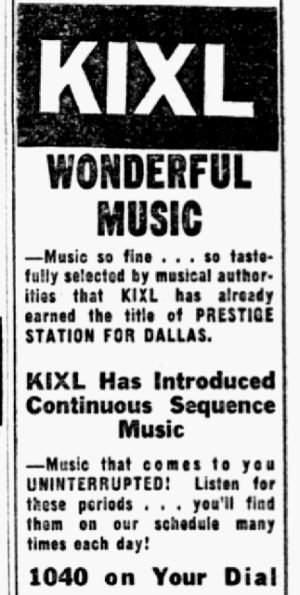
One of the earliest stations that was formatted strictly with music to appeal to adults was KIXL in Dallas - it was the inspiration for KABL in San Francisco.
KIXL used terms like "wonderful KIXL music" in its advertising. In 1947, this kind of all-music programming was pretty much unheard of.
1752328398258.png
 
Last edited:
I'm thinking that back in the 1950s, there weren't "Formats" as we know them. Therefore, there were no, or rather few, stations that aired the same thing throughout the broadcast day. So, there were no format names, such as MOR, during the 1950s, and before. A station could have a Rock music show Monday-Friday sometime in the evening, for example.

John, you're close.

Back then, network stations were largely tied to the network schedule, and even independents tended to be block-programmed to one degree or another.

That began to change in the early 50s. I'm most familiar with California in general and Los Angeles in particular and the earliest example I can think of where a station settled on what we'd now call an "MOR" format was KMPC in Los Angeles.

Before rock and roll/Top 40, though, the best description for them was that they played "popular music".

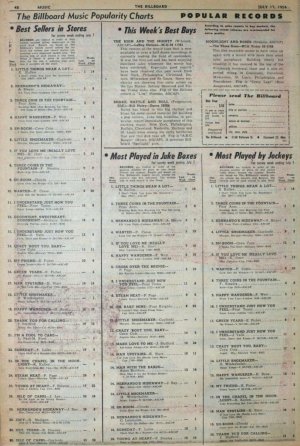
Screenshot 2025-07-12 at 6.35.16 AM.jpeg

This page of three charts (record sales, jukebox play and radio airplay) from Billboard 71 years ago this week shows very few songs such stations wouldn't play---"Sh-Boom" by the Chords and maybe the two Crew Cuts records. That's really it.

So when the charts began to shift and more R&B/rock material began to flow in, "Popular Music" only partly applied. That's when there was a grab bag of "good music", "easy listening" (both of which pretty much were co-opted when the earliest Beautiful Music stations (KABL, Oakland, KPOL and KGBS, Los Angeles) came along), and finally "Middle of the Road" or "MOR".

Format descriptions weren't really a thing yet, either (Billboard can be found referring to Top 40 stations as "Big Beat" stations well into the mid-60s and the Los Angeles Times had a radio columnist, Don Page, who actually used the term "Hard Rock" until about '68 or so).

"Adult Contemporary" has a distinct timeline. Bob Oakes, arriving as PD at KFWB in January 1967, was given a year to fix KFWB's sagging ratings and its new owner, Group W (Westinghouse) let him know they wanted an audience of salable adults. Oakes aimed KFWB in between KHJ and KMPC, playing mostly Top 40 hits, leaving out the harshest ones.

By summer, it was clear that even if it were to catch on, it wouldn't be at night, so B. Mitchel Reed was given free rein to explore the new album rock music.

Oakes failed, KFWB went news on March 11, 1968. But a few months later, Bill Drake took the idea, blended a robust Gold library and put HitParade '68 on KHJ-FM, and then syndicated it to other markets nationwide:


When KGBS dumped country in March of 1969, it said it was going to position itself between KHJ and KMPC. Its air talent (Bob Hudson, Bill Ballance, Roger Christian, Tom Clay) were all older Top 40 refugees, and the maturity set them apart, but the music really was Top 40, not AC.

Also in 1969, KFI, wanting to shed its stodgy image after bringing Lohman and Barkley aboard, hired Top 40 veteran Ted Randal as a consultant and he took them Adult Contemporary, hiring Jerry Bishop, Dave Hull and Jay Lawrence. But the approach scared off the old audience and didn't attract a new one to replace it, so KFI retreated within a year.

In 1970, Chuck Blore took the moribund KRKD (1150) and decided to go with a very high-concept adult contemporary:


And, it really didn't work.

When Jack Woods was hired to program KFMB, San Diego in 1973, he refined the basics of Adult Contemporary: Hit records, deeper gold, Top 40 pacing and production values:


That was essentially the template for Adult Contemporary until Mary Catherine Sneed and Jhani Kaye re-invented the format for FM with the "Continuous Soft Hits" approach in the early 80s at KOST in Los Angeles.

There were softer ACs, more adventurous ACs (mine), more personality-oriented ACs (KMPC, KNBR) but AC and MOR were never the same thing. AC was just the logical thing for MOR to morph into as the material for that format dried up and its audience aged.
 
Last edited:
"Good music" was another term used by stations that were playing music, but weren't Top 40 or Classical.

Then again, there was WGMS: Washington's Good Music Station, which was in fact classical.

The term applied to most stations in the 50s and 60s was "full service." These were stations that played various genres of music mixed with local news and information. For those stations, the genre was less important than the fact that it was popular and acceptable to all audiences. That's how it was possible for artists that you'd think of as representing a specific genre ended up having pop hits played on a broad range of radio stations. Examples might be Al Hirt, Johnny Cash, Louis Armstrong, or Buck Owens. Even artists we'd consider "easy listening," such as Percy Faith or Mitch Miller. These artists received radio airplay on the full service stations that defied their own specific genres.
 
I was program director for WERC in Birmingham around 1972 when we moved from a classic MOR format to what was then being called chicken rock. For that reason, I am very familiar with the creation and evolution of the format. We now call AC.

There were a number of variations of this format early on. Some, like WGAR in Cleveland, were very gold based with fewer currents. In my case, we were about 50% current and recurrent and 50% gold. The format was essentially top 40 songs without the hard rock and deeper R&B songs that top 40 played. There were a few songs but not many that were AC only and did not make it across to top 40.

This was not at all like the Drake syndicated “hit parade“ format, which was intended for automation and had a much less aggressive and foreground sound. I always thought that the Drake format was using beautiful music formatics and just substituting pop music for the orchestras.

Rotations tended to be considerably slower than top 40 stations, with the hottest currents playing about every three hours to three hours and a half. The presentation was very similar to top 40 with jingles limited jock talk and lots of promotions.

Very definitely we did not play any of the traditional MOR artists that were more associated with the Rat Pack and big band type of sound. In fact, there were some songs that became top 40 hits that had that sort of Bobby Darin sound that the new generation of AC stations didn’t play so is not to be characterized as being “your parent’s radio station“.

In the case of WERC, we were also the flagship station for the Crimson Tide and our morning personality was also that team’s play by play announcer. That fact gave us considerable credibility and was a cume magnet as we modernized what had been a traditional AC station

It took a number of years to shed the chicken rock title, and for adult contemporary to be claimed as the name for the format.
 
Then again, there was WGMS: Washington's Good Music Station, which was in fact classical.

The term applied to most stations in the 50s and 60s was "full service." These were stations that played various genres of music mixed with local news and information. For those stations, the genre was less important than the fact that it was popular and acceptable to all audiences. That's how it was possible for artists that you'd think of as representing a specific genre ended up having pop hits played on a broad range of radio stations. Examples might be Al Hirt, Johnny Cash, Louis Armstrong, or Buck Owens. Even artists we'd consider "easy listening," such as Percy Faith or Mitch Miller. These artists received radio airplay on the full service stations that defied their own specific genres.
Remember that those so-called “full service“ stations were almost all outgrowths of network affiliates that were scaling down their CBS, NBC and ABC programs in favor of local originations. Early on, some of those local shows were more talk based and typified by things such as housewife – oriented mid-Morning shows with recipes and other classic black program elements. Some of those MOR stations had lengthy, local newscast and other non-musical content in many cases the music seem to be a fill in between the local content base shows, and the remaining network shows. Eventually, those stations became mostly music true MOR formats.
 
I was program director for WERC in Birmingham around 1972 when we moved from a classic MOR format to what was then being called chicken rock.

The only times I ever heard Adult Contemporary called "chicken rock", it was meant as a derogatory term, usually by management who resented playing any form of current hit music and wished they could go back to MOR or jocks who wanted to let loose on Top 40.

For that reason, I am very familiar with the creation and evolution of the format. We now call AC.

The earliest examples I can find of the use of the phrase Adult Contemporary are both from November of 1968.

One is a piece in Billboard about the format change at KGBS (which I had misdated in my earlier post as being March of '69---that's apparently when they ditched the carryover jocks and brought in Hudson, Ballance, et al), in which the format is described as "Adult Contemporary Pop."

The other is a want ad in Broadcasting magazine for an "announcer with diversified background for adult contemporary format" at WKYN, Santurce, Puerto Rico.

The phrase becomes more common from 1970 on, with a want ad for a news director at KLMS, Lincoln, Nebraska, which describes itself as as a "top-rated medium-market adult contemporary" in the March 7, 1970 issue; an August 24, 1970 Broadcasting magazine article saying that KLUC-AM/FM in Las Vegas will be switching from Top 40 to adult contemporary in September; and a December 5, 1970 Billboard article on the success of WHAM, Rochester, New York's adult contemporary format.

References become more common from there on. I was aware of Adult Contemporary as a format and a format description when I began my career in 1971. I programmed it as a format separate from MOR when I was programming the block Country/MOR/AC/Top 40 day at KIBS in Bishop from 1972 on.

There were a number of variations of this format early on. Some, like WGAR in Cleveland, were very gold based with fewer currents.

Jack Thayer launched the Adult Contemporary format at WGAR on September 9, 1970, and it was an excellent template for the next decade of Adult Contemporary on AM radio.

I was specific in my original post that I was most familiar with California in general and Los Angeles in particular which is why I used the examples I did, but Thayer is absolutely a pioneer of the format and his was one of the earliest big successes (there were smaller ones).

This was not at all like the Drake syndicated “hit parade“ format, which was intended for automation and had a much less aggressive and foreground sound. I always thought that the Drake format was using beautiful music formatics and just substituting pop music for the orchestras.

I'll just post this one more time, because honest to God, David, I don't hear that at all.


What I hear is a big production Bill Drake legal ID, back-sells or front-sells of every record over tails or intros, jingles out of stopsets, incredibly tight automation, and stopsets every three records.

The upbeat yet adult style of the jock voice, production elements, pacing and music place it firmly in the Adult Contemporary world of the time.
 
Last edited:
The only times I ever heard Adult Contemporary called "chicken rock", it was meant as a derogatory term, usually by management who resented playing any form of current hit music and wished they could go back to MOR or jocks who wanted to let loose on Top 40.
When I was programming WERC, I heard "Chicken Rock" used incessantly, mostly by record promoters who did not like the slower rotations and the refusal to air Iron Butterfly.
One is a piece in Billboard about the format change at KGBS (which I had misdated in my earlier post as being March of '69---that's apparently when they ditched the carryover jocks and brought in Hudson, Ballance, et al), in which the format is described as "Adult Contemporary Pop."
Yet the style was quite a bit more like KMPC than KHJ. A lot of stations moved away from MOR, but did not do it thoroughly enough to really make the station distinctive. Of course, the Ballance show became a mostly talk show and even went into syndication.
The other is a want ad in Broadcasting magazine for an "announcer with diversified background for adult contemporary format" at WKYN, Santurce, Puerto Rico.
And if you had heard that station, it was really, truly MOR and it was a daytimer. It, and competitor WHOA, were sort of radio time machines. In the 70's, Bob Bittner of more recent WJIB fame was PD at WHOA, and it sounded a lot like what WJIB did under his ownership. WKYN converted to WQBS with a top 40 format in Spanish in 1970 when it became a fulltime station.
The phrase becomes more common from 1970 on, with a want ad for a news director at KLMS, Lincoln, Nebraska, which describes itself as as a "top-rated medium-market adult contemporary" in the March 7, 1970 issue; an August 24, 1970 Broadcasting magazine article saying that KLUC-AM/FM in Las Vegas will be switching from Top 40 to adult contemporary in September; and a December 5, 1970 Billboard article on the success of WHAM, Rochester, New York's adult contemporary format.
I guess there was some reference to that term, but in the places I went... including the Hamilton and Billboard conventions, most people referred to us as "chicken rock" as the format had not gotten legs yet.
Jack Thayer launched the Adult Contemporary format at WGAR on September 9, 1970, and it was an excellent template for the next decade of Adult Contemporary on AM radio.
But the format was not Thayer's idea. It came from Lund, who really had a cross between AC and oldies.
I was specific in my original post that I was most familiar with California in general and Los Angeles in particular which is why I used the examples I did, but Thayer is absolutely a pioneer of the format and his was one of the earliest big successes (there were smaller ones).
Again, WGAR was often compared with WMOD in DC, which was the first FM oldies station in a major market around 1968. WMOD tossed in some recent but not current gold, while WGAR had a significant but not majority position in currents; that was Lund who was really looking for the confusion in Cleveland as WIXY died and there was really not highly significant FM Top 40 (sort of like the confusion of Top 40 formats in the 70's in LA with dying AMs and no FM that did as well as they had thought they would do. People were looking for the success of stations like WDRQ, KSLQ, WMYQ (until Y-100 with Buzz and then Tanner wiped them away) and in both LA and Cleveland and a couple of other markets we did not see that dramatic transition.
I'll just post this one more time, because honest to God, David, I don't hear that at all.
I listened a lot... both when working with Art Kellar on potential programming for Richmond and out of pure curiosity and I found it dull and mechanical. I always thought it was designed not to compete with Drake's true CHRs and was forced to be less exciting..
I don't think that was the syndicated Hit Parade. It sounded nothing like the demos and "real time" listening I did.
What I hear is a big production Bill Drake legal ID, back-sells or front-sells of every record over tails or intros, jingles out of stopsets, incredibly tight automation, and stopsets every three records.
And that was not the syndicated, automated version. That was am LA format that shared the name with the taped product.
The upbeat yet adult style of the jock voice, production elements, pacing and music place it firmly in the Adult Contemporary world of the time.
If you heard the first true ACs in the eastern markets, they were a lot more Top 40 in jingles, jocks and contests as well as very aggressive in music.
 
I don't think that was the syndicated Hit Parade. It sounded nothing like the demos and "real time" listening I did.

And that was not the syndicated, automated version. That was am LA format that shared the name with the taped product.

I had not heard the syndicated version of HitParade. The KHJ-FM version was automated, and I listened daily for four-plus years as it was one of the few stations playing contemporary music that came up to Bishop on the cable from Los Angeles. That changed over the next few years, but I was a regular listener to HitParade '68, '69, 70 and the "Solid Gold Rock and Roll" and "Solid Gold" formats that preceded the flip to KRTH in the fall of '72.

Rummaging around the internet, I found a scoped aircheck of WIFI-FM in Philadelphia running "Hitparade '70". Same formatics as KHJ-FM. By this time, they'd gone to multiple voices in the same hour and sometimes back-to-back (outro/intro), including Mark Elliott, Charlie Van Dyke and Humble Harve.

I have to say the local production isn't nearly at the same level as KHJ-FM. And they cheaped out and had someone other than Bill Drake voice the ID.

 
I found something more definitive on when Drake-Chenault began syndicating "Hitparade" (initially through the American Independent Radio division). Billboard reported in the December 21, 1968 issue that "Hitparade '69" was being syndicated as a new format ... RKO's FMs -- with the obvious exception of WGMS -- was on the initial list of stations, as was KYNO-FM Fresno (naturally), KBKB-FM San Diego (also naturally ... taht was KGB's FM), WSPD-FM Toledo, and KERN-FM Bakersfield.

 
Hitparade was also on KQWB “Stereo 98” in Fargo, ND in 1970. This is a demo for the syndicated version. It says there are “many mixes available” that could be modified to fit each station, but I’ve only ever heard the MOR version:
 
Hitparade was also on KQWB “Stereo 98” in Fargo, ND in 1970. This is a demo for the syndicated version. It says there are “many mixes available” that could be modified to fit each station, but I’ve only ever heard the MOR version:

This demo is from 1974 (re-used on the 1975 demo). The mixes were tempo-based.

The first mix isn't fundamentally different from the KHJ-FM Hitparades ('68, '69 and '70), and it is absolutely more an adult contemporary mix than an MOR. So this, along with the WIFI-FM aircheck, suggest that the syndicated version wasn't really different from KHJ-FM other than local production and polish. I could also see some markets taking the slowest-tempo mix they could.

A surprising number of small-time General Managers thought they knew better than syndicators and would "adjust" what reels were in rotation. We fought that off with a GM at KUKI when we were running "Great American Country". He eventually lost his job over that and other decisions motivated by nothing other than his personal tastes.

The second mix, according to Robert W. Morgan's v/o, is supposed to be more uptempo, but you can't prove it by me (unless they're counting Stevie Wonder's "Don't You Worry About A Thing"). Again, it's A/C, not MOR, especially by 1974 standards.

By 1976, D-C had re-branded "Hitparade" as "Contempo 300":


...and introduced its Beautiful Music and Album Rock formats:


Last edited:
And 1974 was only a few years before D-C abandoned Hitparade in favor of a real A/C format in Contempo 300, with an optional Contemporary MOR coming along a couple of years later (it was softer and had no recurrent reels).
 
And 1974 was only a few years before D-C abandoned Hitparade in favor of a real A/C format in Contempo 300, with an optional Contemporary MOR coming along a couple of years later (it was softer and had no recurrent reels).

I obviously wrote that while you were editing in those files from Doug Quick's site, but you put XT-100 in there twice instead of Contempo 300.

There was also XT-40, which was the CHR format.
 
An important factor in these timelines is the supply of stations growing. Many markets had only a handful of stations in 1950. A bunch more AMs would sign on by about 1965, and FM started getting traction in certain markets by the late 60s. This increasing supply gave broadcasters more freedom to experiment, and a template was provided by stations that had defined formats, like WDIA in Memphis, which aired an early "Negro" format in the early 50s.

To use an example market, Sacramento had these stations in these years:
1950: 1240 KROY, 1320 KCRA, 1470 KXOA, 1530 KFBK, plus FM sisters for all four.
1960: 1140 KRAK, 1240 KROY, 1320 KCRA, 1380 KGMS, 1470 KXOA, 1530 KFBK, plus nine FMs.

Source: Broadcasting Yearbook, via David's archive.
 
An important factor in these timelines is the supply of stations growing. Many markets had only a handful of stations in 1950. A bunch more AMs would sign on by about 1965, and FM started getting traction in certain markets by the late 60s. This increasing supply gave broadcasters more freedom to experiment, and a template was provided by stations that had defined formats, like WDIA in Memphis, which aired an early "Negro" format in the early 50s.

To use an example market, Sacramento had these stations in these years:
1950: 1240 KROY, 1320 KCRA, 1470 KXOA, 1530 KFBK, plus FM sisters for all four.
1960: 1140 KRAK, 1240 KROY, 1320 KCRA, 1380 KGMS, 1470 KXOA, 1530 KFBK, plus nine FMs.

Source: Broadcasting Yearbook, via David's archive.

Yes, but Adult Contemporary wasn't really an experiment. This was smart programmers realizing that they were now 10-12 years into a generation of listeners who grew up with early Top 40 who were increasingly unhappy with the format as they came into their mid-20s and early-mid 30s, but weren't going to embrace stodgy, old MOR.

I've said it before---Bill Drake was constantly accused of "killing Top 40 radio."

He did no such thing.

What he did do was kill old-school MOR. The audience he trained to expect 16 songs an hour, 70-second stop-sets totaling 14 commercial minutes an hour and seven-second jock talk over intros was not going to love six records an hour, 18 minutes of commercials and stream-of-consciousness personality chat over otherwise dead air.

Adult Contemporary was a necessity for that audience.


Back
Top Bottom