• Get involved.
    We want your input!
    Apply for Membership and join the conversations about everything related to broadcasting.

    After we receive your registration, a moderator will review it. After your registration is approved, you will be permitted to post.
    If you use a disposable or false email address, your registration will be rejected.

    After your membership is approved, please take a minute to tell us a little bit about yourself.
    https://www.radiodiscussions.com/forums/introduce-yourself.1088/

    Thanks in advance and have fun!
    RadioDiscussions Administrators

Time-line help requested.

To use an example market, Sacramento had these stations in these years:
1950: 1240 KROY, 1320 KCRA, 1470 KXOA, 1530 KFBK, plus FM sisters for all four.
1960: 1140 KRAK, 1240 KROY, 1320 KCRA, 1380 KGMS, 1470 KXOA, 1530 KFBK, plus nine FMs.

And then, at the end of the decade, those stations had been joined by 1430 KJAY, and a handful of stations on both bands licensed to outlying communities.
 
Yes, but Adult Contemporary wasn't really an experiment. This was smart programmers realizing that they were now 10-12 years into a generation of listeners who grew up with early Top 40 who were increasingly unhappy with the format as they came into their mid-20s and early-mid 30s, but weren't going to embrace stodgy, old MOR.

At that first A/C I programmed in 1978, our owner, the late Bill Wallace ("Mr. W" to the staff) described our format direction as "top-40 for young adults". He wasn't wrong; we were 50% currents, practically invented the recurrent, and had a gold library going back about 15 years that only differed from top-40 by the elimination of hard rock and bubblegum.

The other thing I loved about working for Mr. W was that he never adopted the term "chicken rock".
 
At that first A/C I programmed in 1978, our owner, the late Bill Wallace ("Mr. W" to the staff) described our format direction as "top-40 for young adults". He wasn't wrong; we were 50% currents, practically invented the recurrent, and had a gold library going back about 15 years that only differed from top-40 by the elimination of hard rock and bubblegum.

The other thing I loved about working for Mr. W was that he never adopted the term "chicken rock".

I never went more than 40% gold, and it was usually 33%.

And I didn't really understand the Gold necessary for the format until I went to San Diego in January of '75 and heard KFMB (AM). They had Charlie Van Dyke doing a voicer ---"KFMB---the California GOLD rush"--- once an hour before a golden and, even though they were only 25%-33% Gold, it was really effective in drawing attention to this set of music that had (mostly) been abandoned by Top 40 (most of KCBQ's Gold was three years old---KFMB went back 20).

What moved me to create a recurrent category was a piece in either Gavin or R&R when Olivia Newton-John's "I Honestly Love You" had its second life in November of 1977. It was just as I arrived at KOLO in Reno and was making changes there in the first week or two.

At KUKI in Ukiah, I rested songs after they came off the chart, moving them into the Gold library after six months. Seeing the logic in the piece, I created that category and moved everything that hadn't stiffed or burned for the past 12 months into Recurrent and cycled them into the Gold library at the one-year mark.

There had been a flurry of pieces in R&R in '76 about stations using a "recurrent" category, but they were mostly Country stations and---dopey me---I ignored them.

Recurrents proved very valuable for AC in my experience, since we didn't burn the records with super-tight rotations. At KUKI and KOLO, powers were four hours and 15 minutes, secondaries were six hours and 10, and tertiaries were eight hours and something. The true hits still had life in them for our audience as they came off the chart.

 
Last edited:
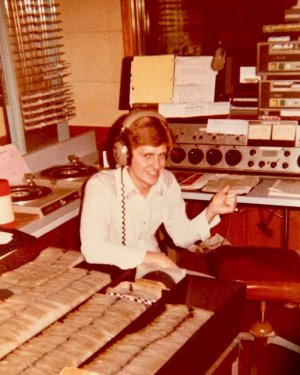
Speaking of KFMB and its Gold---I don't remember if I posted this here before or not, but from Mark Larson's Facebook page, here's Mark in the old 5th Avenue KFMB (AM) studios in 1976, shortly after his arrival.

There was no separate Gold library down the hall---it was all in the studio---just four big, long drawers of 45s:


475432617_10161071051696824_9124403869697371359_n.jpg
 
A few months later, Bill Drake took the idea, blended a robust Gold library and put HitParade '68 on KHJ-FM, and then syndicated it to other markets nationwide:

Wow, thanks for this clip. I haven't heard Hit Parade in maybe 50 years?

I was a fan of Hit Parade. Through the 1970s, I heard it on so many stations in the Northeast, in Maine, NH, VT, etc. The biggest station I remember was 96.1 WLEV Easton-Allentown (now WCTO). I didn't know it had been on KHJ-FM Los Angeles. I was impressed by how it sounded like there was a live DJ to give us the names of the songs and artists even though I knew it was fully automated. How clever the voice would say the station's call letters and dial position, then the jingle singers would sing "Hit Parade!" That way, the jingle singers didn't have to do it for every little station.

This 1968 version has the DJ very foreground, talking over some song intros, not just endings, and even commenting on some songs. But by the time I heard it in the 70s, it was a bit more low-key. No more talking over intros, as least as far as I remember. The voice simply gave us artist and title. Usually two songs would be played in a row and the voice gave both songs' info at the conclusion. "That was Love Train from the O'Jays. And we also heard My Love from Paul McCartney." So I assume the pattern was two current hits followed by two songs from the gold file.

Great to hear it again, if only for five minutes!
 
Another pioneer in what we now call AC was the now-defunct 1330 WTRX in Flint, MI. It had previously been a straightforward Top 40, but was mentioned in a 1968 Billboard article by Claude Hall as an example of what the GM called "bright MOR" - Tony Bennett, Al Hirt, and Herb Alpert but also Simon & Garfunkel, The Cowsills, The Association, and Elvis. Basically, it was filling the gap between the Top 40 of WTAC 600 and the traditional MOR of WFDF 910.
Down in Detroit, 1270 WXYZ had moved into a similar format (also from Top 40) about a year earlier, which it called "The Sound of the Good Life." Other stations mentioned in the article as running similar "middle ground between Top 40 and MOR" music mixes include WHK, KDKA, WMC, WNEW, WHN (to an extent) and KPOL. In Detroit, 1130 WCAR would also move into a prototype AC format (from traditional MOR) in 1970, which lasted about a year before they went full Top 40 against CKLW.
Possibly the first "prototype" AC format in the Detroit area could have been 950 WWJ in the late '50s, when it had a programming concept it called "Melody Parade" which was essentially hit records without the rock and roll. Prior to transforming into WKNR "Keener 13" in 1963, 1310 WKMH also had the short-lived (and unsuccessful) "Flagship Radio" in the early '60s.


Back
Top Bottom