Exactly. The only network programming I now watch when it airs, via television (OK, YouTube TV, but it still counts as television, right?) is live sports and breaking news. And even for those, there are internet-only options available, and that's where much of my "TV" consumption is these days.The problem is it's not being replaced by any one thing, but the audience is being spread out over many different things. Some of them still watch broadcast TV, just not as much. All this is similar to what's happening to radio. People still listen to broadcast radio. Just not as much and not as often. They haven't all gone to any one place. Just disbursed over many different places. Advertising is based on attracting a mass audience, and there's not much media that still does.

-
Get involved.
We want your input!
Apply for Membership and join the conversations about everything related to broadcasting.
After we receive your registration, a moderator will review it. After your registration is approved, you will be permitted to post.
If you use a disposable or false email address, your registration will be rejected.
After your membership is approved, please take a minute to tell us a little bit about yourself.
https://www.radiodiscussions.com/forums/introduce-yourself.1088/
Thanks in advance and have fun!
RadioDiscussions Administrators
You are using an out of date browser. It may not display this or other websites correctly.
You should upgrade or use an alternative browser.
You should upgrade or use an alternative browser.
Late Show ending May 2026
- Thread starter Don CT
- Start date
- Status
- Not open for further replies.

Network affiliations are much more complex than that. In fact, stations generally carry a network in exchange for running the network's national spots. Network deals with larger owners of stations may differ, of course.When that happens, most broadcast chains will be looking at that and reevaluating their want to pay money to carry CBS.
This is also how many individual syndicated TV and radio shows work: station gets show, network gets a percentage of the advertising avails.
Radio reaches over 80% of adults weekly. Since ads are priced based on delivery, advertisers get a good value from radio because it is still about the easiest medium for achieving reach and frequency for those over age 25 or so.Advertising is based on attracting a mass audience, and there's not much media that still does.

Broadcast TV isn't dying in fact it's getting stronger due to cord cutting.
The vast majority of broadcast TV enters homes via cable. Cord cutting hurts broadcast TV:
Survey: Share of Homes With TV Antennas Falls to 19%
Homes with access to live TV channels via antennas declined from 32% in 2020, according to a major new survey from Horowitz Research
 www.tvtechnology.com
Exclusive over-the-air viewers (those without cable or streaming) are older and poorer than viewers with cable, streaming or both.
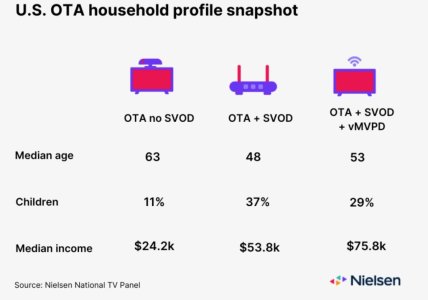
That's absolutely a factor in declining advertising rates.
Here's the full Nielsen report containing the graphic:

 www.nielsen.com
That's absolutely a factor in declining advertising rates.
Here's the full Nielsen report containing the graphic:
Beyond big data: The audience watching over the air | Nielsen
Nearly 23 million U.S. homes access free TV programming using digital antennas—viewership that can’t be measured by big data.
www.nielsen.com
I was hoping that when I had a minute to read about this show that no one watches finally ending
CBS’ The Late Show with Stephen Colbert topped the 11:35 pm hour in total viewers with an average of 2.417 million across 41 first-run episodes.
I mean, you're only off by 2,417,000, but....

Late Night Ratings Revealed: Who's Top & Who's Lagging Behind?
One host has made huge gains year-on-year.

It's the #1 late night show but "no one watches" it.I was hoping that when I had a minute to read about this show that no one watches finally ending, that you would have the right answer. Do you produce
Catsimatidis' show from the studio? If so, I think Cats is possibly pumping the air with some conspiracy-enhancing oxygen from his oil refinery ownership era.
Trumps going to base his politics on Colbert? He hasn't watched that channel in decades. Does Nathan Obral ever help you in the studio?
Radio reaches over 80% of adults weekly. Since ads are priced based on delivery, advertisers get a good value from radio because it is still about the easiest medium for achieving reach and frequency for those over age 25 or so.
Except that no radio station or radio company gets an 80 share. That's what we're talking about. A diluted audience base.
I have nothing to do with Rollo’s day job and have been trying to keep this thread from devolving into another political thread that Lance has to lock. You’re welcome.
Whose counting now that the show is trashed? (My humor obviously about as good as the last late night show I watched - Pat Sajak.)I mean, you're only off by 2,417,000, but....
Late Night Ratings Revealed: Who's Top & Who's Lagging Behind?
One host has made huge gains year-on-year.www.tvinsider.com
Then the FCC should have only licensed one station per market. We could have had the equivalent of the BBC!Except that no radio station or radio company gets an 80 share. That's what we're talking about. A diluted audience base.
The radio audience is there. An advertiser simply aggregates a number of stations in a market to reach the ages and other characteristics they want to reach.

I'd like to buy a vowelWhose counting now that the show is trashed? (My humor obviously about as good as the last late night show I watched - Pat Sajak.)
(My humor obviously about as good as the last late night show I watched - Pat Sajak.)
I watched the first week or two of that show. When sidekick Dan Patrick said something about nursing himself back to health and Sajak's reply was "Don't get a stiff neck", I was gone.
For the record, I like Colbert, but I stopped watching a few months ago. I felt like the takes were a little too broad on topics too serious, so I've gone from three late-night shows (watched the following day via DVR) to two (Seth Meyers and The Daily Show).

K.M. Richards
Program Director, The Eighties Channel™
Are you looking for Lance to shut down yet another thread?
While that hasn't happened yet, I note that he (or one of the moderators) removed the offending post.
Which should be a warning about posting such content, after all the threads that have been shut down for going too far into politics without there being a focus on broadcasting.
Those who still go off like that are either too rabid about their political POV, too dense to restrain themselves from posting despite the known probable outcome, or too effing stupid to realize this ain't the place for that.
K.M. Richards
Program Director, The Eighties Channel™
For the record, I like Colbert, but I stopped watching a few months ago. I felt like the takes were a little too broad on topics too serious, so I've gone from three late-night shows (watched the following day via DVR) to two (Seth Meyers and The Daily Show).
I watch Kimmel's monologue but unless he has a guest that I'm interested in, I'm out of there after that. I stopped watching CBS when Letterman retired, and NBC when Leno did.
It is the number one show in a time period that virtually nobody under 50 watches. Both things can be true. The late night audience has declined by over 40% since 2020, and the trades have been speculating about the end of late night shows since 2023. It's basically an open secret that most believe that once the current hosts are done (whether that be via retirement or not renewing a contract like they did with Colbert) that would be the end of all late night talk show programming.It's the #1 late night show but "no one watches" it.
While I'd love to blame this one on politics, the writing has been on the wall for YEARS before this. Ad revenues are declining, retransmission fees are drying up, and its having noted effects across the board at the networks. Cable networks are mostly just repeats now and broadcast TV networks are down to just a few hours a week of scripted programming (with shorter seasons to boot). It's just that the ball has gotten so big in that decline that we are starting to actually notice now, but if you look at even top shows now, you'll see that episode counts are declining, and more scripted programming is being replaced by reality tv shows/game shows/etc.
I always appreciate you and your perspective, Michael. You have been there. I would imagine that you do indeed watch shows from a different viewpoint that 99.9995% of regular viewers. I honestly don't have the attention span for any of these late night shows. I can listen to radio talk and sports talk, passively in the car. (Old age well even the WABC demo.)I watched the first week or two of that show. When sidekick Dan Patrick said something about nursing himself back to health and Sajak's reply was "Don't get a stiff neck", I was gone.
For the record, I like Colbert, but I stopped watching a few months ago. I felt like the takes were a little too broad on topics too serious, so I've gone from three late-night shows (watched the following day via DVR) to two (Seth Meyers and The Daily Show).
Pat spent some time in radio and TV (Look Pat Sajak weather on WSM-TV - worth a head shake or two on old Youtube videos) along with Dan Miller (his first co-host) in Nashville. They were a great team here. That did NOT translate in LA/late night. You watched more shows that I did. Painfully hard to watch. And I knew both of them. Great guys. I felt like they knew it was a failed concept after the first three or four shows.
I think the powers saw Colbert struggling. I became friends with a close relative of his and he said it was a matter of time before the show was finished. Just some internal workings with Colbert himself. He said he wanted to please everyone but himself. That was probably last October, in a limited conversation.
I have no current info on why things have happened recently.

Which totally explains the way this was done. No it wasn’t decided in a day, but to pretend the glaring neon signs of motivation don’t exist is next-level excuse-making.I agree with all of that. These kinds of corporate decisions aren't made in a day. They've been thinking about it for a while. A lot of people had to sign off on it. Colbert has likely been aware of it as well. He may not have expected the way it happened.

Which totally explains the way this was done. No it wasn’t decided in a day, but to pretend the glaring neon signs of motivation don’t exist is next-level excuse-making.
Maybe it was planned but the timing was awful.
Agreed, To pretend that the glaring neon signs of declining viewership and revenue didn't play a factor is next level excuse making. Glad we can see eye to eye on that! I don't know a single thing that could lose 50% of their "buyers" (advertisers, cable subscribers) and just continue as-is. Being the number one late night show is like being the number one 8-track player manufacturer. You might be, but it's probably not profitable regardless.Which totally explains the way this was done. No it wasn’t decided in a day, but to pretend the glaring neon signs of motivation don’t exist is next-level excuse-making.
Meanwhile… Trump is now targeting Kimmel
 www.tvinsider.com
Jimmy Fallon Reacts to Colbert 'Late Show' Cancellation as Trump Says 'Kimmel Is Next'
'I really thought I'd ride this out with him for years to come.'
- Status
- Not open for further replies.