• Get involved.
    We want your input!
    Apply for Membership and join the conversations about everything related to broadcasting.

    After we receive your registration, a moderator will review it. After your registration is approved, you will be permitted to post.
    If you use a disposable or false email address, your registration will be rejected.

    After your membership is approved, please take a minute to tell us a little bit about yourself.
    https://www.radiodiscussions.com/forums/introduce-yourself.1088/

    Thanks in advance and have fun!
    RadioDiscussions Administrators

TV Guide editions and online resources

Since Glendive is the only market with no local NBC YTTV just gives them one
ABC is interesting because when I had YTTV they gave us what is basically the National feed (there is no licensed ABC in my market) and when there wasn’t National programming they gave us ABC News 24/7 or reruns of the View, etc. weekends were reruns of what would you do? During those open times.

edit: found what I use to get a few years ago on ABC via YTTV
6-8 Good Morning America (normally its on from 7-9 Central)
8-10 ABC News Live
10-11 View
11-12 GMA3
12-1 GMA3
1-2 General Hospital
2-3 General Hospital
3-4 GMA3
4-5 View
5-5:30 GMA3 (half hour?)
5:30-6 ABC Nat'l News
6-6:30 ABC Nat'l News
6:30-7 simulcast from ABC News Live channel
7-10 Prime Time
10-10:35 simulcast from ABC News Live channel
10:35-12:07 Kimmel and Nightline
overnight its national ABC programming (ABC news)

Noticed on the weekend its alot of simulcast from ABC News Live as I see "What would you do?"

Such arrangements also get around the potential problem of extending a nearby market's stations in infill situations such as Glendive (Zanesville OH is another example that comes to mind),. This could be an issue when there is a case of counties on the edge of a market potentially developing a preponderance of viewing for the neighboring market's stations, and possibly shifting the market boundaries when ratings are compiled.

There are very few markets anymore that do not have most or all in-market Big Four networks delivered either via the main channel, subchannels, or LPTVs. Such markets tend to be doggedly loyal to their local stations, such as Presque Isle (Aroostook County ME) and WAGM, or Harrisonburg and WHSV. Both markets rely upon LPTVs for some networks, as well as subchannels. WYMT Hazard KY is another such station with fierce loyalty, though Hazard has never been its own market, instead falling on the fringes of the Lexington market (with wide viewership in the neighboring Knoxville, Tri-Cities, and Charleston-Huntington markets). Lexington fought long and hard to seize a lot of Eastern Kentucky counties.
 
There are very few markets anymore that do not have most or all in-market Big Four networks delivered either via the main channel, subchannels, or LPTVs.
ABC is the most common one missing and its only like 7-9 markets if I recall (correction...its 5). As someone who has CBS and FOX on a station and NBC on a LP (both stations owned by Gray) I'm aware of this.
NBC and FOX is 1 station right now (Glendive). CBS is 1 (Zanesville)

Such markets tend to be doggedly loyal to their local stations, such as Presque Isle (Aroostook County ME) and WAGM, or Harrisonburg and WHSV. Both markets rely upon LPTVs for some networks, as well as subchannels.
correct. The thing is cable is the ONLY option that can import a neighboring station of the same network as available in the market. Satellite and streaming cannot import a network unless there is none avail;able in that market. So in Mankato on satellite and streaming its Mankato CBS, FOX and NBC. ABC can be substituted due to no ABC in market (same as PBS). Cable gives subscribers Minneapolis Big 4+My Network+PBS also. Until about 2007 Mankato was just CBS. Then they added FOX. NBC came along maybe 4 years ago.

WYMT Hazard KY is another such station with fierce loyalty, though Hazard has never been its own market, instead falling on the fringes of the Lexington market (with wide viewership in the neighboring Knoxville, Tri-Cities, and Charleston-Huntington markets). Lexington fought long and hard to seize a lot of Eastern Kentucky counties.
moot point unless its cable. Satellite and streaming gives them Lexington stations as that is the market it is in. They cant give them some neighboring market just because. Cable has rules on what they can carry from the 70s. Satellite and streaming has to abide by current rules.
 
Last edited:
These two editions (El Paso and New Mexico) are almost identical in their channel lineups:

http://www.matthewsittel.com/tvg/cl/19790908_elp_cl.jpg

http://www.matthewsittel.com/tvg/cl/19750906_nm_cl.jpg

It's also worth noting that in both editions, El Paso stations are in black bullets and Albuquerque has white bullets. Four years apart (1975 and 1979) was the closest together that I could find.

How did the signals of the L.A. indies get all the way from California to New Mexico? I assume this was done with microwave links in the pre-satellite era, but I don't think these stations were ever carried on cable in Phoenix and Tucson, so how did this arrangement work and who paid for it?
 
How did the signals of the L.A. indies get all the way from California to New Mexico? I assume this was done with microwave links in the pre-satellite era, but I don't think these stations were ever carried on cable in Phoenix and Tucson, so how did this arrangement work and who paid for it?

It was via a network of microwave relays, and Yuma was the first cable system in the southwest to carry KTLA via microwave. However, by 1967 the microwave relay network had added KCOP, KTTV, and KHJ-TV and was seeking approval to extend the network to Texas.


The Phoenix and Tucson cable systems were among many in Arizona and New Mexico who added at least one of the four during the 1970s (these are documented in Broadcasting as well as FCC regulations at the time required systems to request "distant signal" carriage permission).

There were similar microwave relay networks built to carry the L.A. stations into Central California and Nevada.
 
ABC is the most common one missing and its only like 7-9 markets if I recall (correction...its 5). As someone who has CBS and FOX on a station and NBC on a LP (both stations owned by Gray) I'm aware of this.
NBC and FOX is 1 station right now (Glendive). CBS is 1 (Zanesville)

Zanesville gets WBNS from Columbus for CBS, as well as WSYX for ABC.

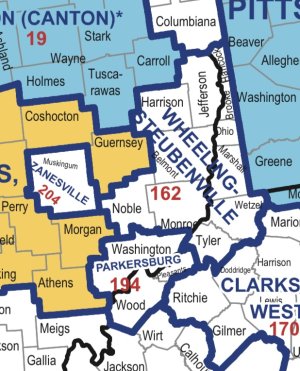
If they weren't their own distinct market, NBC would likely have pulled their affiliation from WHIZ a long time ago. I've long maintained that Zanesville and Parkersburg should be one market, perhaps moving the respective stations' transmitters closer together and having each station carry two of the Big Four networks. The two towns aren't that far apart.
 
If they weren't their own distinct market, NBC would likely have pulled their affiliation from WHIZ a long time ago. I've long maintained that Zanesville and Parkersburg should be one market, perhaps moving the respective stations' transmitters closer together and having each station carry two of the Big Four networks.

Are you planning on forcing them to relocate? Or is this another pipe dream?
 
I have to think that the main appeal of having local stations in markets such as those, is the local news factor, no place wants to be a TV news desert. That said, there are some areas where no station is really "local", and given the choice, many viewers would prefer to watch stations from a larger market, especially one in-state or of great regional significance. Case in point, Prowers County in Colorado, on the Kansas state line. They are probably too far away from Colorado Springs and Pueblo for those cities to have any real connection to their lives, so they land in the Denver market where, presumably, the Denver stations have always been available via cable or satellite (too far for OTA reception). Montezuma and La Plata counties (Durango area) would probably be in the Denver market if it weren't for KREZ being a satellite of KRQE Albuquerque. (Too bad one of the Denver stations didn't snap it up when KREX sold it.) At one time the Albuquerque market extended even deeper into Colorado.
Prowers County actually owns four translators, licensed to Lamar. According to rabbitears.info, they relay ABC, CBS. NBC, and RMPBS stations from Colorado Springs and Pueblo.

La Plata County (Durango, etc.) has an exemption whereby satellite and cable operators are allowed to import signals from Denver. In addition, Rocky Mountain PBS (RMPBS, KRMA Denver) has a repeater station in Durango, KRMU.

I believe it was Hubbard’s purchase of what originally was KIVA-TV in Farmington, NM, becoming KOBF, that pulled the Four Corners into the Albuquerque market.
 
Last edited:
Are you planning on forcing them to relocate? Or is this another pipe dream?

In a scenario of a combined Zanesville-Parkersburg market, the stations might wish to extend their reach to the other core city/metro area of the market in their own self-interest, by seeking at least to some extent to co-locate their towers in the same general area, and recognizing that a larger combined market would be more robust and could command more ad revenue. The two towns are 52 air miles apart, which is in the same ballpark as multi-city markets such as Myrtle Beach-Florence, Charleston-Huntington, or Greenville-Spartanburg-Asheville (where WLOS is in the process of moving their transmitter to provide better coverage of the larger and more prosperous South Carolina part of the market). Each of those markets are more viable together than they would be separately, and in the case of the latter two, there is some localization of news coverage (for all practical purposes, Florence has lost all of its TV stations to Myrtle Beach, where blisteringly-hot growth continues to take place). The same could hold true for two stations that have been covering their modestly-sized cities forever and a day.
 
Last edited:
Zanesville gets WBNS from Columbus for CBS, as well as WSYX for ABC.
That’s nice but LEGALLY the only stations in Zanesville are NBC and FOX which is what I was saying.
Just like Mankato, Presque Isle and Parkersburg who do not have ABC in their market.

If they weren't their own distinct market, NBC would likely have pulled their affiliation from WHIZ a long time ago.
Well they are so moot point. No different than Mankato back in the day when it was just CBS. Rumor years ago was Minneapolis cbs (O&O) would buy it. They never did. There were years Mankato was one county DMA. Now they are 4 counties.

I've long maintained that Zanesville and Parkersburg should be one market, perhaps moving the respective stations' transmitters closer together and having each station carry two of the Big Four networks. The two towns aren't that far apart.
Won’t happen for a few reasons
-the FCC won’t merge 2 DMAs ‘just because’
-can’t merge them as both have NBC and FOX in their own market owned by someone else
-they are far apart from each other….plus the mountains are between them
-Wheeling/Steubenville market actually partially butts up against Zanesville.
IMG_8641.jpeg
 
Won’t happen for a few reasons
-the FCC won’t merge 2 DMAs ‘just because’

If I may ... DMAs are created by Nielsen, not the FCC. The Commission has its own list called Television Market Areas (TMAs) which only go 100 deep -- there are 210 DMAs -- and the TMA list is primarily used in determining disputes such as cable/satellite carriage.

Zanesville is DMA #203. Parkersburg is #194. Neither station is in the TMA list, obviously.

As for the rest of it, deals can be made between station owners and networks, and they could (although I have to agree I don't see it happening) work together to move their transmitters to locations that would cover both DMAs.

So, yeah, there are stumbling blocks, and those would likely derail any serious consideration. But the FCC would only care about transmitter site moves that left more than a de minimis number of viewers unable to receive the station(s) under the new contours.
 
La Plata County (Durango, etc.) has an exemption whereby satellite and cable operators are allowed to import signals from Denver. In addition, Rocky Mountain PBS (RMPBS, KRMA Denver) has a repeater station in Durango, KRMU.

I'm guessing that this was an instance of having an "orphan county" that can't get in-state commercial TV OTA.

I wonder if Durango cable has to sim-sub the Denver stations with Albuquerque when they run the same programs.
 
-can’t merge them as both have NBC and FOX in their own market owned by someone else
I had in mind affiliation flips, possibly make WHIZ ABC, let them keep Fox, and WTAP gives up Fox. That's just one possibility.

-they are far apart from each other….plus the mountains are between them
Again, 52 miles, roughly the same distance as Myrtle Beach and Florence. Charleston and Huntington are 44 miles apart (though their transmitters are more towards the center, Coal Mountain and Barkers Ridge respectively), and Oak Hill and Bluefield are 50 miles apart over far more unforgiving terrain than that between Zanesville and Parkersburg.
 
In a scenario of a combined Zanesville-Parkersburg market, the stations might wish to extend their reach to the other core city/metro area of the market in their own self-interest, by seeking at least to some extent to co-locate their towers in the same general area, and recognizing that a larger combined market would be more robust and could command more ad revenue. The two towns are 52 air miles apart, which is in the same ballpark as multi-city markets such as Myrtle Beach-Florence, Charleston-Huntington, or Greenville-Spartanburg-Asheville (where WLOS is in the process of moving their transmitter to provide better coverage of the larger and more prosperous South Carolina part of the market). Each of those markets are more viable together than they would be separately, and in the case of the latter two, there is some localization of news coverage (for all practical purposes, Florence has lost all of its TV stations to Myrtle Beach, where blisteringly-hot growth continues to take place). The same could hold true for two stations that have been covering their modestly-sized cities forever and a day.

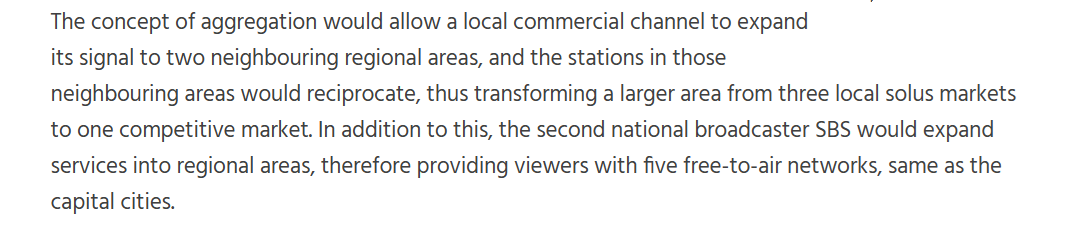
This sounds a bit like regional TV "aggregation" in 1980s/'90s Australia:

Article from Television.AU


In the Australian case, the increased competition had a negative impact on the local stations despite the creation of larger, "aggregated" TV markets.
 
I'm guessing that this was an instance of having an "orphan county" that can't get in-state commercial TV OTA.
No. Durango has translators for the major Albuquerque commercial network affiliates (KOAT, KASA) or their repeaters (KREZ, KOBF).

It appears from rabbitears.info that Farmington, NM is actually market #199 and not part of the Albuquerque market. This would also cover Durango and La Plata County. At one time, KOBF did have a little bit of local programming, mainly news, but that ended years ago. So it's puzzling.

Similarly, Roswell, NM is broken out as market #200 though its network stations are Albuquerque repeaters or translators. KOAT ditched its outstate repeaters in favor of translators several years ago.

I wonder if Durango cable has to sim-sub the Denver stations with Albuquerque when they run the same programs.
I've never been in a position to find out. Whenever I've stayed there, it's been at places that used satellite TV.
 
At one time, KOBF did have a little bit of local programming, mainly news, but that ended years ago. So it's puzzling.

KREZ also carried local news at times. I believe the last time was during (and possibly immediately after) KRQE's ill-fated CBS Southwest era.

As far as I know, KREZ's final local content was in the form of localized weather forecasts (with a "6" logo in place of KRQE's "13" logo) produced at KRQE but with a focus on Durango and Farmington. This example is from 2009:

 
I had in mind affiliation flips, possibly make WHIZ ABC, let them keep Fox, and WTAP gives up Fox. That's just one possibility.
Won’t happen. Just like your ‘let’s break WYMT Hazard to its own DMA’ pipe dream the only market that will merge is Glendive, MT now that Montana PBS bought KXGN.
If they wanted to merge DMA’s they would have done it years ago. Not now. Also Parkersburg (much like Presque Isle and Mankato) all stations Gray TV owns. They like having a monopoly on those markets.
 
No. Durango has translators for the major Albuquerque commercial network affiliates (KOAT, KASA) or their repeaters (KREZ, KOBF).

It appears from rabbitears.info that Farmington, NM is actually market #199 and not part of the Albuquerque market. This would also cover Durango and La Plata County. At one time, KOBF did have a little bit of local programming, mainly news, but that ended years ago. So it's puzzling.

Similarly, Roswell, NM is broken out as market #200 though its network stations are Albuquerque repeaters or translators. KOAT ditched its outstate repeaters in favor of translators several years ago.


I've never been in a position to find out. Whenever I've stayed there, it's been at places that used satellite TV.
Trip (the guy who runs rabbitears) uses his own numbers. DMA’s are broken down as need be but it’s all one DMA. From rabbitears site
Q. Why does READS exist? Why not use the Nielsen DMA rankings?
In 2008, Nielsen sent a cease and desist notice to Wikipedia over its use of the Nielsen DMA system. It was at that time that the determination was made to discontinue use of the Nielsen ranking system on RabbitEars and instead generate a solution.

Here is the DMA map
 
Won’t happen. Just like your ‘let’s break WYMT Hazard to its own DMA’ pipe dream the only market that will merge is Glendive, MT now that Montana PBS bought KXGN.
If they wanted to merge DMA’s they would have done it years ago. Not now. Also Parkersburg (much like Presque Isle and Mankato) all stations Gray TV owns. They like having a monopoly on those markets.

(edited to add 1994 BCYB citation)

Actually, Hazard was eligible to become its own ADI, but elected not to (1994 Broadcasting and Cable Yearbook, page C-202). This came after WKYT's parent company (Kentucky Central Television) bought WKYH and flipped it to WYMT and CBS, so the reason seems obvious, that would peel counties away from the Lexington market, and would not be in the company's best interests. So the idea of a Hazard DMA (or, to be precise, ADI) is a bit more than just some hobbyist's idle "pipe dream".

Your point about Gray having a monopoly in those markets is well-taken. That would also apply to Harrisonburg.
 
Last edited:
Your point about Gray having a monopoly in those markets is well-taken. That would also apply to Harrisonburg.
Harrisonburg is a full market :) but yeah all stations (sans PBS) are owned by same folks
Gray likes having a monopoly. It’s just like when Stephen Marks bought WBKB and KXGN. He wanted the monopoly in Alpena, MI and Glendive, MT.


Back
Top Bottom