• Get involved.
    We want your input!
    Apply for Membership and join the conversations about everything related to broadcasting.

    After we receive your registration, a moderator will review it. After your registration is approved, you will be permitted to post.
    If you use a disposable or false email address, your registration will be rejected.

    After your membership is approved, please take a minute to tell us a little bit about yourself.
    https://www.radiodiscussions.com/forums/introduce-yourself.1088/

    Thanks in advance and have fun!
    RadioDiscussions Administrators

TV Guide editions and online resources

I had in mind original content (news, sports, public affairs, etc.) from in-state, not translators for out-of-state stations.
This is what you wrote:

I'm guessing that this was an instance of having an "orphan county" that can't get in-state commercial TV OTA.

And I responded:

No. Durango has translators for the major Albuquerque commercial network affiliates (KOAT, KASA) or their repeaters (KREZ, KOBF).

First, state lines don't matter. La Plata County gets over-the-air commercial TV. Second, KOBF and KREZ are full-power TV stations. Whatever you have in mind doesn't matter if you don't state it clearly.
 
First, state lines don't matter. La Plata County gets over-the-air commercial TV. Second, KOBF and KREZ are full-power TV stations. Whatever you have in mind doesn't matter if you don't state it clearly.

Okay, let's back up a moment. My point was that Durango doesn't get any in-state OTA TV that originates in Colorado. The translators for the Albuquerque stations do not provide programming relevant to Colorado. Likewise, KREZ, even though it is situated in Colorado, AFAIK merely relays KRQE and has no local content. It is basically a full-power translator (as is KOBF, which is not in Colorado, it's in Farmington).

My reasoning here is that La Plata County qualifies as an "orphan county" for these reasons, and besides, if they get Denver stations on cable, it is presumably to provide that in-state content that the ABQ stations and their translators/KREZ satellite do not furnish.

I suppose the larger question might be "is a county that has a full-power satellite of an out-of-state station considered as not being able to receive any in-state television, and thus considered an orphan county?".
 
Here's an example of KOBF's news inserts from when it still produced local news. Most of the newscast is a direct feed from KOB in Albuquerque, but you can see localized Four Corners segments at 7:14 (a very brief local news insert), 29:52 (a news tease), and 44:10 (a longer local news and weather insert):

 
Here's an example of KOBF's news inserts from when it still produced local news. Most of the newscast is a direct feed from KOB in Albuquerque, but you can see localized Four Corners segments at 7:14 (a very brief local news insert), 29:52 (a news tease), and 44:10 (a longer local news and weather insert):


I actually saw their news cut-in when I was in Farmington one time (early 2000s). I want to say that the anchor's name was Christy Cruz or something like that, as it happened we were driving by KOBF while we were in town, and saw her with a couple of other people getting in a news vehicle. It's a shame they don't have localized content such as that anymore.
 
First, state lines don't matter. La Plata County gets over-the-air commercial TV.

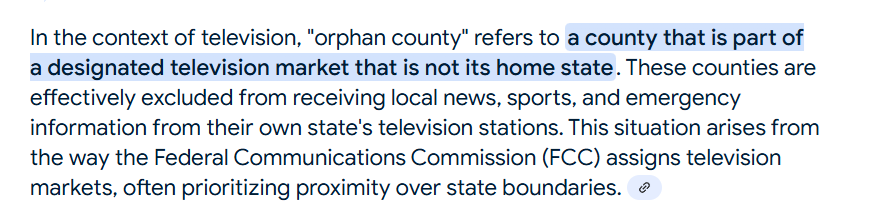
But to be fair, that's what "orphan county" means in a television context:


Here's an interesting Columbia Journalism Review article about orphan counties, focusing on La Plata (Durango):


Excrept:

Jill and Michael Fischer live seven miles outside the city of Durango, a historic mountain town of nearly 20,000 and the seat of La Plata County in southwest Colorado. When they turn on their TV for local news, however, evening broadcasts—about community events, the weather, and most notably politics—arrive via satellite from Albuquerque, New Mexico, more than 200 miles away. The couple rarely sees substantial public affairs coverage about their own state’s legislature. During election season, they receive TV ads and coverage for political campaigns in New Mexico, not Colorado.

For years, some La Plata residents have vented their frustrations about out-of-state news in the editorial pages of the family-owned Durango Herald newspaper. “Albuquerque TV is oppressing us,” ran the headline on one such letter. Another resident wrote that Durango is “still being held hostage by the Nielsen Holdings Co. and many Albuquerque television stations.”
 
But to be fair, that's what "orphan county" means in a television context:


Here's an interesting Columbia Journalism Review article about orphan counties, focusing on La Plata (Durango):


Excrept:
It would not be feasible to make market boundaries conform to state lines in many (probably most) cases. For instance, the Indiana portion of the Cincinnati market, especially the counties bordering Ohio, could not reasonably be made part of the Indianapolis market. So importing at least one in-state station for news, sports, and public affairs could be a Band-Aid solution. There are also the situations of stations being legally licensed in one state, but for all practical purposes broadcasting from another state, such as WXIX Cincinnati (licensed to Newport KY) and WQCW Huntington (licensed to Portsmouth OH). Their transmitters and studios are in Ohio and West Virginia respectively. (To be fair, WSAZ, which shares studios and resources with WQCW, does a good job of covering Kentucky and Ohio, as good a job as they can having to cover three statehouses, three states' college sports, and so on, and in the case of Kentucky, they have the formidable resources of Gray sister stations WKYT and WYMT upon which to draw.) Long story short, some counties just naturally fall into markets where the core cities are in other states.

And as I noted above, it wouldn't require a full complement of an in-state market's major stations. One station would do, preferably the top-rated station from that market and/or with the best news resources. For cable subscribers, there are also in-state news stations such as those offered by Spectrum. To answer the complaint of not getting in-state news, the FCC could respond "you get plenty of in-state news, it's just on a single channel dedicated to that". But that wouldn't help OTA viewers or satellite/OTT subscribers.
 
KNAZ in Flagstaff, Arizona, is another marginal-market station in the Southwest that has become a full-time satellite (in its case, of KPNX in Phoenix). For years, it broadcast a full range of local newscasts, including in the morning. When Gannett bought KNAZ in the 1990s, it began to retransmit some newscasts from its Phoenix sister station, but for about a decade, it retained local newscasts in key timeslots. That all ended in 2008 when.KNAZ's news department was shut down.

Here's an entire KNAZ newscast from 1994, when the station was still locally owned:


And here are the first few minutes of a Gannett-era edition:


When it was still known as KOAI, the station even broadcast a daily Navajo-language newscast:

 
I actually saw their news cut-in when I was in Farmington one time (early 2000s). I want to say that the anchor's name was Christy Cruz or something like that, as it happened we were driving by KOBF while we were in town, and saw her with a couple of other people getting in a news vehicle. It's a shame they don't have localized content such as that anymore.
I caught one of their 10PM newscasts while staying in a motel room in Chinle, AZ, back in the Fall of 2004.

I don't remember who was anchoring the newscast.

I do remember that the KOBF newscast cut-in to a KOB newscast though.
 
There is also the Yuma AZ-El Centro CA market, which has stations on both sides of the Colorado River. Stations there operate as if it was one community without regard to state boundaries.
 
There is also the Yuma AZ-El Centro CA market, which has stations on both sides of the Colorado River. Stations there operate as if it was one community without regard to state boundaries.

And because Arizona, in the Mountain Time Zone, doesn't observe DST, the two parts of the market share the same time zone during DST months, but are an hour apart the rest of the year.
 
KNAZ in Flagstaff, Arizona, is another marginal-market station in the Southwest that has become a full-time satellite (in its case, of KPNX in Phoenix). For years, it broadcast a full range of local newscasts, including in the morning. When Gannett bought KNAZ in the 1990s, it began to retransmit some newscasts from its Phoenix sister station, but for about a decade, it retained local newscasts in key timeslots. That all ended in 2008 when.KNAZ's news department was shut down.

Here's an entire KNAZ newscast from 1994, when the station was still locally owned:


And here are the first few minutes of a Gannett-era edition:


When it was still known as KOAI, the station even broadcast a daily Navajo-language newscast:

I've been there too, and saw their news. They did a good job.

It's not clear from this article whether the Navajo newscast aired on the KOAI mothership, or whether it was just broadcast on the translators.

Too bad these localized newscasts have gone away, first Farmington and Flagstaff, then Glendive (which won't even continue to be a satellite as are KOBF and KNAZ, but will cease to exist entirely as a commercial station).
 
And because Arizona, in the Mountain Time Zone, doesn't observe DST, the two parts of the market share the same time zone during DST months, but are an hour apart the rest of the year.

The stations there operate, for all practical purposes, on Yuma time, so for part of the year, viewers on the California side have to watch network programs two hours earlier than they would otherwise be aired in the Pacific Time Zone, then for the other part of the year, one hour earlier. (I hope I've got that right.)

I suppose you just get used to it.
 
The stations there operate, for all practical purposes, on Yuma time, so for part of the year, viewers on the California side have to watch network programs two hours earlier than they would otherwise be aired in the Pacific Time Zone, then for the other part of the year, one hour earlier. (I hope I've got that right.)

I suppose you just get used to it.

Not a lot of people to "get used to it" ... DMA #164 has 124,600 households. That's about one-tenth of one percent of the number nationwide.
 
Not a lot of people to "get used to it" ... DMA #164 has 124,600 households. That's about one-tenth of one percent of the number nationwide.
True enough, and if you had a recording device, you could simply use that to time-shift programs if desired. They're basically in the middle of nowhere with no feasible way to get stations from anywhere else, and cable/satellite operators aren't allowed to bring in OOM network affiliates.
 
True enough, and if you had a recording device, you could simply use that to time-shift programs if desired. They're basically in the middle of nowhere with no feasible way to get stations from anywhere else, and cable/satellite operators aren't allowed to bring in OOM network affiliates.
Just to clarify, I meant network affiliates when I said "stations from anywhere else". KCAL and KCOP are carried on El Centro cable (per tvtv.us).
 
When you have someplace that "really isn't close to anywhere", and there has historically been viewership for a given market, especially with ADIs tending to keep the same counties year after year, the die is pretty well cast. Cherry County, Nebraska, part of the Sioux Falls market (though quite distant from it), is another case in point. Cherry County is massive in area and, again, "really isn't close to anywhere".
In all of this, I failed to consider that the Sioux Falls stations have satellites in Reliance and Pierre, neither of which would be an outrageous distance from Cherry County. KPRY-4 in Pierre acts not only as a satellite of KSFY (ABC), but also relays NBC and Fox from KDLT. KPLO-6 in Reliance (CBS) is part of the KELOLand group of stations. With a high-gain antenna over essentially flat terrain, OTA reception would probably be possible, at least in Valentine.


Back
Top Bottom