• Get involved.
    We want your input!
    Apply for Membership and join the conversations about everything related to broadcasting.

    After we receive your registration, a moderator will review it. After your registration is approved, you will be permitted to post.
    If you use a disposable or false email address, your registration will be rejected.

    After your membership is approved, please take a minute to tell us a little bit about yourself.
    https://www.radiodiscussions.com/forums/introduce-yourself.1088/

    Thanks in advance and have fun!
    RadioDiscussions Administrators

Which Beautiful/Easy Listening Orchestras Were Better or Worse Than Others and Why

Except for a couple of stations like WPAT in the New York market and KPOL in LA, I can't see many true "Beautiful Music" stations that endured into the 70s. And those two I mention had FM simulcasts that were listed in combined form in Arbitron... generally as the AM station.

Some, like "Ocean" in Miami, left the format in the earlier 70's. And even ones like WVCG-1070 in Miami had their FM as well.

In the 1976 Duncan book, I can not find a single stand-alone AM Beautiful Music station with significan ratings.

But format radio pretty much started taking over in the early 50's when Top 40 was created. By the middle of the decade, there were few block programmed stations and those were, musically, MOR in that era.

Most of those, if they played instrumentals, used a big percentage of bands and not so much Jackie Gleason and the more modern "studio orchestra" sound.

You are missing the fact that Top 40 was created in 1951, and it played "the hits". When rock 'n' roll hits came along, the stations played both traditional sounds and the newer artists together... even as late as 1960 when many stations celebrated "Volare" as the prior year's #1 song... a definite MOR tune!

The stations that were not Top 40 were generally among just a couple of big formats by the end of the 1950's: country, "race music" (sorry, but that is how it was called), and some form of MOR, often called "Full Service". Few were all instrumental. The MORs were the most varied, as they might play some instrumentals, be more traditional or even play some of the crossover artists that had Top 40 hits, like Nat "King" Cole and even Paul Anka

I was an AM band DXer starting in 1958 and in the next 5 or so years logged about 2,500 stations. I can recall very few that played instrumentals in rated dayparts, although there were several shows, such as the Holiday Inn overnight show that played instrumentals.

There were exceptions, such as McLendon's 1960 launch of KABL 960 in San Francisco... a station that took advantage of poor FM coverage in that market. KABL got a few imitators, but the format was not that common on AM

In 1950 there were about 1000 licensed FMs in construction or on the air. By 1960 they had fallen to just over 600. The independent FM for the most part had closed. The others simulcast their AM. Then, in the ealy 60's a new set of owners filed for FMs and got them and stuck with it.

And was not into effect until the start of 1967.

Major market AM station owners, faced with non-duplication rules, looked for the formats that would least affect their cash cows, and so Beautiful Music and Album Rock seemed to be the best way to protect their AMs.

But if anything made Beautiful Music so successful, it was the duo of Shulke and Taylor who used syndication to mae doing the format cheap and easy: no cost of building a library, no PD, generally no talent, ability to automate, and even help in promotion and sales.
Holiday Inn Nighttime with "Dolly Holiday" came later -1966 to 1973. Quite successful for several years. Provided the commentary but then the stations would have to supply the LP cuts indicated.

I would respectfully dispute the statement that there were few Beautiful Music AMs.

Schulke's SRP and Taylor's Bonneville Program Services got top dollar. SRP was when introduced in 1969 two and a half to three and a half times more costly than other Beautiful syndicators. Plus Schulke often would not service them unless they spent the dollars to upgrade their automation and technical systems meet his specifications. Wanted his clients to put out the best signal in their markets as well as take a highly-disciplined approach to what they were doing. In fact the FCC investigated him because of the demands he made on his clients. They construed them as infringing upon the rights of stations to do as they please in servicing the public.
 
Except for a couple of stations like WPAT in the New York market and KPOL in LA, I can't see many true "Beautiful Music" stations that endured into the 70s. And those two I mention had FM simulcasts that were listed in combined form in Arbitron... generally as the AM station.

Some, like "Ocean" in Miami, left the format in the earlier 70's. And even ones like WVCG-1070 in Miami had their FM as well.

In the 1976 Duncan book, I can not find a single stand-alone AM Beautiful Music station with significan ratings.

But format radio pretty much started taking over in the early 50's when Top 40 was created. By the middle of the decade, there were few block programmed stations and those were, musically, MOR in that era.

Most of those, if they played instrumentals, used a big percentage of bands and not so much Jackie Gleason and the more modern "studio orchestra" sound.

You are missing the fact that Top 40 was created in 1951, and it played "the hits". When rock 'n' roll hits came along, the stations played both traditional sounds and the newer artists together... even as late as 1960 when many stations celebrated "Volare" as the prior year's #1 song... a definite MOR tune!

The stations that were not Top 40 were generally among just a couple of big formats by the end of the 1950's: country, "race music" (sorry, but that is how it was called), and some form of MOR, often called "Full Service". Few were all instrumental. The MORs were the most varied, as they might play some instrumentals, be more traditional or even play some of the crossover artists that had Top 40 hits, like Nat "King" Cole and even Paul Anka

I was an AM band DXer starting in 1958 and in the next 5 or so years logged about 2,500 stations. I can recall very few that played instrumentals in rated dayparts, although there were several shows, such as the Holiday Inn overnight show that played instrumentals.

There were exceptions, such as McLendon's 1960 launch of KABL 960 in San Francisco... a station that took advantage of poor FM coverage in that market. KABL got a few imitators, but the format was not that common on AM

In 1950 there were about 1000 licensed FMs in construction or on the air. By 1960 they had fallen to just over 600. The independent FM for the most part had closed. The others simulcast their AM. Then, in the ealy 60's a new set of owners filed for FMs and got them and stuck with it.

And was not into effect until the start of 1967.

Major market AM station owners, faced with non-duplication rules, looked for the formats that would least affect their cash cows, and so Beautiful Music and Album Rock seemed to be the best way to protect their AMs.

But if anything made Beautiful Music so successful, it was the duo of Shulke and Taylor who used syndication to mae doing the format cheap and easy: no cost of building a library, no PD, generally no talent, ability to automate, and even help in promotion and sales.
Beautiful stations were seldom all instrumental. Most in the 60s were 75% instr. When Ted Niarhos and Marlin Taylor came along on FM they played a lot fewer vocals. Taylor only 7% at first, Niarhos (which you heard) at WDBN even less.

Such stations, although they had existed since 1948, began proliferating in 1958 - 59. Most tried to emulate, if badly, WPAT or KABL or both. That is before Marlin Taylor on FM.

KOSI, KHAR, KABL, KXL, XTRA, KIXI, KYXI, KYXY, WAIT, yes WPAT and KPOL are examples of AMs which garnered a significant following in the 60s and maintained it into the 70s.

Based upon my studies I would cite 1953 as the start of so-called Top 40 (Storz) though that phrase did not come into general usage until 1956. Which is the year listeners first began objecting to the proliferation of Rock and "Race Music" on their stations.

I well remember listening to Volare in the Domenico Modugno and Dean Martin recordings on radio in 1958. People who did not care for the youth -oriented music could have found plenty to like on Top 40 through the mid 60s. But by then a lot of them had long before moved to adult stations.
 
Beautiful stations were seldom all instrumental. Most in the 60s were 75% instr. When Ted Niarhos and Marlin Taylor came along on FM they played a lot fewer vocals. Taylor only 7% at first, Niarhos (which you heard) at WDBN even less.
And that is what they were in the 70's and into the 80's. Almost all were 4 vocals an hour.
Such stations, although they had existed since 1948, began proliferating in 1958 - 59. Most tried to emulate, if badly, WPAT or KABL or both. That is before Marlin Taylor on FM.
WPAT was an early FM simulcaster; KABL succeeded mostly because the FMs in SF in the 60's did not cover the hilly market at all well
KOSI, KHAR, KABL, KXL, XTRA, KIXI, KYXI, KYXY, WAIT, yes WPAT and KPOL are examples of AMs which garnered a significant following in the 60s and maintained it into the 70s.
The majority of those had FMs or added them. WAIT was a daytimer, and XTRA burnt through various formats in the 60's trying to be an LA station with a San Diego signal. Remember, even back then Nielsen would list simulcasts at the option of the station under just one station, and that was, back then, the AM.
Based upon my studies I would cite 1953 as the start of so-called Top 40 (Storz) though that phrase did not come into general usage until 1956.
It was 1961, and Storz rapidly expanded to multiple markets such as Minneapolis, Kansas City, New Orleans and others. McLendon went Top 40 on KLIF soon after Storz's big success in the earliest 50's, following with El Paso, Houston, San Antonio and then on to places like Louisville.
Which is the year listeners first began objecting to the proliferation of Rock and "Race Music" on their stations.
Most Top 40's played the hits. When Buddy Holly and Little Richard and Bill Haley hit the charts, those Top 40 station grew even bigger. In those markets (essentially every multi-station market) some other station continued to play Sinatra and Patti Page.
I well remember listening to Volare in the Domenico Modugno and Dean Martin recordings on radio in 1958. People who did not care for the youth -oriented music could have found plenty to like on Top 40 through the mid 60s. But by then a lot of them had long before moved to adult stations.
The big breakaway from any adult-only songs came with the dance crazes of the early 60's, such as the Twist and novelty rhythms like The Bristol Stomp. Then we got the trifecta of the Beach Boys, Motown and the British Invasion. That was earlier to mid 60's, all of it.

Even the ballads, by then, were more like "Blue Velvet" than a Sinatra song.
 
Last edited:
Holiday Inn Nighttime with "Dolly Holiday" came later -1966 to 1973. Quite successful for several years. Provided the commentary but then the stations would have to supply the LP cuts indicated.
I was no longer in the continental US in 1966. I remember listening to the Holiday Inn program in the earlier 60's before emigrating to Mexico in 1963.
I would respectfully dispute the statement that there were few Beautiful Music AMs.
There were AMs that played instrumentals in the mix, but most were MOR stations and those that were more instrumental had FMs or were FM only.
Schulke's SRP and Taylor's Bonneville Program Services got top dollar. SRP was when introduced in 1969 two and a half to three and a half times more costly than other Beautiful syndicators.
I priced Shulke in 1975 for WSRA and compared the product with Boneville and others. It was priced competitively with Bonneville, and only a little bit more than ones like KalaMusic. Pricing was market based.
Plus Schulke often would not service them unless they spent the dollars to upgrade their automation and technical systems meet his specifications.
That was only if the station was not equipped to run the format. Most stations that went to automated or live assist in that era had to upgrade to use any of the syndicated formats. Shulke was a bit more strict on levels and processing, but there was not much that could be done with processing in 1969 other than buy the latest Audimax and Volumax.
Wanted his clients to put out the best signal in their markets as well as take a highly-disciplined approach to what they were doing. In fact the FCC investigated him because of the demands he made on his clients. They construed them as infringing upon the rights of stations to do as they please in servicing the public.
Reference, please. I have never seen a syndicator "investigated" by the FCC for requiring a station to have good equipment and good processing.
 
KABL succeeded mostly because the FMs in SF in the 60's did not cover the hilly market at all well
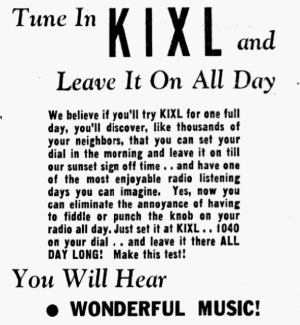
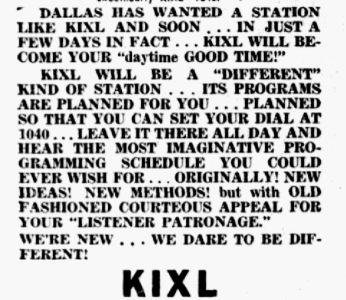
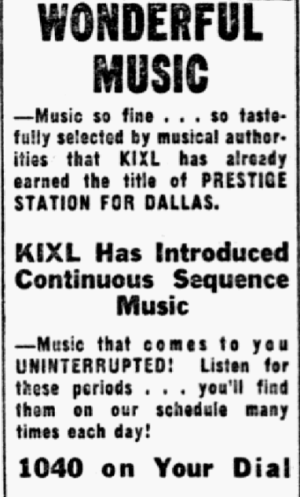
And the inspiration for KABL was Dallas' KIXL - one of the very first stations to carry a true "format" of "Good Music" throughout the day - instead of block programming. In 1947, it was pretty revolutionary. KIXL (a daytimer) was typically #2 or 3 behind KLIF's massive 40-50 shares in Dallas in the mid-to-late '50s, and by the mid 60s, its solid shares had shifted over to its FM.
When Gordon McLendon purchased KROW/Oakland, he surveyed the Bay Area market and decided not to launch yet another Top 40 in a very crowded market. He admired the success of KIXL and contacted owner Lee Segall, who assisted him with creating the format for KABL based on that of KIXL.

1754966651206.png1754966361213.png1754966598911.png
 
And the inspiration for KABL was Dallas' KIXL - one of the very first stations to carry a true "format" of "Good Music" throughout the day - instead of block programming. In 1947, it was pretty revolutionary. KIXL (a daytimer) was typically #2 or 3 behind KLIF's massive 40-50 shares in Dallas in the mid-to-late '50s, and by the mid 60s, its solid shares had shifted over to its FM.
When Gordon McLendon purchased KROW/Oakland, he surveyed the Bay Area market and decided not to launch yet another Top 40 in a very crowded market. He admired the success of KIXL and contacted owner Lee Segall, who assisted him with creating the format for KABL based on that of KIXL.

View attachment 9971View attachment 9969View attachment 9970
Charles Payne, who created the KIXL format according to Segall's notion and helped him develop that idea, soon came to work at KABL for a couple of years. Interestingly Segall and Payne at KIXL A/F did not throw it at their public in one fell swoop but worked into it gradually over a year and a half starting with a wealth of ETs, great ideas, live performers in the midst of which two segments of pretty orchestral and other instrumental music appeared, one in the AM and the other in the afternoon. Which grew and grew, replacing almost all other programming on the station. Until by the late Fall of 1948 you had what would later be termed a Beautiful Music station. With basically a single format plus various other features.
 
I was no longer in the continental US in 1966. I remember listening to the Holiday Inn program in the earlier 60's before emigrating to Mexico in 1963.

There were AMs that played instrumentals in the mix, but most were MOR stations and those that were more instrumental had FMs or were FM only.

I priced Shulke in 1975 for WSRA and compared the product with Boneville and others. It was priced competitively with Bonneville, and only a little bit more than ones like KalaMusic. Pricing was market based.

That was only if the station was not equipped to run the format. Most stations that went to automated or live assist in that era had to upgrade to use any of the syndicated formats. Shulke was a bit more strict on levels and processing, but there was not much that could be done with processing in 1969 other than buy the latest Audimax and Volumax.

Reference, please. I have never seen a syndicator "investigated" by the FCC for requiring a station to have good equipment and good processing.
SRP contract went a lot further than that. Would not allow a client to add recordings to the format, placed a limit on advertising, specified announcing style and even gave him a veto over a client's announcers. Specified how TV spots were to be constructed, etc. Advised potential clients to give up broadcasting on their FM sidebands.. Stations complained to the FCC, as did Muzak. Interestingly because of Schulke Muzak began to develop and later perfect satellite delivery. Hearings held late Spring- early Summer 1973. Also through a typo in something they read the FCC began to investigate whether Schulke owned a portion of the client stations he serviced. About the same time though have not been able to pin down exactly when.

Sorry to appear a stickler for detail but Kemmons Wilson's Holiday Inn Nighttime was formally launched on October 1, 1966. Before that Dotty Abbott was working for a rent-a-car company and the previous year was still with Sam Phillips's WHER AM (of which Wilson owned a part share).

When the Beautiful Music format started appearing on AM ;late 50s , early 60s many people said it was "FM programming on AM" because of the featuring of instrumental music , which people then associated with the FM band, and the limited commercials. FMs featured instrumental music both popular and Classical 1) because it showed off the advantages of that medium best, and 2) because the way to make money in FM from 1948 into the 60s was to broadcast instrumental background music to solicited commercial clients.

Since I have heard the expression "true Beautiful Music station" used on here I will state that for me any that play a preponderance of orchestral instrumentals, 60% or more, are for me "Beautiful". Within that there are other approaches, some of which became more common than others.
 
SRP contract went a lot further than that. Would not allow a client to add recordings to the format, placed a limit on advertising, specified announcing style and even gave him a veto over a client's announcers. Specified how TV spots were to be constructed, etc. Advised potential clients to give up broadcasting on their FM sidebands.. Stations complained to the FCC, as did Muzak. Interestingly because of Schulke Muzak began to develop and later perfect satellite delivery. Hearings held late Spring- early Summer 1973. Also through a typo in something they read the FCC began to investigate whether Schulke owned a portion of the client stations he serviced. About the same time though have not been able to pin down exactly when.
Those are pretty much the requirements or "suggestions" all Beautiful Music Syndicators, from Shulke and Bonneville and FM 100 to KalaMusic, TM, Peters and others, required. What you mention is, in fact, nearly identical to the topics in my own "Música en Flor" service aimed at Latin America.
Sorry to appear a stickler for detail but Kemmons Wilson's Holiday Inn Nighttime was formally launched on October 1, 1966. Before that Dotty Abbott was working for a rent-a-car company and the previous year was still with Sam Phillips's WHER AM (of which Wilson owned a part share).
Possibly so, but there was a sponsored "Music Till Dawn" (or similar name) in multiple markets in the early 60's. Anything after 1963 I would not have heard as I was way outside the U.S
When the Beautiful Music format started appearing on AM ;late 50s , early 60s many people said it was "FM programming on AM" because of the featuring of instrumental music , which people then associated with the FM band, and the limited commercials.
In the 50's, few people knew about the FM band and, thus, could not associate it with anything. Those stations that had formats somewhat similar to what would become "Beautiful Music" were very random, ranging from the inclusion of light classical music to Chet Atkins' "Nashville Sound". While these stations were on FM and played "a lot" of instrumentals, they were very different from the late 60's incarnation into Beautiful Music.

While I see the roots of the format going back to Dallas and SF's KABL, I do not see the execution the same; lots of harp riffs between songs or sets, mostly instrumental versions of standards.
FMs featured instrumental music both popular and Classical 1) because it showed off the advantages of that medium best, and 2) because the way to make money in FM from 1948 into the 60s was to broadcast instrumental background music to solicited commercial clients.
Yes, using the SCA. In fact, one of the first very successful such stations was XHM in Mexico City, "XHM, Un Oasis en FM". It ran no ads on the main carrier, but the SCA narrowcast to the owner's chain of convenience markets all over the city. Likewise, stations like WFID in San Juan would sell ads, but their main business was the SCA and their background service for stores.

I remember being at an FM session at the NAB in 1966 or 1967 where other station owners (all in the USA) could not understand how, of all my stations in Quito, my biggest profits were from the FM.
Since I have heard the expression "true Beautiful Music station" used on here I will state that for me any that play a preponderance of orchestral instrumentals, 60% or more, are for me "Beautiful".
I prefer to find a transition period, likely in the mid-60's, from "good music" to "Beautiful Music" as non-duplication rules forced many co-owned FMs to find a viable format the would cover the expenses.
Within that there are other approaches, some of which became more common than others.
But how many of those "different approaches" were enduringly successful?
 
Last edited:
In the 50's, few people knew about the FM band and, thus, could not associate it with anything. Those stations that had formats somewhat similar to what would become "Beautiful Music" were very random, ranging from the inclusion of light classical music to Chet Atkins' "Nashville Sound". While these stations were on FM and played "a lot" of instrumentals, they were very different from the late 60's incarnation into Beautiful Music.

I prefer to find a transition period, likely in the mid-60's, from "good music" to "Beautiful Music" as non-duplication rules forced many co-owned FMs to find a viable format the would cover the expenses.

This is much closer to my own opinion, timeline-wise. Dick, as much as I appreciate your enthusiasm, there really was no cohesive format(s) in the early days of FM to identify a specific origin point. And most of the AM stations you identify as Beautiful Music were really only a variation on the widespread "good music" format that stations on both bands were programming ... in many cases, simulcast.

I fear this thread has devolved from its original intent, 11 pages ago, and has now turned into a circular argument where every comment made sparks a dissent from Dick because -- it appears so, anyway -- that he can only accept his own timeline as factual.

In short, it's time for me to get off of this merry-go-round, because it's very obvious that there is little or no hope of a consensus.
 
In short, it's time for me to get off of this merry-go-round, because it's very obvious that there is little or no hope of a consensus.
I see the same thing. Dick has studied the subject, which is good. In my case, I began as a listener around 1959 and as a true Beautiful Music owner in 1966 and a station manager fro EZ Communications in 1970 and then manager for a Beautiful Music station from '75 to '79 and a syndicator of the format to about 80 stations (A number in markets the size of LA or Chicago) in the 1972-1978 period.

Because of our different perspective, we will have different opinions.

I'll add a link to an article about "greatest hits" of the format from Marlin Taylor at Beautiful Music’s Greatest Hits! | Marlin Taylor (I agree with nearly all of those, but also think "Lady Di" by Clayderman is better than "Adeline" and think Francis Goya, also on Delphine, is missing.)

The intro to Taylor's web page says it all:

"Marlin Raymond Taylor is an American former radio broadcaster, program director, and radio executive who is credited as the “father of beautiful music,” an update of the older easy listening radio format popular from the 1960s to the 1980s."

In his words, Beautiful music is "an update of the older easy listening radio format popular from the 1960s to the 1980s." So, per Mr Taylor, "easy listening" is and was a separate format. If anyone knows what the format is, it is its creator.
 
Last edited:
Those are pretty much the requirements or "suggestions" all Beautiful Music Syndicators, from Shulke and Bonneville and FM 100 to KalaMusic, TM, Peters and others, required. What you mention is, in fact, nearly identical to the topics in my own "Música en Flor" service aimed at Latin America.

Possibly so, but there was a sponsored "Music Till Dawn" (or similar name) in multiple markets in the early 60's. Anything after 1963 I would not have heard as I was way outside the U.S

In the 50's, few people knew about the FM band and, thus, could not associate it with anything. Those stations that had formats somewhat similar to what would become "Beautiful Music" were very random, ranging from the inclusion of light classical music to Chet Atkins' "Nashville Sound". While these stations were on FM and played "a lot" of instrumentals, they were very different from the late 60's incarnation into Beautiful Music.

While I see the roots of the format going back to Dallas and SF's KABL, I do not see the execution the same; lots of harp riffs between songs or sets, mostly instrumental versions of standards.

Yes, using the SCA. In fact, one of the first very successful such stations was XHM in Mexico City, "XHM, Un Oasis en FM". It ran no ads on the main carrier, but the SCA narrowcast to the owner's chain of convenience markets all over the city. Likewise, stations like WFID in San Juan would sell ads, but their main business was the SCA and their background service for stores.

I remember being at an FM session at the NAB in 1966 or 1967 where other station owners (all in the USA) could not understand how, of all my stations in Quito, my biggest profits were from the FM.

I prefer to find a transition period, likely in the mid-60's, from "good music" to "Beautiful Music" as non-duplication rules forced many co-owned FMs to find a viable format the would cover the expenses.

But how many of those "different approaches" were enduringly successful?
Thank you, we are closer together here. I greatly respect your knowledge and experience. I have chosen to trace the roots of the genre to the flowering of network radio, though as a program format it does not really begin until the war years when suitable product on ETs and commercial recordings became available to stations.

Very true that all syndicators asked for the same things. the difference is that Schulke required and even demanded them much of the time. Perhaps because his personal financial position was more secure. And if they were not forthcoming he sometimes went so far as to remind them they had voided their contract. At least in some very high-profile situations. While all were happy to get the business most did not question and scrutinize clients' execution to the extent he did.

CBS Music Til Dawn 1953 to the beginning of 1970. Other stations, several of them, took it as well. Never had the pleasure of hearing that though I have accumulated a lot of notes on it. In putting together Holiday Inn Nighttime that was one of their models, as was the old Moon River program out of I think Cincinnati.

Even Marlin Taylor has acknowledged that he was not inventing a new format but rather improving and updating one which already existed. Which of course caught on and became highly influential. Most Beautiful syndicators from 1970 put together their libraries in some relation to either Schulke ( whose was perhaps as much as 70% Taylor-consulted) or Bonneville. Did you refer to them in what you created for Musica?

Oh the use of harp interludes on 60s outlets - they were copying KABL. My theory is that McLendon got it the gentleman whose name unfortunately had escaped me in my old age - who had the Purple Grotto jazz show. He also did beautiful Music progr
Those are pretty much the requirements or "suggestions" all Beautiful Music Syndicators, from Shulke and Bonneville and FM 100 to KalaMusic, TM, Peters and others, required. What you mention is, in fact, nearly identical to the topics in my own "Música en Flor" service aimed at Latin America.

Possibly so, but there was a sponsored "Music Till Dawn" (or similar name) in multiple markets in the early 60's. Anything after 1963 I would not have heard as I was way outside the U.S

In the 50's, few people knew about the FM band and, thus, could not associate it with anything. Those stations that had formats somewhat similar to what would become "Beautiful Music" were very random, ranging from the inclusion of light classical music to Chet Atkins' "Nashville Sound". While these stations were on FM and played "a lot" of instrumentals, they were very different from the late 60's incarnation into Beautiful Music.

While I see the roots of the format going back to Dallas and SF's KABL, I do not see the execution the same; lots of harp riffs between songs or sets, mostly instrumental versions of standards.

Yes, using the SCA. In fact, one of the first very successful such stations was XHM in Mexico City, "XHM, Un Oasis en FM". It ran no ads on the main carrier, but the SCA narrowcast to the owner's chain of convenience markets all over the city. Likewise, stations like WFID in San Juan would sell ads, but their main business was the SCA and their background service for stores.

I remember being at an FM session at the NAB in 1966 or 1967 where other station owners (all in the USA) could not understand how, of all my stations in Quito, my biggest profits were from the FM.

I prefer to find a transition period, likely in the mid-60's, from "good music" to "Beautiful Music" as non-duplication rules forced many co-owned FMs to find a viable format the would cover the expenses.

But how many of those "different approaches" were enduringly successful?
Yes all syndicators asked for those things in their manuals etc. but Schulke felt himself more in a position to require or even demand them. Perhaps because he was personally more financially secure. So if a client was not complying with some stipulations of their contracts he would sometimes even tear them up saying they had voided them.

Music Til Dawn - 1953 to early 1970 when CBS stations moved to all news. Several other stations took it too - feeds from the primary stations. Holiday Inn Nighttime was indeed influenced by that as well as the old Moon River program on I think WLW and to some extent also by the Clock Watcher on WSB.

Marlin Taylor had acknowledged that he was not creating a new format but rather improving on and updating one that already existed. Which through him and Schulke became very successful to a much greater extent than on AM in the 60s. Don't know about you, but from 1970 most syndicators consciously planned their offerings in some relation to what Schulke and Bonneville were doing.

Harp interludes on 60s outlets. They copied McLendon on KABL. my guess is that he got it either from Al the Purple Grotto man whose name somehow has escaped me now in my old age but who was using a lot of harp in Beautiful Music programs going back at least to WNEW 1951. Or from Ted Steele's beautiful WOR live mid 50s afternoon show. Interesting that when KORK FM went Beautiful in 1966 with Alto Fonic programming they hired famous Las Vegas harp player Gloria Tracy to record such interludes. An early successful FM station ratings-wise even before they became a Schulke client!
 
I've always enjoyed Bert Kaempfert.

I was introduced to him by a friend when I was young – 12 or 13 years old – and I've been hooked ever since.

And yes, he wrote "Strangers In The Night". In fact, he released a whole album by the same name. I have several copies, and it's probably one of my favorites; in particular, his cover of "The Mexican Shuffle" is quite good, too. Dare I say better than Herb Alpert's TJB version because it was recorded better.

There was also David Rose, who had a decent orchestra.


That's good to know. I'm finding that I like Bonneville's sound too.

I'm finding that many of the online BM-oriented streams (and most of the very few OTA stations airing a format resembling BM) don't have the carefully programmed sound that the top stations had during the format's heyday, and in my opinion it cheapens the sound somewhat.

My biggest pet peeve is segues.

There are some stations that just don't know what good segues are, and sloppy segues just don't sound good.

This is a subject for another thread, but I'm trying to program my Part 15 station as part time on weekends and classic soft AC much of the rest of the time, and I try to make it sound like the old stations, with thoughtful segues and decent sound quality.

I don't really have the means to hire anyone with proper programming expertise to consult with, so I've done it alone. I think I'm doing a decent job, but I really wish I could afford to hire someone I could share and collaborate with.

This forum, though, is quite an excellent alternative :)

OK, more of that in a new thread (or DM or whatever). In the meantime, I will now return us to my regularly scheduled thread, already in progress...

c
I think true what we hear now is less carefully programmed BUT to me at least a lot more fun than what I listened to in the 60s and 70s. Those formats, as highly successful as they often were so careful they would not take any chances for fear of offending so the effect was for me to keep them emotionally under wraps. WPAT which I was not able to listen to very much was the exception.
 
This is true. There were gaps between songs on B/EZ one could drive a Kenworth through, on some stations as long as five seconds, but typically 2-3 seconds.

It probably made B/EZ one of the easiest formats to automate because one didn't have any of that high energy kid stuff to deal with. However towards the end of the format, it wasn't uncommon to hear standard, AC type segues with announcers talking over the opening notes on an instrumental (but still in most cases, rarely, if ever referring to the artists playing the instrumental music.)

It's a key factor in the difficulty in locating music for format research. Many versions were/are proprietary versions held in eternal copyright limbo. But some were from tragically unmentioned international recording artists. Like a German conductor named James Last.

For example, I only a few years ago found what Gen-Xer's across Puget Sound only remember as "The K-Bird Song" It was the snippet of an unknown instrumental heard in the TV commercial of what was KBRD (103.7, now KHTP.) With the Norman Rose voice-over "As Beautiful....As A Bird In Flight.......K-Bird, FM 104....Brings You The World's Most Beautiful Music....". The commercial ran on Puget Sound TV periodically from 1979 to 1991, just weeks before it's change to KMTT (The Mountain) in April 1991. I saw a similiar commercial for KQYT Phoenix "Quiet FM 95" with the same Norman Rose/James Last voice-over/music. So I'm guessing this was a market customized national TV ad theme campaign package.

And that song is?

"The Last Guest Is Gone" James Last (1970)


(Cue to :47 for the instantly familiar TV commercial snippet part.)

James Last also has a nice version of "Hey Jude"

Another criminally overlooked B/EZ conductor is Jackie Gleason (yes, that Jackie Gleason.) While best known as an actor, from the 1950s to the early 1970s, he made a series of albums for Capitol that made instrumental fans take notice. It's been said he couldn't read a note of sheet music. But this guy could conduct an orchestra better than John Williams.

Example: "A Pretty Girl Is Like A Melody" Just listen to that soaring string section! To me, this is the quintessential B/EZ song. Strings, perky trumpets, lush arrangements. Natural ending.............(long dead air pause).............."Your dial is set to Krisp........K-R-S-P.......Stereo 106......"

When vocals get brought up in these conversations, bear in mind in the old days, there really weren't as many mainstream solo Top 40/AC pop vocalists of any sort in B/EZ as you'd think.

And what you did hear was more the Jerry Vale, Roger Whittaker and Engelbert Humperdinck lot. Lots of "crooner covers". But generally, a mish mash of other super soft hits too wimpy for AC anymore (like "You Light Up My Life", Barbra Streisand, Neil Diamond, Christopher Cross, that sort. Nothing more uptempo.) But instrumentals strictly dominated each hour by 80%.

I know. I sat in many doctor's offices for many, many hours as a kid, playing Name That Tune with the office radio. How many of us did that?)

You'd be lucky to hear two vocals an hour on B/EZ. You'd find a unicorn if one of them were an original version of a familiar pop song. That's generally how they were spread out in this format. So, pretty much, once every 3 hours on KSEA Seattle, circa 1981.)


But overall, mainstream pop vocals was more MOR/"Full Service" AC's turf. There were distinct lines between these formats and B/EZ. And they were kept that way. Almost religiously.

It wasn't even really until the 1980s when MOR began dying off that AC vocals started really popping up on B/EZ radio playlists. And ultimately taking over most of them.
In the 1960s most Beautiful Music outlets both AM and FM played about 25% vocals, many of them choral or group vocals. Ted Niarhos on WDBN FM from 1960 introduced almost entirely instrumental programming. Marlin Taylor really popularized that from 1963 on WDVR FM - he was doing usually as few as 7%. Which eventually became pretty standard though some stations and syndicators kept with the 35% proportion. For instance KalaMusic where you would often find more current vocals. In the 1980s most went with a higher percentage of OA vocals hoping to get younger listeners which often turned off the existing audience. By the mid 80s SRP was up to 17% and Bonneville sometimes as many as 36%! Of course they only succeeded in attracting audiences which wanted more vocals rather then instrumentals which soon hastened the end of the format.
 
And mind you, this was 16 years before the arrival of Selector!
That kind of around-the-clock-programming was the exception rather than the rule at that point. Though it shows that his mind was working around to that even as early as 1964. So where they published the playlist ahead of time were special cases. The system they used then involved and hourly tempo flow chart which had to be adhered to. They kept the LPs in order and they would play the next approved cut from the next LP which conformed to the tempo requirement of the plan. Really one 24 hour format within which the tempo emphases fluctuated according to the day part. By 1968 or '69 Marlin Taylor was programming specific cut by cut around the clock ahead of time which required extraordinary mental faculties to carry so much recorded music in memory to be called up. This in addition to managing a station as he did at WRFM FM 1969 to 1971.
 
While "Love's Theme" by Barry White's Love Unlimited Orchestra was a big Top 40 hit in 1973-1974, did Beautiful Music and/or Easy Listening stations play the original hit on 20th Century Records or did they play other orchestral versions recorded for and supplied by the music services, or from BM/EZ albums by Percy Faith, etc. ?
Perhaps, as the gentleman has mentioned, Rich Wood did program it for TM clients. Taylor would not have programmed it on Bonneville. Some stations may have added it themselves. I never heard that on a Beautiful Music outlet at the time. For most of them, and this includes for their syndicators, keeping current rather meant playing instrumental versions of recent hit titles which they emphasized by programming them more often than standard titles.
 
Very true that all syndicators asked for the same things. the difference is that Schulke required and even demanded them much of the time. Perhaps because his personal financial position was more secure. And if they were not forthcoming he sometimes went so far as to remind them they had voided their contract. At least in some very high-profile situations. While all were happy to get the business most did not question and scrutinize clients' execution to the extent he did.
Shulke was most demanding in the large markets where he required live announcers. In the smaller ones, he was less adamant, just "requiring" but not inspectign.
CBS Music Til Dawn 1953 to the beginning of 1970. Other stations, several of them, took it as well. Never had the pleasure of hearing that though I have accumulated a lot of notes on it. In putting together Holiday Inn Nighttime that was one of their models, as was the old Moon River program out of I think Cincinnati.
And, remember, there were precursors such as WDBN in the Cleveland / Akron market that in 1958-1959 had a fairly well assembled precursor to the very later more famous stations like KABL and, then, the syndicated formats.
Even Marlin Taylor has acknowledged that he was not inventing a new format but rather improving and updating one which already existed. Which of course caught on and became highly influential. Most Beautiful syndicators from 1970 put together their libraries in some relation to either Schulke ( whose was perhaps as much as 70% Taylor-consulted) or Bonneville. Did you refer to them in what you created for Musica?
I used the concept of what was "easy listening" before Shulke and Bonneville for my Teleonda 95 in Quito. When I decided to syndicated such a format, updated my own model. The core values to me were...
  • Suitable instrumental versions of Latin American standards done in contemporary styling. This meant stylized versions of genres like the tango, ranchera, vals peruano, cuecas, etc.
  • A portion of instrumental versions of non-Latin American "modern era" songs that had wide age appeal and had been hits in Latin America, such as covers of some American Top 40 songs as well as covers of many of the big French and Italian pop hits of the 60's and later.
  • Instrumental versions of Latin American pop (what would be considered Top 40 in American terms) songs that had been universal hits across the region.
  • Vocals that were either contemporary "Light Pop" that also might have been exposed on Top 40 stations in Latin America or versions of traditional songs done by contemporary singers or choral groups.
Oh the use of harp interludes on 60s outlets - they were copying KABL. My theory is that McLendon got it the gentleman whose name unfortunately had escaped me in my old age - who had the Purple Grotto jazz show. He also did beautiful Music progr
WDBN used the harp before KABL.
Yes all syndicators asked for those things in their manuals etc. but Schulke felt himself more in a position to require or even demand them. Perhaps because he was personally more financially secure. So if a client was not complying with some stipulations of their contracts he would sometimes even tear them up saying they had voided them.
In the very big markets, as I said. I doubt he paid much attention to stations in markets outside the top 20 to 25 and let his staff do that.
Music Til Dawn - 1953 to early 1970 when CBS stations moved to all news. Several other stations took it too - feeds from the primary stations. Holiday Inn Nighttime was indeed influenced by that as well as the old Moon River program on I think WLW and to some extent also by the Clock Watcher on WSB.
Remember, few stations ran "overnight" in the late 60's. There were some frequencies that were totally vacant in all North America after midnight in the late 50's and early 60's. So the few that were on all night might get considerable regional listening.
Marlin Taylor had acknowledged that he was not creating a new format but rather improving on and updating one that already existed. Which through him and Schulke became very successful to a much greater extent than on AM in the 60s. Don't know about you, but from 1970 most syndicators consciously planned their offerings in some relation to what Schulke and Bonneville were doing.
The other syndicators were executing a format, not a single person's approach. Some, like KalaMusic, RPM and Peters, tried to have fewer covers of standards and more contemporary sounds and vocalists.

This is just as Bill Drake and Rick Sklar both "did Top 40" in the 60's, but each had a different "sound" to their product. They were on the same highway, but in different lanes and at different speeds.
Harp interludes on 60s outlets. They copied McLendon on KABL. my guess is that he got it either from Al the Purple Grotto man whose name somehow has escaped me now in my old age but who was using a lot of harp in Beautiful Music programs going back at least to WNEW 1951.
While I had no way of checking many of the stations that did instrumental based formats that far back, the use of the harp sound was based on the interval signals of short wave stations dating back to the 60's. At some point, that became a "stinger" for "good music" stations. But it was not a McLendon original. McLendon like taking proven ideas, such as Todd Storz' Top 40 and adding his own showmanship to them. Heck, he even took credit for "inventing" all-news when he had just simply copied what was created by Goar Mestre in Cuba about 12 years prior!
Or from Ted Steele's beautiful WOR live mid 50s afternoon show. Interesting that when KORK FM went Beautiful in 1966 with Alto Fonic programming they hired famous Las Vegas harp player Gloria Tracy to record such interludes. An early successful FM station ratings-wise even before they became a Schulke client!
Again, those were the Beautiful Music / Good Music equivalent of jingles. And they were based on shortwave interval signals dating back several more decades.
 
I have a fondness for RCA's "Living" series (Living Strings, Living Voices, Living Guitars, etc.). Sadly the vast majority of it has never been officially re-released in digital form. Here's a sample from one of their last new albums, from 1980:

Indeed there is much fine music throughout that series. Which back in the day I eulogized in print when it was discontinued. The family of Johhny Douglas did issued a few of his contributions on his Dulcima CD label after his death a few years ago but they had few takers.
 
In the 1960s most Beautiful Music outlets both AM and FM played about 25% vocals, many of them choral or group vocals. Ted Niarhos on WDBN FM from 1960 introduced almost entirely instrumental programming. Marlin Taylor really popularized that from 1963 on WDVR FM - he was doing usually as few as 7%. Which eventually became pretty standard though some stations and syndicators kept with the 35% proportion. For instance KalaMusic where you would often find more current vocals.
Kala, and several others, were adamant about staying away from the big band sound, in both instrumentals and vocals. But nearly all of those that began from about 1968 onward, had a "one vocal per quarter hour set" usually as the third song of 4 to 5 total songs per set. I don't recall any syndicator that ran more than one vocal per set.

My first such station in Ecuador ran a different structure which was three song sets, with 3 per hour with vocals and 3 with solo instrumentalists. There was one 20" ad after each set, or 2 minutes of total commercial time per hour. That was the model I used for my syndicated format a decade later.
In the 1980s most went with a higher percentage of OA vocals hoping to get younger listeners which often turned off the existing audience. By the mid 80s SRP was up to 17% and Bonneville sometimes as many as 36%! Of course they only succeeded in attracting audiences which wanted more vocals rather then instrumentals which soon hastened the end of the format.
That happened only very late in the 80's when it was obvious the format was nearly dead.
 
Shulke was most demanding in the large markets where he required live announcers. In the smaller ones, he was less adamant, just "requiring" but not inspectign.

And, remember, there were precursors such as WDBN in the Cleveland / Akron market that in 1958-1959 had a fairly well assembled precursor to the very later more famous stations like KABL and, then, the syndicated formats.

I used the concept of what was "easy listening" before Shulke and Bonneville for my Teleonda 95 in Quito. When I decided to syndicated such a format, updated my own model. The core values to me were...
  • Suitable instrumental versions of Latin American standards done in contemporary styling. This meant stylized versions of genres like the tango, ranchera, vals peruano, cuecas, etc.
  • A portion of instrumental versions of non-Latin American "modern era" songs that had wide age appeal and had been hits in Latin America, such as covers of some American Top 40 songs as well as covers of many of the big French and Italian pop hits of the 60's and later.
  • Instrumental versions of Latin American pop (what would be considered Top 40 in American terms) songs that had been universal hits across the region.
  • Vocals that were either contemporary "Light Pop" that also might have been exposed on Top 40 stations in Latin America or versions of traditional songs done by contemporary singers or choral groups.

WDBN used the harp before KABL.

In the very big markets, as I said. I doubt he paid much attention to stations in markets outside the top 20 to 25 and let his staff do that.

Remember, few stations ran "overnight" in the late 60's. There were some frequencies that were totally vacant in all North America after midnight in the late 50's and early 60's. So the few that were on all night might get considerable regional listening.

The other syndicators were executing a format, not a single person's approach. Some, like KalaMusic, RPM and Peters, tried to have fewer covers of standards and more contemporary sounds and vocalists.

This is just as Bill Drake and Rick Sklar both "did Top 40" in the 60's, but each had a different "sound" to their product. They were on the same highway, but in different lanes and at different speeds.

While I had no way of checking many of the stations that did instrumental based formats that far back, the use of the harp sound was based on the interval signals of short wave stations dating back to the 60's. At some point, that became a "stinger" for "good music" stations. But it was not a McLendon original. McLendon like taking proven ideas, such as Todd Storz' Top 40 and adding his own showmanship to them. Heck, he even took credit for "inventing" all-news when he had just simply copied what was created by Goar Mestre in Cuba about 12 years prior!

Again, those were the Beautiful Music / Good Music equivalent of jingles. And they were based on shortwave interval signals dating back several more decades.
Thank you
Indeed there is much fine music throughout that series. Which back in the day I eulogized in print when it was discontinued. The family of Johhny Douglas did issued a few of his contributions on his Dulcima CD label after his death a few years ago but they had few takers.
Shulke was most demanding in the large markets where he required live announcers. In the smaller ones, he was less adamant, just "requiring" but not inspectign.

And, remember, there were precursors such as WDBN in the Cleveland / Akron market that in 1958-1959 had a fairly well assembled precursor to the very later more famous stations like KABL and, then, the syndicated formats.

I used the concept of what was "easy listening" before Shulke and Bonneville for my Teleonda 95 in Quito. When I decided to syndicated such a format, updated my own model. The core values to me were...
  • Suitable instrumental versions of Latin American standards done in contemporary styling. This meant stylized versions of genres like the tango, ranchera, vals peruano, cuecas, etc.
  • A portion of instrumental versions of non-Latin American "modern era" songs that had wide age appeal and had been hits in Latin America, such as covers of some American Top 40 songs as well as covers of many of the big French and Italian pop hits of the 60's and later.
  • Instrumental versions of Latin American pop (what would be considered Top 40 in American terms) songs that had been universal hits across the region.
  • Vocals that were either contemporary "Light Pop" that also might have been exposed on Top 40 stations in Latin America or versions of traditional songs done by contemporary singers or choral groups.

WDBN used the harp before KABL.

In the very big markets, as I said. I doubt he paid much attention to stations in markets outside the top 20 to 25 and let his staff do that.

Remember, few stations ran "overnight" in the late 60's. There were some frequencies that were totally vacant in all North America after midnight in the late 50's and early 60's. So the few that were on all night might get considerable regional listening.

The other syndicators were executing a format, not a single person's approach. Some, like KalaMusic, RPM and Peters, tried to have fewer covers of standards and more contemporary sounds and vocalists.

This is just as Bill Drake and Rick Sklar both "did Top 40" in the 60's, but each had a different "sound" to their product. They were on the same highway, but in different lanes and at different speeds.

While I had no way of checking many of the stations that did instrumental based formats that far back, the use of the harp sound was based on the interval signals of short wave stations dating back to the 60's. At some point, that became a "stinger" for "good music" stations. But it was not a McLendon original. McLendon like taking proven ideas, such as Todd Storz' Top 40 and adding his own showmanship to them. Heck, he even took credit for "inventing" all-news when he had just simply copied what was created by Goar Mestre in Cuba about 12 years prior!

Again, those were the Beautiful Music / Good Music equivalent of jingles. And they were based on shortwave interval signals dating back several more decades.
Thank for illuminating your thinking for Musica En Flor. Which all makes perfect sense. Very interesting.

Regarding the use of harp interludes - they were on KABL from the outset May 1959. WDBN did not go on the air until Fall 1960. Did they use harp? If so I am not sure I was aware of it.

Many of the terms used for the format which I have generally referred to as Beautiful Music have differed over the years. Although that term was used to describe such a format and such programs
 
Thank you


Thank for illuminating your thinking for Musica En Flor. Which all makes perfect sense. Very interesting.

Regarding the use of harp interludes - they were on KABL from the outset May 1959. WDBN did not go on the air until Fall 1960. Did they use harp? If so I am not sure I was aware of it.

Many of the terms used for the format which I have generally referred to as Beautiful Music have differed over the years. Although that term was used to describe such a format and such programs
Kala, and several others, were adamant about staying away from the big band sound, in both instrumentals and vocals. But nearly all of those that began from about 1968 onward, had a "one vocal per quarter hour set" usually as the third song of 4 to 5 total songs per set. I don't recall any syndicator that ran more than one vocal per set.

My first such station in Ecuador ran a different structure which was three song sets, with 3 per hour with vocals and 3 with solo instrumentalists. There was one 20" ad after each set, or 2 minutes of total commercial time per hour. That was the model I used for my syndicated format a decade later.

That happened only very late in the 80's when it was obvious the format was nearly dead.
Sorry do not seem to have got the hang of posting on here. Historically the term "Beautiful Music" comes into general use within the business in the early 1960s as a result of NcLendon's usage. I found it was used to characterize programs and even stations in that format going well back in the 50s at times . Though not generally. As you not it was often referred to as "Good Music" but only after rock m


Back
Top Bottom