• Get involved.
    We want your input!
    Apply for Membership and join the conversations about everything related to broadcasting.

    After we receive your registration, a moderator will review it. After your registration is approved, you will be permitted to post.
    If you use a disposable or false email address, your registration will be rejected.

    After your membership is approved, please take a minute to tell us a little bit about yourself.
    https://www.radiodiscussions.com/forums/introduce-yourself.1088/

    Thanks in advance and have fun!
    RadioDiscussions Administrators

Kimmel returns Tuesday

Status
Not open for further replies.
Would Nexstar and Sinclair actually be in breach of contract with indefinite preemptions? 47 CFR § 73.658 (e) would seem to suggest that their ability to reject programs can't be limited by contract. I had been under the impression that this was a provision of FCC regulation of network-affiliate relations since the original "chain broadcasting" rules of the early 1940s.

47 CFR § 73.658 - Affiliation agreements and network program practices; territorial exclusivity in non-network program arrangements.

(e) Right to reject programs. No license shall be granted to a television broadcast station having any contract, arrangement, or understanding, express or implied, with a network organization which, with respect to programs offered or already contracted for pursuant to an affiliation contract, prevents or hinders the station from:

(1) Rejecting or refusing network programs which the station reasonably believes to be unsatisfactory or unsuitable or contrary to the public interest, or

(2) Substituting a program which, in the station's opinion, is of greater local or national importance.
 
Would Nexstar and Sinclair actually be in breach of contract with indefinite preemptions? 47 CFR § 73.658 (e) would seem to suggest that their ability to reject programs can't be limited by contract. I had been under the impression that this was a provision of FCC regulation of network-affiliate relations since the original "chain broadcasting" rules of the early 1940s.

47 CFR § 73.658 - Affiliation agreements and network program practices; territorial exclusivity in non-network program arrangements.

The key phrase there is the station's definition of "unsatisfactory or unsuitable or contrary to the public interest" in making a pre-emption. "Because we didn't like it" is not an excuse that holds up legally, because it's near-impossible to prove that the management acted in the public interest when the public is actively boycotting the station in large numbers because of their decision.

Whatever language in the affiliation agreements is in there, it is likely worded in a way that complies with §73.658 by pre-defining "in the public interest". That removes a lot of the legal arguments about ambiguity.

As Mike and I have both said: Disney has smart lawyers. I have no doubt they have put that language in there in anticipation of someone trying to use their own subjective definition to win a breach of contract suit.
 
A story on CTINSIDER.COM which is the online version of the newspapers in Connecticut owned by Hearst has a quote from Governor Lamont saying "WTNH needs to air it."

I'm not a fan of the governor or a viewer of Jimmy's show (I've never watched it), but I agree with the governor.

Or let the cable companies air an out of market ABC station i.e. WGGB 40 (Gray), WCVB 5 (Hearst), WABC 7 (Disney), or WPVI 6 (Disney) .

Unless they had been able to get some kind of satellite feed, picking up WPVI in Connecticut for retransmission would have been a real hat trick.

For much of the state, WGGB would have been their best bet.

Too bad "wild-card channels" on cable aren't a thing anymore. Back in the day, those were invaluable for providing shows pre-empted by local affiliates.
 
Disney shareholders are upset over the drop in stock price, and may be gearing up for a lawsuit. They want to take a hard look at affiliate agreements....

 
Are the local affiliates still getting the downlink from the network or are they being blocked.

That would depend on whether the feed is encrypted or not. If it is, I would imagine a network could turn off the authorization when an affiliation ends. Not much you could do if the feed is in the clear.
 
Disney shareholders are upset over the drop in stock price, and may be gearing up for a lawsuit. They want to take a hard look at affiliate agreements....


This is where a pull-quote comes in really handy:

“In a letter to Disney, the American Federation of Teachers and Reporters Without Borders said there’s “credible basis to suspect” that the board breached its fiduciary duty to investors by prioritizing “improper political and affiliate considerations.”

“The fallout from suspending Jimmy Kimmel Live! sparked criticism as an attack on free speech, triggered boycotts and union support for Mr. Kimmel, and caused Disney’s stock to plummet amid fears of brand damage and concerns that Disney was complicit in succumbing to the government overreach and media censorship,”
 
That would depend on whether the feed is encrypted or not. If it is, I would imagine a network could turn off the authorization when an affiliation ends. Not much you could do if the feed is in the clear.
I’m wondering if a Nexstar affiliate could run the show and what would happen if they did.
 
Disney shareholders are upset over the drop in stock price, and may be gearing up for a lawsuit. They want to take a hard look at affiliate agreements....

Factually speaking the stock really hasn't suffered from the controversy. It lost $4 on the 17th, but it picked up $2 today following the ratings news.

It's trading now at about $114 a share, which is a huge improvement from where it was before Iger's return. The 52 week low is $80.
 
For what it's worth, and I have no confirmation that it's fact, Keith Olbermann says in his latest podcast that "if you are an ABC affiliate and you do not run an ABC show, you have to pay a postponement fee each time you don't run it. In Kimmel's case, that's five nights a week. And if you cancel enough network shows, ABC has the right to cancel your contract."

If that is indeed the case, there's the loophole around 47 CFR § 73.658, methinks.
 
And I found language supporting that in an old affiliation agreement from 2012 between ABC and WSET-TV in Lynchburg VA, then owned by Allbritton, on the website of the Securities and Exchange Commission (which I would call a reputable source). I quote from the section headed "Program Clearance":

Preemption Reimbursement. For any preemption of a Network Program supplied pursuant to this Agreement other than Authorized Preemptions, Station will promptly reimburse Network, within thirty (30) days of invoice, an amount equal to the product of: (i) the number of half hour preemptions; (ii) the Station’s Hourly Network Reimbursement Rate (as set forth below); and (iii) the appropriate Reimbursement Matrix percentage set forth below.​

Preemption Reimbursement Matrix
Prime​
100​
%
Daytime (including weekends)​
15​
%
GMA​
25​
%
Other News Programming​
15​
%
WNT​
45​
%
Latenight (non-news)​
10​
%
Weekend Sports​
30​
%

(The Hourly Network Reimbursement Rate was redacted.)

Full text here:

If that language was there a dozen years ago, it's a pretty good bet it's in current affiliation contracts.
 
And I found language supporting that in an old affiliation agreement from 2012 between ABC and WSET-TV in Lynchburg VA, then owned by Allbritton, on the website of the Securities and Exchange Commission (which I would call a reputable source). I quote from the section headed "Program Clearance":

I think what I've been saying on this subject is that networks aren't as concerned about clearing programs as they are about clearing the spots. One likely way around this, at least for the short term, if for the two companies to just run the spots associated with the shows. If ABC is like most nets, they pre-feed all their spots in a bulk feed and they're available to stations to run as scheduled in the network log.

In the case of Kimmel, there are some program sponsorships that go beyond spots. I'm talking about product placements, segment sponsorships with live billboards, and other promotional materials that run in the show. Those also have to be compensated. That second group of sponsorships are where the real money exists in live daily programming. You see the same thing in GMA, The View, and a lot of the live event specials. It's why those shows are more profitable than scripted dramas or comedy shows.

The law quoted in post #281 is about programming. It says nothing about commercials. My view is if a station feels strongly about an issue, they should be willing to compensate the network for its loss. if they want to be a good partner. That's not too much to ask. And it's not covered by the law.
 
Last edited:
Aren’t the national commercials fed down the line with the network feed. The local spots get dropped in separately.
 
And I found language supporting that in an old affiliation agreement from 2012 between ABC and WSET-TV in Lynchburg VA, then owned by Allbritton, on the website of the Securities and Exchange Commission (which I would call a reputable source). I quote from the section headed "Program Clearance":

Preemption Reimbursement. For any preemption of a Network Program supplied pursuant to this Agreement other than Authorized Preemptions, Station will promptly reimburse Network, within thirty (30) days of invoice, an amount equal to the product of: (i) the number of half hour preemptions; (ii) the Station’s Hourly Network Reimbursement Rate (as set forth below); and (iii) the appropriate Reimbursement Matrix percentage set forth below.​

Preemption Reimbursement Matrix
Prime​
100​
%
Daytime (including weekends)​
15​
%
GMA​
25​
%
Other News Programming​
15​
%
WNT​
45​
%
Latenight (non-news)​
10​
%
Weekend Sports​
30​
%

(The Hourly Network Reimbursement Rate was redacted.)

Full text here:

If that language was there a dozen years ago, it's a pretty good bet it's in current affiliation contracts.

I found this with Fisher Communications and ABC....


Beginning 1/1/05, Seattle and Portland shall each have 50 annual half-hour One Time Only preemptions of Network Television Programs (“the basket”). Stations will reimburse ABC for program(s) pre-empted at levels above contractual baskets according to its Hourly Network Reimbursement Rate multipiled by the appropriate Reimbursement Matrix percentage (see Schedule A). All preemptions except for breaking news will be counted against the basket. Preemptions include failures to clear programs which are a part of your clearance commitment, as well as one time only preemptions of previously accepted programs. Preemptions above baskets pursuant to the FCC’s right to reject rule will not be subject to the reimbursement rates below, although compensation will not be earned for any such preemptions.

Assuming something similar exist with Nexstar and Sinclair, their program replacement probably can't last longer than one month.

If I was a Nexstar or Sinclair shareholder* I would be pissed. Their stations in many markets will be worthless without a network affiliation. This may also effect their relationships with the other networks with the networks only choosing to go with Nexstar or Sinclair as a last resort.

*I'm actually a tiny shareholder of each through ownership of VTI I believe.
 
I found this with Fisher Communications and ABC....

Beginning 1/1/05, Seattle and Portland shall each have 50 annual half-hour One Time Only preemptions of Network Television Programs (“the basket”). Stations will reimburse ABC for program(s) pre-empted at levels above contractual baskets according to its Hourly Network Reimbursement Rate multipiled by the appropriate Reimbursement Matrix percentage (see Schedule A). All preemptions except for breaking news will be counted against the basket. Preemptions include failures to clear programs which are a part of your clearance commitment, as well as one time only preemptions of previously accepted programs. Preemptions above baskets pursuant to the FCC’s right to reject rule will not be subject to the reimbursement rates below, although compensation will not be earned for any such preemptions.


Assuming something similar exist with Nexstar and Sinclair, their program replacement probably can't last longer than one month.

Well, I'm not sure. I had forgotten about right-to-reject and I want to thank @Brian Lowe for bringing it up.

Nexstar and Sinclair, whether they can say it with a straight face or not, can and probably should (to protect their shareholders in the short term) argue that 47 CFR § 73.658 (e) applies in this case, if only to avoid the reimbursement rates.

Disney can challenge that claim in court, and at that point I think Nexstar and Sinclair have a difficult argument, given their misrepresentation of what Kimmel actually said in his September 15 monologue. The fact that they made this a blanket pre-emption rather than a "we don't want to offend our viewers in our most conservative markets" works against them, too.

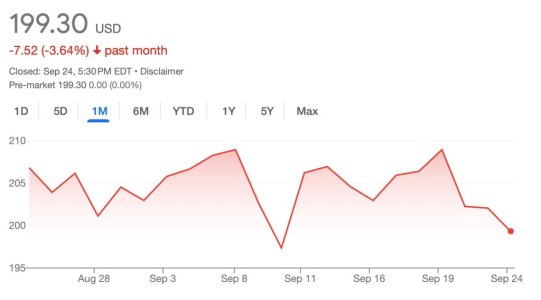
But again, if Nexstar and Sinclair let it get to court, they're dopes. And viewer pressure in their markets is continuing. Sinclair's stock is actually up a little bit, but Nexstar is having a rough week. Their stock spiked when they pre-empted Kimmel (reversing a slide), but they've been losing since ABC announced Kimmel was coming back:

Screenshot 2025-09-25 at 3.50.29 AM.jpeg
 
I think what I've been saying on this subject is that networks aren't as concerned about clearing programs as they are about clearing the spots. One likely way around this, at least for the short term, if for the two companies to just run the spots associated with the shows. If ABC is like most nets, they pre-feed all their spots in a bulk feed and they're available to stations to run as scheduled in the network log.

In the case of Kimmel, there are some program sponsorships that go beyond spots. I'm talking about product placements, segment sponsorships with live billboards, and other promotional materials that run in the show. Those also have to be compensated. That second group of sponsorships are where the real money exists in live daily programming. You see the same thing in GMA, The View, and a lot of the live event specials. It's why those shows are more profitable than scripted dramas or comedy shows.

Excellent point. But even without those elements, clearing the spots without the show has some issues.

There are markets where whatever Nexstar and Sinclair fills the timeslot with would underperform in the ratings compared to Kimmel. Especially in the demo.

The advertisers, buying at a rate assuming 100% clearance, based upon the most recent quarter's nightly average, are now demonstrably overpaying, unless the replacement programming outperforms Kimmel (especially in the demo) sufficiently to offset the underperformance in the other markets.

So relying on that time-honored practice can have a very negative impact for ABC.
 
Status
Not open for further replies.


Back
Top Bottom