
-
Get involved.
We want your input!
Apply for Membership and join the conversations about everything related to broadcasting.
After we receive your registration, a moderator will review it. After your registration is approved, you will be permitted to post.
If you use a disposable or false email address, your registration will be rejected.
After your membership is approved, please take a minute to tell us a little bit about yourself.
https://www.radiodiscussions.com/forums/introduce-yourself.1088/
Thanks in advance and have fun!
RadioDiscussions Administrators
You are using an out of date browser. It may not display this or other websites correctly.
You should upgrade or use an alternative browser.
You should upgrade or use an alternative browser.
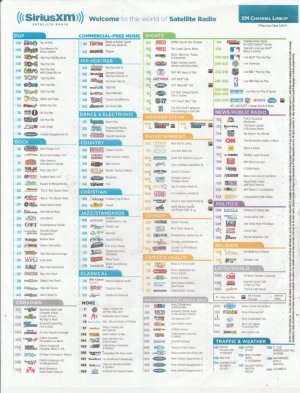
SiriusXM Guide from 2011
- Thread starter Ed Nielson
- Start date


K.M. Richards
Program Director, The Eighties Channel™
Found this lying around. It looks like they still had separate lineups as it says "XM Channels."
It's dated May 4, 2011. That would make it less than three years after the merger.
As I recall, there was a significant period, starting in late 2008, where the channel programming lineups were merged (and therefore identical content and channel names) but the channel numbers were different on both services. I don't think the numbers were standardized across both networks for several years.

Found this lying around. It looks like they still had separate lineups as it says "XM Channels."
Not technically. To this day, there are still separate Sirius and XM lineups to check out from an otherwise merged service.
K.M. Richards
Program Director, The Eighties Channel™
To this day, there are still separate Sirius and XM lineups to check out from an otherwise merged service.
Not having ever been a subscriber to satellite radio, I withdraw that portion of my remarks regarding standardization of channel numbers based on that statement.
What was spice radio.... I hadn't heard of that before. Is that what vivid radio replaced? It wouldn't of been the same as playboy radio why would they need two of those same formats?Found this lying around. It looks like they still had separate lineups as it says "XM Channels."
I think so, but maybe it was the other way around. The same concept: porn stars and porn producers talking about sex.What was spice radio.... I hadn't heard of that before. Is that what vivid radio replaced?

This is especially true with the sports feeds.Not technically. To this day, there are still separate Sirius and XM lineups to check out from an otherwise merged service.

Better back then.
Having only been a subscriber on the legacy Sirius side of things, what are the differences that still exist?Not technically. To this day, there are still separate Sirius and XM lineups to check out from an otherwise merged service.
I don’t believe there is much difference in the channels offered, some numbers might be different.
My ears always found XM’s sound quality a bit better. These days I believe there are more XM radios out there than Sirius.
My ears always found XM’s sound quality a bit better. These days I believe there are more XM radios out there than Sirius.
There used to be college sports conferences carried by Sirius that weren't carried by XM. I've never had Sirius, so I don't know if this is still true. Also, the "diversity" channels mandated under the agreement that allowed SXM government-sanctioned monopoly to happen were different on both services at the outset -- again, no idea if this is still the case, but it definitely was true for some period of time after the merger. On XM radios, those channels are operated by Howard University, the Church of Jesus Christ of Latter-Day Saints (Mormons), and a Korean broadcasting outfit.
One difference that definitely continued after the merger was the presence of Clear Channel-programmed channels on XM radios. That was the result of a quid pro quo deal between CC and XM in return for critical financial support from CC that helped enable XM to launch.
One difference that definitely continued after the merger was the presence of Clear Channel-programmed channels on XM radios. That was the result of a quid pro quo deal between CC and XM in return for critical financial support from CC that helped enable XM to launch.
To be clear the iHeart stations are gone.

Three cities getting about three minutes each, in rotation. And the audio quality was horrendous, especially on busy nights on the sports play-by-play channels. I believe the audio on the traffic channels was fed at a very low bitrate, 2 to 4 kb per second.I'm wondering how the traffic/weather channels with three cities worked. Did they rotate through the cities or use some method (e.g. terrestrial repeaters, spot beams) such that each city only got the relevant feed?
Terrestrial repeaters were prohibited from transmitting localized programming.