• Get involved.
    We want your input!
    Apply for Membership and join the conversations about everything related to broadcasting.

    After we receive your registration, a moderator will review it. After your registration is approved, you will be permitted to post.
    If you use a disposable or false email address, your registration will be rejected.

    After your membership is approved, please take a minute to tell us a little bit about yourself.
    https://www.radiodiscussions.com/forums/introduce-yourself.1088/

    Thanks in advance and have fun!
    RadioDiscussions Administrators

Alabama Public Television may drop PBS programming


Note this is just being considered at the time the article is written. Currently this is being debated among the Alabama Public Television board as of November 2025.

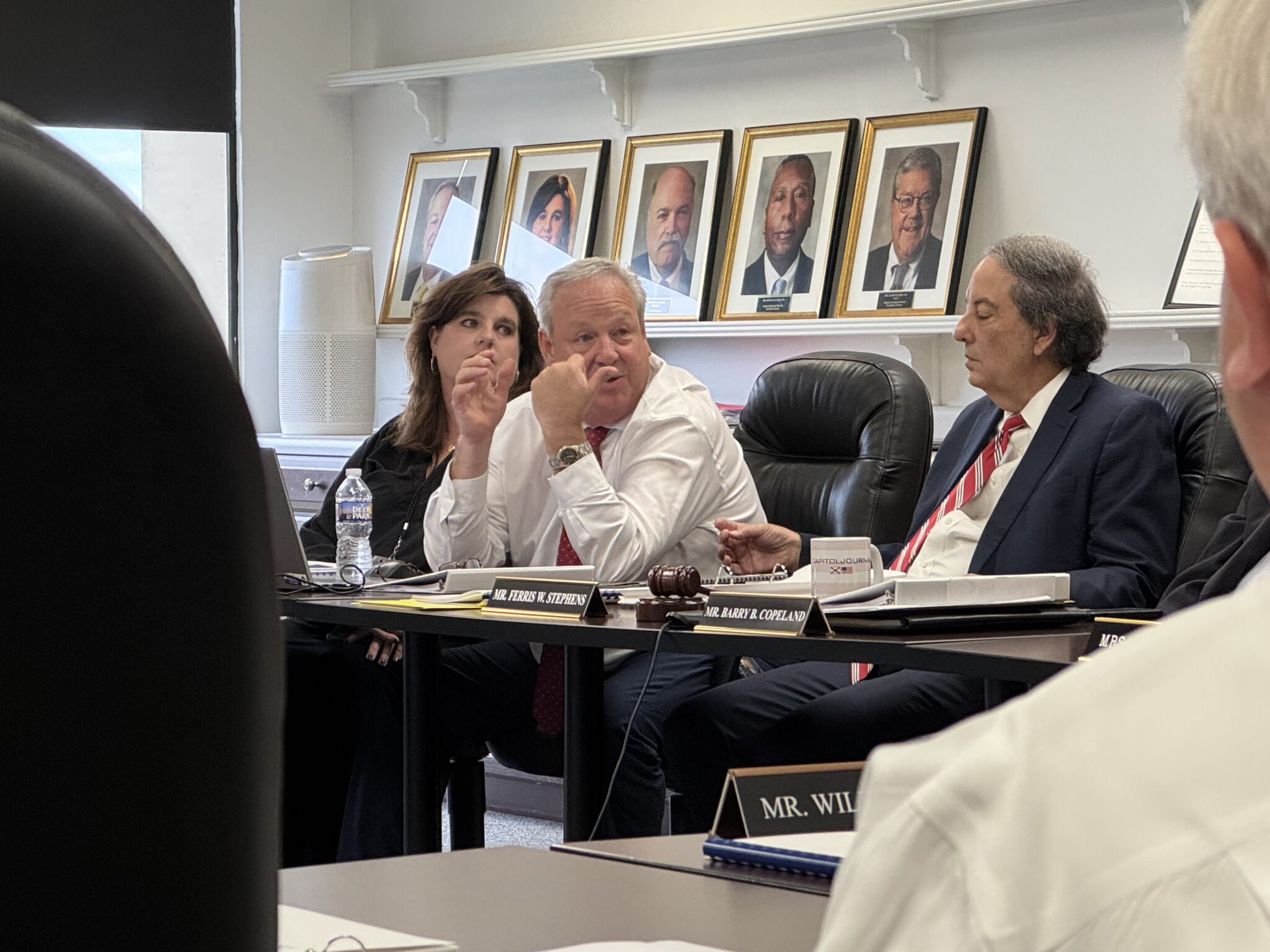
Commissioners at the meeting were split over the proposal. And because APT remains in a contract with PBS and other obstacles, Reid said the split may not happen.
“You’re going to have to redo our websites, redo our media library, because that’s all supported by PBS. Now, the traffic system is really set up for PBS,” Reid told commissioners.

CBP faced a $1.1 billion budget in July after Congress approved House Resolution 4. In 2023, APT reported that it received $2.4 million from CBP.

The budget cuts also meant that APT would have to cut NPR programming for WLRH in Huntsville. While APT has local coverage, NPR and PBS provided national coverage to the network through programs like PBS NewsHour.

Commissioner Bebe Williams said she thought cutting all PBS programming wasn’t the correct move for the network.
 
The article makes it sound like only one commissioner is for dropping PBS. That one commissioner believes the president's talking points. Everyone else knows the reality that PBS presents a lot of children's programming that is free and doesn't require a subscription. Replacing all of that programming is more expensive that continuing to carry PBS. So they have to decide if they want to make a political decision or a financial decision. I've brought up the KCET example many times. The decision to drop PBS essentially destroyed LA's premiere public TV station. If the people in Alabama don't have a plan, the same could happen to them.
 
The article makes it sound like only one commissioner is for dropping PBS. That one commissioner believes the president's talking points. Everyone else knows the reality that PBS presents a lot of children's programming that is free and doesn't require a subscription. Replacing all of that programming is more expensive that continuing to carry PBS. So they have to decide if they want to make a political decision or a financial decision. I've brought up the KCET example many times. The decision to drop PBS essentially destroyed LA's premiere public TV station. If the people in Alabama don't have a plan, the same could happen to them.

The below quote taken from the article tells me everything I need to know about those who are trying to get rid of public radio and television.

"Barnett said funding PBS isn’t something he’s interested in continuing to do.

“Even if the federal Corporation for Public Broadcasting money came back in, I still don’t understand PBS. PBS has made themselves an atma to the President
and a sizable chunk of the state legislature, and probably a sizable chunk of the 65% of people voted for Trump, and I’m one of those people in both categories,”
he said. “I just, I don’t want to fund it, PBS has made themselves the enemy of what I stand with, and so I do not like them, and I don’t follow the philosophy
of feeding the beast.”"
 
So it appears like two out of five commissioners would vote to drop PBS. They obviously weren't listening to the other commissioners. I didn't hear any ideas from the two about how to replace 90% of the programming on the stations. All I heard were the same political talking points. All of Alabama's representatives in congress voted to defund CPB. They did this to themselves. Now they have to figure out what to do next. Too bad they didn't think before they cut the money.

The fact is that all of these stations could have dropped PBS at any time. If it was so politically wrong, then why didn't they drop it years ago? No answer. There was never any requirement that they had to carry PBS in order to receive CPB funding. A lot of stations that receive federal funding don't carry either PBS or NPR. But in the case of APT, they have to figure out how to replace $2.4 million that their own reps cut from their state budget. That's not a political problem. That's a financial problem.
 
PBS has made themselves an atma to the President and a sizable chunk of the state legislature

What's "an atma"?

I'm thinking they meant to say "anathema", and the writer had heard that term and used it correctly, but wasn't familiar with the spelling. It's originally a theological term used to describe something that is condemned or shunned in absolute terms.

I know there was the situation in New Jersey with NJN, and due to OTA coverage of most of the state from WNET and WHYY, they juggled around the PBS schedule, but it would be very, very difficult for a statewide public television network to subsist entirely without PBS. As in many states, the various affiliates of the state public TV network are 100% simulcast, and as a practical matter, can be said to relay the mothership from wherever the broadcast center is located, as in the 600 Cooper Drive facility in Lexington for KET, or the SCETV center near Williams-Brice Stadium in Columbia.
 
it would be very, very difficult for a statewide public television network to subsist entirely without PBS.

Correct. But these people are discussing this in political terms. Not practical terms. The article says they're taking comments from the public, and there will be a vote by the commission on November 18. Hopefully sometime between now & then, they will remind the two members of the committee that this isn't a political decision.
 
If Alabama Public Television relly loses their membership to PBS then who takes over PBS affiliation in the state? Also we have to figure out which PBS stations get to have a superstation status and serve Alabama if thats the case. Yes Superstations are outdated today given where we are with TV apps and PBS itself focusing on the PBS app.

With the former PBS affiliate KCSM-TV San Mateo/ now KPJK-TV Santa Rosa I can understand why they lost their affiliation and its tied to them in the past emphasizing on Telecourse programming from the Annenberg CPB project. But in KCSM's case they had to deal with KQED San Francisco getting the most donations to Public TV in the San Francisco area. For Alabama on the other hand thats not easy to just find an alternate station to get the PBS membership.
 
No one will pick up PBS. I doubt there's enough donor money in the entire state to fund a new PBS affiliate,

Conversely what happens to APT? Not much of a TV station with no programming. The state appropriation is about $5 million. Perhaps that gets cut too. Then what?
 
Conversely what happens to APT? Not much of a TV station with no programming. The state appropriation is about $5 million. Perhaps that gets cut too. Then what?
Would not be surprised to see (perhaps) a local program or two. But with only $5 million to keep the transmitters running, and people employed, that’ll be tough.

Based on the NPR and PBS affiliates dropping programs, don’t be surprised if you get a ton more news/documentaries from BBC, NHK, DW, etc. Whatever it is will have to be free/cheap programming.
 
If Alabama Public Television relly loses their membership to PBS then who takes over PBS affiliation in the state? Also we have to figure out which PBS stations get to have a superstation status and serve Alabama if thats the case. Yes Superstations are outdated today given where we are with TV apps and PBS itself focusing on the PBS app.

If I had to guess, I'd say cable, satellite, and OTT operators would find some way to get GPTV from Georgia into the state. It's close by, and has probably the best resources of any neighboring state's PBS operations. Some viewers on the east side of the state would be able to get them OTA by way of their Warm Springs and Columbus transmitters, but their spillover coverage into neighboring states is quite limited. I cannot get WCES-20 Wrens/Augusta (RF 6) even though I can get other Augusta stations here in Columbia SC. The signal is just not strong enough, part of the reason I got a Televes DATBOSS with a low-VHF add-on was to try and get WCES, but to no avail.

As a kind of side note, does anyone know if Louisiana and Montana PBS are still available in the clear via satellite? They were at one time. But not many people have FTA satellite receivers.
 
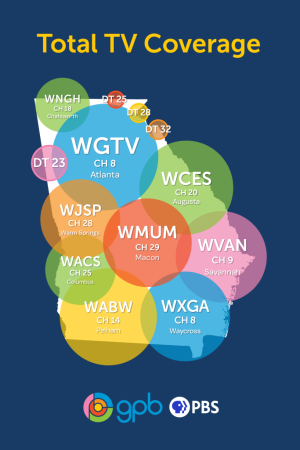
GPB/GPTV has a very tight footprint within Georgia, and its spillover coverage to adjacent states is minimal. They also have a phalanx of translators along the difficult northeastern corner of the state.

1762353199702.png
 
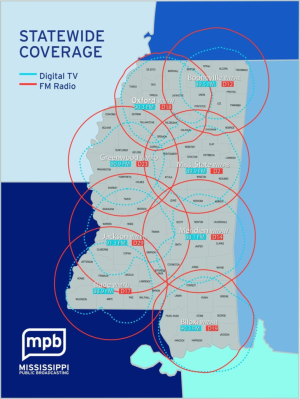
And here's MPB from Mississippi, a similarly tight footprint. It looks as though they flip-flopped the TV and radio signal contours, such that the TV coverage is in red and the FM coverage is in blue, though the legend says the opposite.

1762353457658.png
 
And here's MPB from Mississippi, a similarly tight footprint.

MPB has already announced they're dropping NPR. They will likely do the same to PBS.


You can expect similar actions from other red states, including Georgia.
 
MPB has already announced they're dropping NPR. They will likely do the same to PBS.


You can expect similar actions from other red states, including Georgia.

Georgia is more of a purple state whose legislature has taken to trying to suppress the votes of those who support the opposing party. My guess is that, for the time being at least, GPB, particularly Georgia Public Radio, will not be touched.

One other note of concern. For the most part, the efforts to remove public radio and radio support from state budgets have come from former states of the Confederacy (the group of states that tried to split from the U.S. Federal government prior to the U.S. Civil War back in 1860). I'm saying this because much of public radio programming involves news and talk shows aimed at minorities ("Latino USA," immediately comes to mind, but all of the major news programs have run stories about how blacks and other minorities are affected by Federal and state policies towards them) and many white people in the South very much resent this.
 
One other thing, when the statewide public TV networks were founded, the main purpose in so doing, or at least one of the main purposes, was to provide classroom instruction during the school day for pupils whose schools often lacked the resources to bring in specialized education, indeed, they were often called "[State Name] Educational Television" or something similar. The state networks of Kentucky and South Carolina still bill themselves that way, though in South Carolina, it is shortened to "SCETV", and the Kentucky network simply goes as "KET", I'm not sure if the longer title is ever used anymore in the latter case. With a handful of possible exceptions, public TV stations no longer offer such instructional programming, at least not with any regularity.
 
Last edited:
With Mississippi and Alabama looking to drop PBS, as well as WSRE in Pensacola (Pensacola State College), this will create a vast wasteland of no PBS reach throughout most of Alabama, Mississippi, and the Western Florida Panhandle. Especially affected is the Mobile-Pensacola area which could go from having up to 3 PBS stations, to zero as a result of these changes.

APT keeping PBS is almost a necessity to fill in the gaps caused by Mississippi and WSRE dropping them.


Back
Top Bottom