
• Get involved.
    We want your input!
    Apply for Membership and join the conversations about everything related to broadcasting.

    After we receive your registration, a moderator will review it. After your registration is approved, you will be permitted to post.
    If you use a disposable or false email address, your registration will be rejected.

    After your membership is approved, please take a minute to tell us a little bit about yourself.
    https://www.radiodiscussions.com/forums/introduce-yourself.1088/

    Thanks in advance and have fun!
    RadioDiscussions Administrators

Books About Classic TV

About Television by Martin Mayer provides an insightful look of the television industry in 1972. Topics that get extended treatment include small-market television (with KAYS in Hays, Kansas, and Channel TV in the British Channel Islands serving as case studies), the sale of ad time, the Today Show, PBS and the opportunities its creators had missed, children's television (with an in-depth look at Sesame Street and Saturday morning cartoons), local news at WCCO in the Twin Cities, sports, the emerging cable TV industry in Canada and the U.S., the network news (in the U.S., with France as an overseas example), and so on.
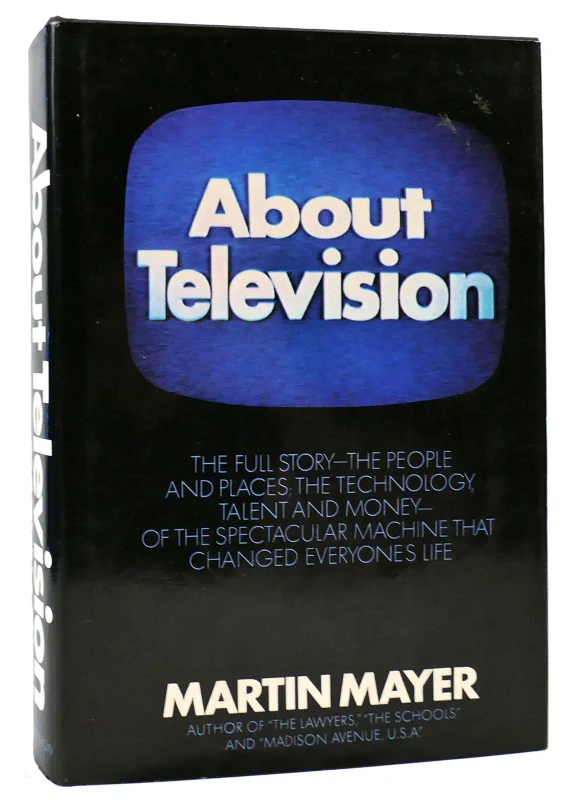
 
About Television by Martin Mayer provides an insightful look of the television industry in 1972. Topics that get extended treatment include small-market television (with KAYS in Hays, Kansas, and Channel TV in the British Channel Islands serving as case studies), the sale of ad time, the Today Show, PBS and the opportunities its creators had missed, children's television (with an in-depth look at Sesame Street and Saturday morning cartoons), local news at WCCO in the Twin Cities, sports, the emerging cable TV industry in Canada and the U.S., the network news (in the U.S., with France as an overseas example), and so on.
I'll also note that this book uses WTOG in Tampa/St Petersburg as a case study -- in essence, the author picked WTOG as being the exact opposite of KAYS and Channel TV. KAYS and Channel TV were highly focused on localized programming, whereas WTOG pretty much just fed syndicated product to its audience all day long. That made sense, because while KAYS and Channel TV were the only options to provide local coverage, WTOG had 2 1/2 VHF competitors that provided local news to the area (the half station was the ABC affiliate in Largo, described as a "crippled" VHF station).
 
I recently just picked this one up. Outfoxed by Alex Ben Block details the history of the Fox network up until 1990 when the book was published. My copy has both the front and back covers ripped off. Sorry about that but they had about bad it and looked ready to be ripped.


Back
Top Bottom