No worse feeling than having a used car on a payment plan start showing its age so soon after leaving the lot. I had a similar situation with an '82 Mustang many years ago. It was five or six years old, ran fine on the test drive, but I was too young and dumb to take it to a trusted mechanic for a once-over before signing the papers. It developed an overheating problem within six months, one that no garage ever found a lasting fix for. Wound up sinking a lot more money into it than I'd ever expected to, and traded it in well before the final payment. Good luck with your next vehicle.I am financing a 2018 Buick Encore. The FM reception is excellent. It is close to my TEF6686 on sensitivity. KHTR-104.3 Pullman and KCMB-104.7 La Grande OR are common catches here in the western neighborhoods of Yakima. KIRO-97.3 Seattle/Tacoma is in all day, weak but audible, at 89 miles over a multitude of mountains.
AM is decent, but it is noisy on several frequencies, and the sensitivity drops like a rock after 1200khz or so. Any way I could possibly fix this? I barely get anything outside of locals between 1300-1500 khz, even at night. Yet KRVN-880, KTNN-660, CBW-990, a weak WHO-1040, and several others have been heard on the car radio. My 2007 Hyundai Elantra with a Pioneer Supertuner III had a very sensitive AM radio and could easily pull in SK/MB on AM at night, plus KSTP-1500 and even WBBM Chicago floating under KKOH.
However, it may be a moot point. The car has given me problem after problem since I signed the lease. It is in the shop with a belt issue, which resulted in overheating. I am disappointed in this vehicle...after only 1500 miles.

-
Get involved.
We want your input!
Apply for Membership and join the conversations about everything related to broadcasting.
After we receive your registration, a moderator will review it. After your registration is approved, you will be permitted to post.
If you use a disposable or false email address, your registration will be rejected.
After your membership is approved, please take a minute to tell us a little bit about yourself.
https://www.radiodiscussions.com/forums/introduce-yourself.1088/
Thanks in advance and have fun!
RadioDiscussions Administrators
You are using an out of date browser. It may not display this or other websites correctly.
You should upgrade or use an alternative browser.
You should upgrade or use an alternative browser.
Today's Radio Reception in the Car: Problematic
- Thread starter tylerSC
- Start date
That's what I assumed. When Sirius/XM first began, it was believed people would have to have dishes on their vehicles.The shark fin antenna on the roof is used for satellite, not AM/FM.

I am financing a 2018 Buick Encore. The FM reception is excellent. It is close to my TEF6686 on sensitivity...
My 2007 Hyundai Elantra with a Pioneer Supertuner III had a very sensitive AM radio and could easily pull in SK/MB on AM at night, plus KSTP-1500 and even WBBM Chicago floating under KKOH.
I have a Pioneer AVIC system in a vehicle with a 30-inch rod antenna and the reception is excellent. It uses a TEF6688 tuner chip (HD Radio version of the TEF6686), but it's still not as sensitive as the Pioneer Supertuner IV I had in a previous vehicle. Those Pioneer Supertuners were fantastic.

Irving is a Dallas suburb. In fact, the market is “Dallas Ft Worth”.Most of those cities I have not visited and therefore I can't comment on them. I visited Dallas once for a blind convention back in 1986, but I stayed inside a hotel in Irving (by the airport) and never got to visit the Dallas suburbs to see how well FM radio did there.
Again, northern VA is part of the DC market.I did visit Atlanta once (my late uncle lived in Dunwoody) and noted that the FMs did a lot better at covering the market than the AMs. I visited Washington, D.C. once and stayed at a hotel over the border in 1981. While the D.C. stations made it to our hotel okay, Baltimore stations could be heard in the background on both AM and FM, and, interestingly, the station licensed to Bethesda, MD, had a hard time getting into the D.C. market.
The LA market includes all of Los Angeles and Orange counties. Many of the stations licensed within the market have trouble reaching the high desert and southern Orange County. This is because the market is geographically very large. A similar situation exists in the New York City market were essentially none of the stations licensed to New York City. Make it all the way out to eastern Long Island. Again, a market that has geographic extremes that exceed the potential of any signalIn the Los Angeles area where I was born and partially raised, while the local FM outlets could be heard inside the city and the San Fernando and San Gabriel valleys pretty well, they had a hard time penetrating the Santa Monica mountains between Hollywood and the valley and then the mountains between Burbank and Pasadena, specifically Sunland and Tujunga where I lived at the time. And that is why I would say that the L.A. FM stations didn't cover the entire L.A. market very well.
One of the issues Coverage of FM stations in San Diego is the need to coordinate the usage of frequencies and channels with Mexico. In particular, the next adjacent channel protections required in observance of all the Tijuana FM stations make transmitter site choices harder for those FM’s on the American side.?I would also say the same thing about the San Diego stations. While it's true that the FM outlets (mostly) covered the city fairly well, they had a harder time, depending on atmospheric conditions, covering the inland valley (El Cajon and eastward) as well as northern county towns like Encinitas where two of my mom's sisters lived. And there were parts of downtown San Diego where some stations, depending on the location of their transmitters, did wind up being somewhat fuzzy.
My fault. I should have said that I was staying at a hotel on the Maryland side of the border.Again, northern VA is part of the DC market.
Last edited by a moderator:
This Thanksgiving Day, I rode with my sister in her 2019 Dodge minivan to my cousin's house in Beardsley (it's a northern Phoenix suburb). We first went to pick up her eldest son who lives around 7th Street and Van Buren which is close to downtown. After picking him up,we took the I-10 through the Phoenix tunnel and then headed north on I-17.
During the time we picked my nephew up, my sister had the car radio on KESZ-FM which was playing Christmas music. We lost that signal briefly going through the tunnel then regained it just before we left. Then my sister turned the station to KSLX which was playing Arlo Guthrie's classic (and somewhat outdated) "Alice's Restaurant," (the full-length original) and we listened to that for 15 minutes.
When the song was over, at my suggestion, my sister switched the radio to KGME-AM so we could hear the Dallas-Kansas City football game. (She doesn't have HD on her car radio.) We rode the signal all the way into Beardsley and to my cousin's without incident.
Later this evening, about three hours after the sun went down, we returned home. KGME-AM was under night power now but there was no interference--not even when we wdrove through the Phoenix tunnel again to take my eldest nephew home. KGME sounded like a champ as it broadcast for us Westwood One's calls of the Cincinnati-Baltimore game. The sound on that radio was quite clear and not muffled like many AM radios I have heard recently. Also, the car had a whip antenna in front of the passenger door which I think helped greatly with the AM reception. I didn't get a chance to try distance reception but I'm willing to bet that it was close to the distance reception of some of the previous vehicles we've owned.
What I'm trying to say here is that there are some cars still on the road today that have good AM radios with good reception and decent sound. It's too bad that more of today's automobiles don't have car radios that have AM reception like that in my sister's Dodge minivan.
During the time we picked my nephew up, my sister had the car radio on KESZ-FM which was playing Christmas music. We lost that signal briefly going through the tunnel then regained it just before we left. Then my sister turned the station to KSLX which was playing Arlo Guthrie's classic (and somewhat outdated) "Alice's Restaurant," (the full-length original) and we listened to that for 15 minutes.
When the song was over, at my suggestion, my sister switched the radio to KGME-AM so we could hear the Dallas-Kansas City football game. (She doesn't have HD on her car radio.) We rode the signal all the way into Beardsley and to my cousin's without incident.
Later this evening, about three hours after the sun went down, we returned home. KGME-AM was under night power now but there was no interference--not even when we wdrove through the Phoenix tunnel again to take my eldest nephew home. KGME sounded like a champ as it broadcast for us Westwood One's calls of the Cincinnati-Baltimore game. The sound on that radio was quite clear and not muffled like many AM radios I have heard recently. Also, the car had a whip antenna in front of the passenger door which I think helped greatly with the AM reception. I didn't get a chance to try distance reception but I'm willing to bet that it was close to the distance reception of some of the previous vehicles we've owned.
What I'm trying to say here is that there are some cars still on the road today that have good AM radios with good reception and decent sound. It's too bad that more of today's automobiles don't have car radios that have AM reception like that in my sister's Dodge minivan.
And the surrounding counties in Maryland are also part of the Washington, D.C., radio market.My fault. I should have said that I was staying at a hotel on the Maryland side of the border.
The market maps are at ARBITRON NIESEN Market Maps - Methodlogy - Market Data And that brings up a question of how you are able to "view" maps. (I have a daughter who is deaf, so am used to finding out the methods used to compensate).
And the surrounding counties in Maryland are also part of the Washington, D.C., radio market.
The market maps are at ARBITRON NIESEN Market Maps - Methodlogy - Market Data And that brings up a question of how you are able to "view" maps. (I have a daughter who is deaf, so am used to finding out the methods used to compensate).
On the computer? I don't! Most maps are graphics and screenreaders are unable to display them, not even with a braille display (and I am fortunate enough to have one of those). Sometimes, written descriptions are provided as to what might be on the maps but usually they tell you that certain things are in certain colors to indicate short or long distances, etc. World Radio Map does this for some of the cities it provides station listings for.
That said, here is one area that I use Radio-Locator.com for. When you look up a city or town, the site gives you a distance rating for each radio station it features in that location. The ratings are from 1-5 with 1 being the weakest signals and 5 being the strongest. In addition, the site gives the location's lattitude and longitude and there is a way to write in a specific lattitude and longitude to have stations listed that you could hear from that location. What I used to do (I don't do it as much anymore) is that I would find a list of interstate highways with the names of cities they passed by or through through Wikipedia and another Internet source which is now no more. Then I would list my starting coordinates on the Radio-locator site, then use my brain to figure where the highway would be if it went in a straight line from the my original coordinates to the coordinates I was seeking and I would slowly move (usually four or five places in the middle number on the lattitude and longitude scales) at a time until I reached my destination. All along the way I would check to see what radio stations was showing was available at those locations.
Now, you might argue that radio-locator.com wasn't always accurate and I would counter that that observation was true, especially in coastal areas. However, it was accurate enough for my purposes--I got to learn how various cities and towns were related directionally to each other in the U.S., and that has given me an edge when family and friends talk about some small town and I can give them a pretty educated guess of its location in relationship to bigger towns in its area.
As I think I've noted before, radio-locator.com despite its flaws, has been a godsend for me and I have now (hopefully) explained one of the reasons why.
I find radio-locator even more unreliable for its signal strength "meters" than for its coverage maps. Some stations that it ranks 2 pound in like locals here, including a translator; others are marginal. In fact, WJJR Rutland, VT, has been lost to my area for months due to a transmitter site change. Radio-locator still has it as a 2, the same rating that WHOM Mount Washington, NH, gets with its powerhouse signal that's easily a 3 or even a 4 here. I appreciate what radio-locator is trying to do, but at the end of the day, it's a hobbyist, amateur operation pretending to be authoritative -- which is disgustingly easy to do on the internet, where everyone can be a publisher.
I just changed from a Toyota with a shark fin to a Hyundai with a stubby little black roof antenna, and the reception in the Hyundai is way better, including on AM for what that's worth. The Toyota was "deaf" while on the test drive, the Hyundai was pulling in FM and DAB stations from 100+ miles away including Ireland (from the UK).Kev, I wish that was the case with our cars! Both of them exclusively use the shark fin for AM/FM/Sirius. The VW head unit has excellent FM/HD FM reception, the AM not so much. The Toyota is just absolutely terrible on all bands, but being my wife's car she doesn;t care- she is all about podcasts anyway.
I find radio-locator even more unreliable for its signal strength "meters" than for its coverage maps. Some stations that it ranks 2 pound in like locals here, including a translator; others are marginal. In fact, WJJR Rutland, VT, has been lost to my area for months due to a transmitter site change. Radio-locator still has it as a 2, the same rating that WHOM Mount Washington, NH, gets with its powerhouse signal that's easily a 3 or even a 4 here. I appreciate what radio-locator is trying to do, but at the end of the day, it's a hobbyist, amateur operation pretending to be authoritative -- which is disgustingly easy to do on the internet, where everyone can be a publisher.
@CTListener:
Please view this from my perspective. I can't read the maps provided by @Michi or even from Radio-locator. That is beyond the capabilities of my screenreader or the available screenreaders on the market today. Radio-locator's numbering system, as flawed as it is, is still the only game in town for me.
I understand, and most likely the signal-strength readings for relatively flat terrain like that of southeastern California and southwestern Arizona are pretty accurate, especially when compared to northern New England's, where mountains, hills and valleys make FM reception an adventure. I can drive a couple of miles up or down US 5 and pick up or lose some stations I can or cannot receive from home on my car radio as I do so. The effect is even more pronounced on US 4, one of the east-west routes through the mountainous spine of Vermont.@CTListener:
Please view this from my perspective. I can't read the maps provided by @Michi or even from Radio-locator. That is beyond the capabilities of my screenreader or the available screenreaders on the market today. Radio-locator's numbering system, as flawed as it is, is still the only game in town for me.

The best AM radio I ever had came out of my '65 Corvair. It was a Delco and when I junked the car I kept the radio for use in my workshop. It still works.What I'm trying to say here is that there are some cars still on the road today that have good AM radios with good reception and decent sound. It's too bad that more of today's automobiles don't have car radios that have AM reception like that in my sister's Dodge minivan.
The display on the AM section of my Hyundai is adorable. Are they all like this, or is this a European thing?
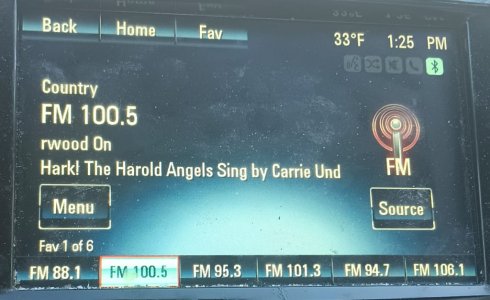
I've had two cars this year. I'll leave it to you to rate their radios' adorability. First, my current car, a Volkswagen, then my previous car, a Chevrolet. Note the creative spelling of the Carrie Underwood Christmas song on the Chevy radio:The display on the AM section of my Hyundai is adorable. Are they all like this, or is this a European thing?View attachment 10914
Attachments

Thank you for the explanation.As I think I've noted before, radio-locator.com despite its flaws, has been a godsend for me and I have now (hopefully) explained one of the reasons why.
I looked through my Nielsen "stuff" and could not find a listing of radio market county composition other than the map.
If any of the readers of this thread have such a thing or have a link to a text based county listing, you might provide it or a link to it here for Ted's use.
In the meantime, Ted, if you need the list of counties in a market, please email me and I will respond with a list: [email protected]
I realised after I posted this that Ted wouldn't be able to 'read' it - the description of the image is as follows: the AM radio screen in the 2025 Hyundai i10, which shows the AM frequency as a set of Nixie tubes or valves, glowing with the numbers. In this case, it's 648 kHz.The display on the AM section of my Hyundai is adorable. Are they all like this, or is this a European thing?View attachment 10914
As an aside, I've not yet figured out how to tune it to a specific frequency on FM yet. As you drive around, there's a live list of available stations on DAB+ and FM that updates as you move, but I can't find out how to tune to, say, 106.9 FM specifically if I know that's what I want to listen to. The car only has 10 miles on it, and only one of those is me going to get gas, so I'm sure I'll figure it out - I'm not a mega miles driver nowadays, hence the i10!

This list from 2023 is the Top 50 market counties from @Michi's site:Thank you for the explanation.
I looked through my Nielsen "stuff" and could not find a listing of radio market county composition other than the map.
If any of the readers of this thread have such a thing or have a link to a text based county listing, you might provide it or a link to it here for Ted's use.
In the meantime, Ted, if you need the list of counties in a market, please email me and I will respond with a list: [email protected]
Thank you for the explanation.
I looked through my Nielsen "stuff" and could not find a listing of radio market county composition other than the map.
If any of the readers of this thread have such a thing or have a link to a text based county listing, you might provide it or a link to it here for Ted's use.
In the meantime, Ted, if you need the list of counties in a market, please email me and I will respond with a list: [email protected]
@davideduardo:
Thank you for the thoughtful reply. Here, I'll answer you about another site I sometimes use if I wish to look at stations by market, though (as you will see) it doesn't necessarily list the counties in a given market, and, if a radio station's signal crosses more than one county line, the site's editor (Thomas C. Hokenson is his name) picks the market area he believes the station is supposed to primarily serve. The site is
and here is the North American page from that site:
Radio Stations, Radio Broadcasting in North America | RadioStationWorld
Radio Broadcasting in North America: USA, Canada, Mexico, Central America, Caribbean
radiostationworld.com
At the bottom of the page (at least using the JAWS screenreader; it may appear elsewhere on the site on other computers) are links to individual U.S. states and Canadian provinces. Clicking on each of them will bring up a list of markets in each state/province. For example (because I know you live there and can set me straight about anything the site gets wrong here), here is the link to the state of California:
At one time, the site was known as tvradioworld.com, and the major market listings were the major markets for TV stations. Also, because each radio station is listed only once, if its signal crosses over market boundaries, say from Los Angeles to Orange County, that station is listed *only* in the Los Angeles market. (The Orange County and Pasadena listings feature FM stations and translators that (mostly) cannot be heard outside of those two counties.) The final note I will make here is that while radio-locator.com does add FCC changes pretty quickly after they are listed, radiostationworld.com does not, meaning that some changed callsigns and newer FM allocations may not be listed. Still, all-in-all, unless you indicate otherwise, I think radiostationworld.com is a useful place to look if I wish to know about radio station markets.