A number of 5-7 teams are in some of those Disney bowl games due to insufficient teams meeting the six-victory (all FBS) minimum. If more schools snubbed by the CFP decide to boycott bowls altogether, could we someday see a 4-8 team meeting a 6-6, or even a 5-7, team in a bowl game? And who, besides gamblers and a smattering of alumni, would watch?

-
Get involved.
We want your input!
Apply for Membership and join the conversations about everything related to broadcasting.
After we receive your registration, a moderator will review it. After your registration is approved, you will be permitted to post.
If you use a disposable or false email address, your registration will be rejected.
After your membership is approved, please take a minute to tell us a little bit about yourself.
https://www.radiodiscussions.com/forums/introduce-yourself.1088/
Thanks in advance and have fun!
RadioDiscussions Administrators
You are using an out of date browser. It may not display this or other websites correctly.
You should upgrade or use an alternative browser.
You should upgrade or use an alternative browser.
2026 prediction thread.
- Thread starter tall_guy1
- Start date
I will hold out hope that Comcast will finally decide to clean up their lineups and announce that 2026 will finally be the year that all SD channels (basically decompressed versions of the HD channels) will be dropped finally (at least on anything above "Limited Basic" or not on Legacy, i.e., 2-99, channel numbers. Perhaps international channels exempt too for now). Doing something that should have been done in 2016. Plus dropping all "legacy" three-digit or lower channels (perhaps with exceptions for "limited basic" and international channels) and going entirely on the 4-digit National Channel Lineup.
5 and even 6-digit channels will start appearing on some areas' Comcast TV listings.
Comcast will also experiment with at least one major headend going all-X1/IPTV only.
Several more companies with traditional cable lineups will drop their video services in favor of all-streaming, or at least all streaming but only offer a "lifeline" package of the local channels and basic shopping, religious, only. And that's it. At least one major company (e.g, Mediacom, Comcast) will experiment with dropping all but local channels on their traditional cable lineups in favor of pushing all streaming-HDTV.
More hotels--and at least one of the major chains--will drop traditional cable and satellite services in their rooms in favor of streaming only. Or at least keep the basic local channels for that market while streaming everything else.
5 and even 6-digit channels will start appearing on some areas' Comcast TV listings.
Comcast will also experiment with at least one major headend going all-X1/IPTV only.
Several more companies with traditional cable lineups will drop their video services in favor of all-streaming, or at least all streaming but only offer a "lifeline" package of the local channels and basic shopping, religious, only. And that's it. At least one major company (e.g, Mediacom, Comcast) will experiment with dropping all but local channels on their traditional cable lineups in favor of pushing all streaming-HDTV.
More hotels--and at least one of the major chains--will drop traditional cable and satellite services in their rooms in favor of streaming only. Or at least keep the basic local channels for that market while streaming everything else.
That's been a problem for years. Even if there are no changes to the CFP next year, the lowest-tier bowls have to go. There's no need whatsoever to have bowl games before Christmas. Trouble is, Disney owns most if not all of them.A number of 5-7 teams are in some of those Disney bowl games due to insufficient teams meeting the six-victory (all FBS) minimum. If more schools snubbed by the CFP decide to boycott bowls altogether, could we someday see a 4-8 team meeting a 6-6, or even a 5-7, team in a bowl game?
NFL scouts. You never know where the next generation of players and coaches will come from. They're not all from the top schools.And who, besides gamblers and a smattering of alumni, would watch?
Aren't most of those scouts -- at least the ones scouting players from the participating schools -- at the games rather than watching them on TV? And how many thousand scouts does the NFL have, anyway? It would have to be thousands to move the Nielsen meter.NFL scouts. You never know where the next generation of players and coaches will come from. They're not all from the top schools.
Yes. They wouldn't help the TV ratings, but they are a reason for these minor bowls to exist in the first place, regardless of who owns them.Aren't most of those scouts -- at least the ones scouting players from the participating schools -- at the games rather than watching them on TV? And how many thousand scouts does the NFL have, anyway? It would have to be thousands to move the Nielsen meter.

K.M. Richards
Program Director, The Eighties Channel™
If PBS is smart all they need is one TV station per market not have 2-3 PBS stations per city.
Fewer stations means fewer subscription fees, means less money for programming. Did you consider that?
There are, indeed, more PBS stations than there need to be, this situation created in large part by mandates to cover an entire state (in the case of state public TV networks), even when portions of that state border areas with PBS stations of their own. The Charlotte market has three PBS stations (WUNG/PBS NC, WTVI which is local to Charlotte and not part of that network, and WNSC/SCETV in Rock Hill), and the Cincinnati market has three as well, WCET, WPTO "Think TV", and WCVN Covington (KET). I have to wonder how much of WUNG and WNSC, or WCET and WCVN, is sheer duplication, in that all of these except WCET are parts of state networks which aren't going to be concerned with whether they are duplicating something from an adjacent state.PBS loses more member stations such as WSBE 36 PBS Rhode Island, WLIW 21 (basically WNET 2) and WGBX 44 due to budget cuts and WGBH 2 covers both the Boston and Providence, RI areas OTA. If PBS is smart all they need is one TV station per market not have 2-3 PBS stations per city.

True and some of the situations where a certain TV market has two or more channels with PBS affiliations were a carryover from the past when "Instructional Television" from AIT, TVO Ontario and Annenberg Learner were at one point producing educational content to PBS affiliates. However the market showed that the viewers turn to PBS for news content and the instructional content went to the schools themselves. Another factor was the primary PBS affiliate represented the majority of Public Media donations for that specific TV market and it resulted in secondary or instructional PBS affiliates losing their PBS affiliation.There are, indeed, more PBS stations than there need to be, this situation created in large part by mandates to cover an entire state (in the case of state public TV networks), even when portions of that state border areas with PBS stations of their own. The Charlotte market has three PBS stations (WUNG/PBS NC, WTVI which is local to Charlotte and not part of that network, and WNSC/SCETV in Rock Hill), and the Cincinnati market has three as well, WCET, WPTO "Think TV", and WCVN Covington (KET). I have to wonder how much of WUNG and WNSC, or WCET and WCVN, is sheer duplication, in that all of these except WCET are parts of state networks which aren't going to be concerned with whether they are duplicating something from an adjacent state.
In markets where the main PBS affiliate produces much of its programming, a second outlet is needed to clear other shows. That's why Boston, home of the prolific WGBH, also has WGBX. But with the demise of the CPB and accompanying funding cuts, no station is doing as much of its own production as it used to, especially in markets outside the top 10. Neither Vermont nor New Hampshire would ever need another station, as their sole stations produce very few shows of their own and can schedule just about everything PBS sends down the pipe on one channel.
Daytime instructional television aimed at schools is just about extinct. We have far more efficient methods now, such as the plethora of instructional videos available online on demand, such that pupils have no need of watching a scheduled show at a specific time in the classroom. At one time, part of the reason for "educational TV" in the first place was to provide standardized learning opportunities for all children, often across an entire state as was the case with Kentucky and KET. KET was huge on providing Kentucky-themed educational programming (history, civics, etc.), to instill a sense of state pride and awareness of "being a Kentuckian", as large portions of the state were out of the reach of in-state OTA television at that time. Youngsters in eastern Kentucky were more likely to know who the governor of West Virginia was, than the governor of Kentucky. Providing specialized instruction in subjects for which local school districts didn't have the resources was also a factor.True and some of the situations where a certain TV market has two or more channels with PBS affiliations were a carryover from the past when "Instructional Television" from AIT, TVO Ontario and Annenberg Learner were at one point producing educational content to PBS affiliates. However the market showed that the viewers turn to PBS for news content and the instructional content went to the schools themselves. Another factor was the primary PBS affiliate represented the majority of Public Media donations for that specific TV market and it resulted in secondary or instructional PBS affiliates losing their PBS affiliation.
Many schools like mine would tape the programs off the local PBS station that would air in the early afternoon or overnight hours and keep copies in their library.
K.M. Richards
Program Director, The Eighties Channel™
Many schools like mine would tape the programs off the local PBS station that would air in the early afternoon or overnight hours and keep copies in their library.
I know that a lot of school districts did that when such programming was more ubiquitous, going back as far as 1971, if you can believe it ...
Many schools like mine would tape the programs off the local PBS station that would air in the early afternoon or overnight hours and keep copies in their library.
VCRs didn't exist when I was in grade school. You either watched the show when it was on, or not at all. That was late 1960s and early 1970s.
K.M. Richards
Program Director, The Eighties Channel™
VCRs didn't exist when I was in grade school. You either watched the show when it was on, or not at all. That was late 1960s and early 1970s.
This was on ½" reel to reel video tape.
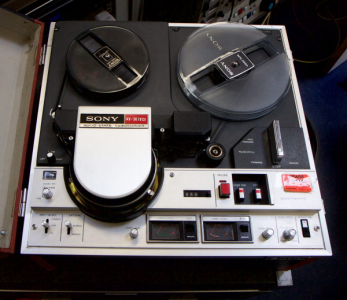
We didn't have one of those either. We weren't that fancy.
K.M. Richards
Program Director, The Eighties Channel™
We didn't have one of those either. We weren't that fancy.
Guess my school district had decent funding. We started with two VTRs like the one pictured, each on a rolling rack with a television monitor bolted to the upper platform, and also had a vidicon-tube camera for original productions. This was at one of the junior high schools.
The second year, they converted one classroom to a studio, control room, and back room/tape library to feed four playback-only machines on VHF channels 7, 9, 11 and 13 via cable strung to every classroom, with several portable TVs on rolling carts moved to various classrooms as requested by faculty.
The fourth year, they similarly converted a classroom at one of the two senior high schools and established playback facilities via cable on that campus, the second high school, and the other three junior highs. At that point, local production was taking place at both studios.
A year or two later, the district got a dedicated channel on the cable system and programmed it based on district-wide needs. This was all in monochrome, obviously.

There are some precedents for bringing PBS programming to unserved markets that haven't been considered here.
In southwestern Virginia, after Blue Ridge PBS sold the spectrum it was using for OTA service in Norton (WSBN) and Marion (WMSY), it started a "PBS Appalachia Virginia" service that's considered a separate station even though it's available only on cable and streaming.
Down in Texas, after the PBS station in Brownsville was sold and went commercial, PBS arranged to put its national feed on the 21.4 subchannel of the market's CW station.
I wouldn't be surprised if some sort of similar arrangement ends up being made in all or some of the markets in Arkansas that are losing what had been "PBS Arkansas."
And in the meantime, though it won't be a linear streaming service, anyone who donates to any other PBS station and gets a password for Passport can still stream massive amounts of on-demand PBS contact into Arkansas. Their member dollars just won't stay within the state.
In southwestern Virginia, after Blue Ridge PBS sold the spectrum it was using for OTA service in Norton (WSBN) and Marion (WMSY), it started a "PBS Appalachia Virginia" service that's considered a separate station even though it's available only on cable and streaming.
Down in Texas, after the PBS station in Brownsville was sold and went commercial, PBS arranged to put its national feed on the 21.4 subchannel of the market's CW station.
I wouldn't be surprised if some sort of similar arrangement ends up being made in all or some of the markets in Arkansas that are losing what had been "PBS Arkansas."
And in the meantime, though it won't be a linear streaming service, anyone who donates to any other PBS station and gets a password for Passport can still stream massive amounts of on-demand PBS contact into Arkansas. Their member dollars just won't stay within the state.
I've wondered if PBS Appalachia Virginia could be carried on one of WCYB's subchannels, and even whether WCYB could get some kind of tax break for doing this, as they are licensed to Bristol, Virginia (the comma is often omitted in local print news coverage).In southwestern Virginia, after Blue Ridge PBS sold the spectrum it was using for OTA service in Norton (WSBN) and Marion (WMSY), it started a "PBS Appalachia Virginia" service that's considered a separate station even though it's available only on cable and streaming.
Something such as that would be an excellent solution. I wonder if, given the circumstances, PBS could also deliver their national feed to cable and other non-OTA providers in those parts of Arkansas which don't have an in-market PBS station from out of state.Down in Texas, after the PBS station in Brownsville was sold and went commercial, PBS arranged to put its national feed on the 21.4 subchannel of the market's CW station.