• Get involved.
    We want your input!
    Apply for Membership and join the conversations about everything related to broadcasting.

    After we receive your registration, a moderator will review it. After your registration is approved, you will be permitted to post.
    If you use a disposable or false email address, your registration will be rejected.

    After your membership is approved, please take a minute to tell us a little bit about yourself.
    https://www.radiodiscussions.com/forums/introduce-yourself.1088/

    Thanks in advance and have fun!
    RadioDiscussions Administrators

560

I had a feeling you might pop in to tell me that.

Next, you'll tell me it's in regular rotation, and not a Forgotten 45. Lol

Okay, I'll tell you. It's a secondary rotation title. Pretty much any 80's songs that are above 400 are going to be there if they aren't powers.

F45's tend to have four digits in their ranking.
 
KFRC has been “revived” at least three times, with diminishing returns each time. Bill Drake left RKO 53 years ago next May. Anyone with any nostalgia for that would be over 65, and if you’re talking about the “original” Big 610 sound, you’re going back 60 years and talking about an audience in its 70s and older.

There’s no market for it and even those people have (largely) left AM radio in the Bay Area.
Why can it work in Fresno and not San Francisco?

I've felt for a number of years now that radio in SF is verging on dead, given how mediocre and over processed/over-Voltaire'd most stations have become over the past ~10 years.

With the tremendous change in SF from the early 70s to present, I'd wager many of the folks who might have nostalgia for the early 70s have largely left the Bay Area itself.
I suspect you're right there. The bulk of the 35-54 demo in SF is composed of tech executives and their underlings, very few of whom care for anything other than whatever the latest pop is. A very fickle and picky audience, for sure.

Of course, I say this while knowing almost nothing about the subject (beyond what I've learned since joining here), so take it with a truckload of salt.

c
 
Because the owner can afford to run the station at a loss and he apparently gets a kick out of playing Oldies using the heritage top-40 calls for the market.
Fair enough.

Since an OTA AM or FM signal wouldn't be practical, then maybe this hypothetical "Big 610" KFRC revival could be at least minimally successful as a stream?

Audacy did have a form of Classic Hits KFRC (using imaging from the mid-late 70s) running as both a stream and an HD2 on 106.9. Of course, it disappeared when they shut off the HD2.

c
 
With the tremendous change in SF from the early 70s to present, I'd wager many of the folks who might have nostalgia for the early 70s have largely left the Bay Area itself.
That's logical, but I also know a lot of people who are Bay Area lifers.
And there, my friends, is the essential essence of this argument. Those "lifers" are increasingly pushing up daisies poppies in Colma with each passing year.
 
Since an OTA AM or FM signal wouldn't be practical, then maybe this hypothetical "Big 610" KFRC revival could be at least minimally successful as a stream?

Audacy did have a form of Classic Hits KFRC (using imaging from the mid-late 70s) running as both a stream and an HD2 on 106.9. Of course, it disappeared when they shut off the HD2.
They actually did a nice job recreating the sound and feel of the late '70s KFRC. Unfortunately, once they launched it, they locked it into amber and it never evolved. The same music, same liners, same jingle package, nothing ever changed. Even the most ardent fans gave up on it after awhile. Everything needs to keep evolving or it dies.
 
Not only that… such stations in the 50’s had formats that were referred to as “race” or “race music”. “Sponsor” magazine had annual “race” feature issues!

My first radio job in 1959 was at WJMO in Cleveland. It was such a station, but management insisted in being called R&B instead of “race”.
Thank you for understanding my point.
 
That is a very old leaning format… only works if there is a significant Mexican business community or general market businesses that have a long and deep understanding of the market. That is not really the case in the Báy Area.
I guess I didn't explain myself on that one. Earlier we talked about whether 560 would be more relevant to any of us if it was on the air compared to how relevant 610 is today. I didn't mean to suggest that it could ever be commercially successful.

Dave B.
 
With the tremendous change in SF from the early 70s to present, I'd wager many of the folks who might have nostalgia for the early 70s have largely left the Bay Area itself.

That's logical, but I also know a lot of people who are Bay Area lifers.

And there, my friends, is the essential essence of this argument. Those "lifers" are increasingly pushing up daisies poppies in Colma with each passing year.
Not to get too solipsistic about it, but I thought I would be in the Bay Area for the rest of my life, too, once I got there at the end of the last century. Then came increased fire danger, days filled with smoke including one day when smoke got trapped in a temperature inversion and it stayed dark all day, power shutoffs whenever there were red-flag conditions, worries about what we would do when The Big One (earthquake) finally hit, weariness with a house that offered nasty surprises every time a repair was attempted, high taxes without the services that should come along with them, poor-quality local governmental services, and so on. So we started looking elsewhere for our retirement. We didn't want to have to be dealing with all that stuff when we were in our 80s. Yes, Colorado has fire danger, too, and we carefully avoided neighborhoods where that would be a problem. Yes, there's snow in the winter. But it's not that bad, not like Chicago or Boston. Yes, I miss some things. I miss our friends. So we try to make sure we get back there every so often. Regarding media, I miss KCBS and KTVU. KUSA(TV) is good, too, though I wonder how long it'll last; in radio, KOA is a poor substitute for a news/talk station and is getting worse, while Colorado Public Radio tends toward featurish material. But there's more to life than consuming media. Our quality of life in Colorado is mostly better than it was in the Bay Area. Twenty or even ten years ago, I wouldn't have said that. But so many people have crowded into the Bay Area, and so much money floats around and chases limited resources, that it's now a better place to visit than to live.

We have a little sport of looking out for California license plates: that's probably the most common out-of-state plate in Colorado. Some of them even have up-to-date registrations.

I haven't looked it up, but I suspect there's still a net gain of population in the Bay Area, but those are people likely not to care about radio of any sort, or even linear TV.

 
Last edited:
Not only that… such stations in the 50’s had formats that were referred to as “race” or “race music”. “Sponsor” magazine had annual “race” feature issues!

My first radio job in 1959 was at WJMO in Cleveland. It was such a station, but management insisted in being called R&B instead of “race”.
I think I mentioned this in the past on another thread, but I remember seeing a very old copy of Billboard when the category for "Soul or R&B" music was incredibly called "Negro" music. I could never figure out whether it was called that because the "Suits" thought all the artists were Black or that the only people who listened to that music were black.
 
I think I mentioned this in the past on another thread, but I remember seeing a very old copy of Billboard when the category for "Soul or R&B" music was incredibly called "Negro" music.

Your memory is faulty, Tomás, at least if you are talking about the chart for same.

I pulled out my Whitburn book on the R&B charts and there is an entire page devoted to the chronology of changes in the name of the rhythm & blues chart, going back to 1942.

At no time was it called the "Negro music" chart, although that word was in colloquial use for a long period of time, during which Billboard did use it to describe format changes and other programming news.
 
Your memory is faulty, Tomás, at least if you are talking about the chart for same.

I pulled out my Whitburn book on the R&B charts and there is an entire page devoted to the chronology of changes in the name of the rhythm & blues chart, going back to 1942.

At no time was it called the "Negro music" chart, although that word was in colloquial use for a long period of time, during which Billboard did use it to describe format changes and other programming news.
I'm glad you are right...I just wonder now what it was I actually saw.
 
It's always been hard for me to believe that some where in between 1510 Oakland and 1500 KSJX San Jose that the adjacent channel rules aren't being violated. Maybe they had been granted waivers??
It looks like KSJX has a null toward Oakland and San Francisco. The Bay complicates matters as it boosts the KSJX signal in the waters. Things could get mighty interesting on the shoreline in either Oakland or San Francisco, but I never thought to try reception there. I wasn't that interested in either station.

The documentation for the original move from San Rafael to "Piedmont" appears to be gone from the FCC systems.
 
The documentation for the original move from San Rafael to "Piedmont" appears to be gone from the FCC systems.

Practically all of the actual documentation for filings under the old CDBS disappeared when the Commission "upgraded" to LMS. And we do not know if the documents themselves still exist; if they were on paper they would have been scanned, with the originals destroyed, and I am presuming that if the electronic filings didn't get erased, they certainly have not been properly imported into LMS.
 
It looks like KSJX has a null toward Oakland and San Francisco. The Bay complicates matters as it boosts the KSJX signal in the waters. Things could get mighty interesting on the shoreline in either Oakland or San Francisco, but I never thought to try reception there. I wasn't that interested in either station.

The documentation for the original move from San Rafael to "Piedmont" appears to be gone from the FCC systems.
Yeah it was originally KTIM San Rafael 1 kW ND daytimer. I think the station may have actually been located in Sausalito, but maybe not.
Both stations are easy to hear at night down here in Socal, but interestingly, 1510 is generally much stronger than 1500. Occasionally KSTP can be heard way down in the background on 1500.
 
Yeah it was originally KTIM San Rafael 1 kW ND daytimer. I think the station may have actually been located in Sausalito, but maybe not.
Both stations are easy to hear at night down here in Socal, but interestingly, 1510 is generally much stronger than 1500. Occasionally KSTP can be heard way down in the background on 1500.
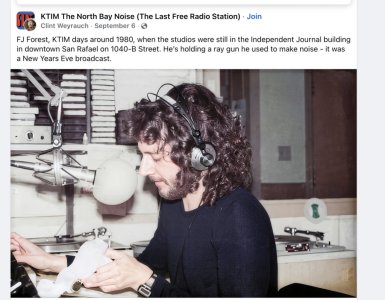
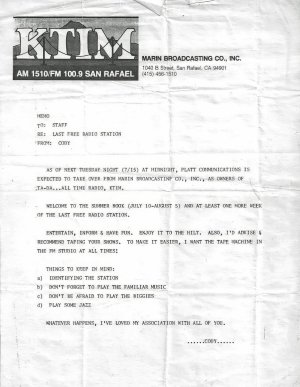
This Facebook post says the studios were in downtown San Rafael, and the memo from the same Facebook group bears that out:
IMG_1889.jpegIMG_1890.jpeg
 
Why can it work in Fresno and not San Francisco?
Fresno has a large local direct account base, while in SF nearly everything is agency business.


Back
Top Bottom