• Get involved.
    We want your input!
    Apply for Membership and join the conversations about everything related to broadcasting.

    After we receive your registration, a moderator will review it. After your registration is approved, you will be permitted to post.
    If you use a disposable or false email address, your registration will be rejected.

    After your membership is approved, please take a minute to tell us a little bit about yourself.
    https://www.radiodiscussions.com/forums/introduce-yourself.1088/

    Thanks in advance and have fun!
    RadioDiscussions Administrators

70s Automation

With all the discussion of TM's Stereo Rock, I might mention that I just added the 1988 operations manual published by D/C for that format. It is at:

https://www.worldradiohistory.com/A...S/Drake-Chenault-Sterero-Rock-1988-Manual.pdf

There have been past posts about this being called Rock in Stereo but all the D/C stuff I have calls it Stereo Rock.
I took a look through it. The automation system required four tape decks plus an array of cart machines. I read through some of the procedures, and noticed that the reels had to be changed periodically. How long was it between changes? ... how long could it be left unattended?... and, what was the probability of a missed cue tone, causing a meltdown? (I think we can safely assume it happened to someone at some time.)

Also, I know there were other systems that were carousels of carts.
 
The "walk away" time depended on how many cuts were on a reel and how often that reel was scheduled. That operations manual has a section that calculated how long each category's decks would need changing.

Carousels were usually used in automation for commercial playback, although I remember a few stations that used them for current songs so as to be better able to change the order of play from day to day. KTMS in Santa Barbara did that for a while in the mid-1970s.

Cue tones were not often missed, provided the detector circuit in the playback deck didn't fail. More common, when a lot of systems used Scully reel-to-reel machines with 14" reels (the Beautiful Music format was big on those) it was easy to accidentally leave a deck in reverse mode, which meant all the music played backwards until someone noticed. That happened a lot after the one BM station I worked at briefly in 1977-78 fired the entire FM staff on the premise that the AM jocks could handle tape changes. I got a big laugh out of that, because that firing resulted in my being hired the very next day to program the first AC station in the market and made sure all the other stations in the market knew that was happening.

As Bugs Bunny would have said: "Ain't I a stinker?"
 
In the 70s, what was then WCGY (93.7) in Lawrence, MA ran TM Rock, using a Shafer 903 automation system. It had 4 (IIRC) Otari 1000 reel-to-reel machines and (I think) BE Control 16 cart decks. The reels were changed out a couple of times a day....each reel had about 20 songs. The Current reel was updated by TM each week (the new reel was sent via the mail --- no satellite delivery back then!!)
At that same time I worked at (then) WKXL-FM (102.3) in Concord, NH We used a Harris System 90 automation. It had 4 ITC 750 reel-to-reel machines (one was used for an instrumental "dead-roll" to join the CBS Network at top-hour) and 2 SMC 250 carousels for commercials. There was an ITC Triple-Decker cart machine for weather and news inserts, and 2 Harris cart machines that were used for automatic time-announce -- one machine for EVEN times :)02, :04, :06,ets) and one for ODD times :)01, :03 :05, etc.).
Side note.....the music on the reels was stereo --- the carts were all MONO....the engineer at that time did not want to have to deal with nearly-constant alignment to prevent phase error!!
Shafer, Harris, BE and others had full systems used in the new England area.
 
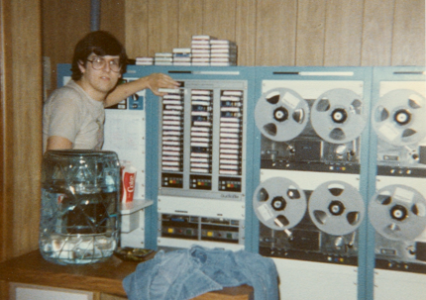
Here's a short video of a Schafer 903 at an Australian station circa 1976, with six Teac reel-to-reels and four Schafer Audiofiles:


And a picture of some has-been PD with a 903 in the Oxnard-Ventura (CA) market from 1979:

1766210283331.png

Wonder whatever happened to him? :rolleyes:
 
Last edited:
Side note.....the music on the reels was stereo --- the carts were all MONO....the engineer at that time did not want to have to deal with nearly-constant alignment to prevent phase error!!

The vast majority of automated stations tended to keep the cart equipment mono, because it didn't matter for commercials, news, weather, time announce, etc.
 
You rewound reels or changed them based on how many songs were on the reel versus how long it took to get through a reel. I worked a station with 3 10.5 inch reel decks in our Autogram. We were a CHR with two reels of 17 currents each and 12 recurrent reels of 20 songs. Simple rotation: 2 currents, 1 Recurrent. Changing tapes was staggered: there was a third hits reel to change out. These had to be changed every 51 songs but the recurrent reel every 60 songs.

You never wanted to be getting a new reel ready out of synch. If automation hit and you were not ready, you would snap the tape. We were told replacement reels were $75. The boss said he'd give you one but do it twice and it comes out of your pay.
 
You rewound reels or changed them based on how many songs were on the reel versus how long it took to get through a reel. I worked a station with 3 10.5 inch reel decks in our Autogram. We were a CHR with two reels of 17 currents each and 12 recurrent reels of 20 songs. Simple rotation: 2 currents, 1 Recurrent. Changing tapes was staggered: there was a third hits reel to change out. These had to be changed every 51 songs but the recurrent reel every 60 songs.

Just from that description, I could hazard a fairly accurate guess as to which format and syndicator that was. The last letter of the alphabet comes to mind.
 
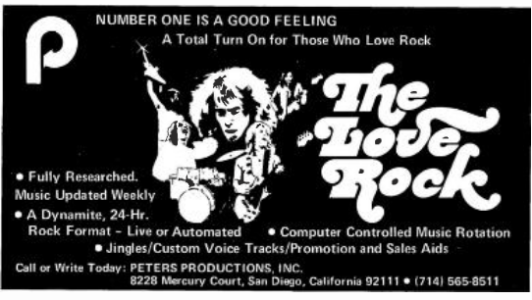
I want to say it was Peters. Memory is a little fuzzy. They were out of San Diego

I was wrong, then. But Peters Productions was indeed based in S.D.

Here's a memory flogger for you, as the late Gary Owens would have said:

And I even found an ad in Broadcasting (April 5, 1976) for that format you were running:
1766291991550.png
 
Last edited:
What happened to the company, did it….peter out?

Ignoring the stupid joke ...

Peters was an also ran (as in smaller player) in the radio syndication business. They were bought out by BPI (Broadcast Programming International) early in the consolidation of tape-based formats that took place as CDs and satellite-delivered formats replaced them. Broadcasting reported the sale took place in September 1987:

 
Carousels were usually used in automation for commercial playback, although I remember a few stations that used them for current songs so as to be better able to change the order of play from day to day. KTMS in Santa Barbara did that for a while in the mid-1970s.
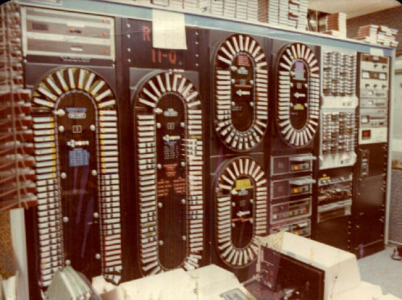
Here is my later 70's automation at Hot AC "11-Q" in San Juan...

1766296629672.png

The carrousels ran all the music. The big ones held the two oldies categories, and got rotated daily. Two smaller ones did the three current categories and the recurrent category. One additional one did the matching intros by the shift jock for the songs. There were usually 4 to 5 differenent intros recorded for each song by each jock, and they were changed every week or so.

The commercials were on the instacarts, and there were two decks for time checks synchronized with the announcer shift Another deck handled weather... in San Juan, there was a narrow range of temperatures and forecasts, so it took very few carts to match everything excpet a hurricane warning, which was done "custom".
 
You've posted that several times as has been appropriate in various threads, David, and every time I see it I find myself wishing I'd had a setup like that at some of the stations I've been at over a half century.

It is amazing now to think what we managed to do with entirely tape-based systems. I remember how revolutionary it seemed when I discovered by experimentation that the Schafer 903 would let you talk over the intro of a song with a carted voicetrack if you held down the sec tone button while you talked.
 
You've posted that several times as has been appropriate in various threads, David, and every time I see it I find myself wishing I'd had a setup like that at some of the stations I've been at over a half century.

It is amazing now to think what we managed to do with entirely tape-based systems. I remember how revolutionary it seemed when I discovered by experimentation that the Schafer 903 would let you talk over the intro of a song with a carted voicetrack if you held down the sec tone button while you talked.
In the next room, we had WZNT, "Z-93", also fully automated with the same gear. When It launched, by the 5th month on the air it had a 42 share in a 30 station market. Our competitor, WBMJ, which did Top 40 with nearly all English songs, was also fully automated. Together, the top 3 stations in San Juan, with about 60 shares together, were all automated and all sounded live.


Back
Top Bottom