L.A., 50 kw monsters at 1070 and 1110 with 1090 from Mexico sandwiched in

-
Get involved.
We want your input!
Apply for Membership and join the conversations about everything related to broadcasting.
After we receive your registration, a moderator will review it. After your registration is approved, you will be permitted to post.
If you use a disposable or false email address, your registration will be rejected.
After your membership is approved, please take a minute to tell us a little bit about yourself.
https://www.radiodiscussions.com/forums/introduce-yourself.1088/
Thanks in advance and have fun!
RadioDiscussions Administrators
You are using an out of date browser. It may not display this or other websites correctly.
You should upgrade or use an alternative browser.
You should upgrade or use an alternative browser.
Closely-Spaced AMs
- Thread starter K8PLW
- Start date

@ David Eduardo
Reading your quote here
(>> 'Farther up the dial in the same city[Quito] we had 700, 720, 740, 769, 785, 805, 835, 860, 880, 900, 920, 940, 960, 990…' <<)
I was reminded of something you'd posted long ago. You mentioned *FM* stations, in foreign lands, who in markets are a lot closer than our .8 mHz apart. The folks here might enjoy a few of those.
In any case, and with another question: The FCC apparently knew what it was doing with short-spacing. I've yet to read an instance posted where such shoehorring didn't work.
Question: Amid the engineering specs submitted to the FCC for *AM* stations by applicants, does the FCC apply any quotient taking ground conductivity into consideration?
Reading your quote here
(>> 'Farther up the dial in the same city[Quito] we had 700, 720, 740, 769, 785, 805, 835, 860, 880, 900, 920, 940, 960, 990…' <<)
I was reminded of something you'd posted long ago. You mentioned *FM* stations, in foreign lands, who in markets are a lot closer than our .8 mHz apart. The folks here might enjoy a few of those.
In any case, and with another question: The FCC apparently knew what it was doing with short-spacing. I've yet to read an instance posted where such shoehorring didn't work.
Question: Amid the engineering specs submitted to the FCC for *AM* stations by applicants, does the FCC apply any quotient taking ground conductivity into consideration?

Yes.
Unlike the mileage spacings used for FM, the AM spacing rules are entirely based on contour overlap, and the way those contours are calculated take ground conductivity very much into account. That can be done either by using the FCC's own M3 conductivity map, which is widely known to be an overestimate in many areas, or by the applicant taking its own measurements on nearby stations to demonstrate real-world ground conductivity.
It's why class C graveyard AMs can be spaced 50 or so miles apart in some areas but need 150 or more miles in others.
Unlike the mileage spacings used for FM, the AM spacing rules are entirely based on contour overlap, and the way those contours are calculated take ground conductivity very much into account. That can be done either by using the FCC's own M3 conductivity map, which is widely known to be an overestimate in many areas, or by the applicant taking its own measurements on nearby stations to demonstrate real-world ground conductivity.
It's why class C graveyard AMs can be spaced 50 or so miles apart in some areas but need 150 or more miles in others.
WOL was 1 Kw until they moved to WYCB’s site many years ago.On AM 1450 we have 51.069 miles for this pair.
WOL Washington DC (370 watts Days/Night) (Near the Ft Totten Metrorail stop)
WTHU Thurmont MD (500 watts Days / 400 watts Night)
Of course, neither station is running the full graveyard 1 kw.
Wow. Two class C's on a graveyard frequency. Still though, 46 miles? Hard to believe there wasn't a better option.East Tennessee: 1490 WITA, Knoxville, 46 miles from WFXY, Middlesboro KY and 61 miles away from WCSV, Crossville, TN
Ground conductivity is terrible, and the stations don't interfere with each other in their own market areas.Wow. Two class C's on a graveyard frequency. Still though, 46 miles? Hard to believe there wasn't a better option.

There are stations on 1340 in Kansas City, Kansas, and Pittsburg, Kansas, which are not quite 120 miles apart.
In the mid-1990s, there was an attempt to make these two signals into a wide-coverage station with mostly agriculturally-based programming. A synchronized on-channel booster was installed at Amoret, Missouri, which is about halfway between Kansas City and Pittsburg KS.
This arrangement was evidently not very successful and was discontinued at some point. I do remember driving south of Kansas City once while listening to the 1340 signal, about half way between Kansas City and the booster location. The beat interference between the two signals was quite audible at that location.
In the mid-1990s, there was an attempt to make these two signals into a wide-coverage station with mostly agriculturally-based programming. A synchronized on-channel booster was installed at Amoret, Missouri, which is about halfway between Kansas City and Pittsburg KS.
This arrangement was evidently not very successful and was discontinued at some point. I do remember driving south of Kansas City once while listening to the 1340 signal, about half way between Kansas City and the booster location. The beat interference between the two signals was quite audible at that location.
The one good part of AM IBOC was that all carriers were locked to the same master clock (derived from WWV), to eliminate the fluttering effect caused by co-channel signals having carriers that are a few Hz apart.The beat interference between the two signals was quite audible at that location.
Another approach is to purposely offset one carrier about 20 Hz apart from the other, which makes the beat frequency less annoying to the listener.
A hum at 20 Hz is very annoying. The Cuban stations always caused that when they were off frequency like that.
Another long-time closely-spaced AM situation has just been changed. Both KAAA (Kingman, AZ) and KLAV (Las Vegas, NV, some 90 miles distant) shared the 1230 frequency for many years. When I rode between the two towns in the back of my parents' camper in late 1979, I noted a lot of interference on the 1230 frequency between both stations after one crossed over the Hoover Dam and for a good ways into Nevada. Now, it appears this situation has changed (or is changing).
That's right! KLAV is moving over to the 1240 frequency.
Interestingly, in the same area, I also noted interference between Needles' KTOX (1340) and the Las Vegas station on the same frequency. However, I'm not aware of any attempts to fix *that* issue.
That's right! KLAV is moving over to the 1240 frequency.
Interestingly, in the same area, I also noted interference between Needles' KTOX (1340) and the Las Vegas station on the same frequency. However, I'm not aware of any attempts to fix *that* issue.
Is that close spacing why KLAV is only licensed for 900 watts daytime? But strangely they get to use the full 1 kW at night.Both KAAA (Kingman, AZ) and KLAV (Las Vegas, NV, some 90 miles distant) shared the 1230 frequency for many years.
South Carolina is pretty crowded up with 1400s. WCOS Columbia, WJMX Darlington, WGTN Georgetown, WSPG Spartanburg, then previously you had Savannah on there too.
Also Waynesville, NC not too far from Spartanburg.
Also Waynesville, NC not too far from Spartanburg.
Often the reduced power happens when the station is relicensed, to a nearby tower, and or taller tower. The station may also have been squeezed in by slight reduction in the Day power by what was called a "Series Limiting Resistor". Later, the FCC allowed reduced transmitter power to the actual power required to achieve the reduced efficiency, instead of burning power off in resistance. The Night power allowed 1000 watts because it was not restricted under the rules, except border stations under International Agreements. Many Class IVs were required to reduce when the Day power limit was increased from 250 to 1000 watts, usually when channels adjacent to Local Channels required overlap protection.Is that close spacing why KLAV is only licensed for 900 watts daytime? But strangely they get to use the full 1 kW at night.

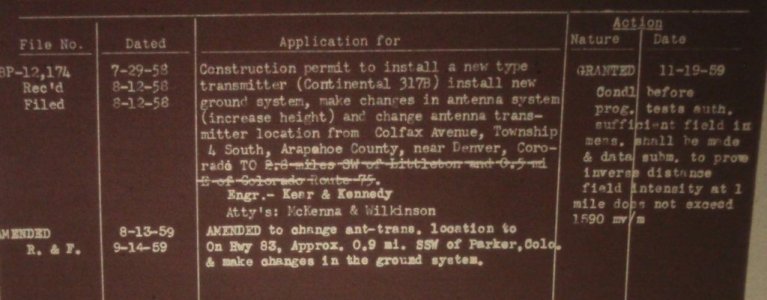
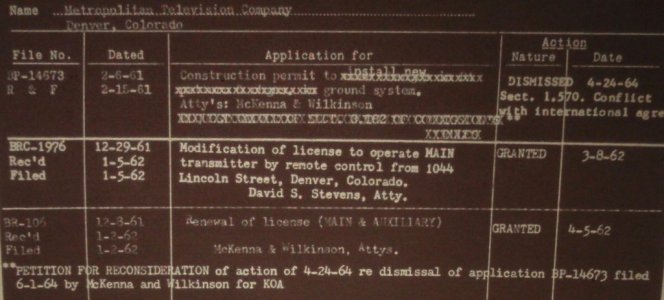
KOA 850 had a limiting resistor was told due to the 1937 NARBA and the new taller tower. Not much of a reduction but they could still say they were 50 kw. Removed in the 80s with NARBA amendments.Often the reduced power happens when the station is relicensed, to a nearby tower, and or taller tower. The station may also have been squeezed in by slight reduction in the Day power by what was called a "Series Limiting Resistor". Later, the FCC allowed reduced transmitter power to the actual power required to achieve the reduced efficiency, instead of burning power off in resistance. The Night power allowed 1000 watts because it was not restricted under the rules, except border stations under International Agreements. Many Class IVs were required to reduce when the Day power limit was increased from 250 to 1000 watts, usually when channels adjacent to Local Channels required overlap protection.
@ charlestondxman
Back in the DX heyday (high school years, mostly Monday Mornings) some AM graveyard channels seemed to rotate Top 40 sations that stayed atop the channel for weeks. WROV 1240 Roanoke was one. These stations evidently tried 24/7 for a while, then decided to disappear from MM's altogether.
Atop 1400 was WJET Erie PA for a spell. WKWK Wheeling was another. And that WSGA Savannah you mentioned was one more that wouldn't go away for maybe a month worth of Monday Mornings. Not much of a sheer water-path exists between Queens NYC and Savannah -- but apparently enough of it does.
A close-spaced I *thought* would be critical was 1490's WDLC Port Jervis NY and WKNY Kingstin NY. US 209 links both cities, 52 miles apart .....
Not even close to overlapping. I dated a Brooklyn gal who drove up to Jervis to do a weekend shift at WDLC; their tower was in a gulley. And even though I worked at WKNY -- my first-ever job, lol -- I never saw their tower. On a subsequent afternoon drive years later up 209, at the midway point in came WAZL Hazleton PA. No sign of either WDLC or WKNY unless you were right on top of either one.
Back in the DX heyday (high school years, mostly Monday Mornings) some AM graveyard channels seemed to rotate Top 40 sations that stayed atop the channel for weeks. WROV 1240 Roanoke was one. These stations evidently tried 24/7 for a while, then decided to disappear from MM's altogether.
Atop 1400 was WJET Erie PA for a spell. WKWK Wheeling was another. And that WSGA Savannah you mentioned was one more that wouldn't go away for maybe a month worth of Monday Mornings. Not much of a sheer water-path exists between Queens NYC and Savannah -- but apparently enough of it does.
A close-spaced I *thought* would be critical was 1490's WDLC Port Jervis NY and WKNY Kingstin NY. US 209 links both cities, 52 miles apart .....
Not even close to overlapping. I dated a Brooklyn gal who drove up to Jervis to do a weekend shift at WDLC; their tower was in a gulley. And even though I worked at WKNY -- my first-ever job, lol -- I never saw their tower. On a subsequent afternoon drive years later up 209, at the midway point in came WAZL Hazleton PA. No sign of either WDLC or WKNY unless you were right on top of either one.
How about 3 50 KW during daytime stations less than 315 miles apart? You use to have WAPI non-directional daytime 50 KW day on 1070. WFLI 50KW 3 tower directional day Lookout Mountain (Chattanooga) only 133 miles northeast. And 168 miles away from WFLI you have WCSZ San Souci SC (Greenville) 50 KW non-directional day. You had two 50 KW non-directional stations around 240 miles apart. Somewhere between downtown Ball Ground GA and the end of Interstate 575 there two non-directional 50 KW signals than 125 miles away. But during the daytime normally you can’t either because WFLI is approximately 115 miles away.
1070 would be considered “mid dial” in most areas, but thanks to super crappy soil conductivity the commission licensed all three Class B AMs.
1070 would be considered “mid dial” in most areas, but thanks to super crappy soil conductivity the commission licensed all three Class B AMs.
It would be interesting to see the Proof of Performance for the DAs on that. In Western and Northern Michigan, there are plenty of places that show 0.1-2 mS/m in the higher elevation areas. This sounds like the mountains are also very low conductivity. On Long Island, they just did a Proof where the dots on the radials were well below the lowest ground wave curve, 0.1 mS/m.How about 3 50 KW during daytime stations less than 315 miles apart? You use to have WAPI non-directional daytime 50 KW day on 1070. WFLI 50KW 3 tower directional day Lookout Mountain (Chattanooga) only 133 miles northeast. And 168 miles away from WFLI you have WCSZ San Souci SC (Greenville) 50 KW non-directional day. You had two 50 KW non-directional stations around 240 miles apart. Somewhere between downtown Ball Ground GA and the end of Interstate 575 there two non-directional 50 KW signals than 125 miles away. But during the daytime normally you can’t either because WFLI is approximately 115 miles away.
1070 would be considered “mid dial” in most areas, but thanks to super crappy soil conductivity the commission licensed all three Class B AMs.