• Get involved.
    We want your input!
    Apply for Membership and join the conversations about everything related to broadcasting.

    After we receive your registration, a moderator will review it. After your registration is approved, you will be permitted to post.
    If you use a disposable or false email address, your registration will be rejected.

    After your membership is approved, please take a minute to tell us a little bit about yourself.
    https://www.radiodiscussions.com/forums/introduce-yourself.1088/

    Thanks in advance and have fun!
    RadioDiscussions Administrators

Northern California California's electricity rates impacting broadcasters.

I just saw this STA filed for . This completely makes sense for KJDX (Class C) in rural Susanville.

"The Licensee requests special temporary authority (STA) to operate at a reduced power of 5.0kW, representing approximately 25% of the licensed power of 19.5 kW. This reduction offsets the Licensee’s cost of electrical power at Licensee’s transmitter site which remains well above historical costs and allows the Licensee to continue to service its community. If granted, the Licensee will continue monitoring its electrical power costs and, depending on whether costs continue to be above historical costs, may seek a reduction in power in the future. Given the above, the Licensee respectfully requests the grant of STA for a full six months."

Any other stations hurt by the crazy electricity prices in California?
 
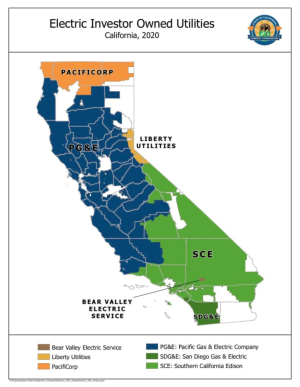
I have not heard of any similar situation elsewhere in the state. In most of Southern California (excluding the cities of Los Angeles, Burbank, Glendale,and Palm Springs, among others which have local municipal providers [footnote 1], and San Diego, which is served by San Diego Gas & Electric [footnote 2] ), the electric utility is the now-infamous Southern California Edison ... and has been for longer than I have been alive.

David might know, since he worked for Univision, which has transmitters up on Mt. Wilson, but perhaps the broadcasters are getting a special rate from SCE ...?

Footnote 1: The California Office of the Treasury has a complete list of these cities, statewide.
Footnote 2: A small part of southern Orange County is also serviced by SDG&E.
 
As a former residential customer in California I was blown away by the incredibly high rates. Remember, it's not just the TPO energy costs but also the HVAC to keep the transmission plant cool. When you add in HD FM with its less efficient properties (50% vs 72% or so for pure analog) then things get ugly.
 
When you add in HD FM with its less efficient properties (50% vs 72% or so for pure analog) then things get ugly.

Hey, I have a half-serious idea: Stations get to deduct the transmitter site electric bill from their royalty payments to Xperi.
 
I have not heard of any similar situation elsewhere in the state. In most of Southern California (excluding the cities of Los Angeles, Burbank, Glendale,and Palm Springs, among others which have local municipal providers [footnote 1], and San Diego, which is served by San Diego Gas & Electric [footnote 2] ), the electric utility is the now-infamous Southern California Edison ... and has been for longer than I have been alive.
Palm Springs is on very costly PG&E. Only La Quinta, Indio, Coachella and all Imperial County is on a rural electric cooperative that is as much as 50% less than PG&E. This makes a big difference when summer heat hits 120º.
 
KJDX has filed similar STAs in the past. There oldest one on LMS was filed on 7/21/2023, and there might have been others on CDBS.

KJDX has a mountaintop site above Susanville. It is possible that they have a higher price for power than usual due to the isolated nature of the site. It appears their tower is one of 4 or 5 structures within 3 miles in any direction. Their 100kW facility appears to use three phase power, which is not always provided on rural circuits. It probably cost a ton to get power to the site, I just don't know if that cost is ongoing or if it was all up-front.
 
When you add in HD FM with its less efficient properties (50% vs 72% or so for pure analog) then things get ugly.
I get 64% DC to RF with -14dB HD on FAX series transmitters and stay in mask. Assuming 94% efficient PSUs then AC to RF should be 60% or better. PAPR algorithms have gotten better. To get peak efficiency you have to reduce PA DC voltage to the point where RTAC starts to struggle keeping mask.
 
Actually, Palm Springs is on Southern California Edison.
Sorry, I got SCE and PG/E confused. In any case, the market from Indian Wells to the east and southeast is Imperial Irrigation District. I paid over $7,200 to them last year, even with solar!
 
KJDX has a mountaintop site above Susanville. It is possible that they have a higher price for power than usual due to the isolated nature of the site. It appears their tower is one of 4 or 5 structures within 3 miles in any direction. Their 100kW facility appears to use three phase power, which is not always provided on rural circuits. It probably cost a ton to get power to the site, I just don't know if that cost is ongoing or if it was all up-front.

This is your answer. Susanville's power comes from the Lassen Municipal Utility District, which charges much lower rates---close to half that of PG&E. So this is not a story about "California's electricity rates".
 
As a former residential customer in California I was blown away by the incredibly high rates.

That is a very broad brush.

You know how many different power vendors there are in California?

113.

Three majors: PG&E, SoCalEdison, SDG&E (San Diego).

86 municipal power districts, including LADWP and SMUD.

24 community choice aggregators, usually in smaller rural areas.

Rates are all over the map. In Folsom, we're on SMUD (Sacramento Metropolitan Utility District). Go three miles from my house, you're in El Dorado Hills, which is in El Dorado County, and they're on PG&E.

I pay half what PG&E customers do.

You need to be way more specific than "California".
 
I'll echo that, Mike.

I grew up in Ventura, where Edison was the electric utility.

In 1989, I moved to the San Fernando Valley and was astonished at how much less LADWP charged.

Given everything I have read about the investor-owned utilities constantly requesting rate increases, I'm sure the gap is even wider now. I don't perceive that my DWP bill is significantly higher now than it was 35 years ago.
 
It's data centers for the AI bubble era causing the price of power to spike for everyone else. It's the price we all pay for AI to kill everyone's jobs, steal creative intellectual property, ravage the Earth's water supply and suck up all the power, disrupting the supply and demand balance. The techbro CEOs and their companies get exponentially wealthier while the rest of us get stuck with skyrocketing utility bills to subsidize their AI greed games.

More light reading on the topic here:
 
Last edited:
It's data centers for the AI bubble era causing the price of power to spike for everyone else.
Electric power is a regulated commodity in all 50 states, and the price ratepayers pay is set by state commissions. Nothing "spikes" without their authorization.

AI Data centers probably will cause power prices to spike in the future, assuming the current construction boom doesn't peter out.. But so far I have not seen any regulatory decision from such a state commission on account of AI power demands.

What has actually been approved in several states are investments in renewable power generation, and the recouping the cost of retirement of coal-fired generation units in favor of natural gas. That capital expenditure definitely does have a cost. It may even be a good investment, it just isn't free.

The fact that Cory Doctorow is widely cited in all kinds of discussions is amusing to me. He's a prolific writer and a good story teller, but that's where his expertise stops. I regard him as a lefty version of Ben Shapiro.
 
For years, posters who have speculated that some station would have to turn in its license because it couldn't pay its electric bill have been shouted down here by certain radio professionals. So now, with costs increasing and advertising plummeting, are we past that stage? Will we see more and more stations either turning down the power or calling it quits because simply powering up the transmitter is a money pit?
 
It's data centers for the AI bubble era causing the price of power to spike for everyone else. It's the price we all pay for AI to kill everyone's jobs, steal creative intellectual property, ravage the Earth's water supply and suck up all the power, disrupting the supply and demand balance. The techbro CEOs and their companies get exponentially wealthier while the rest of us get stuck with skyrocketing utility bills to subsidize their AI greed games.

More light reading on the topic here:

What it does is spike peak demand, and most states have allowed utilities to adopt demand pricing.
In some states such as Kansas and Missouri, the electric utilities are charging the data centers higher prices, rather than increasing rates for individuals. This was spurred by state legislation in Missouri:

 
For years, posters who have speculated that some station would have to turn in its license because it couldn't pay its electric bill have been shouted down here by certain radio professionals.

I don't recall that. We've discussed how the only way Saul Levine keeps 1260 on the air in L.A. is revenue from his other stations. He admitted almost a decade ago that the revenue from 1260 doesn't cover the power bill.

So now, with costs increasing and advertising plummeting, are we past that stage? Will we see more and more stations either turning down the power or calling it quits because simply powering up the transmitter is a money pit?

Yeah. Electricity is a cost of doing business. When the revenues no longer meet expenses, you have to do something.

And if you're one of the remaining operators who still owns the land the tower sits on, it makes all the sense in the world to get out of radio and into real estate.


Back
Top Bottom