• Get involved.
    We want your input!
    Apply for Membership and join the conversations about everything related to broadcasting.

    After we receive your registration, a moderator will review it. After your registration is approved, you will be permitted to post.
    If you use a disposable or false email address, your registration will be rejected.

    After your membership is approved, please take a minute to tell us a little bit about yourself.
    https://www.radiodiscussions.com/forums/introduce-yourself.1088/

    Thanks in advance and have fun!
    RadioDiscussions Administrators

Northern California California's electricity rates impacting broadcasters.

I don't recall that. We've discussed how the only way Saul Levine keeps 1260 on the air in L.A. is revenue from his other stations. He admitted almost a decade ago that the revenue from 1260 doesn't cover the power bill.
By "here," I meant RadioDiscussions as a whole, not just this thread or this state forum.
 
By "here," I meant RadioDiscussions as a whole, not just this thread or this state forum.

I just can't think of one of the "pros" here who has ever said that. I think most of us have been pretty vocal about the fact that economics will cause AMs to start turning in their tickets.

Electric bills may not have been specifically mentioned, because they're kinda bundled with a whole bunch of other costs that are just going to be there if you're going to be on the air.
 
For years, posters who have speculated that some station would have to turn in its license because it couldn't pay its electric bill have been shouted down here by certain radio professionals. So now, with costs increasing and advertising plummeting, are we past that stage? Will we see more and more stations either turning down the power or calling it quits because simply powering up the transmitter is a money pit?
No. You'll generally get a lot of other costs before you cut the transmitter. No transmitter means no revenue. Less transmitter means less revenue. If the transmitter is a large burden on the business, a radio station would be on the verge of closing.

The utility cost per month for a typical Class A FM at national average utility rates is going to be around $300-$400, depending on your climate (how much air conditioning you need).

This Class C FM might be looking at $4000 a month, due to much higher transmitter power and the higher utility rates in California. $4k is quite a bit for a very small market. The county KJDX is licensed to has a population under 30k.
 
You know how many different power vendors there are in California?

113.

Three majors: PG&E, SoCalEdison, SDG&E (San Diego).

86 municipal power districts, including LADWP and SMUD.

24 community choice aggregators, usually in smaller rural areas.
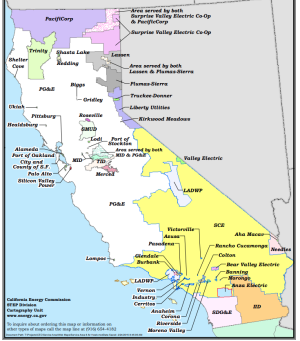
First, another map:

1769736497267.png
From: https://californiareleaf.org/wp-content/uploads/2020/01/Electric_Service_Areas_calif.pdf

Some of the providers, particularly the municipals, are very small indeed. San Francisco is counted separately but the power it sources from its own hydro can't be sold to the public. Service to the general public in San Francisco still is provided by PG&E. This has been a bone of contention for more than 100 years. The situation is similar with the port authorities that source their own power.

PG&E is the largest and, unusually for an investor-owned utility, serves a lot of rural areas. The communications infrastructure alone that ties all of it together is impressive. Among other things, it's why PG&E has a lot of radio licenses (not broadcast, of course) and a small team to manage them.

CCAs (community choice aggregators) don't own their own infrastructure. They're using the infrastructure of the IOU (investor-owned utility) in their area of service. They are in most IOU service areas now. Often, their pitch is not that the rates are lower...because the IOU still charges for the use of its infrastructure...but that the energy they provide comes from "clean" sources. But there's no way to guarantee that. An electron is an electron. When a CCA came to the East Bay about eight years ago, residential customers were automatically switched to it. You could call to switch back to PG&E, and I did so.

The complete list from the California Energy Commission is here: Electric Load-Serving Entities (LSEs) in California - or, if you prefer a spreadsheet (I do, actually): California_Electric_Load-Serving_Entities_Updated_2022-06-30_ADA - the jargon to know here is "electric load-serving entity", or LSE.
 
KJDX has super-power translators (250 watts each) licensed to Portola, Chester, and Quincy. They're that power level because they're fill-in for the main. I don't know for sure but I suspect that at least two of them are no longer within their coverage area at the reduced power. Wonder how they handle that one. Or does anyone even care?

Dave B.
 
KJDX has super-power translators (250 watts each) licensed to Portola, Chester, and Quincy. They're that power level because they're fill-in for the main. I don't know for sure but I suspect that at least two of them are no longer within their coverage area at the reduced power.
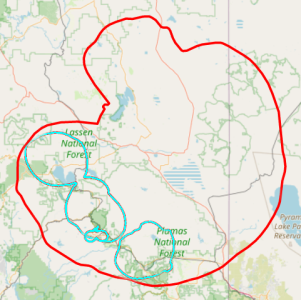
I looked at the maps for all three and compared it to the primary station and I think they're okay.

Edit: Merged the translators into a map of the main, and while they are right at the edge in a couple of places, their predicted contours are within the coverage area.

1769796870040.png
 
Last edited:
KJDX has super-power translators (250 watts each) licensed to Portola, Chester, and Quincy. They're that power level because they're fill-in for the main. I don't know for sure but I suspect that at least two of them are no longer within their coverage area at the reduced power. Wonder how they handle that one. Or does anyone even care?
Good point!

I suspect you have pointed out the reason for the repeated special temporary authority requests instead of straight downgrading the license to a lower class. Downgrading the license would eliminate the possibility of translators outside the licensed 60 dBu. The 60 dBu of a fill-in translator may not exceed the 60 dBu of the parent station, and as K.M. shows on his map, they were close to the bounds with the licensed 100 kW.
 
I probably should point out that there isn't a map for the STA coverage area, but given the fact that all the translators are at the southwestern edge of the licensed contours, you are both likely correct.

But a STA doesn't change the fact that the translators are licensed based on the regular contour and are therefore technically legal.


Back
Top Bottom
