• Get involved.
    We want your input!
    Apply for Membership and join the conversations about everything related to broadcasting.

    After we receive your registration, a moderator will review it. After your registration is approved, you will be permitted to post.
    If you use a disposable or false email address, your registration will be rejected.

    After your membership is approved, please take a minute to tell us a little bit about yourself.
    https://www.radiodiscussions.com/forums/introduce-yourself.1088/

    Thanks in advance and have fun!
    RadioDiscussions Administrators

Largest FM Signal (U.S)

I wonder this all the time. Lmk is there’s a thread about this already , but I have a few ideas from my experience
WHOM-FM (heard in Boston)
WXSS-FM (Lake Michigan helps , was in Pentwater, MI this summer , came loud and clear)
KPFK-FM (no experience, but seems monster)
Type more you have!
 
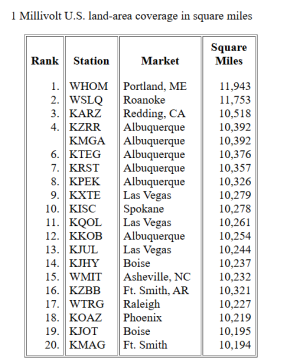
Here is the list compiled by famed radio researcher James Duncan in 1998. This is based on predicted contour coverage over land.
Some of the call letters and facilities have changed since then, but the list should give you an idea as to who has the largest coverage.

1770686928972.png
 
No mention in here about KRUZ/103.3 in Santa Barbara - the station can be heard from San Diego County in the south to Monterey County in the North and east into Kern County (almost to Bakersfield) - I've picked up the station in various parts of the San Diego area as well as at the top of Laureles Grade Road near Carmel Valley in Monterey County, a total distance of about 375-400 miles end to end - I think the signal is heard well along the coast of Baja California in Mexico as well, so assuming Rosarito (not sure if it gets all the way to Ensenada) - we're looking at closer to 400 miles. KRUZ is 105,000 watts at a height of 2,969 feet
 
No mention in here about KRUZ/103.3 in Santa Barbara - the station can be heard from San Diego County in the south to Monterey County in the North and east into Kern County (almost to Bakersfield) - I've picked up the station in various parts of the San Diego area as well as at the top of Laureles Grade Road near Carmel Valley in Monterey County, a total distance of about 375-400 miles end to end - I think the signal is heard well along the coast of Baja California in Mexico as well, so assuming Rosarito (not sure if it gets all the way to Ensenada) - we're looking at closer to 400 miles. KRUZ is 105,000 watts at a height of 2,969 feet
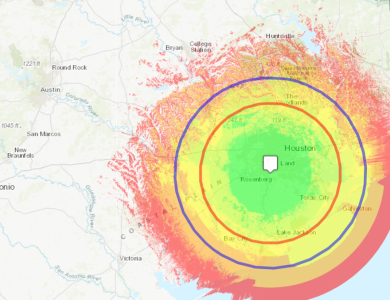
That’s a good one. KRBE also comes to mind. According to posts on this website, it acts like a local in Austin (~170 miles)!
 
I wonder this all the time. Lmk is there’s a thread about this already , but I have a few ideas from my experience
WHOM-FM (heard in Boston)
WXSS-FM (Lake Michigan helps , was in Pentwater, MI this summer , came loud and clear)
KPFK-FM (no experience, but seems monster)
Type more you have!
You probably had some major tropospheric effects going on over Lake Michigan to get WXSS in Pentwater that strong. It isn't that far outside of their predicted fringe area contours. It's changed call letters several times, so I had to look it up. I remember it as WEZW way back. WTCM 103.5 Traverse City has quite a footprint as a Class C0 (formerly Class C before they squeezed in 103.9 Big Rapids). The other closest full power station on 103.7 is a Class A in Hubbardston. And there's 103.7 in South Haven, another Class A. So next to Lake Michigan, there's probably no substantial interference to WXSS. Some of the MIlwaukee area station Class B frequencies are duplicated in Western Michigan under old short spacing rules. So 103.7 may be more interference free there than other frequencies. Stations inland are almost always shadowed near the shoreline. Could you get WIXX 101.1? That gets out well with 100000 watts from Green Bay. Back 50 years ago, a Class B could be heard all over Michigan. Class As could easily get out 100 miles on a good radio, unless their frequency was duplicated or there were stong first adjacents, like WJFM, once 500000 watts on 93.7, and WOOD-FM 265000 watts on 105.7.
 
KPQ-FM Wenatchee? KXRX Walla Walla? (which can be heard 200 miles away on a regular basis)
 
That’s a good one. KRBE also comes to mind. According to posts on this website, it acts like a local in Austin (~170 miles)!
I can assure you the only time KRBE comes in like a local in Austin is during times of tropospheric ducting, typically the morning/evening hours in the springtime. It is not a constant reliable signal that far. If it was, you would have many Houston stations blasting into Austin, since KRBE is on the same antenna and same power as most of the other main FMs in the market.

1770690334903.png
 
All of the Phoenix FM stations with 100kW and with transmitters and antennas on South Mountain have a range of approximately 120 miles or so using a good receiver. This is true especially if you're going west where, though there are some mountains, most aren't high enough to block the South Mountain signals.

The thing about FM reception of course is that mountains do block signals, especially if those mountains are higher than the spaces on which the stations' transmitters and antennas are perched. However, there are spots when driving through central and northern Arizona (which is very mountainous) where those South Mountain FM signals become quite listenable, at least for a minute. One such area is on Arizona State Route 260 around Woods Canyon Lake and going northeastwards until one crosses over the Mogeollon (not sure of spelling) Rim into the town of Heber. An even shorter space is when you are driving down Interstate 17 from Flagstaff and you are about to enter the Verde Valley from the north side--there is a two to three-minute window where all of those South Mountain transmitters come in nicely. And I've been told (I haven't visited to check myself) that there is a point on the south Rim of the Grand Canyon where all of those South Mountain transmitters come in strong and clear.

I hope you realize that the point I am making is that FM distance reception is not only determined by transmitter location and antenna height (or even by the atmosphere) but also by any objects in the distance, including mountains, that could quite easily block even the best of FM signals.
 
Last edited:
i remember traveling to Austin and my hotel was on a ridge near the airport area. I parked in the hotel parking lot and scanned the FM dial and I got a few stations in Dallas, about 185 miles away. I don't think I got anything in Houston, which was 140 miles away, but there may have been terrain preventing me from receiving from there. It was 2007 so I don't really remember.
 
I wonder this all the time. Lmk is there’s a thread about this already , but I have a few ideas from my experience
WHOM-FM (heard in Boston)
WXSS-FM (Lake Michigan helps , was in Pentwater, MI this summer , came loud and clear)
KPFK-FM (no experience, but seems monster)
Type more you have!

I lived in the Los Angeles area (Tujunga, to be exact) until 1972 when I was 9 years of age. We then visited the area regularly every Christmas through 1978 (my mom's mom had the big Christmas get together at her Tunjunga house every year), and I lived on campus while I attended Loyola Marymount University between 1981 and 1985. I'm letting you know this to tell you that I never found any differences between how far away I could pick up KPFK versus other signals from Los Angeles radio stations, especially those on Mt. Wilson where I believe (@K.M. Richards or others will correct me if I'm wrong) KPFK's transmitter is located. In fact, it wasn't until the age of the Internet that I learned that KPFK had a higher power output than the other Los Angeles stations. In fact, the FM stations with the most distance I've ever heard from Los Angeles have been, and continue to be, KRTH (101.1), KLOS (95.5), and KBIG (104.3).
 
WHOM-FM came in fine when I lived in Old Orchard Beach, ME from 1985-87.

WBLM-FM 102.9 Portland is 100,000 watts to this day.
 
I hope you realize that the point I am making is that FM distance reception is not only determined by transmitter location and antenna height (or even by the atmosphere) but also by any objects in the distance, including mountains, that could quite easily block even the best of FM signals.

Yep. Terrain shielding is the enemy to reception.

This is why there are so many on-channel FM boosters to improve reception in shadowed areas of a station's protected contour. I worked at the very first station to get a FCC authorization for same ... KOVA/105.5 in Ojai CA (now KFYV), which found its original transmitter site on Sulphur Mountain blocked from the community of Oak View, literally only a few miles down Highway 33 from the studios.

That booster was engineered in a very clever way to avoid interference ... it was actually fed from what was then Storer Cable, which had broadband FM on their service, meaning that the main transmitter was in perfect sync with the booster. We later used the same engineering to cover the foothills in the eastern part of Ventura which were also terrain shielded from Sulphur.

When 105.5 (KMYX then) moved to Red Mountain, as chief operator I duly re-engineered and filed with the FCC a minor change to the Ventura booster, as the protected contour no longer went as far east. And as soon as we implemented the reorientation of the antenna, the next community over (Santa Paula) suddenly started receiving 105.5 from Long Beach ... and we got a lot of angry calls from now former listeners.

The owner asked me what we could do about it, and I had to tell him "nothing" because he knew from the engineering studies submitted for the change in transmitter site showed Santa Paula to be outside the protected contour.

I tell the story because this pendulum can swing both ways.
 
I'm letting you know this to tell you that I never found any differences between how far away I could pick up KPFK versus other signals from Los Angeles radio stations, especially those on Mt. Wilson where I believe (@K.M. Richards or others will correct me if I'm wrong) KPFK's transmitter is located.

You are correct, Ted. Reference the first post in this thread from two years ago for a list of who's up there.
 
People used to report hearing WJFM 93.7 500000 watts ERP on 93.7 frequently for 400 miles around. People would often hear it at stop lights in Iowa. It's now WBCT with 320000 watts, and there are all kinds of stations, translators, LPFMs, and IBOC sidebands that limit it from what it used to be. As a result of broadcasters looking for easier ways to "upgrade", I did frequency studies that showed that 93.7 could be dropped in as a 6 kW Class A only around 111 miles away, because its only protected as a 50000 watt/150 meter reference Class B. I told them that it would receive a lot more interference from WBCT than from a 50000 watt/150 meter Class B, but their lawyers told them to do it anyway. I was surprised that the Class As had decent signals anyway. The lawyers' rationale was that if they didn't do it, a competitor would.
 
People used to report hearing WJFM 93.7 500000 watts ERP on 93.7 frequently for 400 miles around. People would often hear it at stop lights in Iowa.
It might be different today with our digital FM tuners, but back when I lived in the Chicago W and NW suburbs (1975-94), the only times I could hear then-WJFM was when the weather was right and tropo was working. WLAK/93.9 would override it when listening on the conventional analog tuners with AFC that were available at the time. It was a regular in NW Indiana, but not in Illinois.
 
It might be different today with our digital FM tuners, but back when I lived in the Chicago W and NW suburbs (1975-94), the only times I could hear then-WJFM was when the weather was right and tropo was working. WLAK/93.9 would override it when listening on the conventional analog tuners with AFC that were available at the time. It was a regular in NW Indiana, but not in Illinois.
My Uncle lived in that area, near ORD, and somehow had substantial discounts on Panasonic products where he worked. Around 1980, he had a Panasonic portable with about a 25 dB first adjacent selectivity. Every time I tried it, I could hear WJFM next to WLAK, and WOOD-FM 105.7 next to 105.9 Elmwood Park.
 
Playing with the car radio a few years ago (not sure if 93.7 was 500k or 330k at the time), the signal was audible in the northern Chicago suburbs within a couple miles of Lake Michigan. Similarly, Chicago FMs were (and generally are) an easy listen in Benton Harbor / St. Joseph, Mich., but a couple miles inland, you need height to get them.
 
My Uncle lived in that area, near ORD, and somehow had a substantial discounts on Panasonic products where he worked. Around 1980, he had a Panasonic portable with about a 25 dB first adjacent selectivity. Every time I tried it, I could hear WJFM next to WLAK, and WOOD-FM 105.7 next to 105.9 Elmwood Park.
Other than my first few years in the area, I lived much further out (Glendale Heights, Palatine, Wauconda, Streamwood). But even when I lived in Franklin Park or Addison, I don't remember hearing any Michigan stations on a regular basis. Your uncle must have had better tuners in his radios than I did. :D
 
Playing with the car radio a few years ago (not sure if 93.7 was 500k or 330k at the time), the signal was audible in the northern Chicago suburbs within a couple miles of Lake Michigan. Similarly, Chicago FMs were (and generally are) an easy listen in Benton Harbor / St. Joseph, Mich., but a couple miles inland, you need height to get them.
I had family in Stevensville in the late '70s. Pre-cable TV came strictly from South Bend, and I don't remember any of the Chicago FMs being audible once I got east of Michigan City IN.
 
Other than my first few years in the area, I lived much further out (Glendale Heights, Palatine, Wauconda, Streamwood). But even when I lived in Franklin Park or Addison, I don't remember hearing any Michigan stations on a regular basis. Your uncle must have had better tuners in his radios than I did.
I lived about 15 miles from WDRQ 93.1 when it was 20000 watts under old 73.213 rules. With a Technics tuner with 25 dB first adjacent selectivity, I could get WKJF-FM 92.9 Cadillac, 157 miles away, with a wire dipole in the attic. Only when CFCO-FM 1 on 92.9 came on with just 50 watts did it make it no longer possible to hear it. Could you get WKJF near Chicago? My in laws live near Union Grove, WI, and I could get WKJF, and WCXT 105.3 Hart, MI, which was Z-Rock, when WZRC 106.7 Des Plaines was Z-Rock, on a very good Panasonic.


Back
Top Bottom