• Get involved.
    We want your input!
    Apply for Membership and join the conversations about everything related to broadcasting.

    After we receive your registration, a moderator will review it. After your registration is approved, you will be permitted to post.
    If you use a disposable or false email address, your registration will be rejected.

    After your membership is approved, please take a minute to tell us a little bit about yourself.
    https://www.radiodiscussions.com/forums/introduce-yourself.1088/

    Thanks in advance and have fun!
    RadioDiscussions Administrators

Old TV Sets Where Each "Number" Had A VHF/UHF Dial

I was going back and rereading old threads on this board. I found this posted by "TheRob"

My great grandmother had a bizarre TV with 12 channels, but each "number" had a VHF/UHF dial requiring you to tune to the station, and lock it in. She lived in the Wichita DMA, so conceivably one could tune KAKE on all 12 channels as a practical joke if desired.
I am not at all following what he means. Can someone who knows about this, explain it in more detail. I have never heard of it before. Then underneath his post someone named "Poledo" wrote

My neighbor had one of those TVs with individual tuners for all 12 channels... This was back when the UHF dial went up into the 80s. After the cable co started offering the box to add 10 additional channels we tinkered with her TV and got channel 4 fine tuned to show CATV channel 21, which was MTV at the time. For some reason we could only fine tune channel 4 to get MTV which was a problem for her dad because channel 4 was supposed to be ESPN. Eventually we got smart and fine tuned PBS channel 8 to pick up ESPN channel 4 and left MTV on channel 4.

This only sounded more strange. So if anyone can clue me in, I'd appreciate it.

Here is a link to the original thread titled "12 Channel Cable Systems"
 
I was going back and rereading old threads on this board. I found this posted by "TheRob"


I am not at all following what he means. Can someone who knows about this, explain it in more detail. I have never heard of it before. Then underneath his post someone named "Poledo" wrote


This only sounded more strange. So if anyone can clue me in, I'd appreciate it.

Here is a link to the original thread titled "12 Channel Cable Systems"

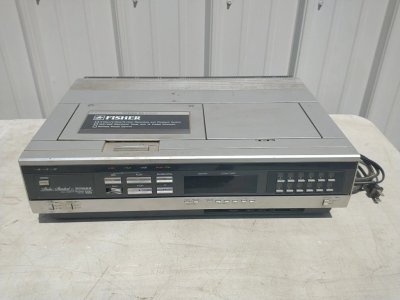
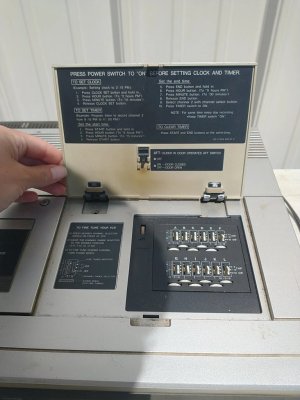
Lots of TV's and VCR's were like that. Our first VCR was a pop-up style with that type of tuning system. Fisher, I believe. 13 individual tuners hidden behind a door and a sheet of numbers you put in the window in front of the LED that lit up when you pushed the button. I brought the VCR to a place that had cable one evening to record a filmed concert by a local band that was being replayed by the local cable system on the channel that had MTV. Thought I had it tuned in properly (and I did) and then regrettably did some fine tuning during the concert.

Found one for sale on eBay and stole two relevant pictures. Second one shows the tuning system in detail.

fisher1.jpg fisher2.jpg
 
The tuning controls shown on that VCR were quite common on TVs in the 1970s and 80s. Sort of a bridge between the old mechanical channel tuners and fully electronic tuning that became the standard in the 1990s.
 
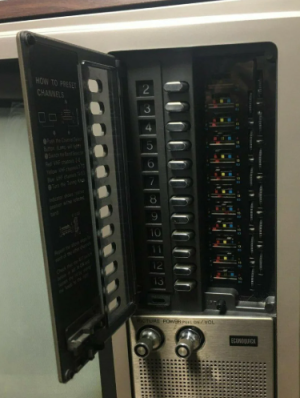
These could be found in the 1980s in the US. They had a little pinwheel tuner and a switch for (I believe) low-VHF, high-VHF, and UHF behind a door that opened out, and you set each button to a desired channel. The sets came with a sheet of clear black plastic channel numbers to slide into a slot where each channel would appear. You did not have to set them in sequential order, for instance, you could cluster together all the stations from one market, and use the higher buttons for OOM stations, or in whatever configuration you desired. Here's what they looked like:

1771515920094.png

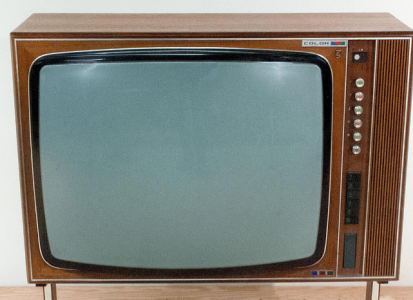
These were much more common in Europe, where OTA channel numbers are rarely used for marketing purposes or to identify stations, and they did not typically come with the pre-cut channel numbers. For instance, in the UK you would set the first button to BBC1, then BBC2, ITV, Channel 4, and so on.

1771516028056.png

This one must not have been manufactured in the UK, otherwise it would say "colour", not "color".

My son's family in Poland once had a TV set with a detent "click" tuner with separate dials for VHF and UHF, just like in North America, though the channel configuration was somewhat different than here. Same basic concept.
 
Lots of TV's and VCR's were like that. Our first VCR was a pop-up style with that type of tuning system. Fisher, I believe. 13 individual tuners hidden behind a door
Actually in that case only 12, for channels 2 to 13. Some had a blank space or two for adding UHF channels, but in this case to add a UHF channel you'd need to reprogram one of the VHF channels that was unused in your area.

I've also seen some old TVs where the channels were not in numerical order. Instead, first it would have the set of major-market channels (2, 4, 5, 7, 9, 11, 13) and then the set of "everywhere else" channels (3, 6, 8, 10, 12).
 
Actually in that case only 12, for channels 2 to 13. Some had a blank space or two for adding UHF channels, but in this case to add a UHF channel you'd need to reprogram one of the VHF channels that was unused in your area.

I've also seen some old TVs where the channels were not in numerical order. Instead, first it would have the set of major-market channels (2, 4, 5, 7, 9, 11, 13) and then the set of "everywhere else" channels (3, 6, 8, 10, 12).
12- you are correct. How quickly we forget that the channels started at 2 and not 1, since you could now have a channel 1 in theory.
 
Actually in that case only 12, for channels 2 to 13. Some had a blank space or two for adding UHF channels, but in this case to add a UHF channel you'd need to reprogram one of the VHF channels that was unused in your area.

I've also seen some old TVs where the channels were not in numerical order. Instead, first it would have the set of major-market channels (2, 4, 5, 7, 9, 11, 13) and then the set of "everywhere else" channels (3, 6, 8, 10, 12).

On many of those sets, you could tune to as many UHF channels as you wished, within the limit of usually 12 slots. Each of the individual tuners could be used for VHF or UHF. If you were in between two all-UHF markets, such as Fort Wayne and South Bend, you'd need quite a few.
 
The first VCR we owned was a Sharp with a similar tuning arrangement, only it also included the mid-band cable channels (A through I) alongside low-/high-VHF and UHF. It might have had the superband (J through W) as well ... I don't recall that specifically.
 
I had a small GoldStar (predecesor to LG) color TV from KMart and it didn't have any cable-ready features, ditto a larger Sony set I got in 1981. Both had the twelve-channel pushbutton layout, as well as those plastic channel tabs you would slide in each window. I used the Sony with twelve-channel cable and marked the Lexington (KY) stations with their OTA UHF channel numbers (they were converted to VHF channels on the cable).
 
The first VCR we owned was a Sharp with a similar tuning arrangement, only it also included the mid-band cable channels (A through I) alongside low-/high-VHF and UHF. It might have had the superband (J through W) as well ... I don't recall that specifically.
That might have simply been a free bonus, if the tuner was designed to accommodate the differing VHF TV broadcast channel allocations around the world, some of which coincided with the frequency range used by analog cable TV here in North America.

Speaking of which, back in school I had a classmate who claimed his little portable black & white TV could pick up cable channels. At the time I doubted him, but if it had a tuner with some extra leeway below channel 7 on VHF-Hi and there was some leaky coax in his neighborhood, it certainly would've been possible!
 
That might have simply been a free bonus, if the tuner was designed to accommodate the differing VHF TV broadcast channel allocations around the world, some of which coincided with the frequency range used by analog cable TV here in North America.

Speaking of which, back in school I had a classmate who claimed his little portable black & white TV could pick up cable channels. At the time I doubted him, but if it had a tuner with some extra leeway below channel 7 on VHF-Hi and there was some leaky coax in his neighborhood, it certainly would've been possible!
Back in the 1990s, the cable system in Grantsville MD was very leaky, and it was entirely possible to pick up the cable channels OTA. How watchable they were is another story. They carried the major Pittsburgh stations, WJAC from Johnstown, WTRF from Wheeling, and, I'm pretty sure, WHAG from Hagerstown (good for in-state news). I used to stay at the Casselman Inn all the time and had my small B&W portable for DXing on the road, that's how I know.

One morning there was tropospheric activity and WHIO Dayton started overriding WTRF. That was kind of neat. (Fun fact for today, the TRF stood for "two radio frequencies", i.e., their AM and FM stations, that may have been a backronym.)
 
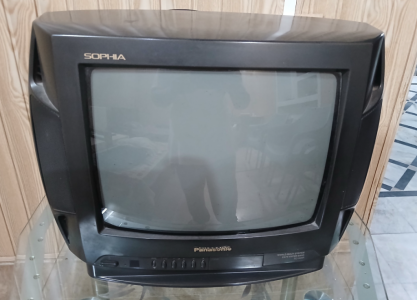
That tuner type was known as varactor. We had a Panasonic with 14 channel slots in the 1980's. It came with a sheet of number tabs that could be inserted in each slot. It worked out well, since we had UHF translators for channels 8, 12, and 13, and those slots were easily retuned to 74, 33, and 76 respectively. Still had a great picture when I gave it away in 2008. I found an image of it at https://www.govdeals.com/en/asset/341/1223
 
That might have simply been a free bonus, if the tuner was designed to accommodate the differing VHF TV broadcast channel allocations around the world, some of which coincided with the frequency range used by analog cable TV here in North America.

That's entirely possible, but I give them credit for labeling the tuner setup to make the end user aware of it.
 
That tuner type was known as varactor. We had a Panasonic with 14 channel slots in the 1980's. It came with a sheet of number tabs that could be inserted in each slot. It worked out well, since we had UHF translators for channels 8, 12, and 13, and those slots were easily retuned to 74, 33, and 76 respectively. Still had a great picture when I gave it away in 2008. I found an image of it at https://www.govdeals.com/en/asset/341/1223
I didn't think of the possibility of allowing translators to show the channel number of the mother station.

Kind of like a low-tech version of what is now done with PSIP on translators for many stations, as well as DTS transmitters.

I lived in the DC area when I had the GoldStar set, and I clustered together all of the Washington stations, then whatever Baltimore stations I could get below those.
 
Thanks for the replies. I had never heard of or seen anything like this before. I guess you can completely miss out on things. At least it makes sense now,
 
I didn't think of the possibility of allowing translators to show the channel number of the mother station.

You would wreak havoc with FCC licensing procedures, since the two digit number which follows K or W in the calls is the actual channel of transmission.
 
That might have simply been a free bonus, if the tuner was designed to accommodate the differing VHF TV broadcast channel allocations around the world, some of which coincided with the frequency range used by analog cable TV here in North America.

I had a multisystem set that could accommodate pretty much anything. It was this one (I didn't take this picture, I just found this online, it's the same receiver):

1771545555760.png

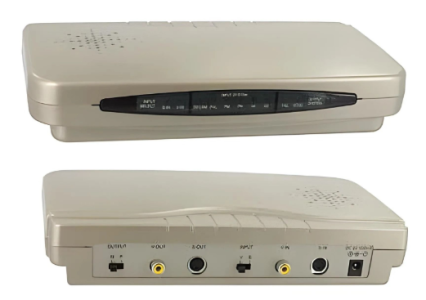
It didn't have the row of channel buttons on it, it was all digital, but it accommodated the various flavors of NTSC and PAL as well as SECAM. Sadly, it gave up the ghost a few years ago and I junked it. It had the European coax input (rigid plug), ditto for the electric plug (dual-voltage 110/220), with the menu in (I believe) English, Russian, Chinese, and Arabic. I still have a multisystem Sharp DVD/VCR with similar capabilities, it takes a British-style 220 plug, and I also have a systems converter similar to this one:

1771546000956.png
 
You would wreak havoc with FCC licensing procedures, since the two digit number which follows K or W in the calls is the actual channel of transmission.
I was simply referring to the use of the plastic channel tabs, to indicate the channel of the mother station rather than the OTA channel used by the translator.
 
I was simply referring to the use of the plastic channel tabs, to indicate the channel of the mother station rather than the OTA channel used by the translator.

Oh, okay. That wasn't clear from my reading. Thank you for clarifying!


Back
Top Bottom