
• Get involved.
    We want your input!
    Apply for Membership and join the conversations about everything related to broadcasting.

    After we receive your registration, a moderator will review it. After your registration is approved, you will be permitted to post.
    If you use a disposable or false email address, your registration will be rejected.

    After your membership is approved, please take a minute to tell us a little bit about yourself.
    https://www.radiodiscussions.com/forums/introduce-yourself.1088/

    Thanks in advance and have fun!
    RadioDiscussions Administrators

KHAT 1210 Laramie, WY

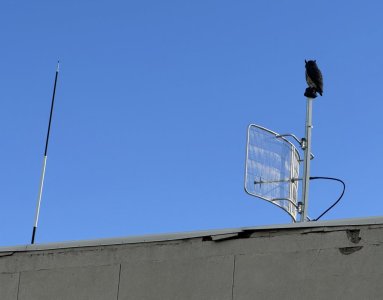
Here’s a look at the current, temporary transmitter site for KHAT 1210… picture attached.

Licensed for 10kw non directional days and 1kw 2 tower directional nights from a site south of town near the highway, half mile from 1290 KOWB. It holds a CP to operate daytime only.

But, it’s running 10 watts from the roof of its soon to be ex studio and that’s the way it’ll be for awhile.

Read the FCC LMS files on the special temporary authority grants. Part of the issue is the previous owner sold off the tower site. And fixing this or moving it is very costly.
IMG_4603.jpeg
 
Am I to understand that KHAT is now running 10 watts during the daytime? I'll bet the translator makes rings around *that* coverage area.
Thats what i implied, 10 watts full time

And yes, with 250 watts from a a nearby hill/mountain at much higher height, 96.7 is audible on the west side of cheyenne 30 some odd miles away
 
The letter they wrote to the FCC says 10 watts, but their actual STA application says 0.0001 kW, which is 100 milliwatts! Are they using a Part 15 transmitter?
 
The letter they wrote to the FCC says 10 watts, but their actual STA application says 0.0001 kW, which is 100 milliwatts! Are they using a Part 15 transmitter?

The FCC Wouldnt license somethign that low. Theyre using something liek a TRS6000 transmitter i think it is
 
That's the EXACT same pole (tower) that was used by the now defunct Part 15 Radio Barrio Logan. They had theirs inside the community center, not outside, or on the roof.
 
That's the EXACT same pole (tower) that was used by the now defunct Part 15 Radio Barrio Logan. They had theirs inside the community center, not outside, or on the roof.

what the?

Thatd get them about 10 feet
 
Thatd get them about 10 feet
I’ve always wondered how much range you could get out of a Part 15 FM unit if it had decent height (top of a tall building) and a listener had a sensitive receiver using a large (and tall) yagi antenna pointing directly at the transmitter. I suspect you might get a detectable signal up to two miles away.

Same question with those toy walkie talkies on 49 MHz.
 
A pal of mine gave me a used Ramsey part 15 FM transmitter.to have some fun with. I hooked up a cassette deck to it with songs, used an old transistor radio-type battery, provided an antenna with a long rabbit-ears TV aerial near the front door but still inside, and went driving around, into and through town.
My front door north of the town was some 1500 feet ASL. The station faded about 200 feet, and was inaudible through town The commerce of the town --- itself about 1250 feet ASL -- was in a sort of bowl ringed by hills. .
SOUTH of town was another hill and a mall that required a spiral conduit route to drive up. The vast parking lot was around 1600 feet up. And there, off the car radio, we were. Faint but unmistakable. No real station would be playing that music selection. Total distance was something like a mile and a quarter.
 
Might be a new trend. AM stations with 10-50 watts of power 24/7 just to keep the FM translator on. Why throw out 5,000 watts of power D/N? Flea power 24/7 just to be the "parent" for the FM translator which gets 99.9% of the audience. Almost like QRP DXing.

Old timers out there...what was graveyard AM DX like when they were all 250W at night? Was it easier to ID stations? Of course, this was the 1970s and frequency checks (with the usual 1000hz tones) / Monday morning sign-offs were common anyway.
 
Old timers out there...what was graveyard AM DX like when they were all 250W at night? Was it easier to ID stations? Of course, this was the 1970s and frequency checks (with the usual 1000hz tones) / Monday morning sign-offs were common anyway.
Not really much different than today. Sit on a frequency (1230/1240/1340/1400/1440/1490) for a quite a while and wait for someone to briefly rise above the co-channel pileup. Might only have a minute or two of distinct reception before fading back into the slop…and hope what you heard included something that would point you to the station’s identity.

Portable radios with ferrite rod antennas allowed you to null out any pesky nearby stations plus others that were directionally co-linear.

I’m likely an outlier on this, but I think there should have been more of the graveyard allocations created back in the day, perhaps as many as 20 frequencies. Might have gone with fewer stations on each, but with somewhat more power. I think that would have been a better idea that would have allowed most stations to be full time, without all the silly daytimers we wound up with.
 
Might be a new trend. AM stations with 10-50 watts of power 24/7 just to keep the FM translator on. Why throw out 5,000 watts of power D/N? Flea power 24/7 just to be the "parent" for the FM translator which gets 99.9% of the audience. Almost like QRP DXing.

Not legal to do permanently forever unless the fcc changes rules.


Back
Top Bottom