
• Get involved.
    We want your input!
    Apply for Membership and join the conversations about everything related to broadcasting.

    After we receive your registration, a moderator will review it. After your registration is approved, you will be permitted to post.
    If you use a disposable or false email address, your registration will be rejected.

    After your membership is approved, please take a minute to tell us a little bit about yourself.
    https://www.radiodiscussions.com/forums/introduce-yourself.1088/

    Thanks in advance and have fun!
    RadioDiscussions Administrators

590 KLBJ's Move Appears to Be Dead

I was in North Austin today and drove by the proposed Metric Boulevard site that Waterloo's KLBJ has a construction permit to build on. The site is the longtime home of iHeart's 1300 KVET "The Zone". The permit took a very long time to be granted, supposedly due to its proximity to Mexico.

After nearly three years, KLBJ's permit expires this Sunday, November 30th. The permit was for one new tower on the southwest portion of the property to be used non-directional day and night. You can see from the photo below that no equipment or materials are present and nothing has been constructed. This move appears to be dead... for now.

Considering the location, I wonder if 1300's days here might be numbered too.
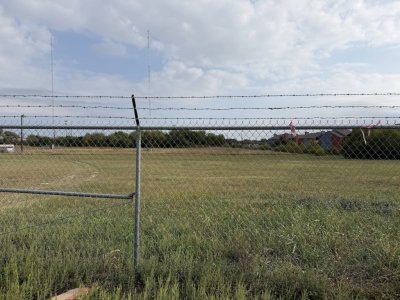

IMG_1017thumb.jpg

There are a couple more photos in full resolution images here...
 
Not a surprise. I had a feeling this was going nowhere a year into the CP. Wonder if a sale of the legacy 590 site fell through?

Also might add more to the chatter about KLBJ winding up on 93.3. If they do that it should be from the Bertram tower.

The KVET site is now an odd patch of land surrounded by vast urban sprawl. Surprised it is still there. 20 years ago there was a plan to move KVET to a new day site southeast of Austin IIRC with 5kw and a night site northeast of the city with 700 watts. Never happened.

More than 60 years ago while I was growing up in Austin the KVET site was out in the country, surrounded by disused farmland and the occasional abandoned farmhouse.
 
More than 60 years ago while I was growing up in Austin the KVET site was out in the country, surrounded by disused farmland and the occasional abandoned farmhouse.

How true of so many AM transmitter sites. Think of how Austin has grown over the years... and many other cities as well. Nielsen says the Austin market now has a population of 2.3 million. I'm sure it only had a fraction of that when the KLBJ towers were erected out in the sticks.

Maybe AM radio will collapse more from having no inexpensive places to put the towers than from a lack of ratings.
 
Maybe AM radio will collapse more from having no inexpensive places to put the towers than from a lack of ratings.
By the 1960's, post WW II urban sprawl had made most metro area AMs inadequate to cover their whole market.

When Arbitron became the accepted standard for audience measurement, we found that their methodology expended the geographic areas of markets way beyond what Pulse and Hooper used.

And the huge increase in man-made noise has reduced the effective coverage of stations as a "bigger signal" is needed to overcome that noise.

Today, there are many rated markets where no AM covers the whole market day and night with a usable signal. In many others, it is just one or two AMs that fully cover the Metro Survey Area. Only a handful have 3 or more full signals.

Coverage deficiencies have killed as many stations... or maybe more... than bad formats.
 
Today, there are many rated markets where no AM covers the whole market day and night with a usable signal. In many others, it is just one or two AMs that fully cover the Metro Survey Area. Only a handful have 3 or more full signals.

Austin is one of the "no" markets. The current KLBJ comes closest, but has some real issues in Williamson County including Georgetown. The permit KLBJ would cut the power almost by two thirds. This would likely help some in Georgetown but would create new problems in Hays and Caldwell. Also, 350 watts in a market as noisy and dense as Austin is going to have issues even within the predicted strong areas too.

The other local AMs are worse to much worse.
 
20 years ago there was a plan to move KVET to a new day site southeast of Austin IIRC with 5kw and a night site northeast of the city with 700 watts. Never happened.

Even 20 years ago, two sites around Austin would've been expensive and likely not worth the money for an AM that would, at best, barely cover the entire city (not market).

How true of so many AM transmitter sites. Think of how Austin has grown over the years... and many other cities as well. Nielsen says the Austin market now has a population of 2.3 million. I'm sure it only had a fraction of that when the KLBJ towers were erected out in the sticks.

Until the mid-80's, Austin was pretty much just a college and government town. If you looked at Austin and Tulsa in 1982, both had about the same population. If you were told at the same time that one would be one of the nation's fastest growing cities and would attract massive migration from the west coast over the next 10 years while the other would stagnate, you would likely have guessed incorrectly.

Maybe AM radio will collapse more from having no inexpensive places to put the towers than from a lack of ratings.

That's a chicken and egg question. If AM got the numbers, owners would find ways to get the land they needed for towers or would otherwise not be selling the land where the towers sit in the first place. In the 80's, AM tended to be slow to catch up programming-wise to the new FM's signing on. That didn't help the band, but, as David mentions (and most all of us have discussed at one time or another), AM's biggest problem was that it wasn't built for urban sprawl. The suburb either didn't exist or otherwise was perceived as an anomaly that would only impact big cities when AM's signed on. Going back to Tulsa and Austin, neither was predicted even 45 years ago to grow in the directions they have. Even designing an AM in 1980 for either of those markets would've left out a large chunk of suburban growth that would've put the viability of the station in jeopardy by now.
 
Until the mid-80's, Austin was pretty much just a college and government town. If you looked at Austin and Tulsa in 1982, both had about the same population. If you were told at the same time that one would be one of the nation's fastest growing cities and would attract massive migration from the west coast over the next 10 years while the other would stagnate, you would likely have guessed incorrectly.
From a few visits to Austin in the mid-1980s, I can say that this is mostly true, though you could see activity already starting up on the north side around Highway 183. The central part of the city was still pretty sleepy and relaxed. Waterloo Records was wonderful. Some of the Austin attitude made it over to Houston inside Loop 610. The first Whole Foods Market outside Austin was at South Shepherd and West Alabama in Houston, about a 10-minute walk away from my house. It fit right in to the Montrose.

In any event, Austin has changed tremendously. A lot of it seems to be about money now.

You know more about Tulsa than I do, but my perception is that Tulsa had the same problem as Houston in the 1980s: overdependence on the oil and gas industries.

AM's biggest problem was that it wasn't built for urban sprawl. The suburb either didn't exist or otherwise was perceived as an anomaly that would only impact big cities when AM's signed on. Going back to Tulsa and Austin, neither was predicted even 45 years ago to grow in the directions they have. Even designing an AM in 1980 for either of those markets would've left out a large chunk of suburban growth that would've put the viability of the station in jeopardy by now.
I agree somewhat, though I think the primary problem with AM was with directional patterns, particularly at night, that were designed for cities as they existed shortly after World War II. Suburbanization was just starting in many areas. Even where suburbs already existed, such as the Kansas side of Kansas City, the designers of those new arrays still focused on central business districts, which were still vibrant into the 1960s. Then shopping malls became more popular because they were out where people lived and were easy to get to by car, a major consideration since most cities gutted their public transit systems in the mid to late 1950s. Often, all that suburban growth managed to go where the AM signals didn't reach, especially at night. The AM stations mostly couldn't redesign their patterns to cover new areas because they'd run into some else's nighttime coverage by that point. So overpopulation of stations also played a role.
 
It took a long time for the FCC to approve the permit and when it wasn't built after the first year, I grew skeptical it was going to happen at all.

Perhaps this was just Waterloo being ready in case the "strike price" for the current 590 tower site was ever reached in an offer and with Tesla's recent struggles it was not.
 
Postscript: KLBJ has filed for an engineering STA to operate with 250 watts at night, nondirectional. No change to daytime parameters.

“Waterloo Media Group, licensee of Station KLBJ(AM), Austin, Texas, hereby requests Special Temporary Authority (“STA”) due to a recent diagnosis indicating noncompliance with the nighttime operation. Station KLBJ(AM) is licensed to operate with 5 kW daytime nondirectional and 1kW nighttime with 4 towers directional.
The diagnosis revealed that one tower appears to have a hot wire that has caused the tower lights to have shorted and a second tower that had its grounding strap knocked loose from the junction box at the bottom section of the tower. As a result, the licensee’s engineers decided it would be prudent to operate at night with the daytime tower nondirectionally with reduced power of 250 Watts pending repairs of the two nighttime towers.
Accordingly, Waterloo respectfully requests STA with reduced power at night in order to continue serving Austin and its surrounding area.”
 
The shutdown of KXSP 590 in Omaha is of interest to KLBJ. If KXSP turns in its license, I wonder if KLBJ might attempt to loosen up its night pattern?

Growing up in Austin in the 1960s I could hear what was then WOW from Omaha on 590 at night if I nulled out what was then KTBC.
 
The shutdown of KXSP 590 in Omaha is of interest to KLBJ. If KXSP turns in its license, I wonder if KLBJ might attempt to loosen up its night pattern?

Growing up in Austin in the 1960s I could hear what was then WOW from Omaha on 590 at night if I nulled out what was then KTBC.
KXSP wasn't even mentioned in KLBJ's application to move to Metric. I don't think it is a major factor holding KLBJ down.

Also, no one in building new arrays right now to enlarge coverage... regardless of market size.
 
KXSP wasn't even mentioned in KLBJ's application to move to Metric. I don't think it is a major factor holding KLBJ down.
KLBJ's null due north is very much due to KXSP. Omaha is about 5 degrees bearing from Austin, and the null is sharpest from 0 to 10 degrees.

KXSP wasn't mentioned in the site move application because KLBJ was going to downgrade to ~300 watts at night, too low to interfere with Omaha.
 
KLBJ's null due north is very much due to KXSP. Omaha is about 5 degrees bearing from Austin, and the null is sharpest from 0 to 10 degrees.

KXSP wasn't mentioned in the site move application because KLBJ was going to downgrade to ~300 watts at night, too low to interfere with Omaha.

I got that and you are correct in a sense, but in the broader context of my post, the 350 watts night proposed on Metric was not limited by KXSP. The current site likely has a limited shelf life due to property values around Tesla HQ and even in Austin, a new multi tower array for AM is very very unlikely, so if, KXSP is turned in, it likely has no meaningful impact on KLBJ.

If KLBJ were to file again to move to a different site other than Metric, the proposed facility would look a lot more like what was previously proposed and expired at the KVET Metric site than some brand new array to create a maximum facility in light of KXSP's demise.
 
KLBJ's null due north is very much due to KXSP. Omaha is about 5 degrees bearing from Austin, and the null is sharpest from 0 to 10 degrees.

KXSP wasn't mentioned in the site move application because KLBJ was going to downgrade to ~300 watts at night, too low to interfere with Omaha.
I wonder... if 590 in Omaha is turned in and cancelled... whether KLBJ might spend the needed money to relax its protection to the north.

We still do not know if the Omaha station will be sold, restored to the air or whatever....

(See another thread about WOW being turned off.... we do not know if that is permanent)
 
We still do not know if the Omaha station will be sold, restored to the air or whatever....

(See another thread about WOW being turned off.... we do not know if that is permanent)
That's right, though the prospects don't look good. A license without a transmitting site to go along with it loses a lot of value.

We may not know for sure until 2027.

What happens in San Francisco the next couple of weeks may be a bellwether.

Also, no one in building new arrays right now to enlarge coverage... regardless of market size.
That's also important to remember. I think it's unlikely anyone would recoup the investment needed to do such a thing. The only new DA projects I've heard of lately have been from Salem, and those have been to accommodate warehouse construction at or near existing sites.
 
Now we have KLIS 590 in St. Louis turning in its license. More nighttime room for KLBJ?
The suburban St Louis station was a later-era station wedged onto the the channel. I don't think is was protected by any of the prior occupants of 590.


Back
Top Bottom