
• Get involved.
    We want your input!
    Apply for Membership and join the conversations about everything related to broadcasting.

    After we receive your registration, a moderator will review it. After your registration is approved, you will be permitted to post.
    If you use a disposable or false email address, your registration will be rejected.

    After your membership is approved, please take a minute to tell us a little bit about yourself.
    https://www.radiodiscussions.com/forums/introduce-yourself.1088/

    Thanks in advance and have fun!
    RadioDiscussions Administrators

Weird audio problem at KALW

I'd been listening to KQED about an hour ago on a Superradio, no problems. At about 9:30, I switched over to KALW on 91.7 to check out the day's Fresh Air, and when they rejoined to the satellite feed, I started hearing double audio, one of which was delayed by some number of milliseconds. It created an annoying echo effect that made it tough to understand what was being discussed.

I gave it five minutes or so, and then I found the phone number, called the station and got to the air studio. The man who answered (who's the AM drive host/engineer, but I'll leave his name off this post) listened to 10 seconds of audio from my radio, then said he's listening on an air monitor and doesn't hear the problem, and nobody else has called in to report it. So I left it there.

I did a quick dial scan, and no other station on my dial was doing this (as I expected). I fired up their stream, and the problem wasn't there either. But going back to the Superradio, the problem was still there. Just to confirm it wasn't some weird anomaly with that radio, I fired up a different radio which also had the double audio. At 10:01, the station went to a feed of the BBCWS hourly newscast, which was stomped on by the feed of the live NPR hourly. When the two casts ended, the NPR feed went into some other program, while KALW's normal 10AM program sonically battled with it.

Calling the KALW studio back, I again explained that they were still concurrently airing two feeds, NPR and BBC, and he again said they don't hear any evidence of a problem, no one else has called, etc. He gave me the email of their ops manager, and I shot him an email, and that's where we left it.

I have a theory, but it's nothing more than a guess, so I'd be interested in what the assembled wisdom here thinks is (maybe by now it's "was") their problem.
 
I'd been listening to KQED about an hour ago on a Superradio, no problems. At about 9:30, I switched over to KALW on 91.7 to check out the day's Fresh Air, and when they rejoined to the satellite feed, I started hearing double audio, one of which was delayed by some number of milliseconds. It created an annoying echo effect that made it tough to understand what was being discussed.

I gave it five minutes or so, and then I found the phone number, called the station and got to the air studio. The man who answered (who's the AM drive host/engineer, but I'll leave his name off this post) listened to 10 seconds of audio from my radio, then said he's listening on an air monitor and doesn't hear the problem, and nobody else has called in to report it. So I left it there.

I did a quick dial scan, and no other station on my dial was doing this (as I expected). I fired up their stream, and the problem wasn't there either. But going back to the Superradio, the problem was still there. Just to confirm it wasn't some weird anomaly with that radio, I fired up a different radio which also had the double audio. At 10:01, the station went to a feed of the BBCWS hourly newscast, which was stomped on by the feed of the live NPR hourly. When the two casts ended, the NPR feed went into some other program, while KALW's normal 10AM program sonically battled with it.

Calling the KALW studio back, I again explained that they were still concurrently airing two feeds, NPR and BBC, and he again said they don't hear any evidence of a problem, no one else has called, etc. He gave me the email of their ops manager, and I shot him an email, and that's where we left it.

I have a theory, but it's nothing more than a guess, so I'd be interested in what the assembled wisdom here thinks is (maybe by now it's "was") their problem.
I suspect he wasn't listening to the actual air monitor, and without knowing what their setup is I'm guessing the satellite feed is accidentally patched/routed to their STL. The echo effect happens because there's a slight delay in the airchain, which is also why the operator's "off air" audio isn't really off air. That slight delay really messes with your head when you hear it in the headphones. It's weird that nobody else is complaining, but the cardinal rule is that only a small percentage (maybe someone here knows what that percentage is today) actually call in to complain when something bad happens like this.

Dave B.
 
After an hour, I went into another room and fired up a Bose Wave radio that I use bedside. The Bose was getting clean audio on 91.7. Went back to the Superradio and it still had the two audio streams. Then back to the Bose, which didn't. Strange...

At a certain point I grabbed my Qodosen DX-286, which has incredible sensitivity. Holding it next to the Superradio got me a clean KALW, but by tweaking the antenna just a bit, I was able to pull in North State Radio's 91.7 from Chico. (Sometimes I pull in 91.7 from Groveland, which is in the foothills ENE of Modesto, but they air CapRadio Music. Had it been them, the classical music would have been a giveaway.) It seems rather unlikely I was hearing two stations simultaneously on 91.7, especially when one of them is ~160 miles away.

My theory's that they have an emergency "raw" NPR feed off an on-site dish/receiver at their Twin Peaks transmitter site, set up to cut in automatically after a certain amount of dead air in case they lose their STL feed. I suspect this backup system detected silence, cut in, but never went off (or wasn't turned off) once things returned to normal. The extra milliseconds of STL delay, compared to the direct-off-satellite feed, created the weird echo I heard. I guess it's possible I was receiving a second station via e-skip, maybe even the Chico one, but then shouldn't my radio capture one or the other, but not both simultaneously for an extended (as in hours) amount of time?
 
After an hour, I went into another room and fired up a Bose Wave radio that I use bedside. The Bose was getting clean audio on 91.7. Went back to the Superradio and it still had the two audio streams. Then back to the Bose, which didn't. Strange...

At a certain point I grabbed my Qodosen DX-286, which has incredible sensitivity. Holding it next to the Superradio got me a clean KALW, but by tweaking the antenna just a bit, I was able to pull in North State Radio's 91.7 from Chico. (Sometimes I pull in 91.7 from Groveland, which is in the foothills ENE of Modesto, but they air CapRadio Music. Had it been them, the classical music would have been a giveaway.) It seems rather unlikely I was hearing two stations simultaneously on 91.7, especially when one of them is ~160 miles away.

My theory's that they have an emergency "raw" NPR feed off an on-site dish/receiver at their Twin Peaks transmitter site, set up to cut in automatically after a certain amount of dead air in case they lose their STL feed. I suspect this backup system detected silence, cut in, but never went off (or wasn't turned off) once things returned to normal. The extra milliseconds of STL delay, compared to the direct-off-satellite feed, created the weird echo I heard. I guess it's possible I was receiving a second station via e-skip, maybe even the Chico one, but then shouldn't my radio capture one or the other, but not both simultaneously for an extended (as in hours) amount of time?
Ah @Weiserguy - where is your location? If it's not directly in San Francisco proper we certainly could be having some ducting. 91.7 from Chico would explain everything.

Dave B.
 
Ah @Weiserguy - where is your location? If it's not directly in San Francisco proper we certainly could be having some ducting. 91.7 from Chico would explain everything.

Dave B.
Dave, I'm in the hills near Redwood City.

Chico's not in the exact direction of Twin Peaks from here, but maybe the few degrees of difference is insignificant.
 
Dave, I'm in the hills near Redwood City.

Chico's not in the exact direction of Twin Peaks from here, but maybe the few degrees of difference is insignificant.
Yeah, it's not so much the direction but the strength of the two signals. In your area that's going to depend significantly on reflections. The key here is what happened when you moved the Qodosen, which is going to have a very good capture ratio due to its DSP receiver. The detector in the superadio isn't nearly as good. There's a decent description of this phenomenon here:


From that article:
The capture effect can occur at the signal limiter, or in the demodulation stage for circuits that do not require a signal limiter.[3] Some types of radio receiver circuits have a stronger capture effect than others. The measurement of how well a receiver rejects a second signal on the same frequency is called its capture ratio. It is measured as the lowest ratio of the power of two signals that will result in the suppression of the weaker signal.

The Twin Peaks signal is probably not REAL strong at your location, and conditions were probably just right to allow Chico to interfere. I am surprised the audio wasn't highly distorted though. Seems like it would have sounded very multipath-y.

Dave B.
 
Ah @Weiserguy - where is your location? If it's not directly in San Francisco proper we certainly could be having some ducting. 91.7 from Chico would explain everything.

Dave B.
For me, in Saratoga, ducting from the North was really good yesterday. As an example, I received KHRD "Red 103.1" (with RDS) from Redding. I did not receive KCHO 91.7 yesterday, but I have captured it here with RDS under similar conditions.
 
Thank you both, @DaveBayArea and @snratio. Given that the unseasonably warm weather was starting to build at about that time, I now suspect you're right about it being ducting (I know I mistakenly said "e-skip" up above). The part that's harder to fathom is how the radio was pulling in and demodulating both stations simultaneously (rather than bouncing between one signal and the other based on which was instantaneously stronger) and creating that echo effect for over two hours. That threw me. That CapRadio station in Groveland has a few predictable spots in my neighborhood (including my garage) where it overwhelms the momentarily weaker KALW signal, but the radio flips from one to the other, then back, but never mixes both together into one audio stream. That was a new one. In any event, things seem back to normal, I appreciate your expert input.
 
Can go back to the '80s and the station I was at....well, you had some DJs that listened to audio straight off the console before going to the transmitter and other guys that brought in a radio and plugged their headphones in to that to get the audio straight from over the air so that way they'd know if there were any audio problems.......and at that station there was something usually going wonky once a month. I don't know why they never asked the Chief Engineer to fix it so they could have done both straight off the console. I have a feeling they may have been frightened that he'd rat them out to the PD or GM and they'd get a memo telling them to knock off bringing in an outside radio and take the audio right from the console. Never had any doubling/phasing of audio though since we never had any sister station or national feeds to deal with that had the same format. Closest we came to something like that was when I/we conspired with friends at other stations to play the same song at the same time or play the same song just after the other guy ended it. Did it till we either got yelled at about it or were afraid of getting busted....maybe did it for like three or four songs. Of course, like all good DJs, stole that idea from other DJs that did it first. But same type of problem sorta.....heard the daytime signal at nighttime, called the DJ on air who was responsible for taking the transmitter reading so he checked and said it showed it was putting out the nightime wattage and pattern so it wasn't his problem. Went on for a week till stations being interfered with called and bitched.
 
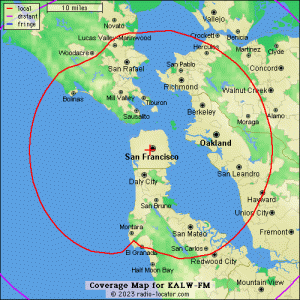
This map shows Redwood City is at the edge of where one can reach KALW-FM’s OTA signal. But i understand why KALW said there was nothing wrong with their OTA feed. Then again KALW’s core audience are in San Francisco, Oakland, Berkeley.IMG_0859.gif
 
My theory's that they have an emergency "raw" NPR feed off an on-site dish/receiver at their Twin Peaks transmitter site, set up to cut in automatically after a certain amount of dead air in case they lose their STL feed. I suspect this backup system detected silence, cut in, but never went off (or wasn't turned off) once things returned to normal. The extra milliseconds of STL delay, compared to the direct-off-satellite feed, created the weird echo I heard. I guess it's possible I was receiving a second station via e-skip, maybe even the Chico one, but then shouldn't my radio capture one or the other, but not both simultaneously for an extended (as in hours) amount of time?

i know youve got this figured out by now, but MOST stations ive been at, including one npr station, if silence is detected, will move to the next thing in the playlist that sits on the local hard drive or activate some hard drived stored material that isnt the automation and alert someone.

I'm sure some stations have back up satellite feeds somewhere but that could also present its own set of issues. past the two reievers you get that NPR gives you, you have to pay for them.

I could see KALW being a test bed for NPR's new IP delivery


Back
Top Bottom