
KDSN in Denison, Iowa is like that. They played Zedd, Miriam Bryant and Matthew Korma's "Find You" followed by 3 Doors Down's "Let Me Be Myself" earlier this morning.I know of two of those in tiny little markets. It's like listening to Hour 1 of an old AT40 all the time without the benefit of Casey's personality

-
Get involved.
We want your input!
Apply for Membership and join the conversations about everything related to broadcasting.
After we receive your registration, a moderator will review it. After your registration is approved, you will be permitted to post.
If you use a disposable or false email address, your registration will be rejected.
After your membership is approved, please take a minute to tell us a little bit about yourself.
https://www.radiodiscussions.com/forums/introduce-yourself.1088/
Thanks in advance and have fun!
RadioDiscussions Administrators
You are using an out of date browser. It may not display this or other websites correctly.
You should upgrade or use an alternative browser.
You should upgrade or use an alternative browser.
What happens to songs not in a station's active playlist?
- Thread starter tall_guy1
- Start date
In the past, when a station had programming and engineering people on staff who cared a great deal about their on-air sound, yes, they would often make extensive tweaks to their copies of older songs to assist the processing in producing the best on-air sound possible for each song. Those tweaks could consist of absolutely anything: linear equalization, de-essing, taming screechy upper mids or honking midranges by appying gentle compression to just one frequency range, light amounts of AGC, de-noising, or even just finding obscure out-of-print copies of songs that there were no decent-sounding modern issues of. Michael Hagerty mentioned this being one of former KRTH chief engineer Lynn Duke's passions when the station was still running 50s-70s oldies, for example (see here).Basically, the sound quality/volume of the individual track if it does not go through modernization needed to sound on par with current tracks (for example, older songs' sound quality is different and radio stations process songs to be up to par.)
I got to talk with Lynn a few times during the Usenet era, and can add that he told me KRTH had two identical airchains -- i.e., a clone of the famous fogged cabinet, made up of all the same boxes, each modified and adjusted in exactly the same ways. The reason was so the station could transparently switch to the auxiliary chain if anything happened to the primary. But knowing that, I wouldn't be surprised if Lynn used that auxiliary chain whenever tweaking songs in the station's library. With it just sitting around idle otherwise, it would have made perfect sense to utilize it that way, so as to be able to hear exactly how each tweak was interacting with the station's processing in real time. Absolute best way to achieve perfect results.
The industry being what it is now, I doubt much of this finessing still goes on. There's less need for it with 50s/60s oldies now as scarce as they are. The intelligence in modern digital processors is also much better at correcting disparate source material for consistency than it previously was.
And then you have the sound of eCBET and Voltair enshittifying the sound signatures of most stations in PPM markets. That ought to be enough to demoralize any engineer out of spending time polishing much of anything these days.
The main one that always comes to mind for me is WPNC in Plymouth, North Carolina. They advertise themselves as having over 12,000 songs in regular rotation. The problem, of course, is that if you like one song you likely won't like or want to hear the next. And if you listen for any length of time, you'll hear a stiff or album cut you've never heard before.KDSN in Denison, Iowa is like that. They played Zedd, Miriam Bryant and Matthew Korma's "Find You" followed by 3 Doors Down's "Let Me Be Myself" earlier this morning.
On weekends it's all syndicated stuff. Good shows, but they don't always flow together. Flashback with Matt Pinfield, Yacht Rock shows, AT40 70s and 80s, Backtrax, Dave Koz Jazz, etc., all on the same day. They flip to Christmas in Nov/Dec but not on the weekends because they don't pre-empt any of these shows. So they'll advertise themselves as "The Christmas Station" but the last time Christmas was on a Saturday, anyone waking up hoping for Christmas music got classic rock with Matt Pinfield instead.

K.M. Richards
Program Director, The Eighties Channel™
First off, this thread is a pretty funny read.
To everyone but the OP, I suspect.
I know some old songs need to be reprocessed for current sound quality.
I don't know of any stations that "reprocess". I suppose someone, somewhere does.
Without opening further cans of worms...
In most modern automation systems (NexGen, Zetta, WideOrbit being 3 of the most popular in the U.S.), the song file is simply saved in the system at whatever level it came from, be it from the record label, from ripping a track from a CD, whatever.
The system has a configured playback level that someone, likely an engineer, set up on installation. Let's suppose it's -17 LUFS. That's a pretty good level that ensures nothing will be clipped if it actually needs to be turned up.
All audio that plays out will play out at this level. The playout system anazlyses the average level of each file, and adjusts the playback level so the average level is the same across all cuts. It won't change in real time...it's the average for the file, so you're still preserving dynamic range.
The audio cuts themselves, whether it be a song, jingle, commercial, will not be touched. But their level of playback will all be at a standard level. So a newer song that has been more heavily compressed in the mastering stage might get turned down more than something from 40 years ago. That may not need to be turned down at all.
This provides a consistent level that then feeds the stations audio processing box (likely an Omnia or Orban). This is where a stations "signature sound" is dialed in, and you can adjust things like clipping, attack and release time for how fast it reacts to changes in level, etc. Providing a consistent level to your processor will make it's job much easier and the station will sound better for it.
TL;DR - stations don't reprocess. The automation has a playback level for all cuts, the downstream audio processor sets the overall sound for the radio station.
K.M. Richards
Program Director, The Eighties Channel™
TL;DR - stations don't reprocess. The automation has a playback level for all cuts, the downstream audio processor sets the overall sound for the radio station.
And the second will optimize the overall sound and level to however the station wants to be heard by a listener tuning in.
Any programmer who tries to re-EQ (which is what I think @tall_guy1 means by his made-up word) is playing with fire and pouring gasoline on it ... especially with gold. The listeners have subconscious memories of what their favorite songs sounded like when they were currents, and when you try to "fix" that by reprocessing, you end up with something not much better than those abominations of re-records that Madacy is infamous for releasing on "greatest hits" albums.
Once again, our friend has some unique preconceptions about our business, and his only ongoing mistake is not learning from the answers to his questions and therefore asking more absurd questions.


The era of the Voltair is pretty much over. If you look at the Telos page, it's apparently not available. This is mostly because Nielsen introduced its own processing device for stations... and which is far less noticeable.And then you have the sound of eCBET and Voltair enshittifying the sound signatures of most stations in PPM markets. That ought to be enough to demoralize any engineer out of spending time polishing much of anything these days.
Here is an interesting Radio World article on PPM in general...
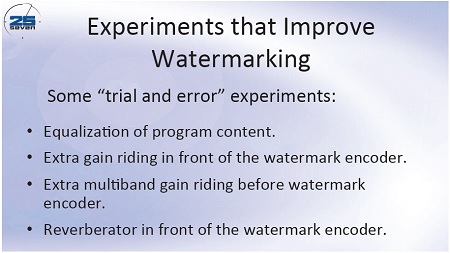

Interesting!First off, this thread is a pretty funny read.
Second, as others have said, it depends.
But really, where a lot of songs go is "into the grubby hands of people with access to the media." Way back when I was a young lad during the time when stations actually played vinyl records, I met a Music Director who'd amassed a collection of 20,000 albums from his time in album rock radio. Fast forward 30 years later and I'm doing kind of the same thing..."acquiring" a copy of the music library of a defunct alternative station before it was wiped from the servers. Oddly enough my collection of songs I've surreptitiously...collected is about the same number as that man I met so long ago...20,000.
It's a fringe benefit of a radio career.
I do all sorts of stuff like that for my Part 15 station.In the past, when a station had programming and engineering people on staff who cared a great deal about their on-air sound, yes, they would often make extensive tweaks to their copies of older songs to assist the processing in producing the best on-air sound possible for each song. Those tweaks could consist of absolutely anything: linear equalization, de-essing, taming screechy upper mids or honking midranges by appying gentle compression to just one frequency range, light amounts of AGC, de-noising, or even just finding obscure out-of-print copies of songs that there were no decent-sounding modern issues of. Michael Hagerty mentioned this being one of former KRTH chief engineer Lynn Duke's passions when the station was still running 50s-70s oldies, for example (see here).
I got to talk with Lynn a few times during the Usenet era, and can add that he told me KRTH had two identical airchains -- i.e., a clone of the famous fogged cabinet, made up of all the same boxes, each modified and adjusted in exactly the same ways. The reason was so the station could transparently switch to the auxiliary chain if anything happened to the primary. But knowing that, I wouldn't be surprised if Lynn used that auxiliary chain whenever tweaking songs in the station's library. With it just sitting around idle otherwise, it would have made perfect sense to utilize it that way, so as to be able to hear exactly how each tweak was interacting with the station's processing in real time. Absolute best way to achieve perfect results.
The industry being what it is now, I doubt much of this finessing still goes on. There's less need for it with 50s/60s oldies now as scarce as they are. The intelligence in modern digital processors is also much better at correcting disparate source material for consistency than it previously was.
And then you have the sound of eCBET and Voltair enshittifying the sound signatures of most stations in PPM markets. That ought to be enough to demoralize any engineer out of spending time polishing much of anything these days.
When I add songs, I meticulously slave over each one, trying to find the best quality version, lightly reprocessing them as needed.
I also slave over the processing, which, of course, is nowhere near the quality of an Optimod or whatever.
But nevertheless, when I listen to my station in the car and do comparisons between it and several other music stations, it really sounds much better than all the commercial stations I hear (KYNO out of Fresno (comes in almost like a local most nights) sounds excellent as far as music and imaging are concerned, but they really ought to dial back their processing a bit, and actual local KXBX (I'm about 10 road miles from the transmitter) sounds like they don't use processing at all, so it sounds kind of strange). It has a nice depth, and it's very clean and transparent sounding, at least to my ear.
I want my station to be the best sounding one that people will never hear!
c
K.M. Richards
Program Director, The Eighties Channel™
KYNO is actually proud of their overprocessing. They think it makes them sound more authentic.
Ah, I see. Far be it for me to complain, then!KYNO is actually proud of their overprocessing. They think it makes them sound more authentic.
Did stations really sound like that back in the 60s? Most of the various airchecks I've heard sound less processed than KYNO?
c
One station I worked for in the 90s had bins for 12" and 7" records mounted to a wall of the studio, floor-to-ceiling except for one window. Probably 30 plywood cubes, which should have held 75-100 LP albums each, and a smaller number of 7" cubes. Wasn't a huge studio... I'd say 250 sqft. The station offices were down the hall in that building.How did they fit so many records in such a small building?
But the records were long gone, because it was the 90s. Made nice cubbies for the staff to put office supplies, jackets, and various other stuff though.
The '60s had several songs with intentionally distorted audio. "Go Now," by the Moody Blues, comes to mind, along with the Tornados' "Telstar." There was nothing any oldies station could do to make those recordings sound as good as the rest of the songs on the playlist. I'm surprised that they were still getting airplay in the early '00s.

A station I worked at has a HD-2 that flipped formats quite often. I found stuff in the Wide Orbit central server from 2008, 16 years later. Since there is only two people working there as paid employees, all of that stuff never gets deleted unless the GM does it when a jock plays something from that ancient library. Otherwise, it will be overwritten when new stuff gets imported within existing categories (instead of complicating it by creating new categories). There are no vintage jingles from the early 2000 since they were all overwritten with new stuff in the JIN category. I did a lot of work on our Wide Orbit system, so I know more about it than someone should not employed in broadcast.
Yes and no, K.M.And the second will optimize the overall sound and level to however the station wants to be heard by a listener tuning in.
Any programmer who tries to re-EQ (which is what I think @tall_guy1 means by his made-up word) is playing with fire and pouring gasoline on it ... especially with gold. The listeners have subconscious memories of what their favorite songs sounded like when they were currents, and when you try to "fix" that by reprocessing, you end up with something not much better than those abominations of re-records that Madacy is infamous for releasing on "greatest hits" albums.
Once again, our friend has some unique preconceptions about our business, and his only ongoing mistake is not learning from the answers to his questions and therefore asking more absurd questions.
I have a bit of a problem with the "subconscious memories of what their favorite songs sounded like when they were currents" argument you're making. For 50s/60s oldies, for example, this means even FM stations should be using the original mono 45 mixes which often sounded a lot different than their (often inferior) stereo counterparts. Also, a song sounds a lot different through a CBS Audimax/Volumax than it does through even an early-80s Orban box, for example. And of course, FM sounds far different than AM.
I'd argue that an FM station playing the stereo version of "Green Tamborine" through a modern processing box is going to sound almost nothing like the AM station with an Audimax/Volumax, or even Level Devil on a smaller market station in '67 they probably heard it on as a current. In fact, adding a bit more bass to that awfully wimpy stereo mix would probably make it sound more like what listeners would remember.
I realize that's a somewhat archaic example, but I think it illustrates my point well.
I bought some old CBS rigs a few years back and played "Shannon" by Henry Gross through it for my dad (he was a kid when the song was a current). His face immediately lit up and he said "WOW! This takes me back to my childhood. I haven't heard that song sound like that since I was a kid!" He's not an audio nerd (never worked in radio, either) and is a pretty typical 60-something-year-old, albeit one who loves music. The processing was a big part of the experience of hearing a current on the radio. Modern processing isn't going to replicate that. So why not tweak a song's sound a bit to optimize it for airplay?
Last edited:
You mean an "Orban" box, right? As in "Optimod"?Also, a song sounds a lot different through a CBS Audimax/Volumax than it does through even an early-80s Urban box, for example. And of course, FM sounds far different than AM.
Oh yes, thanks for catching that David! Autocorrect... I went ahead and fixed it.You mean an "Orban" box, right? As in "Optimod"?
K.M. Richards
Program Director, The Eighties Channel™
The processing was a big part of the experience of hearing a current on the radio. Modern processing isn't going to replicate that. So why not tweak a song's sound a bit to optimize it for airplay?
I think there are some circumstances where that would improve the song significantly without affecting listeners' memories of the original.
But my point was -- and continues to be -- that such tweaking should not be an automatic policy. Applied on a case-by-case basis, maybe. It would depend on how aggressive the processing was and how far from the original sound a PD would want to stray.
I'd love it if I had access to an Audimax/Volumax. It would definitely make my Part 15 station sound different.
I use Stereo Tool presently, and I've got it to the point where it sounds pretty good, but it's kind of flat and boring.
It does have the advantage of not taking up any physical space, which I like.
These days with all these digital models of analog gear such as compressors and reverbs, why doesn't someone create an Audimax/Volumax model so we can use it as a digital plugin?
There's nothing like the real thing, of course, but it might be fun for playing around with.
c
I use Stereo Tool presently, and I've got it to the point where it sounds pretty good, but it's kind of flat and boring.
It does have the advantage of not taking up any physical space, which I like.
These days with all these digital models of analog gear such as compressors and reverbs, why doesn't someone create an Audimax/Volumax model so we can use it as a digital plugin?
There's nothing like the real thing, of course, but it might be fun for playing around with.
c
Surely someone must have. There's thousands of presets. Here's one I found that may be close to the CBS processors and their competitors:These days with all these digital models of analog gear such as compressors and reverbs, why doesn't someone create an Audimax/Volumax model so we can use it as a digital plugin?
But the Audimax/Volumax sucks, being a single band. It's 60 year old technology. Wanting to emulate that is like wanting to emulate vinyl records.
...Oh, right... It's 2026, and vinyl is back.
