• Get involved.
    We want your input!
    Apply for Membership and join the conversations about everything related to broadcasting.

    After we receive your registration, a moderator will review it. After your registration is approved, you will be permitted to post.
    If you use a disposable or false email address, your registration will be rejected.

    After your membership is approved, please take a minute to tell us a little bit about yourself.
    https://www.radiodiscussions.com/forums/introduce-yourself.1088/

    Thanks in advance and have fun!
    RadioDiscussions Administrators

Minimum signal strength for RDS?

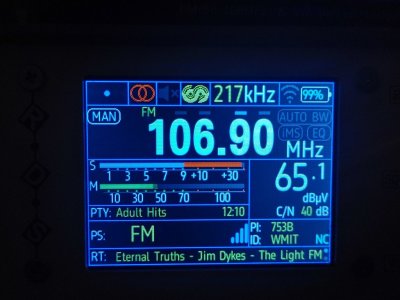
I was listening to WMIT-FM 106.9, which has the mother of all FM catbird seats at 6744' ASL atop Clingmans Peak near Mount Mitchell, here along I-20 in Columbia SC, and I had a reasonably strong signal, but no RDS data. What kind of signal strength threshold, if any, is there before RDS data will display?

Too bad nobody has a TV transmitter up there.
 
I did a quick search and found that WMIT FM doesn't broadcast with RDS.

My experience from E Skip and tropo when I lived in Florida shows that the RDS will only register if the signal reaches a maximum threshold.

The signal can sound strong and be in stereo but the RDS only is registered by the receiver after a certain point.

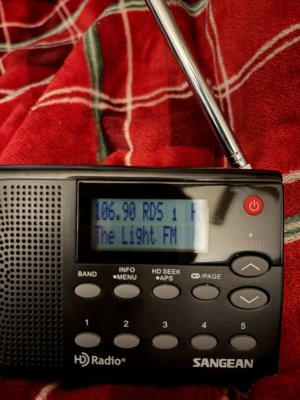
Here's an example where the RDS only registers once the signal is strong enough and then the wording froze because the signal couldn't sustain that same level of strength.


I miss my Sangean PR-D5 but I like my C. Crane Skywave better.
 
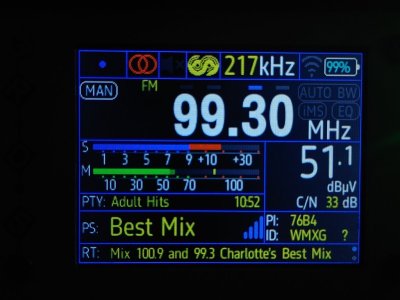
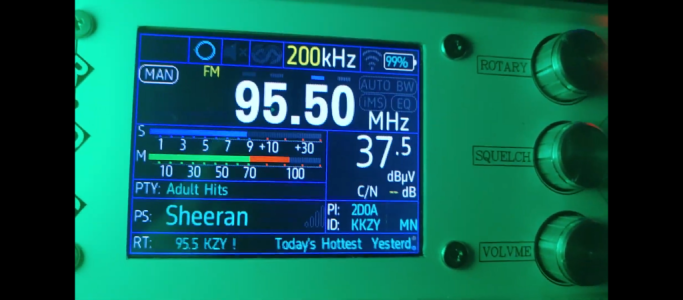
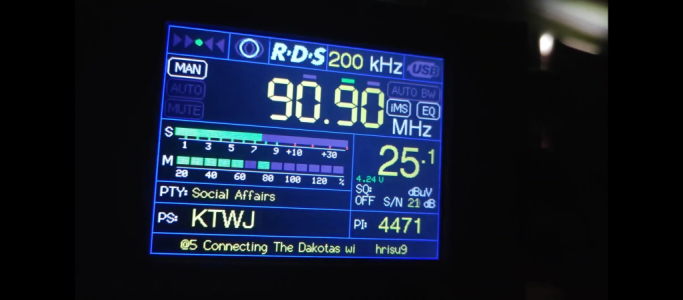
Try the Tef86 SDR Radio Receiver ..
Easily Decodes RDS and Station PI data - ID's the station without having to wait til the top of the hour. Fair Signal is usually good enough to decode most stations .. Nice to do that during E-Skip & Tropo DX ... Some Reception Images Attached
 

Attachments

  • 0308261852.jpg
    0308261852.jpg
    102.7 KB · Views: 23
  • 0308261910a.jpg
    0308261910a.jpg
    113.2 KB · Views: 14
  • Screenshot_20260308-192219.png
    Screenshot_20260308-192219.png
    372.1 KB · Views: 14
  • Screenshot_20260308-192304.png
    Screenshot_20260308-192304.png
    296.2 KB · Views: 21
Some stations have their RDS injection at higher levels, some at lower levels. In Idaho, I can't get RDS from KBXL-94.1 Boise until I get about 10 miles from Horseshoe Bend. The other FMs are fine.
One station that ALWAYS cues RDS even at weak signals is KSOM 96.5 Audubon, IA. The Es signal could be fuzzy and grainy, and "KSOM" RDS IDs will still pop in.
 
Does RDS work without the pilot tone? I've seen some MONO talk stations broadcast RDS without the pilot and my radios seem to decode everything just as fine without it.
 
Keep in mind that stations can inject their RDS signal at different levels. I usually keep mine at about a 5.5% injection level, which typically gives me good RDS decoding out past my 60 dBu contour on most car radios.
 
I was listening to WMIT-FM 106.9, which has the mother of all FM catbird seats at 6744' ASL atop Clingmans Peak near Mount Mitchell, here along I-20 in Columbia SC, and I had a reasonably strong signal, but no RDS data. What kind of signal strength threshold, if any, is there before RDS data will display?

Too bad nobody has a TV transmitter up there.
The other blowtorch signal in western North Carolina is WKSF-99.9 atop Mt. Pisgah. I believe it shares the same TV tower as Channel 13-WLOS. In the analog era, WLOS had a powerful TV signal reaching multiple states. But after the digital conversion, they adopted a directional pattern that is subject to VHF noise and interference. The signal is now problematic in the Upstate of South Carolina. They have a permit to move to Pinnacle Mountain, but it was delayed due to Hurricane Helene. Too bad WLOS can't adopt an omnidirectional UHF signal on Mount Pisgah. It is one of the tallest broadcast towers east of the Mississippi. But on Channel 13 they have to protect WBTW in Florence, SC and a channel in Roanoke.
 
The other blowtorch signal in western North Carolina is WKSF-99.9 atop Mt. Pisgah. I believe it shares the same TV tower as Channel 13-WLOS. In the analog era, WLOS had a powerful TV signal reaching multiple states. But after the digital conversion, they adopted a directional pattern that is subject to VHF noise and interference. The signal is now problematic in the Upstate of South Carolina. They have a permit to move to Pinnacle Mountain, but it was delayed due to Hurricane Helene. Too bad WLOS can't adopt an omnidirectional UHF signal on Mount Pisgah. It is one of the tallest broadcast towers east of the Mississippi. But on Channel 13 they have to protect WBTW in Florence, SC and a channel in Roanoke.

WLOS, back in the day, was the only ABC affiliate on VHF from Cincinnati all the way down to Augusta GA, and when UHF posed more of a challenge, became the default ABC affiliate for viewers in several states. They got deep into southeastern Kentucky and were carried on cable as far north as Corbin and London. They also had translators in that area. And it wasn't only Florence and Lynchburg, I'd imagine they had to protect stations on channel 13 in Huntington WV (WHTN/WOWK) and Macon (WMAZ). It wasn't unknown for both WHTN and WLOS to be carried on a single cable system in Kentucky (would have needed highly directional antennas with some kind of shielding on the back end).

WKSF has a very large coverage area, but nothing compared to WMIT. I was able to get WMIT last night on my handheld radio with a TEF6686 chip and a small FM antenna in back of my house that I cannibalized from an old RadioShack VHF/UHF yagi and installed an inline amplifier.


Back
Top Bottom