• Get involved.
    We want your input!
    Apply for Membership and join the conversations about everything related to broadcasting.

    After we receive your registration, a moderator will review it. After your registration is approved, you will be permitted to post.
    If you use a disposable or false email address, your registration will be rejected.

    After your membership is approved, please take a minute to tell us a little bit about yourself.
    https://www.radiodiscussions.com/forums/introduce-yourself.1088/

    Thanks in advance and have fun!
    RadioDiscussions Administrators

Stations running crawls during E-skip season?

Back in the 1970s, I recall WSAZ (channel 3) in Huntington WV running a crawler (and may even have announced on-air, I have a vague and possibly false memory of Bos Johnson doing this) telling viewers, during E-skip season in the summer, that "atmospheric conditions" might interfere with reception, and that there was nothing they could do about it.

Did any other stations ever do this?

Sadly, with the dearth of low-VHF stations, and the problems with DXing that go with digital TV, this isn't really a "thing" anymore. I had a Televes DATBOSS with a low-VHF add-on installed two years ago, and have yet to log a single low-VHF station.
 
Last edited:
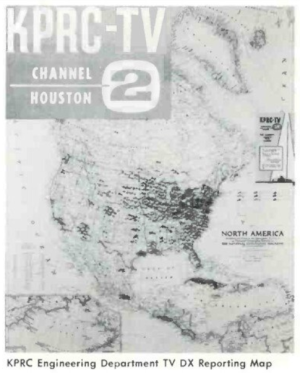
I vaguely recall KPRC/2 in Houston running a crawl when E-skip was kicking up in the analog era. Their signal would take quite a beating from other stations on Channel 2.
 
I vaguely recall KPRC/2 in Houston running a crawl when E-skip was kicking up in the analog era. Their signal would take quite a beating from other stations on Channel 2.
Of course, if your signal is getting beaten down during tropo, it's also getting bounced somewhere else... the KPRC engineering department kept a pushpin map of reception reports in the 50s and 60s
1773327222961.png
 
Last edited:
In 1979, which was a great year for DXing (in my south suburban Chicago home). Channel 2 WBBM was getting messed up on and off for a week by WTWO, in Terre Haute so WBBM started running a scroll telling people not to call the station as there was nothing you could do about it.
 
"Can you please broadcast an announcement telling all our listeners we're off the air?"

Well, they didn't have websites then, so that's really about all they could do. Viewers would probably have to be in a deep fringe area for the station to be totally overridden, in most cases it would be more a matter of the station's signal being compromised by co-channel interference, rather than being totally unviewable. At the height of E-skip openings, WSAZ could get kind of shaky, with intermodulation bars (or whatever they are called) running up and down the picture.
 
WBBM also mentioned it on the news once or twice. Never got KPRC here in the southwest suburbs of Chicago, but a bunch of other channels 2, including WCBS.
 
The first skip signal I recall getting was in southern Maine. 1986. I saw a car ad on channel 2, which greater Portland didn't have. I thought it was NBC 2 from Bangor...until I saw "Charleston". It was channel 2 (WCBD) from Charleston, SC. After that, I would frequently get channel 2 from Daytona Beach (WESH) and Miami (WPBT).

Here in Connecticut, I would get those two, along with Cedar Rapids, IA (KGAN) and, one time only, Tulsa (KJRH). There was also one day when local 3 (WFSB) of Hartford was getting stepped on. I couldn't tell who was trying to pop in.
 
The first skip signal I recall getting was in southern Maine. 1986. I saw a car ad on channel 2, which greater Portland didn't have. I thought it was NBC 2 from Bangor...until I saw "Charleston". It was channel 2 (WCBD) from Charleston, SC. After that, I would frequently get channel 2 from Daytona Beach (WESH) and Miami (WPBT).

Here in Connecticut, I would get those two, along with Cedar Rapids, IA (KGAN) and, one time only, Tulsa (KJRH). There was also one day when local 3 (WFSB) of Hartford was getting stepped on. I couldn't tell who was trying to pop in.
Those were the days. Unfortunately the clearing-out of the low-VHF band, and the inherent limitations of digital TV where DX is concerned (no more getting a very weak signal with enough information to identify, you either have the signal or you don't), have made summer long-haul E-skip very much a thing of the past. Some receivers will decode enough of a pilot signal to give you PSIP information even if you never get audio or video. That happens for me sometimes when I do an additive scan on the ZapperBox.
 
"How can we tell them we're off the air when we're off the air?" :ROFLMAO:
Well, in the case of running a crawler during E-skip openings, the station isn't off the air, it's just more difficult to receive. When WSAZ ran that crawler, especially given the terrain in that area, I have to imagine that by the time you got out to places such as Pikeville, Athens, or Marietta, the signal would have been so degraded as to be unwatchable due to the interference. It's something utterly beyond the station's control (though obviously fiber feeds to cable systems or other MVPD providers would be unaffected, that's how stations can stay "on the air" even when their transmitters are down).
 
Of course, if WTWO’s signal was blowing out WBBM, WBBM’s viewers couldn’t see the crawl.
WBBM-TV ran much lower power than most stations on Channel 2 in the analog days. About 40 kW ERP or thereabouts. They were iffy even in Northwest Cook County and were snowy in Lake County. I lived in both areas at one time or another between 1979 and 1994. An outside antenna was required to pick up both it and WMAQ-TV/5 anywhere outside the 294. Channel 5 also ran lower power than normal for a VHF-LO station.

WTWO ran the full 100 kW, and put a good signal into the entire West Central Indiana and East Central Illinois area. No shock that they could override WBBM-TV if the weather was right. They were one of only three channels I could pick up on a portable TV with rabbit ears in my hometown of Bloomington IN, 60 miles ESE of Terre Haute. The others were WTTV/4 and local PBS WTIU/30.
 
Well, in the case of running a crawler during E-skip openings, the station isn't off the air, it's just more difficult to receive. When WSAZ ran that crawler, especially given the terrain in that area, I have to imagine that by the time you got out to places such as Pikeville, Athens, or Marietta, the signal would have been so degraded as to be unwatchable due to the interference. It's something utterly beyond the station's control (though obviously fiber feeds to cable systems or other MVPD providers would be unaffected, that's how stations can stay "on the air" even when their transmitters are down).
I was just channeling WKRP In Cincinnati, although I never saw such a crawl on any TV station back in the day. If the skip was in, Sporadic-E or Tropo (more prevalent on VHF-HI and UHF), that was just the way it went.
 
WBBM-TV ran much lower power than most stations on Channel 2 in the analog days. About 40 kW ERP or thereabouts. They were iffy even in Northwest Cook County and were snowy in Lake County. I lived in both areas at one time or another between 1979 and 1994. An outside antenna was required to pick up both it and WMAQ-TV/5 anywhere outside the 294. Channel 5 also ran lower power than normal for a VHF-LO station.

WTWO ran the full 100 kW, and put a good signal into the entire West Central Indiana and East Central Illinois area. No shock that they could override WBBM-TV if the weather was right. They were one of only three channels I could pick up on a portable TV with rabbit ears in my hometown of Bloomington IN, 60 miles ESE of Terre Haute. The others were WTTV/4 and local PBS WTIU/30.
Low-VHF had the advantage of being able to carry over longer distances, 100 miles was not at all uncommon. The signal might not be much by the time it got there, but at least it was something, and in difficult reception areas, viewers could be very forgiving.

I don't believe I've ever viewed a low-VHF digital station except for WGGS Greenville SC when they were on RF 2, and I could literally see the transmitter from our hotel in Travelers Rest. I could sit out on the patio at night and look at their tower lights blinking on and off. I almost always carry at least basic TV equipment when I travel by car (small antenna, tripod, PVC pipe sections that I put together with joiners for a mast, preamp, coax, and small TV set).
 
WBBM-TV ran much lower power than most stations on Channel 2 in the analog days. About 40 kW ERP or thereabouts....
I am assuming they ran on lower power because there transmitter was on the Sears Tower (or maybe Hancock either way a tall building). Is this so? If not then why?
 
I am assuming they ran on lower power because there transmitter was on the Sears Tower (or maybe Hancock either way a tall building). Is this so? If not then why?
Per the 1972 Television Factbook, both WBBM and WMAQ on RF 5 had their towers on the John Hancock building with similar power. (I chose this edition because it was the last one available that shows the counties reached, with legends for three different tiers of viewership, in an "at a glance" format.)

Just guessing, it was possibly the height, as well as perhaps simply not needing to use that much power to reach their desired market. Could the FCC have limited both stations' power due to the height of the transmitter and HAAT? It may be kind of apples and oranges, but I know that low-VHF stations with transmitters at very high elevations, such as in mountainous regions, would have reduced power apparently for that reason, examples being WSAZ, WSVA/WHSV, WCYB, and WHIS/WVVA. Indeed, WSVA/WHSV was specifically restricted to 8.32kw visual and 1.66kw aural, on the rare occasion I could get it in Fairfax City VA when I lived there, the signal had a faded, washed-out look. They definitely had one hand tied behind their back. Being in the National Radio Quiet Zone could also have been a factor.
 
I am assuming they ran on lower power because there transmitter was on the Sears Tower (or maybe Hancock either way a tall building). Is this so? If not then why?
I remember reading something about 2 and 5 being forced to lower power by the FCC due to protests from the CBS and NBC affiliates in adjacent markets Milwaukee, Rockford, South Bend, and Grand Rapids/Kalamazoo, all within 100 air miles of downtown Chicago. They didn't want competition from Chicago stations, and this was long before the John Hancock Center and Sears Tower were built.

But believe me, as a former resident of Lake, DuPage, and NW Cook County, I can assure you that Channels 2 and 5 did not cover the entire Chicago TV market without cable (which didn't exist there until the early 1980s) or a good outside antenna. In all three areas, rabbit ears were just about useless.

I wonder if the NYC stations had to do the same thing, with Hartford and Philly being about the same distance away?
 
Just like FM stations, TV stations have to reduce power to compensate for antenna height in certain circumstances. I'm pretty sure that was the case for 2 and 5 in the analog era.

It's not about protecting adjacent markets - it's about protecting co- and adjacent-channel stations, which in this case would be Green Bay, St. Louis, 3 in Champaign and Kalamazoo and 4 in Milwaukee.


Back
Top Bottom