
• Get involved.
    We want your input!
    Apply for Membership and join the conversations about everything related to broadcasting.

    After we receive your registration, a moderator will review it. After your registration is approved, you will be permitted to post.
    If you use a disposable or false email address, your registration will be rejected.

    After your membership is approved, please take a minute to tell us a little bit about yourself.
    https://www.radiodiscussions.com/forums/introduce-yourself.1088/

    Thanks in advance and have fun!
    RadioDiscussions Administrators

An AM nearly 2khz off frequency?

Most nights, I've had a rumble on 970 that's clearly someone off frequency but most nights, there's no audio

A week or two ago, someone posted to a DX list from another state that they had a rumble on 970 too and it was KVWM... to which I said "that solves a mystery for me"

A DXer on the west coast measured KVWM nearly 2khz off frequency last night!

Normally I'm one of the first to call someone out but this is a DXer of 40 plus years whos also using pretty sophisticated equipment plus its plainly obviously to even the basic hobbyists ear that KVWM is WAY off kilter
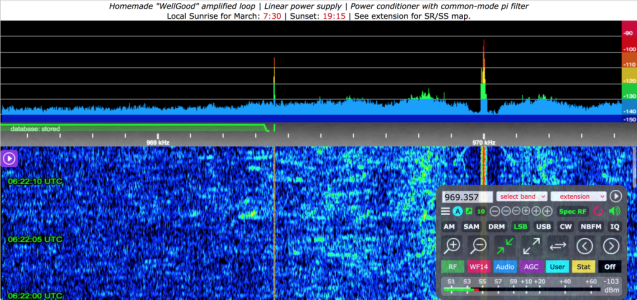
 
Most nights, I've had a rumble on 970 that's clearly someone off frequency but most nights, there's no audio

A week or two ago, someone posted to a DX list from another state that they had a rumble on 970 too and it was KVWM... to which I said "that solves a mystery for me"

A DXer on the west coast measured KVWM nearly 2khz off frequency last night!

Normally I'm one of the first to call someone out but this is a DXer of 40 plus years whos also using pretty sophisticated equipment plus its plainly obviously to even the basic hobbyists ear that KVWM is WAY off kilter

That station (licensed to Show Low, AZ) used to be owned by Petracom. However, Petracom (if memory serves) went bankrupt and it's now owned by Simcast LLC. I have absolutely no idea who is behind Simcast LLC and how much that person knows about radio. And I don't know how much the FCC cares about being off frequency like that, though I think they should.
 
Yeah, that's 970 KVWM (Show Low, AZ).

I had them here in the Minneapolis/St.Paul area early in the morning hours on April 1st. They were in and out with audio matched to their online stream. Arizona AM log #10 for me here.

KVWM offset.png

@ted chittenden The FCC has a carrier offset limit of ±20Hz. Although, there's many stations who have been running greater than that for quite some time now.
 
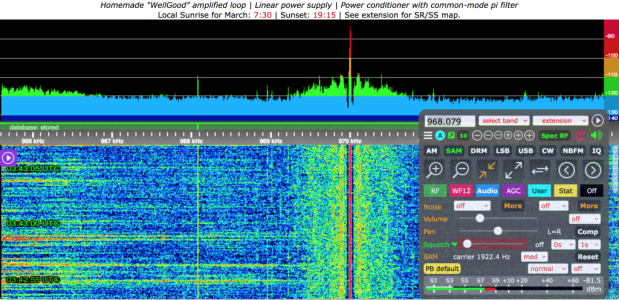
KVWM is almost -2kHz off tonight. They are at 968.079 at the moment.


View attachment 11768

KVWM is almost -2kHz off tonight. They are at 968.079 at the moment.


View attachment 11768
You're hearing it in Minnesota (and, to a lesser extent, @SomeRadioGuy's hearing it in Wyoming) suggests something else to me. KVWM's power output is supposed to be 5Kw by day and .195Kw at night and I'm beginning to wonder now if KVWM is also not reducing its power after sunset.
 
Not being on the technical side, asking the more adept members here. Is this something the operator of the staiton culd easily fix, if someone could get ahold of them? Or is this a much more dificult thing to solve that might be systemic in their array etc.? Is this IS the Show Low station, they only have the one tower so logic would say it is not at that end. But you folks would know more than me.
 
You're hearing it in Minnesota (and, to a lesser extent, @SomeRadioGuy's hearing it in Wyoming) suggests something else to me. KVWM's power output is supposed to be 5Kw by day and .195Kw at night and I'm beginning to wonder now if KVWM is also not reducing its power after sunset.
195 watts can get out quite well, if only to cause a het.

AM DXers use the presence of various hets on 10 kHz spaced stations as an indication that trans-Atlantic or trans-Pacific signals are coming in from 9 kHz spaced stations.
 
Depends the age and type of transmitter. Some of the old "tube" rigs had a "crystal oven". Which could be used economically if the daytime 5 kw transmitter won't step down to 195 easily.

Whoever is monitoring the transmitter (contract engineer?) could be getting "wonky" readings since you usually try to match your antenna to 50 ohm feed at that frequency especially if it's a "narrow tuned" antenna.*.

At one time you would take frequency + or - readings with transmitter readings but that is not required any more.

*Rumor was WHAS 840's antenna was so narrow tuned that they couldn't run IBOC. They did have AM stereo so I am not sure of that rumor. I only dealt with their production department when they used my commercials.
 
Depends the age and type of transmitter. Some of the old "tube" rigs had a "crystal oven". Which could be used economically if the daytime 5 kw transmitter won't step down to 195 easily.

Whoever is monitoring the transmitter (contract engineer?) could be getting "wonky" readings since you usually try to match your antenna to 50 ohm feed at that frequency especially if it's a "narrow tuned" antenna.*.

At one time you would take frequency + or - readings with transmitter readings but that is not required any more.

*Rumor was WHAS 840's antenna was so narrow tuned that they couldn't run IBOC. They did have AM stereo so I am not sure of that rumor. I only dealt with their production department when they used my commercials.

To give a historical context, when KVWM first signed on the air (1963, if I remember correctly) until sometime in the 1990s (after the station was sold from its original owner, again from memory), it was a daytime-only AM operation. It added a small but full power FM in 1970 (again from memory) to handle any nightime operations, but all of those operations ended at 10pm on most nights. Given all of that and the history of its ownership, I'd be *very* surprised if the station was using any new transmitting equipment today.
 
Since 'normies' will be listening locally, using their car radios that only tune in 10khz increments, being 2k off is only going to effect 6 out of the 17 folks that listen on a regular basis to the AM.

Probably a few more of those out there with some ancient GE table radio with analog tuning in the kitchen would notice nothing at all.
 
Whoever is monitoring the transmitter (contract engineer?) could be getting "wonky" readings since you usually try to match your antenna to 50 ohm feed at that frequency especially if it's a "narrow tuned" antenna.*.
But a mis-tuned antenna just raises the SWR. That does not affect the frequency: that is an effect of the transmitter
.
*Rumor was WHAS 840's antenna was so narrow tuned that they couldn't run IBOC. They did have AM stereo so I am not sure of that rumor. I only dealt with their production department when they used my commercials.
I can't see a single tower station with a half wave antenna being that narrow.
 
Given all of that and the history of its ownership, I'd be *very* surprised if the station was using any new transmitting equipment today.
Given the difficulty in obtaining tubes for pre-solid-state transmitters, there are not that many rigs of that kind in daily use. Some stations may have an old backup transmitter with tubes, but they don't use it often and they may have some spares still available. The major re-builder of transmitting tubes is closing now and the few international tube makers are either closing or reducing the tubes they still support.
 
But a mis-tuned antenna just raises the SWR. That does not affect the frequency: that is an effect of the transmitter
.

I can't see a single tower station with a half wave antenna being that narrow.

Especially since I'm pretty sure the WHAS antenna predated 1941, and so would have been originally designed for 820, not 840.
 
Especially since I'm pretty sure the WHAS antenna predated 1941, and so would have been originally designed for 820, not 840.
I'm too lazy to look up the license, but that would likely mean that the antenna is a tiny bit over 1/2 wave.
 
Given the difficulty in obtaining tubes for pre-solid-state transmitters, there are not that many rigs of that kind in daily use.
RadioWorld reported recently that K-Love is planning to retire "almost all" tube transmitters by 2027. I'd wager many broadcasters who don't have K-Love money are still using tubes, especially in smaller markets.


Especially since I'm pretty sure the WHAS antenna predated 1941, and so would have been originally designed for 820, not 840.
WHAS's original tower on that site fell in the mid 80s and was replaced with a new tower. At least according to oral history from retired WHAS host Terry Meiners: The Vault: WHAS Radio celebrates 95 years

I thought I remembered reading years ago that the original WHAS tower was one of the Blaw-Knox diamonds, but surely there would be a photograph of that, and I can't find one. So maybe I imagined that detail.
 
RadioWorld reported recently that K-Love is planning to retire "almost all" tube transmitters by 2027. I'd wager many broadcasters who don't have K-Love money are still using tubes, especially in smaller markets.
The issue is getting tubes. The transmitters, if well maintained, last for much longer.


Back
Top Bottom