
-
Get involved.
We want your input!
Apply for Membership and join the conversations about everything related to broadcasting.
After we receive your registration, a moderator will review it. After your registration is approved, you will be permitted to post.
If you use a disposable or false email address, your registration will be rejected.
After your membership is approved, please take a minute to tell us a little bit about yourself.
https://www.radiodiscussions.com/forums/introduce-yourself.1088/
Thanks in advance and have fun!
RadioDiscussions Administrators
You are using an out of date browser. It may not display this or other websites correctly.
You should upgrade or use an alternative browser.
You should upgrade or use an alternative browser.
FM reception
- Thread starter billy2047
- Start date
When I go to Vallejo, CA to visit
Most time I can't hear 93.7 the River (Sacramento) cause of K229DD (KVTO-AM) San Francisco
Most time I can't hear 93.7 the River (Sacramento) cause of K229DD (KVTO-AM) San Francisco
I would add one more negative to the list you've supplied: many FM receivers that are out now really wouldn't be able to pick up those distant stations if translators, LPFMs, and IBOC (though I haven't experienced that) weren't in the way. I was reminded of this when I purchased a cheap Tomashi AM/FM/cassette player off of Amazon last week. When I got the receiver, it performed as terribly as I expected (it wasn't in stereo, the analog tuner had trouble holding on to a single frequency, the knobs and headphone jack were *not* where I expected them to be and thus got in the way of each other) save one thing. Its distance reception capabilities, on both AM and FM (the latter with a whip antenna) surpassed the other more expensive receivers I had. For example, I was able to hear the 104.3 signal (licensed to Camp Verde but whose transmitter is near Crown King north of Phoenix) clearly for the first time in years with this receiver. I am also able to hear the translator for KDKB-HD2 clearly while sitting on my exercise bike, something I couldn't do with the more expensive Walkman-style receiver I also own. Amd, if truth be told, I blame some of the decline of the AM band on the types of receivers currently available to pick up stations in that band. It's as if manufacturers got together (despite existing anti-monopoly rules) and decided as a group to forgo distant reception capabilities in order to persuade consumers to purchase other products that weren't radios and that may have ongoing monthly fees (satellite radio) attached to them.

The distance isn’t 100 miles, but 94.5, 107.7 and 100.3 are 100kW Class C0, C1 and C stations in Topeka that get into Kansas City. 106.9 does also but it depends where you are, and it battles with K295CH on the same frequency.

Before it downgraded, 107.7 got in really well to Kansas City.The distance isn’t 100 miles, but 94.5, 107.7 and 100.3 are 100kW Class C0, C1 and C stations in Topeka that get into Kansas City. 106.9 does also but it depends where you are, and it battles with K295CH on the same frequency.
I just returned home from a few days this week in Kansas City. In my downtown-ish area hotel, the Topeka station that really surprised me with its coverage was 88.1 KJTY. To be fair, I was using a Qodosen DX-286, which has amazing performance on FM. But it also came in on a Sangean HDR-14, which is a little less sensitive. The station was around in the 1990s when I lived in Kansas City...and had an outdoor FM antenna...but I don't remember ever receiving it. It's possible the station upgraded at some point, particularly once the TV channel 6 from Sedalia, Mo. went to digital on UHF, which would have relaxed restrictions on how far east the 88.1 signal could have gone.
(edit to clarify the effect KMOS-TV would have had on restricting KJTY's coverage area before it vacated its analog channel 6 allocation; what I had written originally implied that the move to UHF would have restricted KJTY, which made no sense. My excuse: I was traveling today and my fingers are still on Central time.)
Last edited:
Yeah it did. When did 107.7 downgrade? Was that during the time they were planning to move the signal into the KC area?Before it downgraded, 107.7 got in really well to Kansas City.
I just returned home from a few days this week in Kansas City. In my downtown-ish area hotel, the Topeka station that really surprised me with its coverage was 88.1 KJTY. To be fair, I was using a Qodosen DX-286, which has amazing performance on FM. But it also came in on a Sangean HDR-14, which is a little less sensitive. The station was around in the 1990s when I lived in Kansas City...and had an outdoor FM antenna...but I don't remember ever receiving it. It's possible the station upgraded at some point, particularly once the TV channel 6 from Sedalia, Mo. went to digital on UHF, which would have restricted how far east the 88.1 signal could have gone.
I was considering adding KJTY to my post, but I’ve never listened to it so I didn’t know how well it comes in. Thanks for the info about it.
It was sometime after I left. I believe @Kent would know more.Yeah it did. When did 107.7 downgrade? Was that during the time they were planning to move the signal into the KC area?
In the 1990s, it had an upbeat adult-contemporary format that was more energetic than what similar Kansas City stations were airing.
It's contemporary Christian music, for the most part. It's on the same Lecompton tower as KKSW (I have to remember not to type KLZR here) but seems to do better at getting into Kansas City than the 105.9 signal.I was considering adding KJTY to my post, but I’ve never listened to it so I didn’t know how well it comes in. Thanks for the info about it.
Cool, thanks for the info.It was sometime after I left. I believe @Kent would know more.
In the 1990s, it had an upbeat adult-contemporary format that was more energetic than what similar Kansas City stations were airing.
It's contemporary Christian music, for the most part. It's on the same Lecompton tower as KKSW (I have to remember not to type KLZR here) but seems to do better at getting into Kansas City than the 105.9 signal.
Yeah it did. When did 107.7 downgrade? Was that during the time they were planning to move the signal into the KC area?
KMAJ-FM became a C1 licensed to Carbondale after Cumulus got the Susquehanna stations and no longer needed to move it into KC. KCMO-FM was moved to Shawnee as a result, though I don’t think Cumulus actually had to do that when it abandoned the effort to move KMAJ-FM into KC.
If I remember correctly, KMAJ-FM could no longer be licensed as a Class C in the Topeka area because a few other stations were moved in the early stages of its planned move. As I mentioned before, I was briefly involved in an effort to move KCVK into Columbia or Jefferson City, but I'm not sure if that ever resulted in any change to the facility. Once I got passed over for the tech job, my airtime and hours were almost immediately cut, and I decided I wasn’t doing that for free. My time was better spent trying to find a tech job somewhere else. The person they thought was a better fit for the job could do that.
KMAJ-FM really did put a good signal into KC, at least on the Kansas side. So did KDVV. I had a co-worker in Lenexa who used to listen to both, and 107.7 came in on my clock radio in Shawnee. I don’t really know what it's like now. I haven’t really tried to get it during my visits to KC. I usually find myself in the area every couple months as my partner is from Prairie Village, and we visit her family a few times a year. I might have to try it the next time I'm over there.
If I hadn’t mentioned it before, Topeka's 96.9 was supposed to be the replacement for KMAJ-FM when 107.7 was moved out. If that move couldn’t be completed in-time, KMAJ-FM was to move to 102.9 or 99.3 depending on which of those performed better or was more necessary to keep the cluster's billing up.
KDVV and KMAJ both still come in fairly well on the Kansas side. KDVV comes in a little better than KMAJ in my car depending on where I’m driving in the KC area. I don’t remember you mentioning those possible replacements before, that’s neat.KMAJ-FM became a C1 licensed to Carbondale after Cumulus got the Susquehanna stations and no longer needed to move it into KC. KCMO-FM was moved to Shawnee as a result, though I don’t think Cumulus actually had to do that when it abandoned the effort to move KMAJ-FM into KC.
If I remember correctly, KMAJ-FM could no longer be licensed as a Class C in the Topeka area because a few other stations were moved in the early stages of its planned move. As I mentioned before, I was briefly involved in an effort to move KCVK into Columbia or Jefferson City, but I'm not sure if that ever resulted in any change to the facility. Once I got passed over for the tech job, my airtime and hours were almost immediately cut, and I decided I wasn’t doing that for free. My time was better spent trying to find a tech job somewhere else. The person they thought was a better fit for the job could do that.
KMAJ-FM really did put a good signal into KC, at least on the Kansas side. So did KDVV. I had a co-worker in Lenexa who used to listen to both, and 107.7 came in on my clock radio in Shawnee. I don’t really know what it's like now. I haven’t really tried to get it during my visits to KC. I usually find myself in the area every couple months as my partner is from Prairie Village, and we visit her family a few times a year. I might have to try it the next time I'm over there.
If I hadn’t mentioned it before, Topeka's 96.9 was supposed to be the replacement for KMAJ-FM when 107.7 was moved out. If that move couldn’t be completed in-time, KMAJ-FM was to move to 102.9 or 99.3 depending on which of those performed better or was more necessary to keep the cluster's billing up.
I've noticed the same thing with car radios too. My old Mitsubishi AM/FM/cassette head unit with whip antenna above A pillar had great selectivity and sensitivity. My new Ford has the SYNC radio and I can definitely notice a drop in reception both FM and AM. For AM it's pretty much deaf and I can only get local AM station. Granted, the ford has Sharkfin AM/FM antenna mounted above D pillar with plastic car roof.many FM receivers that are out now really wouldn't be able to pick up those distant stations if translators, LPFMs, and IBOC (though I haven't experienced that) weren't in the way.
I've noticed the same thing with car radios too. My old Mitsubishi AM/FM/cassette head unit with whip antenna above A pillar had great selectivity and sensitivity. My new Ford has the SYNC radio and I can definitely notice a drop in reception both FM and AM. For AM it's pretty much deaf and I can only get local AM station. Granted, the ford has Sharkfin AM/FM antenna mounted above D pillar with plastic car roof.
On another thread, it was mentioned that those shark fin antennas were designed for one purpose: to receive satellite signals. However, as you, and others on that other thread have mentioned, some car manufacturers (I believe Toyota was specifically mentioned) now *only* have the shark fin antennas on the roof for their AM/FM in-car receivers. I'm guessing here (I've never been in a car with a shark fin antenna) that the effect on radio reception is similar to the effect on radio reception when antennas were built into the car's winshield (something I have definitely experienced.)
KDVV and KMAJ both still come in fairly well on the Kansas side. KDVV comes in a little better than KMAJ in my car depending on where I’m driving in the KC area. I don’t remember you mentioning those possible replacements before, that’s neat.
Also, I remember now why KMAJ-FM was downgraded to a C1. When Cumulus abandoned the effort to move it into KC, it decided to focus on moving KMJK closer. Those few miles from Odessa to Oak Grove required 107.7 to be a C1 since it's a second-adjacent to 107.3.
Both of my cars have shark-fin antennas, with no other antenna. The stock Toyota radio has some of the worst AM and FM reception of any car I have ever witnessed, and I am old. The stock VW radio has truly exceptional FM reception, thought the AM is only so-so. Both radios also do receive satellite signals. So while the shark-fins may be problematic for terrestial signals, that weakness can be engineered around if rhe manufacuturer cares.On another thread, it was mentioned that those shark fin antennas were designed for one purpose: to receive satellite signals. However, as you, and others on that other thread have mentioned, some car manufacturers (I believe Toyota was specifically mentioned) now *only* have the shark fin antennas on the roof for their AM/FM in-car receivers. I'm guessing here (I've never been in a car with a shark fin antenna) that the effect on radio reception is similar to the effect on radio reception when antennas were built into the car's winshield (something I have definitely experienced.)
And I am using "caring" on purpose here. Neighbor has the Lexus version of our Toyota, and the radio head unit on the Lexus is superior for reception. Basically it feels like Toyota de-contents their Toyota line so that there is room for the more expensive Lexus brand to flourish. Remembering that Lexus is a brand that only exists in N America, consisiting of cars that are sold as Toyotas everywhere else in the world.
Depending on how old your VW and Toyota are, you might be able to upgrade the radio head unit. VW used to use different head units even between loaded models, my brother had a loaded Passat with a better head unit than my loaded GTI had, but I was able to upgrade mine to the same head unit that his had.Both of my cars have shark-fin antennas, with no other antenna. The stock Toyota radio has some of the worst AM and FM reception of any car I have ever witnessed, and I am old. The stock VW radio has truly exceptional FM reception, thought the AM is only so-so. Both radios also do receive satellite signals. So while the shark-fins may be problematic for terrestial signals, that weakness can be engineered around if rhe manufacuturer cares.
And I am using "caring" on purpose here. Neighbor has the Lexus version of our Toyota, and the radio head unit on the Lexus is superior for reception. Basically it feels like Toyota de-contents their Toyota line so that there is room for the more expensive Lexus brand to flourish. Remembering that Lexus is a brand that only exists in N America, consisiting of cars that are sold as Toyotas everywhere else in the world.
When I first moved to Houston 25+ years ago there were no translators around and, this being the Gulf coast, I could hear tropo often from New Orleans, the Valley, San Antonio, and Austin. This was on my morning commute in a 1994 Mazda (with an antenna in the rear window). Now, in a 2014 Audi (or 2024 Subaru), I don't get tropo that much anymore. Part of it is the crowded modern dial, but I've noticed that often the only out of market signals I get are not on blank local frequencies, but are stations overriding local translators. My interpretation is that the modern cars have the "soft muting" as default (the old "Local" setting) and it can't be turned off. Thus, the radio will lock into the translator and pick up the interfering signal underneath. Is this the correct explanation or something else?
On another thread, it was mentioned that those shark fin antennas were designed for one purpose: to receive satellite signals. However, as you, and others on that other thread have mentioned, some car manufacturers (I believe Toyota was specifically mentioned) now *only* have the shark fin antennas on the roof for their AM/FM in-car receivers. I'm guessing here (I've never been in a car with a shark fin antenna) that the effect on radio reception is similar to the effect on radio reception when antennas were built into the car's winshield (something I have definitely experienced.)
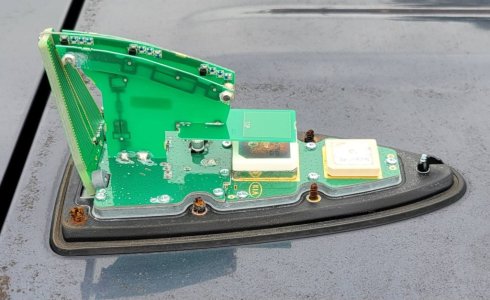
Most new vehicles only have the shark fin antenna for FM. This is what one of them looks like inside, I believe the board on the left side with the zig zag pattern is the FM portion of the antenna. These small antennas are all over the place in a modern smartphone. Its how they're able to work on former UHF TV frequencies without needing you to connect a UHF loop.
For their size these small antennas do a decent job, but from my experience a regular antenna works better and when I moved from a car with a traditional FM antenna to one with a sharkfin, there was a noticeable decrease in fringe reception. I think the actual tuners in most new vehicles are pretty good, if only they had better antennas.
The frustrating thing about soft mute is that its often just a software feature on the DSP tuner chip. The manufacturers could easily add a disable soft mute in the on screen settings menu somewhere for those of us who want it, but I'm not aware of anyone that does this. There used to be an android FM tuner app that could disable soft mute and it made the radio much better for DX. I made a video some years back doing an FM band scan using this app with soft mute disabled.When I first moved to Houston 25+ years ago there were no translators around and, this being the Gulf coast, I could hear tropo often from New Orleans, the Valley, San Antonio, and Austin. This was on my morning commute in a 1994 Mazda (with an antenna in the rear window). Now, in a 2014 Audi (or 2024 Subaru), I don't get tropo that much anymore. Part of it is the crowded modern dial, but I've noticed that often the only out of market signals I get are not on blank local frequencies, but are stations overriding local translators. My interpretation is that the modern cars have the "soft muting" as default (the old "Local" setting) and it can't be turned off. Thus, the radio will lock into the translator and pick up the interfering signal underneath. Is this the correct explanation or something else?
Attachments
Interesting observation. My own theory is that the infilling of the dial with low-power operators (LPFMs and translators) along with rimshots simply reduced the number of open slots available for tropo or E-skip to break through for listeners with ordinary receivers and simple antennas. At one time, the FCC wisely tried to control congestion on the FM dial. Those days are long gone. Whether the trade-off is worthwhile is a whole other question. My own opinion is that it's just replicated the mistakes made on the AM band, resulting in more interference and increased listener fatigue, thus hastening the exodus of listeners from the band to other audio sources. When everyone is shouting, no one can hear anything.When I first moved to Houston 25+ years ago there were no translators around and, this being the Gulf coast, I could hear tropo often from New Orleans, the Valley, San Antonio, and Austin. This was on my morning commute in a 1994 Mazda (with an antenna in the rear window). Now, in a 2014 Audi (or 2024 Subaru), I don't get tropo that much anymore. Part of it is the crowded modern dial, but I've noticed that often the only out of market signals I get are not on blank local frequencies, but are stations overriding local translators.