• Get involved.
    We want your input!
    Apply for Membership and join the conversations about everything related to broadcasting.

    After we receive your registration, a moderator will review it. After your registration is approved, you will be permitted to post.
    If you use a disposable or false email address, your registration will be rejected.

    After your membership is approved, please take a minute to tell us a little bit about yourself.
    https://www.radiodiscussions.com/forums/introduce-yourself.1088/

    Thanks in advance and have fun!
    RadioDiscussions Administrators

Tell Me About "Test Pattern"

I was watching an interview (YouTube) with Anne Lucas (Australian who wrote for Prisoner: Cell Block H and played Fay Quinn) and she was saying when she grew up in Perth (in the 50s, first station 1958) and she was talking about a "test pattern." Then she said, the station used to sign on in the afternoon air children's programs then sign off, then sign back on around 6pm and air adult TV until 10pm.

Then then she explained what a test pattern was, and the co-interviewer said, that he remembers his TV station signing in at 4pm and the family would turn the TV on at 3:45pm and watch the test pattern for fifteen minutes till the station came on.

Basically Anne said that the test pattern was used to calibrate the signal, which sounds right. I grew up in Chicago and I recall WFLD TV32 signing on around 10:30am (in the 70s) but the test patterns I saw were all colored bars and not like the "Indian Head" patterns I see when I google the term.

I assume stations also ran test patterns rather than shut down because it was hard on a transmitter to shut down and restart so it was easier to just broadcast a test pattern. Did this save any money in terms of power?

So I thought it'd be interesting if any of you had any old stories from either work or home regarding "test patterns," if so I'd like to hear them.
 
I was watching an interview (YouTube) with Anne Lucas (Australian who wrote for Prisoner: Cell Block H and played Fay Quinn) and she was saying when she grew up in Perth (in the 50s, first station 1958) and she was talking about a "test pattern." Then she said, the station used to sign on in the afternoon air children's programs then sign off, then sign back on around 6pm and air adult TV until 10pm.

Then then she explained what a test pattern was, and the co-interviewer said, that he remembers his TV station signing in at 4pm and the family would turn the TV on at 3:45pm and watch the test pattern for fifteen minutes till the station came on.

Basically Anne said that the test pattern was used to calibrate the signal, which sounds right. I grew up in Chicago and I recall WFLD TV32 signing on around 10:30am (in the 70s) but the test patterns I saw were all colored bars and not like the "Indian Head" patterns I see when I google the term.

I assume stations also ran test patterns rather than shut down because it was hard on a transmitter to shut down and restart so it was easier to just broadcast a test pattern. Did this save any money in terms of power?

So I thought it'd be interesting if any of you had any old stories from either work or home regarding "test patterns," if so I'd like to hear them.
I don't remember test patterns being on all night. I mostly remember them early mornings. One station I watched played Herb Alpert and the Tijuana Brass along with the test pattern.
 
You're right, the test pattern was used to calibrate the cameras and electronics in an era where most equipment was much less stable than it subsequently became. There were a small handful of different test pattern cards, so you saw the same ones appear on many stations. (The earlier ones were for black & white, and when color started becoming available there was a need to redesign the test cards with color bars and not just resolution lines.) But you'd see them before sign-on, so the engineers could get everything re-aligned before the day's schedule fired off. After sign-off, you might have seen the test card again until the transmitter engineer could throw it off for the night. Nobody in those days would keep it on the air all night, those were the days of mostly tube equipment, which generated gobs of heat and burned more gobs of power, so it was in a station's financial interest to get it all turned off as quickly as possible. (Later on, as solid state replaced tubes, the practice became to keep everything "hot" all day and night, since that led to more stability and fewer breakdowns, but that was years later.)
 
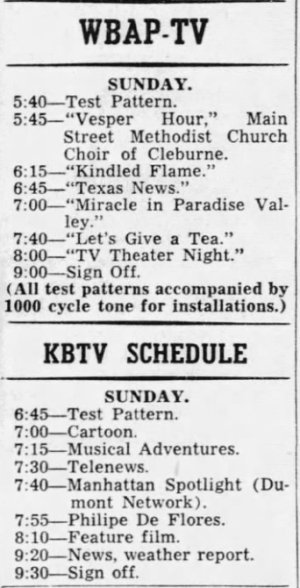
In TV's infancy, schedules in newspapers would include the test pattern. At a time when there were few channels on the air, and little programming available to fill the time, even a test pattern would have plenty of people watching, just to marvel and get acquainted with the then cutting edge technology. This clipping is from October 1949, about a year after WBAP-TV (now KXAS) signed on and weeks after KBTV (now WFAA-TV) signed on in Dallas/Fort Worth:

1776476191727.png
 
In TV's infancy, schedules in newspapers would include the test pattern. At a time when there were few channels on the air, and little programming available to fill the time, even a test pattern would have plenty of people watching, just to marvel and get acquainted with the then cutting edge technology. This clipping is from October 1949, about a year after WBAP-TV (now KXAS) signed on and weeks after KBTV (now WFAA-TV) signed on in Dallas/Fort Worth:
About twenty years ago, we saw at least one cable network revive the practice of including an occasional short test pattern block (I think it was ten minutes or so) in their published program schedule. That network was HDNET, owned by early high definition TV aficionado Mark Cuban. This was at a time when HD broadcasts were still fairly new and not that many people had sets to receive them yet. Those who did at the time tended to be more technically oriented, so the test patterns appealed to viewers who wanted to use those test patterns to adjust their sets for optimum picture quality, or just to get a measure of the performance of their sets.

That didn't last long, eventually the test patterns went away, and the network became more commercial and rebranded as AXS-TV. Mark Cuban no longer has an ownership position.
 
What I found really interesting is that Anne Lucas said in Perth (50s and early 60s) the TV station would sign on, show children's shows, then sign off, then sign on again later same day with adult shows. Did any American stations ever sign off twice in one day?

I remember as a kid the color bar test pattern on various Chicago stations would generally last half an hour after sign off and come on about a half an hour before sign on, on the off chances I'd be up at those times, I would notice.
 
Did this save any money in terms of power?
Not really, compared to any other programming they might have run.

For the most part, test patterns are really rare now, and have been for 20-30 years, because most TV stations run *something* 24/7.

What I found really interesting is that Anne Lucas said in Perth (50s and early 60s) the TV station would sign on, show children's shows, then sign off, then sign on again later same day with adult shows. Did any American stations ever sign off twice in one day?
Not that I heard of, unless you consider signing off at 1am, signing on at 6am, and signing off again at 11:59 pm as "signing off twice in one day." Many stations had different schedules M-F and on weekends.

But of course the US is very large and TV has 80 years of history now, so it is very possible.
 
Some PBS stations would sign on at 7-8AM for Sesame Street and instructional TV programming for schools, sign off for a couple of hours and then come back on with an afternoon repeat of Sesame Street (or Mister Rogers), and evening PBS programming. Blue Ridge Public TV was one of those.

Meanwhile, on the topic of 'test pattern.' Some stations varied on what was on prior to sign-on. Some did RETMA or Indian Head test patterns, with varied audio (1000hz or 400hz tones, music, or just silence)...others did the color bars...others still had an ID slide. I don't think most TV stations stayed on all night w/ test pattern in the 1960s-1970s. They all cut the juice.
 
I don't think most TV stations stayed on all night w/ test pattern in the 1960s-1970s. They all cut the juice.

I think you're right. Most stations would not stay on the air all night, neither with programming nor the test pattern. Pulling the plug meant that maintenance could be done while the transmitter was off.

The exception was stations that stayed on "almost" 24/7. WCBS-TV 2 New York would schedule the overnight movies to end sometime in the 5 a.m. hour. The station would run a brief sermonette, play its sign-off, show the Star Spangled Banner video and then air the Test Pattern. I suppose the tech crew would use the 30-45 minutes to calibrate everything. Then at 6 a.m., it would run the sign-off in reverse. It would be anthem, sign-on video, sermonette and then the show at 6 a.m. would begin.

According to old TV Guides, the exception was overnight Sunday. That's when more involved maintenance would be scheduled. WCBS-TV 2 would sign-off around 1 or 1:30 a.m. and remain off the air until just before 6 a.m.
 
I think you're right. Most stations would not stay on the air all night, neither with programming nor the test pattern. Pulling the plug meant that maintenance could be done while the transmitter was off.

The exception was stations that stayed on "almost" 24/7. WCBS-TV 2 New York would schedule the overnight movies to end sometime in the 5 a.m. hour. The station would run a brief sermonette, play its sign-off, show the Star Spangled Banner video and then air the Test Pattern. I suppose the tech crew would use the 30-45 minutes to calibrate everything. Then at 6 a.m., it would run the sign-off in reverse. It would be anthem, sign-on video, sermonette and then the show at 6 a.m. would begin.

According to old TV Guides, the exception was overnight Sunday. That's when more involved maintenance would be scheduled. WCBS-TV 2 would sign-off around 1 or 1:30 a.m. and remain off the air until just before 6 a.m.

I have heard that some clear-channel AM stations would also sign off overnight on Sundays for maintenance. When those frequencies were cleared out, DX was possible on them that otherwise would not have been.

For a semi-local example of something more recent, WBT 1110 Charlotte went off the air for about 20 minutes one evening, and instead of that inane vanilla music loop they're now running 24/7 while we all wait to see what they're going to do with that frequency, all kinds of things started coming in. You would never hear those stations here otherwise.
 
The last time I saw an actual test pattern, Indian head included, that wasn’t a bit for a program, was in 2001. It was on a CTV station (Winnipeg or Saskatoon) late on a Sunday night, via satellite, just before the signal was dropped for the night. I was amazed. Every other station was using color bars by then when testing.
 
It was the CTV Saskatchewan network (CKCK, CFQC, etc.), and no, the Indian was not on the test pattern. The CTV Saskatchewan logo was plastered over the Indian.


I found a VHS years ago at a church rummage sale with an old movie taped off KABC Los Angeles late at night in 1989, followed by a sign-off which also had a B&W test pattern. The ABC logo was in the middle, and was not of the Indian Head or RETMA style—very cool find.

My late father, who died in 2013, used to watch the late horror movie on Saturday night over KTNT/11 Tacoma as a kid...late 1950s/early 1960s. KTNT aired a bunch of Universal '30s-40s sci-fi/horror flicks (he discovered the original Dracula, Frankenstein, Mummy via that station!) They were the original CBS affiliate for Seattle, duplicated for a few years with KIRO after they signed on, and then went independent. He remembered the movie ended, they showed the late farm report (unless his mind got confused with the early morning farm news...), sign-off announcement, national anthem, and then for a few minutes, the good ole' Indian Head before it went to static. But it wasn't the usual Indian Head either on top of the pattern. He said the Indian was huge...took up much of the screen with the beep. Does anybody recall a 'giant' Indian head in the B&W TV days?
 
Some PBS stations would sign on at 7-8AM for Sesame Street and instructional TV programming for schools, sign off for a couple of hours and then come back on with an afternoon repeat of Sesame Street (or Mister Rogers), and evening PBS programming. Blue Ridge Public TV was one of those.
This was once pretty common for public TV stations that offered in-school programming during the school year. When school was off for the summer, these stations would just sign off during the hours when they otherwise carried in-school programming during the school year. In the late 70s, there were two local (to me at the time) public TV stations that did that -- KTPS channel 62 (owned by Tacoma Public Schools) and KCPQ channel 13 (owned at the time by the Clover Park School District). For KCPT that ended when they were sold and reverted to commercial operation, but KTPS (which moved to channel 28 in the early 80s) continued doing so for at least another couple years.
 
Here in Yakima, KYVE 47 had a shortened schedule on weekends as late as 1988 or 1989. Often they signed on at 2 or 3PM.
Has anyone ever recovered early Beta recordings from KCPQ's PBS stint? I'd love to see what they looked like circa 1979 or so. Surely some rich lawyer in Tacoma taped a Masterpiece Theatre or something from them on an early Sony Betamax ;)
 
Here in Yakima, KYVE 47 had a shortened schedule on weekends as late as 1988 or 1989. Often they signed on at 2 or 3PM.
Has anyone ever recovered early Beta recordings from KCPQ's PBS stint? I'd love to see what they looked like circa 1979 or so. Surely some rich lawyer in Tacoma taped a Masterpiece Theatre or something from them on an early Sony Betamax ;)
It would be interesting to see some recording from that period of time -- and I suppose it is possible that someone could have a recording from when they signed off in early 1980. After all, a recording does exist of the station's return to commercial operation towards the end (November 4) of that same year.

I actually did get my first VCR just a few months after KCPQ ceased its run a PBS station. That means that the oldest PBS recording that I have is of a rebroadcast of "The Lathe of Heaven" from KTPS, channel 62...
 
Some PBS stations would sign on at 7-8AM for Sesame Street and instructional TV programming for schools, sign off for a couple of hours and then come back on with an afternoon repeat of Sesame Street (or Mister Rogers), and evening PBS programming. Blue Ridge Public TV was one of those.
And even before the morning airings of Sesame Street and the other PBS shows, "A.M. Weather" was generally the lead-off program for most PBS stations during the morning portion of their broadcast day.

Here's a sample broadcast on Youtube from WTTW-11 Chicago (with test pattern at very beginning) from Oct. 20, 1983:

 
It was the CTV Saskatchewan network (CKCK, CFQC, etc.), and no, the Indian was not on the test pattern. The CTV Saskatchewan logo was plastered over the Indian.


I found a VHS years ago at a church rummage sale with an old movie taped off KABC Los Angeles late at night in 1989, followed by a sign-off which also had a B&W test pattern. The ABC logo was in the middle, and was not of the Indian Head or RETMA style—very cool find.

My late father, who died in 2013, used to watch the late horror movie on Saturday night over KTNT/11 Tacoma as a kid...late 1950s/early 1960s. KTNT aired a bunch of Universal '30s-40s sci-fi/horror flicks (he discovered the original Dracula, Frankenstein, Mummy via that station!) They were the original CBS affiliate for Seattle, duplicated for a few years with KIRO after they signed on, and then went independent. He remembered the movie ended, they showed the late farm report (unless his mind got confused with the early morning farm news...), sign-off announcement, national anthem, and then for a few minutes, the good ole' Indian Head before it went to static. But it wasn't the usual Indian Head either on top of the pattern. He said the Indian was huge...took up much of the screen with the beep. Does anybody recall a 'giant' Indian head in the B&W TV days?
Thank you. I stand corrected on the Indian head but didn't remember seeing the CTV logo, and for some reason didn't record it.


Back
Top Bottom