
• Get involved.
    We want your input!
    Apply for Membership and join the conversations about everything related to broadcasting.

    After we receive your registration, a moderator will review it. After your registration is approved, you will be permitted to post.
    If you use a disposable or false email address, your registration will be rejected.

    After your membership is approved, please take a minute to tell us a little bit about yourself.
    https://www.radiodiscussions.com/forums/introduce-yourself.1088/

    Thanks in advance and have fun!
    RadioDiscussions Administrators

NAB Thinks It’s Time for AM Boosters.


I'm scratching my head and trying to think in what reality this is a good idea. AM is and had been dying a sloe death for years. Some countries don't use AM at all and some have switched entirely to digital modes like DAB+.

If even huge powerhouses like WBT are switching to FM, how are smaller stations going to find the money for these AM boosters and who would listen that doesn't now?
 
770 KKOB has a 230 watt "booster" in Santa Fe to provide a better signal on the backside of their original night pattern. I'm surprised they didn't mention that in the article.

The carriers and programming of these boosters will have to be synchronized to the main station or else you'll get beating of the carriers and/or an echo in the programming. It's doable, but I can see the booster eventually slipping out of sync and stations not getting around to fixing it very quickly.

I've heard KKOB echoing on KiwiSDRs in west Texas before, so they have even slipped out of sync before, at least the audio programming has.
 
I'm scratching my head and trying to think in what reality this is a good idea. AM is and had been dying a sloe death for years. Some countries don't use AM at all and some have switched entirely to digital modes like DAB+.
Yet there are examples where AMs were licensed to fully cover their markets with adequate power where AM is doing quite well. For example, in Argentina the huge Buenos Aires market has over a dozen 50 kw to 100 kw fulltime AMs with no crazy direcional systems and they are, as a group, doing quite well.

In the United States, there are many larger markets were no AM or only one or two actually cover the market day and night. No wonder the band collapsed as man made noise even further reduced coverage.

Where nations have moved to DAB we see that the government controls broadcasting right down to a huge participation in station ownership and programming. Where there is little government involvement in day to day radio, such as nearly every nation in the Western Hemisphere, there is no DAB and FM is alive and relatively well.
If even huge powerhouses like WBT are switching to FM, how are smaller stations going to find the money for these AM boosters and who would listen that doesn't now?
Good example of a bad signal. WBT has a horrible night signal that misses the western third of the market. Charlotte has no full coverage AM at all.
 
Where nations have moved to DAB we see that the government controls broadcasting right down to a huge participation in station ownership and programming. Where there is little government involvement in day to day radio, such as nearly every nation in the Western Hemisphere, there is no DAB and FM is alive and relatively well.

The UK is an exception. Very good DAB coverage and FM definitely alive and well. AM on the other hand is not. But the stations are becoming exclusively DAB not migrating to FM. Regulation wise it's pretty lax now. FM is full of network stations, very little truly local.
 
The UK is an exception. Very good DAB coverage and FM definitely alive and well. AM on the other hand is not. But the stations are becoming exclusively DAB not migrating to FM. Regulation wise it's pretty lax now. FM is full of network stations, very little truly local.
Most of Western Europe is the same, having had only government radio into the 70's (Spain and Portugal being the exception). So, whether it was France or Germany or Italy or Greece, the use of "radio" was determined by bureaucrats, not entrepreneurs.

We saw a bit of that in our Hemisphere in places like Monserattee, Guadelupe, Jamaica, French and British Guayana and even the BVI and British Honduras. But the major nations, from Canada to Argentina, all were driven totally or in a big part by private radio.

Canada tried DAB. It failed and was abandoned. There is a big story, summarized by Google AI this way: "DAB (Digital Audio Broadcasting) failed in Canada due to low consumer adoption, expensive receivers, and technical incompatibility. Canada utilized L-band frequencies rather than the standard Band III, and lack of support from the US market stifled receiver manufacturing. By 2010, broadcasters dropped support, and the CRTC stopped pushing the technology, allowing HD Radio (IBOC) to become the preferred digital standard. "
 
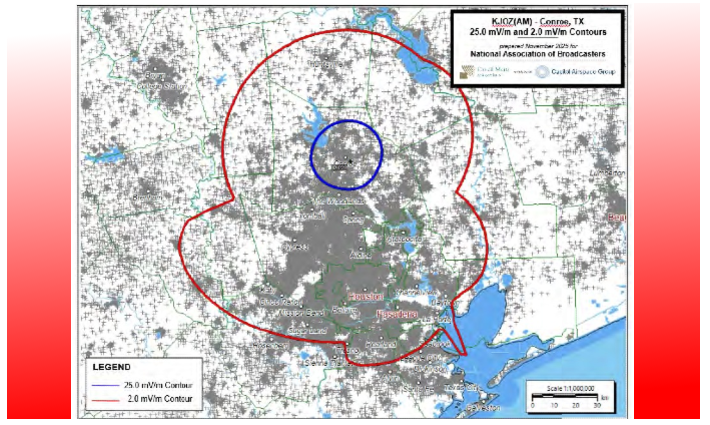
Being in Houston, I got a good laugh out of the KJOZ example in the article. KJOZ has been an irrelevant merry-go-round of brokered formats for many years now. The day signal is at best poor to mediocre in Harris County, and the night coverage is useless outside of Montgomery County. The stations problems are uncompelling programming and that it’s an AM. Adding boosters solves nothing.
how are smaller stations going to find the money for these AM boosters and who would listen that doesn't now?
Boosters are a lot of added expense with tower leases and additional equipment. Same issue with Maxxcasting on FM. Is there a return on investment and operating costs?
 
I've often wondered whether all-digital AM combined with multiple transmitters in a market might actually offer a decent, high-fidelity option for the AM band. The inverse-square law still applies, which means the total power used would actually be less than having one single transmitter. Therefore less out-of-market skywave interference. Many hurdles to be overcome before it could actually be implemented, but it could be interesting.

Dave B.
 
I've often wondered whether all-digital AM combined with multiple transmitters in a market might actually offer a decent, high-fidelity option for the AM band. The inverse-square law still applies, which means the total power used would actually be less than having one single transmitter. Therefore less out-of-market skywave interference.
Despite the lower transmitter powers lowering electric bills, you still have the issue of the infrastructure cost of multiple transmitters.

Digital would eliminate clashes between different originating transmitters and other signals, as presumably the digital decoder in the receiver would sort out the data streams while ignoring superfluous input. Cell phones already do this to a great extent.
 
I think that AM boosters could be a part of a solution to the problems that AM radiois facing but it alone cannot solve those problems. Other things that would have to be done would be to force all new radio receivers to include the AM band; force radio manufacturers to manufacture radios that provide higher frequency response on the AM band; force more programming, including music programming, onto the AM bands.

Of course, the only group that could "force" any of these things would be the U.S. Federal government and I will guarantee you right now that if any one of these items were "forced" on anyone, the lawsuits would be flying thick and fast. Hell, I'm sure many of you reading this may believe that I have either gone off my rocker or something else. The point I am making, however, is that while AM boosters may be a part of the solution to the problems with the AM band, adding AM boosters alone will *not* discontinue the decline in listenership and radio stations the AM band is currently facing.
 
Boosters are a lot of added expense with tower leases and additional equipment. Same issue with Maxxcasting on FM. Is there a return on investment and operating costs?
If boosters use the new generation of "mini" antennas with limited radials, that might work at a low cost... by filling in nulls.
 
I think that AM boosters could be a part of a solution to the problems that AM radiois facing but it alone cannot solve those problems. Other things that would have to be done would be to force all new radio receivers to include the AM band; force radio manufacturers to manufacture radios that provide higher frequency response on the AM band; force more programming, including music programming, onto the AM bands.
Those all require that the government force the radio industry and the electronics industrry to do what, on its own, it does not want to do.

Nobody buys stand-alone radios today.

The manufacturers are all in China and Asia, and will not do something that raises cost for a very limited market.

Long ago the FCC required us to put up a wall before reaching 10 kHz audio bandwidths. The reason: too many stations on the band with heterodynes, particularly at night.

No station on AM will want to be "forced" to do music programming where it will not work. Ever.

Boosters could fill in the horrible nulls most stations have that have, over time, resulted in whole hunks of their metros not having service.
Of course, the only group that could "force" any of these things would be the U.S. Federal government and I will guarantee you right now that if any one of these items were "forced" on anyone, the lawsuits would be flying thick and fast. Hell, I'm sure many of you reading this may believe that I have either gone off my rocker or something else. The point I am making, however, is that while AM boosters may be a part of the solution to the problems with the AM band, adding AM boosters alone will *not* discontinue the decline in listenership and radio stations the AM band is currently facing.
The biggest issue for most metro area AMs is signal, and with no signal, no matter what the format, it will not work out financially. The car has to have wheels to move. AM stations generally are missing two to three wheels today.

And then we get to daytimers... a bad idea that should never have been allowed.
 
770 KKOB has a 230 watt "booster" in Santa Fe to provide a better signal on the backside of their original night pattern. I'm surprised they didn't mention that in the article.

The carriers and programming of these boosters will have to be synchronized to the main station or else you'll get beating of the carriers and/or an echo in the programming. It's doable, but I can see the booster eventually slipping out of sync and stations not getting around to fixing it very quickly.

I've heard KKOB echoing on KiwiSDRs in west Texas before, so they have even slipped out of sync before, at least the audio programming has.
At one time Boston's WBZ 1030 had a similar operation in Springfield, MA. it was WBZA with 1 kW I think daytime only, but this station has been off the air for many years now.
 
The time to really save AM was in the early seventies, before FM really took over, and I'm not even sure what that could have looked like. The Average Joe wasn't going to flip over to AM for music unless it sounded just as good as FM. Oh, I've heard it get very close, on a clear day within 15 miles of the tower, in AM stereo, with the road noise masking imperfections. But that's not nearly close enough. Not for Average Joe. And now Joe isn't even listening to FM. I don't fault anyone at the NAB for seeking a solution; I just don't know what it could be. I'm not technical enough, but, really wideband, after eliminating half the frequencies? Spitballing.
 
At one time Boston's WBZ 1030 had a similar operation in Springfield, MA. it was WBZA with 1 kW I think daytime only, but this station has been off the air for many years now.
Same with WBT in Charlotte. They had a similar one in Shelby, NC, to fill the null to the west... at least in the western part of the metro.
 
And then we get to daytimers... a bad idea that should never have been allowed.
In retrospect, the mistake that was made in the 1930s and 40s is that more “graveyard” frequencies should have been allocated instead of the six we actually got. Perhaps 20, 25 or even 30 frequencies, less densely packed, and with higher transmitter powers than 1/0.25kw, operating in the upper reaches of the AM band. This would have provided decent, 24 hour local service to small and midsized markets without the need for the silly daytimer arrangement.

50-60+ years ago, regular radio listeners at least had a vague idea about nighttime AM skywave, and likely somewhat understood the technical restrictions of daytimers. But that doesn’t make any sense to today’s audience, with access to multiple platforms, any time of day or night.


Back
Top Bottom