
The country matters. Truth matters. A journalist being ordered to inject lies matters. Is there a lot of handwringing? Heck yeah. Because we care about not letting the country slide further into fascism. Because we care that journalism remains independent. Because we care that the government does not have de facto control of the media.

-
Get involved.
We want your input!
Apply for Membership and join the conversations about everything related to broadcasting.
After we receive your registration, a moderator will review it. After your registration is approved, you will be permitted to post.
If you use a disposable or false email address, your registration will be rejected.
After your membership is approved, please take a minute to tell us a little bit about yourself.
https://www.radiodiscussions.com/forums/introduce-yourself.1088/
Thanks in advance and have fun!
RadioDiscussions Administrators
You are using an out of date browser. It may not display this or other websites correctly.
You should upgrade or use an alternative browser.
You should upgrade or use an alternative browser.
"Newsroom culture clash" at CBS News
- Thread starter Mark Roberts
- Start date
Given the track record of the network in recent months….extreme skepticism is warranted.So it’s definitely happening.

Paramount asks judge to toss lawsuit over proposed Warner Bros Discovery merger
June 4, 2026 - Attorneys for Paramount say an antitrust lawsuit filed by streaming and pay TV consumers over the company's deal to acquire Warner Bros should be tossed due to lack of standing.
 thedesk.net
Here is more on the current legal issues on the Paramount WB deal thats the other reason why CBS News is in the position they are in.
The point is, as time continues to march on, you aren't going to have younger people tuning in to the nightly network news or 60 minutes because they are getting information from other sources. And that's just going to accelerate. Fox is going to have the same problem. Doesn't matter if the content is left or right. As far as journalism remaining independent, with the Internet that becomes easier than ever when information isn't limited to the big three networks and the news cable/satellite channels.The country matters. Truth matters. A journalist being ordered to inject lies matters. Is there a lot of handwringing? Heck yeah. Because we care about not letting the country slide further into fascism. Because we care that journalism remains independent. Because we care that the government does not have de facto control of the media.

It's a lot more complicated than that.What complicated the situation was that Mrs. Murrow and Mrs. Paley were best friends and neighbors.
The main thing that happened after McCarthy was Murrow's airtime and staff were significantly cut.
I did a quick review of Ann Sperber's biography of Murrow (it's not the only one I've read, but it's the most comprehensive), where much of the focus is on Murrow's relationship with Bill Paley and how it soured, along with Murrow's attempts to remain independent of the CBS News division. See It Now was cancelled in 1958, but replaced with Small World. The budget for the latter program was smaller than for See It Now, and it was under the direction of the CBS News division, which See It Now wasn't. Murrow's RTNDA speech of October 1958 decrying the state of television was viewed by Bill Paley as a personal attack, though Paley and Murrow never had a direct confrontation except through an intemperate letter that Murrow sent to Paley. After receiving that letter, Paley basically ghosted Murrow, as we would now say. Paley tended to deny that there were issues between them, but Sperber's research found otherwise. The Murrow letter was never made public, but Sperber was allowed to see it as she researched the biography.
There were also poor personal relations between Murrow and CBS president Frank Stanton, which came to light in 1959 when Stanton made some backhanded criticisms of Murrow's other famous program, Person to Person, which was a somewhat fluffy, content-free hour in prime time. Murrow also took a year-long sabbatical in 1959 and 1960, though he was still working on pieces for Small World at the time. Stanton, meanwhile, to deflect increasing criticism of CBS, came up with CBS Reports, a documentary series. Murrow worked on a few of those shows but was not a lead personality for any of them, despite the efforts of the CBS Reports executive producer, Fred Friendly. That's where Harvest of Shame, Murrow's last work for TV, came from. Murrow also had a weekly CBS Radio show called Background.
Murrow's contract was up for renewal in 1961, but in 1960, Paley was seen as dragging his feet on the renewal. It was clear to Murrow that, upon his return from sabbatical, he wasn't going to have a lead role. But the rise of Huntley-Brinkley on NBC, and the ratings success that team was starting to have, led up to a pairing of Murrow and Cronkite for the 1960 conventions. The combination of two such strong personalities did not work well. Meanwhile, NBC was getting both ratings success and plaudits from critics, which annoyed Paley to no end. After the conventions, and the end of Small World, Murrow just wasn't given much to do. He reached out to the BBC for a possible role, and the BBC was interested, but, meanwhile, JFK was elected president. Murrow had a low opinion of Kennedy, but when the USIA offer came along, he took it.
Reading Sperber's book, one can see that Murrow's situation was mostly due to internal politics and bitter personal disputes that played out for years. Pelley's situation is due to external political pressures being brought to bear on CBS in a much shorter period of time.
Murrow was squeezed out slowly and artfully, but in the end, he was still out.Reading Sperber's book, one can see that Murrow's situation was mostly due to internal politics and bitter personal disputes that played out for years. Pelley's situation is due to external political pressures being brought to bear on CBS in a much shorter period of time.

The point is, as time continues to march on, you aren't going to have younger people tuning in to the nightly network news or 60 minutes because they are getting information from other sources. And that's just going to accelerate. Fox is going to have the same problem. Doesn't matter if the content is left or right. As far as journalism remaining independent, with the Internet that becomes easier than ever when information isn't limited to the big three networks and the news cable/satellite channels.
Sure, media has fragmented since the growth of the internet. That doesn't mean journalists should care any less about the quality of their content or their ethical standards. If anything, there is more need than ever for trustworthy news voices in a growing sea of disinformation. The stories that spread online have to originate somewhere, even if not everyone watches the original source.
The New York Times is now reporting that Nick Bilton has agreed to provide editorial independence to 60 Minutes. He's also met with the three remaining correspondents, who are still deciding whether to remain with the show:
Here are two more versions of the story:

 www.hollywoodreporter.com
 www.yahoo.com
Here are two more versions of the story:
Nick Bilton to ‘60 Minutes’ Staff: “Hell of a First Week” But Ready to Move On In “Good Faith”
The show's new boss sent the memo amid a tumultuous week for the venerable newsmagazine.
www.hollywoodreporter.com
‘60 Minutes’ Boss Consults With Lesley Stahl, Bill Whitaker and Jon Wertheim Amid Turmoil: ‘Hell of a First Week’
Nick Bilton reaffirmed his commitment to editorial independence for "60 Minutes" while consulting with Lesley Stahl, Bill Whitaker and Jon Wertheim as turmoil continues.
The New York Times is now reporting that Nick Bilton has agreed to provide editorial independence to 60 Minutes. He's also met with the three remaining correspondents, who are still deciding whether to remain with the show
My mother, who has been a dedicated 60 Minutes viewer every week for as long as I can remember, removed it from her DVR recording schedule this week.
Sure he will.The New York Times is now reporting that Nick Bilton has agreed to provide editorial independence to 60 Minutes.
I remember when Substack was introduced to the public it was originally known for having wild content like MAGA and Neo-Nazi content.
However once Substack had done reforms it became better known in the past 3-4 years of getting well known journalists, Op-ed writers and Ex-Republicans to the platform to become what it is today. I hope all the fired staff at CBS News fight their way back in other places just like Sharyn Alfonsi is doing by blogging on Substack.
David Ellison has a choice to restore sanity to Paramount and if merger is final join WB and restore sanity there too, But that won’t happen while Bari Weiss and Ellison are there. Everything we are watching here is basically the stuff we used to accused certain platforms of doing in the past but is now happening at Paramount specifically.

 on.substack.com

 charliesykes.substack.com

 substack.com
 substack.com
 substack.com

However once Substack had done reforms it became better known in the past 3-4 years of getting well known journalists, Op-ed writers and Ex-Republicans to the platform to become what it is today. I hope all the fired staff at CBS News fight their way back in other places just like Sharyn Alfonsi is doing by blogging on Substack.
David Ellison has a choice to restore sanity to Paramount and if merger is final join WB and restore sanity there too, But that won’t happen while Bari Weiss and Ellison are there. Everything we are watching here is basically the stuff we used to accused certain platforms of doing in the past but is now happening at Paramount specifically.
Society has a trust problem. More censorship will only make it worse.
We will always view censorship as a last resort, because we believe open discourse is better for writers and better for society.
on.substack.com
To the Contrary | Charlie Sykes | Substack
You are not the crazy ones. Click to read To the Contrary, by Charlie Sykes, a Substack publication with tens of thousands of subscribers.
charliesykes.substack.com
Adam Kinzinger | Substack
Dad. Husband. Former GOP congressman. Voted to impeach Trump. Now fighting for our democracy. Lt. Col. Air National Guard (ret). Founder of Country First.
substack.com
Terry Moran | Substack
Independent journalist, formerly with ABC News. I publish a Substack newsletter called “Real Patriotism,” and host a podcast by the same name on YouTube.
substack.com
Katie Couric | Substack
I’m a journalist always looking for a deeper understanding of the issues.
substack.com
From Oliver Darcy and Status on Bluesky:
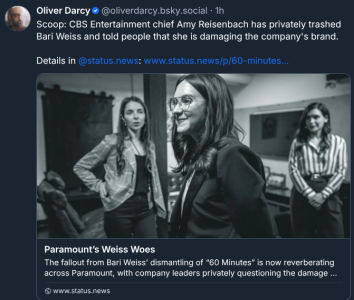
Text: "Scoop: CBS Entertainment chief Amy Reisenbach has privately trashed Bari Weiss and told people that she is damaging the company's brand."
I'm not a Status subscriber, so this is all that's publicly available.
If true, this reaction isn't surprising.
Text: "Scoop: CBS Entertainment chief Amy Reisenbach has privately trashed Bari Weiss and told people that she is damaging the company's brand."
I'm not a Status subscriber, so this is all that's publicly available.
If true, this reaction isn't surprising.

Tick, Tick, Boom
Paramount delivers “60 Minutes” to Donald Trump on a gold platter
 steady.substack.com

Dan Rather takes Bari Weiss to task over 'nonsensical' killing of '60 Minutes'
Former "60 Minutes" correspondent Dan Rather took current CBS News chief Bari Weiss to task on Thursday over her "nonsensical changes" at the network. Rather argued in a new Substack essay that "60 Minutes" has gone from being the gold standard of broadcast journalism to a "diminished...
 www.rawstory.com
Here is more this time Dan Rather responds to Bari Weiss and David Ellisons decision to fire staff at 60 minutes from Tanya Simon to Scott Pelley.
CBS News head Bari Weiss has a diversity problem: Insider
Bill Whitaker is the only correspondent of color left at the famed news magazine.
Here is more on why David Ellison and Bari Weiss makes questionable hires at CBS News.
Scott Pelley may not be Mr. Excitement, but he is not an idiot. He knew very well what he was getting into. He had to. I haven't heard, but I have to ass-u-me that he took advice from his agent and/or his attorney before speaking out. I mean, what he did was something that every employed person is guaranteed to get fired for: Insubordination. The Boss gets to define what that is, even if it's just disagreement with management. But he had a contract. I have to believe that he will get some kind of 6-figure severance settlement from CBS, or will sue. Regardless, he'll land on his feet.
I know this has already been shared from other sources.
 thedesk.net
CBS: No plan to offer Joe Rogan spot on "60 Minutes"
June 4, 2026 - Paramount is disputing a report published by a gossip blog and repeated by a newspaper that claims "60 Minutes" is weighing a role for podcaster Joe Rogan.
thedesk.net
I'm trying to find a link here that does not lead to a paywall...........Scott Pelley says that he was instructed to insert biased statements and false allegations into his stories after new management arrived at at CBS News. Management, of course, denies this. Seems like a story that will not readily fade away.

Bari Weiss's head on block as as senior CBS execs push for ouster over '60 Minutes' chaos
CBS News head Bari Weiss has created a powerful new enemy within the network after her controversial decision to revamp the popular “60 Minutes” newsmagazine with a mass firing that blew up into front-page news.According to media watchdog Status, the conflict has evolved from a news division...
www.rawstory.com
Well in Scott Pelley case he is backing what Cecilia Vega, Sharon Alfonsi, Tanya Simon, said right when Bari Weiss removed them. It's all an indication on how Bari Weiss and the Ellisons controls CBS News.
Fewer young people are sitting down to watch 60 Minutes on TV, but they were definitely sharing clips from it on social media. The segment about CECOT in El Salvador went viral after it was pulled from U.S. broadcast but "leaked" by a Canadian network.The point is, as time continues to march on, you aren't going to have younger people tuning in to the nightly network news or 60 minutes because they are getting information from other sources.

LISTEN: Credit Risks: Top S&P Global Analyst Breaks Down the Paramount-Warner Bros. Discovery Deal
S&P Global media analyst Naveen Sarma breaks down the deal terms for Paramount-Warner Bros. Discovery on Variety podcast 'Strictly Business.'
 variety.com
Here is more this time as the approval process between Paramount and WB are at play here. It’s one of the core reasons why CBS News ended up having to deal with political interference and why multiple staff members quit or got fired by Bari Weiss and David Ellison. Even if Paramount merged with WB they have to deal with the EU and multiple states lead by California attorney general Rob Bonita for antitrust issues surrounding the deal.
The proposed $111 billion merger between Paramount and Warner Bros. Discovery is approaching completion, but concerns around debt, execution risk, and long-term industry volatility loom large. “Leverage is significantly high for this transaction,” he said. “We’ve seen this story before with a lot of transactions. We do think this company has the ability to de-lever without going and making massive cuts, certainly at the studios, and so that got us comfortable with the idea that they could de-lever.”
That said, there is considerable skepticism regarding Paramount-WBD’s ability to thrive encumbered by tens of billions of dollars if the transaction clears regulatory hurdles as soon as later this summer. Even if the Department of Justice gives the deal a greenlight, opposition could still come from European regulators or a potential antitrust lawsuit from California State Attorney General Rob Bonta.
Leslie Stahl, Bill Whitaker, and John Wertheim say they'll stay with 60 Minutes:

 barrettmedia.com

 www.nbcnews.com
Leslie Stahl is reported to be shooting a story for next season:

 nypost.com
Lesley Stahl, Bill Whitaker, Jon Wertheim to Remain on 60 Minutes
"Audiences trust them because they have proved it, story by story, for decades. Working with them is a privilege and every journalist's dream."
barrettmedia.com
Lesley Stahl, Bill Whitaker and Jon Wertheim say they’ll stay at ‘60 Minutes’
“We don’t want to see ‘60 Minutes’ die,” the show veterans said after CBS News boss Bari Weiss fired several correspondents and top producers.
www.nbcnews.com
Leslie Stahl is reported to be shooting a story for next season:
Exclusive | Lesley Stahl on assignment for new ‘60 Minutes’ segment following bloodbath — sparking chatter that she’s staying: sources
CBS News insiders are speculating that Lesley Stahl will likely remain a correspondent at “60 Minutes” after she was out shooting footage for the show’s next season following a bl…
nypost.com