• Get involved.
    We want your input!
    Apply for Membership and join the conversations about everything related to broadcasting.

    After we receive your registration, a moderator will review it. After your registration is approved, you will be permitted to post.
    If you use a disposable or false email address, your registration will be rejected.

    After your membership is approved, please take a minute to tell us a little bit about yourself.
    https://www.radiodiscussions.com/forums/introduce-yourself.1088/

    Thanks in advance and have fun!
    RadioDiscussions Administrators

AM Flea power.

If the have the typical 10 kw day 1 kw night expanded AM band licence and the clock or PC that controls the transmitter is messed up you could have 10 kw at night on a relatively clean channel. The coverage could be impressive.

Uh no. It's not a regular broadcast station. It's what we think of being classed as a travelers information station or highway advisory radio station. those typicallly have 10 watts but some have had STA or regular licenses for up to 100 watts
 
Uh no. It's not a regular broadcast station. It's what we think of being classed as a travelers information station or highway advisory radio station. those typicallly have 10 watts but some have had STA or regular licenses for up to 100 watts
When I was in Cookeville in the mid 1970s, our competition was WHUB AM & FM. I had a couple of friends that worked there and on the hallway out of the front reception area was a bunch of historical pictures. They are on 1400AM. The channel wasn't the mess it is now when they signed on in 1940. I forgot if they were 100 watts or 250 watts but they had regular listeners daytime in Arkansas. Supposedly there were a couple of stations that should have blocked them going west but maybe someone can explain better but I believe the relative height of Cookeville with the steep drop-off into the Nashville basin had something to do with it.
 
Near where I go in the mountains there was a traveler information station on 1610 AM. When the motel was still standing (they tore it down for a road project) I could hear it in the room at night.
 
Near where I go in the mountains there was a traveler information station on 1610 AM. When the motel was still standing (they tore it down for a road project) I could hear it in the room at night.
It was probably less then a mile away from you if you heard it in the hotel room on a crappy clock radio on the dresser
 
And there are various pirates and people operating a 100 mW Part 15 transmitter even though 1710 kHz is not a valid frequency for legal Part 15 operation.
I see.

I've been on 1610, in part because I like being able to use my old, pre-expanded band radios), but mainly because it's the best, most valid and most legal choice. I started out on 1710 because it was so much quieter that range was excellent even at the legal 100mW limit (I could receive the signal up to 10 miles away).

Because it's so quiet, I've been thinking of going back to 1710 (which I realize technically isn't quite legal under Part 15, but in practice, nobody seems to care? I mean, if Travis AFB – operated by the Air Force, which is a department of the federal government – can broadcast on 1710 without issue, why can't I?

That said, since 1710 is technically not within the AM band, it shouldn't be possible to have a licensed TIS – from Travis AFB or anywhere else – on there either, right?

Or am I missing something?

c
 
I see.

I've been on 1610, in part because I like being able to use my old, pre-expanded band radios), but mainly because it's the best, most valid and most legal choice. I started out on 1710 because it was so much quieter that range was excellent even at the legal 100mW limit (I could receive the signal up to 10 miles away).

Because it's so quiet, I've been thinking of going back to 1710 (which I realize technically isn't quite legal under Part 15, but in practice, nobody seems to care? I mean, if Travis AFB – operated by the Air Force, which is a department of the federal government – can broadcast on 1710 without issue, why can't I?

That said, since 1710 is technically not within the AM band, it shouldn't be possible to have a licensed TIS – from Travis AFB or anywhere else – on there either, right?

Or am I missing something?

c

Some TIS' arent licensed by the FCC, theyre licensed by another arm of the federal government.

TIS are mainly on 530 and 1610........ no broadcast stations are on 530 in the US and there was only one on 1610.. KALT Atlanta, TX.. built, on air ages ago then they dismantled it.
 
And there are various pirates and people operating a 100 mW Part 15 transmitter even though 1710 kHz is not a valid frequency for legal Part 15 operation.
All frequencies, other than TV broadcast frequencies and those listed in 15.205 are OK under Part 15. The latter frequencies are for disaster communications under various services, and cannot be used for anything else, licensed or unlicensed.

One cannot operate with 100 mW input (50-75 mW out) into a 3 meter antenna on 1710, but other regulations do permit it. 15.223 allows the following:

The field strength of any emission within the band 1.705-10.0 MHz shall not exceed 100 microvolts/meter at a distance of 30 meters. However, if the bandwidth of the emission is less than 10% of the center frequency, the field strength shall not exceed 15 microvolts/meter or (the bandwidth of the device in kHz) divided by (the center frequency of the device in MHz) microvolts/meter at a distance of 30 meters, whichever is the higher level. For the purposes of this section, bandwidth is determined at the points 6 dB down from the modulated carrier. The emission limits in this paragraph are based on measurement instrumentation employing an average detector. The provisions in § 15.35(b) for limiting peak emissions apply.

That's about the same field strength as what is allowed at 1700 kHz under 15.209, which is 24000/f(kHz), or 14.1 uV/m at 30 meters. Given the "efficiency" of a 3 meter antenna at those frequencies, there probably is little to no difference. The ERP is in nanowatts, just like on FM.
 
I wonder what the expected coverage area would be for an AM Transmitter with 100 mW? Would local ground conductivity be a factor, or is that somewhat negligible at this small scale (compared to 50 kW).

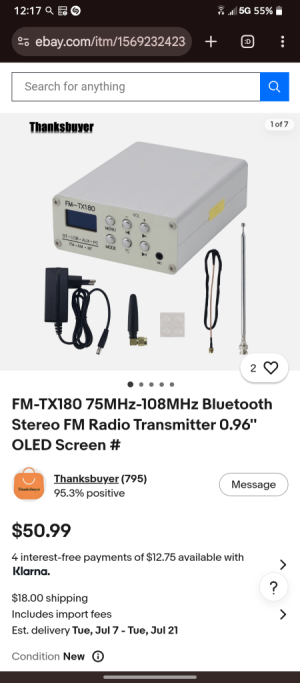
There's a decent transmitter (FM/AM) on ebay for about $70. (Model FM-TX180). From what I read, it has such a low power, that it would be difficult to hear it from more than just 3 meters (10 feet) away.
 

Attachments

  • Screenshot_20260626-001708.png
    Screenshot_20260626-001708.png
    175.7 KB · Views: 11
  • Screenshot_20260626-001811.png
    Screenshot_20260626-001811.png
    177 KB · Views: 11
Last edited:
I wonder what the expected coverage area would be for an AM Transmitter with 100 mW? Would local ground conductivity be a factor, or is that somewhat negligible at this small scale (compared to 50 kW).
Ground conductivity is a minimal issue. The FCC states that the ENTIRE length of the transmitter-to-antenna structure under 15.219 is 3 meters. Period. The idea goes back to when this was first allowed in the 1930s or '40s, when some phonographs included a small AM transmitter that was to be connected to a single wire no more than 10 feet long. The return was supposed to be the AC wiring. The idea was to be able to play your records over a radio in your own house but not any further.
There's a decent transmitter (FM/AM) on ebay for about $70. (Model FM-TX180). From what I read, it has such a low power, that it would be difficult to hear it from more than just 3 meters (10 feet) away.
AM and FM? Never heard of such a thing. An FM transmitter is restricted to 250 uV/m at 3 meters. That means it'll cover your own property, but little else.
 
AM and FM? Never heard of such a thing. An FM transmitter is restricted to 250 uV/m at 3 meters. That means it'll cover your own property, but little else.

Says its for transmitting on FM
but for a "Modulation Signal" on AM ...

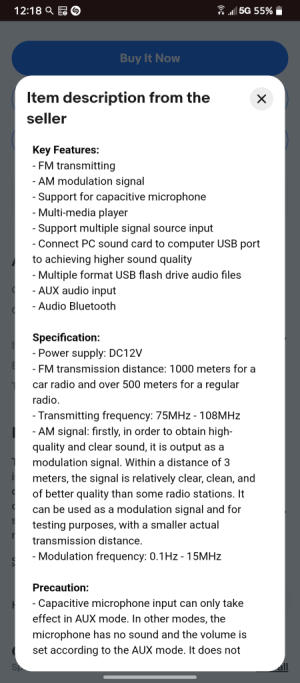
Here's some of the specs of the
FM-TX180 transmitter pic I posted:

Key Features:
- FM transmitting
- AM modulation signal
- Support for capacitive microphone
- Multi-media player
- Support multiple signal source input
- Connect PC sound card to computer USB port to achieving higher sound quality
- Multiple format USB flash drive audio files
- AUX audio input
- Audio Bluetooth

Specification:
- Power supply: DC12V
- FM transmission distance: 1000 meters for a car radio and over 500 meters for a regular radio.
- Transmitting frequency: 75MHz - 108MHz
- AM signal: firstly, in order to obtain high-quality and clear sound, it is output as a modulation signal. Within a distance of 3 meters, the signal is relatively clear, clean, and of better quality than some radio stations. It can be used as a modulation signal and for testing purposes, with a smaller actual transmission distance.
- Modulation frequency: 0.1Hz - 15MHz
 
Here's some of the specs of the
FM-TX180 transmitter pic I posted:
That transmitter is not legal for Part 15 operation, regardless of what frequency range or modulation type it uses.

A legal 100 mW Part 15 transmitter in the 525 - 1705 kHz band will typically achieve a range of about 1/4 mile, and up to a few miles under ideal circumstances.

On FM, while a legal Part 15 signal typically does cover only about a 250-foot radius, in ideal direct line-of-sight, hilltop-to-hilltop scenarios I have observed a range of about 2-1/4 miles.


Back
Top Bottom