• Get involved.
    We want your input!
    Apply for Membership and join the conversations about everything related to broadcasting.

    After we receive your registration, a moderator will review it. After your registration is approved, you will be permitted to post.
    If you use a disposable or false email address, your registration will be rejected.

    After your membership is approved, please take a minute to tell us a little bit about yourself.
    https://www.radiodiscussions.com/forums/introduce-yourself.1088/

    Thanks in advance and have fun!
    RadioDiscussions Administrators

Why Did the U.S. Government Never Own TV Stations?

The United States is the only large country where the national government never put its own TV stations on the air? All the other major countries I can think of have their own television stations, some of them years before they allowed private commercial broadcasting. BBC, CBC, Austalia Broadcasting Corporation, NHK. I believe all of Europe has government-owned television. (I know the Mexican government owns some TV and radio stations too, although I think that was an afterthought. XEW-TV and other commercial stations came first. )

And isn't that the reason we have no Channel 1 on our television sets? Channel 1 was supposed to be for the government, a channel assignment the federal government never claimed?

It's also the reason ABC is on Channel 7 in so many large markets, NYC, LA, Chicago, SF, Detroit. The American Broadcasting Company thought the government would someday claim Channels 2 through 6 and displace all those private broadcasters. Better to be on 7 and not get bumped when the federal and state governments wanted their own TV stations?
 
And isn't that the reason we have no Channel 1 on our television sets? Channel 1 was supposed to be for the government, a channel assignment the federal government never claimed?
The old Channel 1 allocation (44-50 MHz) was for lower powered “community” stations, not necessarily government run. These might have been similar to PEG channels later available on cable TV.

The frequency band for Channel 1 was quite susceptible to skywave interference, and was subsequently deemed unfit for TV broadcasting in the U.S. Thus the allocation was deleted in 1948. Development of TV receivers was too far along at that point to renumber everything else, so Channel 1 became the phantom “lost” slot on TV sets. If you find an old TV with Channel 1, it is among the very first generation of consumer televisions.


It's also the reason ABC is on Channel 7 in so many large markets, NYC, LA, Chicago, SF, Detroit. The American Broadcasting Company thought the government would someday claim Channels 2 through 6 and displace all those private broadcasters. Better to be on 7 and not get bumped when the federal and state governments wanted their own TV stations?
The main concern was that channels 2 through 6 would be reallocated in the same way and for the same reasons as Channel 1, not because of a government takeover.

Elsewhere in the world TV systems had a Channel 1 and even a Channel 0 in some places.
 
The United States is the only large country where the national government never put its own TV stations on the air?

It's in the Communications Act of 1934. Congress was concerned about government propaganda. So they forbade the government from owning broadcasting that could be consumed by the citizens.

However the US government owns radio & TV stations in OTHER countries.

The concept of public-private partnerships were very popular in the 1920s. The president at the time advocated for these kinds of things. He didn't want the government to get into the ownership business.

On the other hand, state and local governments are allowed to own radio & TV stations.
 
It's in the Communications Act of 1934. Congress was concerned about government propaganda. So they forbade the government from owning broadcasting that could be consumed by the citizens.

However the US government owns radio & TV stations in OTHER countries.

The concept of public-private partnerships were very popular in the 1920s. The president at the time advocated for these kinds of things. He didn't want the government to get into the ownership business.

On the other hand, state and local governments are allowed to own radio & TV stations.
When state and local governments owned radio and TV stations it was under an educational license when that took place. 1967 Public broadcasting act had to be the other one when more states and local jurisdictions got funding from this act to sign on public TV and radio stations.

 
The United States is the only large country where the national government never put its own TV stations on the air?
Fundamentally it would be unconstitutional, because "operating television stations" is not among the enumerated powers that James Madison envisioned in the 1780s, and it is hard to squeeze that into one of the powers that are granted (such as operating a postal service, a standing army, or appointing ambassadors to foreign nations).

Couple that with the overwhelming demand for television licenses from private owners in the 1950s, there was not much interest in Washington for setting up something like the BBC.

Frankly, I'm not sure that was ever even a fringe opinion among members of Congress at any point in the 20th century.
 
The reason many ABC O-and-O's are on channel 7 is that they came late to the party. Either real or imagined, it was thought that lower band channels would have better coverage. Therefore they were preferred by the early license applicants.
 
The old Channel 1 allocation (44-50 MHz) was for lower powered “community” stations, not necessarily government run. These might have been similar to PEG channels later available on cable TV.

The frequency band for Channel 1 was quite susceptible to skywave interference, and was subsequently deemed unfit for TV broadcasting in the U.S. Thus the allocation was deleted in 1948. Development of TV receivers was too far along at that point to renumber everything else, so Channel 1 became the phantom “lost” slot on TV sets. If you find an old TV with Channel 1, it is among the very first generation of consumer televisions.
Right. When I was growing up in the 1970s, the area I called Channel 1 (it wasn't marked on the sets I learned later) was actually where you moved your main tuner if you wanted to watch something on UHF. You see, the TVs I had in my house had two tuning knobs: one for VHF and one for UHF. However, the UHF tuner would only work if you switched the VHF tuner to the blank space between Channels 12 and 2 (or channel 1, as I called it).
 
Right. When I was growing up in the 1970s, the area I called Channel 1 (it wasn't marked on the sets I learned later) was actually where you moved your main tuner if you wanted to watch something on UHF. You see, the TVs I had in my house had two tuning knobs: one for VHF and one for UHF. However, the UHF tuner would only work if you switched the VHF tuner to the blank space between Channels 12 and 2 (or channel 1, as I called it).
You didn't have 13?
 
The United States is the only large country where the national government never put its own TV stations on the air?

Germany's public broadcasters, both radio and TV, are operated by the states (Laender), rather than the federal government. In fact, when the federal government tried to set up a network of its own in the early 1960s, the courts blocked the move because the central government wasn't authorized to engage in broadcasting. ARD is merely a joint organization operated by the various Laender-based public broadcasters (BR, WDR, NDR, WDR, RBB, etc.), while ZDF is run as a single national consortium by the Laender. The same is/was true in several federated countries, including Yugoslavia.
 
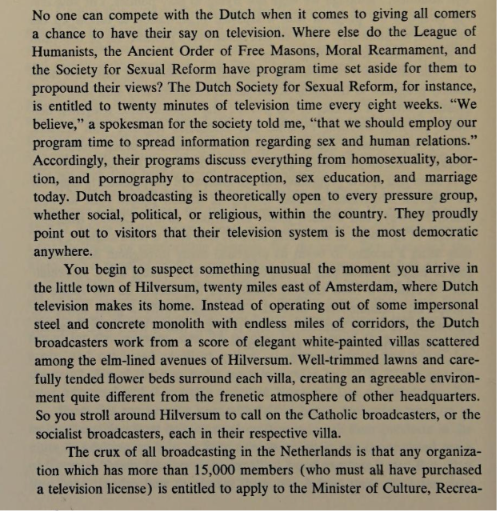
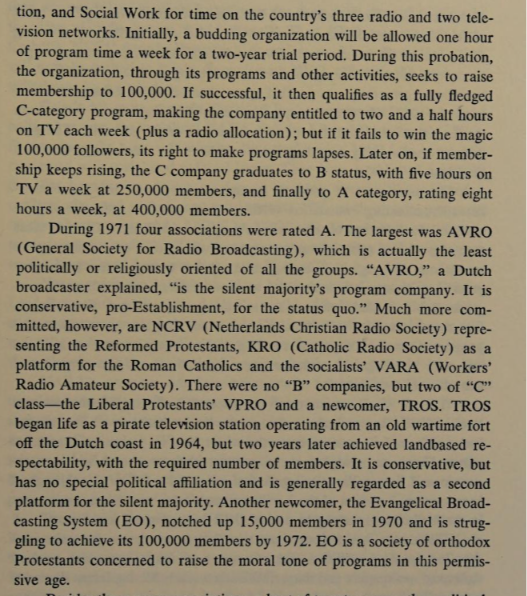
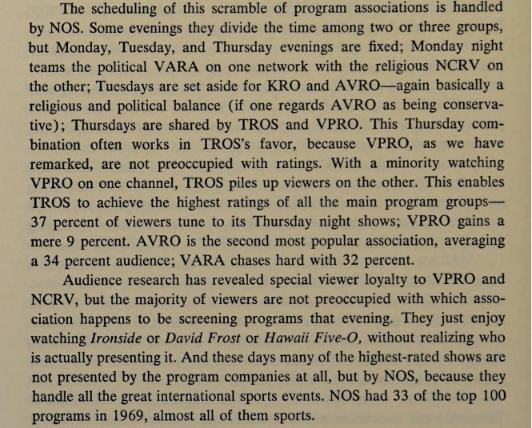
And then there's the Netherlands, where public broadcasting was and is decentralized in a different (non-geographic way). Here's British journalist Timothy Green writing in 1972:


The reason many ABC O-and-O's are on channel 7 is that they came late to the party. Either real or imagined, it was thought that lower band channels would have better coverage. Therefore they were preferred by the early license applicants.

That's only part of the reason. Back then, the ownership restrictions only allowed five television stations nationwide to be owned by a single entity.

ABC, finding a patchwork of stations on low-VHF, opted to file for channel 7 in New York, Chicago, Detroit, San Francisco and Los Angeles so that they would have the same channel number for all five stations.

I believe that the preference you allude to had more to do with how television started with a handful of channels and then expanded. The early license applicants were therefore on low channel numbers because they were licensed pre-expansion.
 
If you find an old TV with Channel 1, it is among the very first generation of consumer televisions.
I have a modern flat-panel TV whose analog tuner includes channel 1 when in antenna (not cable) mode. If you use the channel up/down buttons it skips over channel 1, but you can type in 01 on the keypad and it'll show channel 1 on the display with snow on the screen. No clue if it's actually tuning in 44-50 MHz, though, because I don't have a frequency-agile RF modulator which goes that low.
 
The reason many ABC O-and-O's are on channel 7 is that they came late to the party. Either real or imagined, it was thought that lower band channels would have better coverage. Therefore they were preferred by the early license applicants.
The story I heard is that they thought the FCC was going to eliminate the VHF-Low band, so they wanted to have the first and best channel on the VHF-High band.
 
I have a modern flat-panel TV whose analog tuner includes channel 1 when in antenna (not cable) mode. If you use the channel up/down buttons it skips over channel 1, but you can type in 01 on the keypad and it'll show channel 1 on the display with snow on the screen. No clue if it's actually tuning in 44-50 MHz, though, because I don't have a frequency-agile RF modulator which goes that low.
My cable system has a Channel 1 which is the news channel. But the news channel is also Channel 14.
 
The United States is the only large country where the national government never put its own TV stations on the air? All the other major countries I can think of have their own television stations, some of them years before they allowed private commercial broadcasting. BBC, CBC, Austalia Broadcasting Corporation, NHK. I believe all of Europe has government-owned television. (I know the Mexican government owns some TV and radio stations too, although I think that was an afterthought. XEW-TV and other commercial stations came first. )

And isn't that the reason we have no Channel 1 on our television sets? Channel 1 was supposed to be for the government, a channel assignment the federal government never claimed?

It's also the reason ABC is on Channel 7 in so many large markets, NYC, LA, Chicago, SF, Detroit. The American Broadcasting Company thought the government would someday claim Channels 2 through 6 and displace all those private broadcasters. Better to be on 7 and not get bumped when the federal and state governments wanted their own TV stations?
True too and also Washington DC was one of the first cities to get a signal on Channel 7 like WJLA-TV it signed on in 1947 prior to ABC TV operations officially opening in April 1948 with their O&O s actually opening in August 1948.

But there's another one the VOA had shortwave transmitters within that direct their signals outside the US at one time. But then again its the priorities of the FCC in 1934 that lead to where we are today.
 
Now that everything is digital, channel numbers are pretty much meaningless. "1" is now a valid virtual channel number for digital broadcast TV as well.
Channel 1 as a virtual designation should be commonly allowed. No technical reason to restrict it.

Maybe I shouldn’t suggest this, but the FCC could auction the rights to the virtual Channel 1 designation in each market, since the Commission never seems to pass over a chance to make money.

Even as a very young kid (long ago!) I wondered why there was no Channel 1 on the TV dial.
 
Channel 1 as a virtual designation should be commonly allowed. No technical reason to restrict it.

Maybe I shouldn’t suggest this, but the FCC could auction the rights to the virtual Channel 1 designation in each market, since the Commission never seems to pass over a chance to make money.

Even as a very young kid (long ago!) I wondered why there was no Channel 1 on the TV dial
Captain Kangaroo's TV tuned to channel 1 as I recall


Back
Top Bottom