The Charlotte NC market still had two independents. Although Pax came along at some point, but the one station didn't do a very good job of airing its programming. It did not stay around for Ion.I feel you. Around that time The WB and UPN came about and every TV station was affiliated with a network somehow-someway.

-
Get involved.
We want your input!
Apply for Membership and join the conversations about everything related to broadcasting.
After we receive your registration, a moderator will review it. After your registration is approved, you will be permitted to post.
If you use a disposable or false email address, your registration will be rejected.
After your membership is approved, please take a minute to tell us a little bit about yourself.
https://www.radiodiscussions.com/forums/introduce-yourself.1088/
Thanks in advance and have fun!
RadioDiscussions Administrators
You are using an out of date browser. It may not display this or other websites correctly.
You should upgrade or use an alternative browser.
You should upgrade or use an alternative browser.
Are their any independent local stations anymore?
- Thread starter WillowsIvy
- Start date

The 1990s and early '00s also saw the first round of former big-three affiliates become news-heavy total independents (not always by choice): KTVK, KRON, and WJXT.
By the way, this is how KTVK became an independent--as reported by the Arizona Republic on the day of the announcement in June 1994. Click to enlarge:
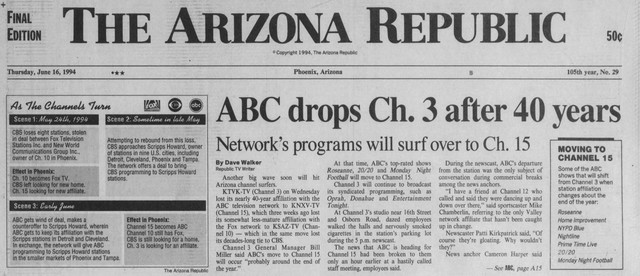
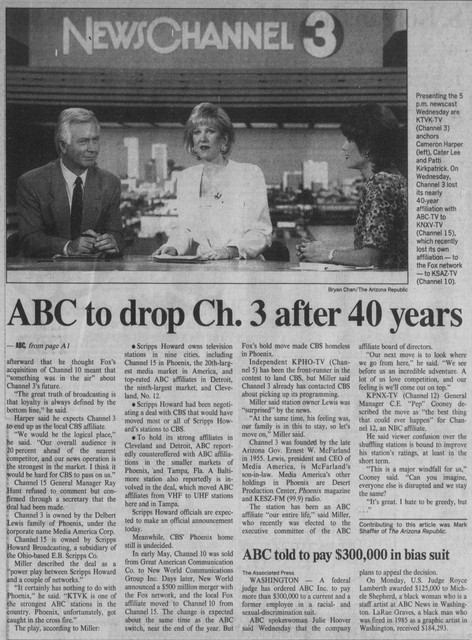
By the way, here's KTVK's post-independence news format (with a clip that includes the director's track!); note the heavy reliance on CNN branding, which was used to compensate for the loss of ABC News:
WXMI was the only independent in West Michigan before they signed on as FOX in 1987, aired the Pistons, I don't know if they aired the Redwings, aired Lions preseason games I don't know if they aired it in there early years or not or if it was late 80s. In 95 aired a few Tigers games weekends only as WWMT aired the Tigers for many years before that and CBS programs were delayed in spring & summer.
Cablevison in Kazoo had TBS, WGN, WKBD channel 50 Michigan's Superstation was dropped I think in 93 not sure on that as I didn't have Cablevision at that time my grandparents did only time I could watch WKBD was over there. Adelphia Comm had WNDU NBC South Bend, WSBT CBS also South Bend, WSYM FOX47 FOX17 sister station 2019-2026, WWOR that was dropped in Dec, 31, 1994 before they became UPN in 1995 was surprised got a TV station close to NYC which was NJ. I think Jan, 1, 2000 all the of South Bend WNDU & WSBT were dropped and WSYM Lansing as well as my friend and former neigbor told me it was dropped.
Now indies are WXSP, ARC-WMI, The Spot GR 17 FOX17 DT2 dropped Antenna TV which they had since day 1 a few weeks ago and WOOD TV put it on their DT2 and Rewind TV was dropped Nexstar didn't add it to any other DT, may return when one of the diginets contracts runs out in my opinion. Which confirms that FOX17 DT2 The Spot will air the Pistons this fall only thing worth watching as there not much on The Spot just throw anything on the channel at the dart board does air Scripps News from 6AM to 12PM M-F.
Cablevison in Kazoo had TBS, WGN, WKBD channel 50 Michigan's Superstation was dropped I think in 93 not sure on that as I didn't have Cablevision at that time my grandparents did only time I could watch WKBD was over there. Adelphia Comm had WNDU NBC South Bend, WSBT CBS also South Bend, WSYM FOX47 FOX17 sister station 2019-2026, WWOR that was dropped in Dec, 31, 1994 before they became UPN in 1995 was surprised got a TV station close to NYC which was NJ. I think Jan, 1, 2000 all the of South Bend WNDU & WSBT were dropped and WSYM Lansing as well as my friend and former neigbor told me it was dropped.
Now indies are WXSP, ARC-WMI, The Spot GR 17 FOX17 DT2 dropped Antenna TV which they had since day 1 a few weeks ago and WOOD TV put it on their DT2 and Rewind TV was dropped Nexstar didn't add it to any other DT, may return when one of the diginets contracts runs out in my opinion. Which confirms that FOX17 DT2 The Spot will air the Pistons this fall only thing worth watching as there not much on The Spot just throw anything on the channel at the dart board does air Scripps News from 6AM to 12PM M-F.
when WDAF switched from NBC to Fox in 1994, it used to CNN compensate for the loss of NBC News, even for years after FNC launched, what did KSAZ use?By the way, here's KTVK's post-independence news format (with a clip that includes the director's track!); note the heavy reliance on CNN branding, which was used to compensate for the loss of ABC News:
when WDAF switched from NBC to Fox in 1994, it used to CNN compensate for the loss of NBC News, even for years after FNC launched, what did KSAZ use?
KSAZ also used CNN for awhile. In fact, you can just about see the CNN logo behind the "Coverage You Can Count On" slogan in this 1996 KSAZ ID:

Of course, this was nothing compared to KTVK's all-out approach in touting its partnership with CNN:

Yes KRON went with CNN for national news content after they lost their NBC affiliation in the 2000's. Today under nexstar management KRON uses Newsnation for national content.The 1990s and early '00s also saw the first round of former big-three affiliates become news-heavy total independents (not always by choice): KTVK, KRON, and WJXT.
KFTY Videos
lizmar.com
KKOG-TV: An experiment in local, live television
www.kmrichards.com
There used to be local independent TV stations that mainly focused on a subset of a DMA region such as WLIG-TV Riverhead/ Now secondary CBS O&O WLNY New York mainly focused on Long Island (Eastern part of the New York TV Market) in 1985. KFTY Santa Rosa, California mainly focused on Mendocino, Napa and Sonoma areas (Northern Parts of the San Francisco DMA) at one point in its history. KDOC-TV Anaheim/Los Angeles at one point only focused on the Orange County part of the LA TV market. KKOG and KADY mainly focused on Ventura county part of the LA TV market at one point. But in all of these cases they either went off the air as in the case of KKOG, changed their COL's to the core city, changed affiliations or became part of a duopoly with the main affiliate.
KFTY-TV Santa Rosa became KEMO-TV San Francisco and mainly affiliate with subchannel diginets.
KDOC Los Angeles became a TCT affiliate.
WLIG is WLNY-TV New York and may carry CBS content whenever WCBS-TV has to air breaking news or CBS Sports programming.
Inland Empire Live News : KHIZ TV - Serving the Los Angeles, High Desert, and Inland Empire Communities
A fast-growing television station serving the greater Los Angeles area with diverse programming and a community focus.
web.archive.org
KHIZ-TV Barstow used to exist in the 1990s to cover the High Desert part of the LA TV market in the 1990s. The news stories here were more on places like Barstow.
Today its part of a duopoly with Ion affiliate KPXN Los Angeles.
Los Angeles is an artificially large TV market for reasons of sheer geography. Stations licensed to towns as far away as Barstow and Bishop are still considered as being within the LA market, and Palm Springs is carved out of it as a very small market almost completely surrounded by LA. Incidentally, that old KHIZ logo reminds me of WFMZ Allentown PA (another example of a station within a large market serving local needs).
Inland Empire Live News : KHIZ TV - Serving the Los Angeles, High Desert, and Inland Empire Communities
A fast-growing television station serving the greater Los Angeles area with diverse programming and a community focus.web.archive.org
KHIZ-TV Barstow used to exist in the 1990s to cover the High Desert part of the LA TV market in the 1990s. The news stories here were more on places like Barstow.
Today its part of a duopoly with Ion affiliate KPXN Los Angeles.
The same could be said of several Western markets, and in the case of Salt Lake City, an intricate network of translators makes the market viable. Otherwise, St George/Cedar City would make perfect sense as a naturally occurring market.

K.M. Richards
Program Director, The Eighties Channel™
Los Angeles is an artificially large TV market for reasons of sheer geography. Stations licensed to towns as far away as Barstow and Bishop are still considered as being within the LA market, and Palm Springs is carved out of it as a very small market almost completely surrounded by LA.
In the case of Bishop, that is because that area was the very first to have high-UHF translators licensed, and they rebroadcast the CBS and NBC stations from L.A., because from the peak that James Oliver chose for his receiving antenna had a line-of-sight to Mount Wilson.
It's part of my article on the subject at the UHF History site (of course):
History of UHF Television
In the case of Bishop, that is because that area was the very first to have high-UHF translators licensed, and they rebroadcast the CBS and NBC stations from L.A., because from the peak that James Oliver chose for his receiving antenna had a line-of-sight to Mount Wilson.
It's part of my article on the subject at the UHF History site (of course):
History of UHF Television
uhfhistory.com
I had read that on your site before, but I went back and took a look at it. Your site is an invaluable resource.
K.M. Richards
Program Director, The Eighties Channel™
I had read that on your site before, but I went back and took a look at it. Your site is an invaluable resource.
Thank you. The original idea came from the late Clarke Ingram after I had helped him update his site on the history of the DuMont network and I threw myself enthusiastically into the project (I am, you might guess, a strong supporter of preserving history).
About a year before Clarke passed away -- he had been in managed care for a while by then -- he gave me the intellectual rights to both sites, and @davideduardo donated server space to host it as I did not have the legal rights to deal with the existing hosting service.
There were a lot of "untold" stories out there and I think we managed to cover a decent amount of them. I even busted a few "urban myths" in the process, including ones involving channel 39 in San Diego and channel 20 in Detroit. It is a very satisfying feeling to uncover the facts and set the record straight, as you would probably presume.
Thank you for your visits to the site.

What you call “urban myths” are widespread in broadcast history as reported online. Some are just badly written Wikipedia articles that have wrong on-air dates or format eras for stations, while others improperly credit the wrong people for innovations in the industry. And others just present stupidity as fact, such as one item I found online showing how the 93KHJ DJs picked their own music and got record company favors in exchange.There were a lot of "untold" stories out there and I think we managed to cover a decent amount of them. I even busted a few "urban myths" in the process, including ones involving channel 39 in San Diego and channel 20 in Detroit. It is a very satisfying feeling to uncover the facts and set the record straight, as you would probably presume.
There is a lot… way too much… false stuff about the histories of radio and TV. Those who are exploring such data today need to keep in mind that, perhaps, half or more of what is on the web is wrong or partially inaccurate.
This Kaiser Broadcasting promotional film from 1968 profiles that company's range of exceptionally ambitious UHF independents (for that time):
K.M. Richards
Program Director, The Eighties Channel™
Noticeably absent from that promo film was KBSC-TV/52 in Los Angeles, which had not only three network O&Os but four independents ... all on VHF. They had originally intended to provide subscription TV service but were delayed by a variety of legal challenges (at one point, voters passed a ballot proposition that forbade over-the-air pay TV anywhere in the state).
Facing the deadline of a final extension of their construction permit, they signed on as KMTW (the call letters standing for Mount Wilson, where the channel 52 transmitter was located) June 29, 1966 with a nightly four hour schedule of freebie travelogues, airing in monochrome! They changed call letters in 1968, but it wasn't until 1971 that they upgraded the signal to 55kW and leased a floor at Metromedia Square (where KTTV/11 lived) as a main studio location. The programming was haphazard at best, starting with a block of kid-friendly programs that ranged from Felix The Cat to the Little Rascals, even including some early anime in the form of Gigantor and Kimba The White Lion. They actually sold a half-hour every night to the Santa Anita racetrack for horse racing highlights, which was followed by Hollywood Television Theatre with a neverending parade of forgettable movies (the only benefit was that by the end of the first reel they had run out of commercials for the day and just let the movie run, signing off whenever it ended). Weekends were brokered to Japanese and Korean production companies.
That ended in 1977, when Kaiser sold KBSC to Oak Industries, which proceeded to take advantage of the FCC's original subscription television authorization to launch ON TV. But as cable penetration started to erode their audience, they eventually threw in the towel and sold out in 1985 to the then-new Telemundo network.
KBSC-TV was the black sheep in the Kaiser Broadcasting family.
Facing the deadline of a final extension of their construction permit, they signed on as KMTW (the call letters standing for Mount Wilson, where the channel 52 transmitter was located) June 29, 1966 with a nightly four hour schedule of freebie travelogues, airing in monochrome! They changed call letters in 1968, but it wasn't until 1971 that they upgraded the signal to 55kW and leased a floor at Metromedia Square (where KTTV/11 lived) as a main studio location. The programming was haphazard at best, starting with a block of kid-friendly programs that ranged from Felix The Cat to the Little Rascals, even including some early anime in the form of Gigantor and Kimba The White Lion. They actually sold a half-hour every night to the Santa Anita racetrack for horse racing highlights, which was followed by Hollywood Television Theatre with a neverending parade of forgettable movies (the only benefit was that by the end of the first reel they had run out of commercials for the day and just let the movie run, signing off whenever it ended). Weekends were brokered to Japanese and Korean production companies.
That ended in 1977, when Kaiser sold KBSC to Oak Industries, which proceeded to take advantage of the FCC's original subscription television authorization to launch ON TV. But as cable penetration started to erode their audience, they eventually threw in the towel and sold out in 1985 to the then-new Telemundo network.
KBSC-TV was the black sheep in the Kaiser Broadcasting family.
One interesting story is that of the station that became WQCW Channel 30 Portsmouth OH. I did a write-up on it for Wikipedia, to correct some errors in their article, but someone didn't like it, and went in and deleted it, claiming that my comments were unsubstantiated, which they most certainly weren't. I went back and supported my research with articles from newspapers.com as well as Television Factbook.Thank you. The original idea came from the late Clarke Ingram after I had helped him update his site on the history of the DuMont network and I threw myself enthusiastically into the project (I am, you might guess, a strong supporter of preserving history).
About a year before Clarke passed away -- he had been in managed care for a while by then -- he gave me the intellectual rights to both sites, and @davideduardo donated server space to host it as I did not have the legal rights to deal with the existing hosting service.
There were a lot of "untold" stories out there and I think we managed to cover a decent amount of them. I even busted a few "urban myths" in the process, including ones involving channel 39 in San Diego and channel 20 in Detroit. It is a very satisfying feeling to uncover the facts and set the record straight, as you would probably presume.
Thank you for your visits to the site.
In a nutshell, and just working from memory here (hence the dates are only approximate):
- Went on the air circa 1968 as WRLO, a local venture with weather reports as well as original content and syndicated shows, with plans to cherry-pick certain shows from ABC, CBS, and NBC (ran on very low power and barely got out of Scioto County, a scenario that now exists with unrelated LPTV WTZP Channel 50)
- Went belly-up a couple of years later and returned to the air circa 1998 as WUXA, even listed in the West Virginia TV Guide
- Later became WHCP and moved its operations to Charleston WV (80 miles away!), initiating an ill-fated newscast with well-known anchor Tom McGee (that's a story in and of itself), and affiliating with WB
- Then became WQCW, got acquired by Gray, went with the CW, and now is basically a sidecar to WSAZ, with which it shares studios in Huntington
Here's their short-lived WB 30 newscast, really quite impressive for what it was:
K.M. Richards
Program Director, The Eighties Channel™
I'll give you a few exact dates for your files, since I have kept a copy of the Excel spreadsheet where I logged all my research from Broadcasting for the original launch of UHF History:
WRLO's original air date was May 14, 1966. They went off the air sometime in 1969 (I don't have the exact date). I believe the resurrection was under a new CP, so WUXA was a new station; I am basing that conclusion on an entry in the December 17, 1984 Broadcasting of the call letter assignment being to a "New TV" rather than an existing station.
WTVQ signed on June 2, 1968 as WBLG-TV, and applied for the new call letters in August 1973, right before they were sold to Starr Broadcasting. Their last day on 62 was June 20, 1980 and they returned on channel 36 three days later.
WRLO's original air date was May 14, 1966. They went off the air sometime in 1969 (I don't have the exact date). I believe the resurrection was under a new CP, so WUXA was a new station; I am basing that conclusion on an entry in the December 17, 1984 Broadcasting of the call letter assignment being to a "New TV" rather than an existing station.
WTVQ signed on June 2, 1968 as WBLG-TV, and applied for the new call letters in August 1973, right before they were sold to Starr Broadcasting. Their last day on 62 was June 20, 1980 and they returned on channel 36 three days later.
I'll give you a few exact dates for your files, since I have kept a copy of the Excel spreadsheet where I logged all my research from Broadcasting for the original launch of UHF History:
WRLO's original air date was May 14, 1966. They went off the air sometime in 1969 (I don't have the exact date). I believe the resurrection was under a new CP, so WUXA was a new station; I am basing that conclusion on an entry in the December 17, 1984 Broadcasting of the call letter assignment being to a "New TV" rather than an existing station.
WTVQ signed on June 2, 1968 as WBLG-TV, and applied for the new call letters in August 1973, right before they were sold to Starr Broadcasting. Their last day on 62 was June 20, 1980 and they returned on channel 36 three days later.
Thanks for the info. I never saw WRLO as we did not have a UHF-capable set until I was about ten years old, and we had no need for a converter. I know we would drive by the WRLO studio on the way to Columbus and I'd say to myself "hey, what station is that, and why don't we get it?". I distinctly remember when WTVQ cut over to channel 36 though I didn't recall the exact time frame, I imagine that Lexington viewers had to use those big antennas that were common there, to try and get WKRC or possibly WLKY during those three days if they wanted ABC programming (both of those stations, now CBS, were ABC at the time).
One of these days, when I've got some time on my hands and feel like doing it, I think I'll rewrite my WRLO/WUXA/WHCP/WQCW research for Wikipedia, and be sure to save it somewhere (unlike when I submitted it before), so that I will have it if someone comes along again, and deep-sixes it with baseless accusations of it not being sufficiently documented.
Always make sure you include your sources.One of these days, when I've got some time on my hands and feel like doing it, I think I'll rewrite my WRLO/WUXA/WHCP/WQCW research for Wikipedia, and be sure to save it somewhere (unlike when I submitted it before), so that I will have it if someone comes along again, and deep-sixes it with baseless accusations of it not being sufficiently documented.