• Get involved.
    We want your input!
    Apply for Membership and join the conversations about everything related to broadcasting.

    After we receive your registration, a moderator will review it. After your registration is approved, you will be permitted to post.
    If you use a disposable or false email address, your registration will be rejected.

    After your membership is approved, please take a minute to tell us a little bit about yourself.
    https://www.radiodiscussions.com/forums/introduce-yourself.1088/

    Thanks in advance and have fun!
    RadioDiscussions Administrators

1230 AM KWTX

R

radioguyntx

Guest
Hi,

I was wondering if anyone knows anything about this station, I live about 15 miles away and I listen to it frequently and it fades out alot, other stations bleed through constantly. I don't really know anything about the technical aspect of radio transmission but have always been interested, and would love to learn more about it.

I thought about getting a better antenna to remedy the situation, but I can't really find anything out-of-the-box , and as I stated above, don't really know about engineering or building one. So if anyone would be willing to point me in the direction of a good website to read up on, or help me out I would greatly appreciate it.
 
The 1230-AM frequency seems to be a bad one for reception. There is a station in Cincinnati on that frequency. There is another one in Columbus, Ohio. Back in the 1950's and into the 1960's, the station at 1230-AM here had a popular rock format, but at night, it couldn't be heard beyond the city limits, and relied on its powerful FM simulcasting affiliate for its programming to be heard. It seems there are so many stations on that frequency and each is only permitted to operate with minimal power that it is quite hard to hear it beyond 15 miles - particularly at night when hearing other stations bleeding through is very common. My suggestion is to use very little in the way of an antenna because it only seems to bring in the distant stations on 1230 which override the one you are trying to listen to. I've even tried turning down the volume on the radio so only the initial signal comes through and then amplifying it with a second source it so that station is the basic sound amplified. It seems today many AM receiving sets do not have a connection for an external antenna so the internal one must be relied upon. In that case, rotating the radio to pick up the best signal should be tried.
 
Cincinnati Kid said:
The 1230-AM frequency seems to be a bad one for reception.

1230 is a "local channel", occupied by "Class C" stations. (the other local channels are 1240, 1340, 1400, 1450, and 1490. There are two Class C stations on other frequencies - one on 570 in Wisconsin and the other on 1350 in Oklahoma.)

Class C stations are protected from daytime interference from other stations. They are then allowed to use their daytime facilities at night - it is simply assumed that since they're far enough from other stations on the same frequency to not interfere during the day, there won't be any nighttime interference either.

Of course, as you've observed that isn't a very good assumption!

On all other frequencies, the differences between daytime and nighttime signal propagation are taken into account.
 
I live less than 2 miles from 1010 KBBW AM night-time transmitters. I was wondering if that would have anything to do with interference from this station. The tuner I am using is a Sony MHC-GX450 it has a factory AM loop antenna. BTW: most of the noise and interference/bleed-through is at nighttime.
 
There may be other factors here because as "graveyard" stations go, KWTX in Waco has excellent daytime coverage. There are some areas in Texas with very high ground conductivity and that includes much of central and north-central Texas. In fact KWTX and co-channel KSST in Sulphur Springs can both be heard (individually or mixing it up) in many parts of the Dallas Fort-Worth Metroplex. (KWTX is almost 90 miles south of downtown Dallas; KSST is roughly 70 miles to the East-northeast.) Likewise KAND 1340 Corsicana puts a listenable signal into the downtown Dallas area, about fifty miles to the north.
 
Its amazing you can hear KWTX at all at night 15 miles out. 1230 is a "graveyard" frequency--with hundreds of stations broadcasting on 1230 in the US; most broadcasting 1000 watts non-directional day and night. It is rare to hear these stations more than 10 miles at night. For better reception, you might try a "Select-A-Tenna," an inductive loop AM antenna which is not connected directly to your radio (you simply set it next to the radio and turn the Select-A-Tenna). It is one of the AM DXers best friends and available by mail order. I'm sure you can find it by googling AM Supertenna.
 
I can hear this station but days only. It's fairly strong during the day but absent at night, of course, north of Austin.
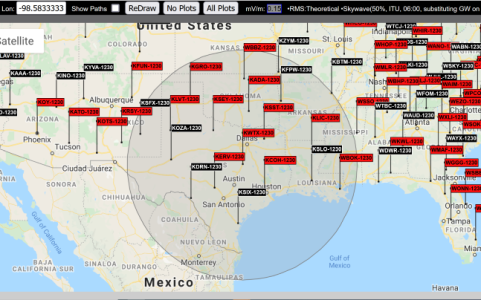
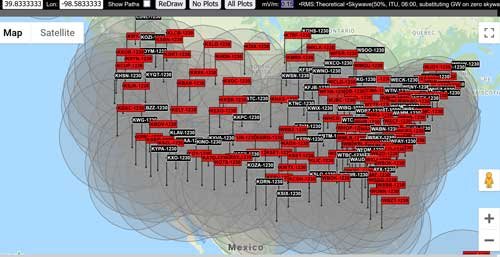
If I could only scroll in deeper to see it's coverage region. There are so many stations on this local graveyard frequency, one cannot separate them in this highly accurate radio contour map site.


Screenshot-2022-01-05-141118-.jpg
 
If I could only scroll in deeper to see it's coverage region. There are so many stations on this local graveyard frequency, one cannot separate them
There is a way...Click on no plots, than click on KWTX's flag and select show plot. Every station on a graveyard frequency can be heard at an average of 250 miles away by skywave, but because there is so much competition, it makes it super hard to gauge one. Luckily, I managed 1340 KTMM Grand Junction, CO from Cheyenne, WY (275 miles) based on mentions of the "Altitude Sports Network", and 1340 being the only such affiliate on that freq. Also, you can use radio-locator to get a good idea of the daytime coverage, as well as using the website you mentioned.

I enjoy using nf8m as well, and it is highly accurate, IMO. :)
 
There is a way...Click on no plots, than click on KWTX's flag and select show plot. Every station on a graveyard frequency can be heard at an average of 250 miles away by skywave, but because there is so much competition, it makes it super hard to gauge one. Luckily, I managed 1340 KTMM Grand Junction, CO from Cheyenne, WY (275 miles) based on mentions of the "Altitude Sports Network", and 1340 being the only such affiliate on that freq. Also, you can use radio-locator to get a good idea of the daytime coverage, as well as using the website you mentioned.

I enjoy using nf8m as well, and it is highly accurate, IMO. :)
That's a big help. What a difference that makes. Thank you for the tip

Here the map I made. Impressive contour.


Screenshot 2022-01-05 161559-.png
 
With 14 other stations on the same frequency in Texas and surrounding states, hard to believe that 1kw night signal would go very far...
 
With 14 other stations on the same frequency in Texas and surrounding states, hard to believe that 1kw night signal would go very far...
@Dondd Here in north DFW, during the daytime, I can hear News Talk KWTX-1230 (104 miles) weakly under the stronger Oldies KSST-1230 (88 miles). At night, neither station is heard in the Graveyard muddle.
 
Last edited:
With 14 other stations on the same frequency in Texas and surrounding states, hard to believe that 1kw night signal would go very far...
It depends on conditions. When living in Ecuador, I heard stations on the former Class IV channels (1230, 1240, 1340, 1400, 1450, 1490) from as far away as the Dakotas and Miami. Before that, from Cleveland, OH, I heard KTIP in Porterville, CA on 1450 and many from Texas, New Mexico, Colorado, etc.

Depending on local ground conductivity, those stations can cover as little as a 7 to 10 mile radius on Long Island to perhaps 30 to 40 miles in parts of the great plains. Night skip is "anything goes". Many of those US stations are heard in Australia and New Zealand, in fact.
 
@ RadioGuy :
One benefit I've found about 'graveyard' stations at night -- especially semilocal ones -- is when they are loud and clear is the time when the great Northern Light are afoot and aflame. They don't even have to be visible. It's time for stations on those 6 frequencies and others to open up matters to the south and even souther. Caribbean, even South America.

Semi local WPAM Pottsville 1450 (now dark) was one such pilot station. Ordinarily, one could see their tower in Minersville PA, at night, perhaps from 4-5 miles away, and they would be getting digested by a grumble of other stations.
It's the same situation with semilocal WAZL 1490 Hazleton. They're just 22 miles away to the northeast, but when they are L&C at night -- groundwave only? -- it's a Night of the Aurora.

Maybe my best AM catch ever, with considerable assistance from the Northern Lights, was from South America. And on a graveyard frequency : 1400 HJAS from Colombia. The WRTH log listed them as 3000 watts.
 
I can hear 1230 KIFW Sitka or 1230 kVAK Valdez.. about 350 miles away at night very well. 1450 KLAM is only 250 watts from.. about 300 miles away and its very audible most of the time its dark
 
I can hear 1230 KIFW Sitka or 1230 kVAK Valdez.. about 350 miles away at night very well. 1450 KLAM is only 250 watts from.. about 300 miles away and its very audible most of the time its dark
And that's because there are few or no stations in between you and them, I think. That's the same reason why I was able to hear many stations on the "graveyard" channels when I was in Ecuador... very few stations in between that nation and the US on those channels, so the only limiting factor was reception conditions... so on different night I might get different areas from the US.
 
And that's because there are few or no stations in between you and them, I think. That's the same reason why I was able to hear many stations on the "graveyard" channels when I was in Ecuador... very few stations in between that nation and the US on those channels, so the only limiting factor was reception conditions... so on different night I might get different areas from the US.
Am I correct in assuming that most of the good DX you heard in Ecuador was during winter in the Northern Hemisphere? I know
there is sometimes very good trans equatorial DX during the equinoxes.
 
And that's because there are few or no stations in between you and them, I think. That's the same reason why I was able to hear many stations on the "graveyard" channels when I was in Ecuador... very few stations in between that nation and the US on those channels, so the only limiting factor was reception conditions... so on different night I might get different areas from the US.

Correct. .and KIFW, KVAK and KLAM arent limtied to 1kw, they arent class C's.. they could in theory go to 50kw, they are class B's
 
Status
This thread has been closed due to inactivity. You can create a new thread to discuss this topic.


Back
Top Bottom