
• Get involved.
    We want your input!
    Apply for Membership and join the conversations about everything related to broadcasting.

    After we receive your registration, a moderator will review it. After your registration is approved, you will be permitted to post.
    If you use a disposable or false email address, your registration will be rejected.

    After your membership is approved, please take a minute to tell us a little bit about yourself.
    https://www.radiodiscussions.com/forums/introduce-yourself.1088/

    Thanks in advance and have fun!
    RadioDiscussions Administrators

2023: Fewest Consensus Hits

Radio wasn't where music was discovered. It was the ONLY place where music was discovered. There was no other place. Now it has competition. But to say people don't discover music on the radio ignores how many artists have depended on radio to put their music in FRONT of people. That's the difference between radio and the internet. The internet is the proverbial haystack in which people are trying to find a needle. Radio puts a focus on certain songs and artists. Radio makes discovery cheap and easy. There's a market for that. Granted it's not the ONLY market. There are other ways to do it. But when it's done well, it works, and artists know it.
Understood, and I'm glad to hear that radio is deemed important by artists.

But streaming is the future, and the future is now. You are absolutely correct about the internet being the proverbial haystack where people are trying to find a needle. From the perspective of the artist, that needle being lost somewhere in the haystack is the visibility factor, something all internet content creators have to deal with to a certain extent -- how to gain some visibility.

In many cases, they are fighting search and/or suggestion algorithms.

Radio still overcomes the visibility problem, for now.

I read the article and it doesn't really look like there are any answers. One guy apparently says Radio needs more "live and local". LOL. Every time that suggestion is mentioned on radio forums, such as this one, it's usually by older demos who want things the way they were 40 years ago, and it is pooh-poohed by people here (and elsewhere) who know what they're doing. So that is out of the question. I'm not sure about the other suggestions in the article.

For example, one suggestion is "we need to review how we test music to ensure our research target is old enough to represent existing listeners". Isn't that -- and most of the other things mentioned -- already SOP?

One factor that few in the industry seems to bring up is that it's possible that when CHR was still vital in the early 2010's, the pop music was a lot better quality. And now it's not. And the listeners are voting by turning to another format or to a streaming channel. It looks that way on the chart about halfway down the article, the younger demos seem to be tuning CHR out. It's almost as if the pop listeners have already spoken.

Or, maybe what we call pop is aging out. It's happened to other formats -- something mentioned here on RD all the time.
 
Woodstock came after Monterey. Monterey is where Clive Davis heard and signed Janis Joplin. Other acts were signed to record deals at these festivals. Then the record labels worked their music to radio. Thousands of people saw these artists at Monterey or Woodstock. Millions heard them on the radio. Understand the difference?
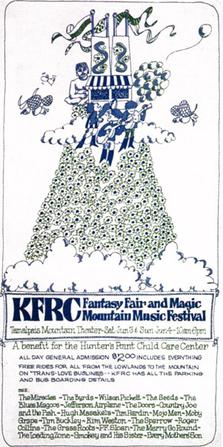
But the first of those events, the one prior to Monterey done by Tom Rounds and KFRC. Fantasy Fair and Magic Mountain Music Festival was held in the second weekend of June 1967 at Mount Tamalpais State Park in Marin County, California.

I mention it because it was done by a radio station as a station promotion. And for the most part, the artists played songs that were already familiar because they were played on the radio.

People don't go to concerts to hear "new songs". If tbolt does not understand this, he should listen to or just read the lyrics to Rick Nelson's "Garden Party" about wanting to singing new songs with a new long-hair appearance at a concert when the audience wanted to hear the familiar tunes and see the old Ricky, not the new Rick.

"Nelson came on stage dressed in the then-current fashion, wearing bell-bottoms and a purple velvet shirt, with his hair hanging down to his shoulders. He started playing his older songs like "Hello Mary Lou", but then he played the Rolling Stones' "Country Honk" (a country version of their hit song "Honky Tonk Women") and the crowd began to boo. While some reports say that the booing was caused by police action in the back of the audience, Nelson thought it was directed at him. Nevertheless, he sang another song but then left the building and did not appear onstage for the finale." (Wikipedia)
 
But streaming is the future, and the future is now.
Which is why radio stations are investing in streaming, even though it's mostly a loss for now.

Or, maybe what we call pop is aging out.

Or it's changing. That's why I say CHR stations need to be open to music that might not seem to fit the format. The only real qualification is that it connects, regardless of the genre.
 
But nearly nobody spent money on concerts to see a band or artist they had never heard of. That statement makes no sense at all.

Yes, lots of local club bands began by playing in tiny venues where the objective was to sell booze.

And what percentage of the population there went to concerts with artists they had never heard before?

That's just BS. Maybe a person would hear a song being played at a record shop or record department at a department store back in the day, but such retail outlets were not sites of discovery.

In fact, those of us who used employees at record shops to report sales in the 60's and 70's were very familiar with the environment and we can all say that it no "statistical impact" at all on record familiarization. You are trying to defend a point by making things up on the fly.
You obviously never worked at a record store or experienced the scene in San Francisco. Radio was not the centre of the music universe. Ever heard of Tower Records? That's just one place where people discovered music. Your statement is BS. Many people did discover music at Record shops. Maybe you never did, but you cannot speak for everyone...
 
Last edited:
One factor that few in the industry seems to bring up is that it's possible that when CHR was still vital in the early 2010's, the pop music was a lot better quality. And now it's not. And the listeners are voting by turning to another format or to a streaming channel. It looks that way on the chart about halfway down the article, the younger demos seem to be tuning CHR out. It's almost as if the pop listeners have already spoken.
Top 40 has had many lulls over the years. This is one of them.

Others were, for example, the earliest 60's after the payola scandals and the earliest 80's after disco collapsed.

And there are plenty of KISS-FM's and Z-100's that are doing just fine today. And, as I said elsewhere, in places where the pure Top 40 station is on an off-moment, it is often because the market has a rhythmic CHR, or a Curban or even a hip hop station that is taking younger demos. A lot of that has to do with the changes in ethnic composition in many major markets.

For example, WQAM and WFUN were great pure Top 40's in the 60's. Then Miami began to be influenced and then dominated by Cubans and an increasing Black population, setting the ground for a more rhythmic Top 40 station... Y-100... to totally take over. Things like that happened all over the U.S. in that era as markets suddenly had two or three times the viable stations due to the growth of FM.
Or, maybe what we call pop is aging out. It's happened to other formats -- something mentioned here on RD all the time.
Top 40 or CHR don't age out. They reflect, or should reflect, the tastes of the younger demos. However, today Top 40 targets young adult women, not teens. So it is really a format that suddenly "grew up" along with its audience in the 70's.
 
I mention it because it was done by a radio station as a station promotion.

This is still very common now. Radio stations hold "listener appreciation shows" where they introduce their listeners to new artists. It may be just one singer and a guitar, or it may be a "12 man jam." These things introduce listeners to new artists, and at the same time introduce those artists to the PDs and DJs. A lot of artists got their start that way.
 
You obviously never worked at a record store or experienced the scene in San Francisco. Radio was not the centre of the music universe. Ever heard of Tower Records? That's just one place where people discovered music. Your statement is BS. Many people did discover music at Record shops. Maybe you never did, but you cannot speak for everyone...
Yet you are talking about handfulls of people at a record store in San Francisco vs a Top 40 station that might have cumed nearly a million people in its biggest era of the 60's.

You are using the "Spinal Tap played Mytown and filled the Businessname Arena" argument where a 15,000 seat auditorium selling out is compared to a radio station that might cume half a million people or more.

Oh, and in the early days of Rock 'n' Roll, I went to music stores regularly in the city that almost can be credited with inventing "music discovery" through Alan Freed and Pete "Mad Daddy" Meyers. I never "discovered" a song I liked or bought at Record Rondevous or any of the other big downtown record outlets. And as a kid, I "DeeJayeed" for school and club record hops, and never saw the things you think were prevalent in that era.

A few dozen people in a record store is not the same as over a million who listened to KFRC and KYA and KEWB in the 60's in San Francisco... or even KOBY in the later 50's.
 
Last edited:
This is still very common now. Radio stations hold "listener appreciation shows" where they introduce their listeners to new artists. It may be just one singer and a guitar, or it may be a "12 man jam." These things introduce listeners to new artists, and at the same time introduce those artists to the PDs and DJs. A lot of artists got their start that way.
But the Fantasy Fair and Magic Mountain Music Festival was not a gathering to hear new music by new artists.


The Doors, Canned Heat, Dionne Warwick, Every Mother's Son, The Merry-Go-Round, The Mojo Men, P. F. Sloan, The Seeds, Country Joe and the Fish, Captain Beefheart, The Byrds, Tim Buckley, The Sparrows, The Grass Roots, The Loading Zone, The 5th Dimension and Jefferson Airplane were among those who played. Yes, a couple of bands with local hits, and one or two one-hit-wonders, but some astoundingly big names in what was the first big multi-artist all-weekend-long show.
 
But the Fantasy Fair and Magic Mountain Music Festival was not a gathering to hear new music by new artists.

Neither is the iHeart Jingle Ball. But there are a few on the bill:


Here's one in Houston. Some big names and some new artsts:


Sponsored by a client that might not normally buy radio.
 
That's just BS. Maybe a person would hear a song being played at a record shop or record department at a department store back in the day, but such retail outlets were not sites of discovery.
All true. It wasn't until most new artists got some airplay that their careers were considered launched. Only a teeny tiny percentage of consumers trolled record stores looking for new music.
 
Then they continue to circle the drain. If CHR ratings are sinking due to listener apathy, they have to try something. Or just unplug and close shop...
This happened in the early 90s.

I remember when Myrtle Beach SC didn't have a CHR. The one CHR that was left changed to AC and called itself Mix. The name didn't change back when it returned to CHR, so a name that most people associate with AC is still on a CHR which seemed quite high energy and rhythmic leaning to me.
 
Not any more. But it all began with Too Much. He can't do a show without playing that song. It was a cross-genre radio hit.

He had non-stop radio airplay for ten years.
He has a nonstop 24/7 channel on SiriusXM, but I suppose his label is paying handsomely for that.
 
Lots of people discovered artists and music at record stores during the record store era. Most of the larger stores did not just stock the Hot 100, or Top 40 artists. There were hundreds of feet of shelf space, with bins full of LPs and CDs that reflected every kind of music out there, and that is a reason that the stores stocked all that stuff -- it obviously sold. 1000's of albums by all sorts of artists, not just the hit stars that were played on the radio formats. That all went the way of the Dodo when MP3 piracy kicked in, and Streaming after that. Can't beat unlimited access and the cost of free.

Did the music discovery at record stores amount to the same influence radio had in the 70s-00s? Probably not. One play on a hit station maybe catches a few hundred thousand sets of ears, and that's a lot of influence. Versus the number of CD consumers who made their way to the International music or Punk or Blues or Metal music sections, or maybe flipped through some bins with artists they hadn't heard of previously, and decided to chance it.

It's the same with artists being discovered playing shows. I live in a city where there was a lot of music discovery during the tail end of the 1980s, of bands that got next to zero airplay, unless it was a pipsqueak college station (KCMU) that wasn't clearly audible over the entire metro. Yet these bands had fans in the suburbs, even in parts where KCMU didn't reach. Soundgarden, Nirvana, Mother Love Bone, Malfunkshion, Gruntruck, Green River, Mudhoney, Alice In Chains, Second Coming, the Posies, Candlebox, Sweetwater, and a whole host of others sold records locally through word of mouth and shows, until the record companies finally discovered the scene, and commercial radio finally got in on the act after 1991 when Nirvana hit.

Some of the bands, after being signed, obviously "made it". Some few (Pearl Jam) still fill arenas and stadiums. Others didn't quite hit, but they were discovered, and eventually played on radio, and did national tours.

Then you had scenes like the metal scene, and -- aside from a handful of artists like Metallica -- metal music doesn't get a lot of play on radio, even today. You got Deathcore, Emo-core, Black metal and Death metal, and these artists get discovered mostly through the internet, and through word of mouth. And although here in the US the scene isn't incredibly active, there still are concerts and a large fan base for many of these acts. Their vids often get 100Ks of plays easily. In the EU, of course, they have entire festivals. Go to any YouTube metal vid and you'll see comments by people who said how they discovered the artist -- and especially if they aren't in the EU, chances are probably 99% that it wasn't radio.

Music 'discovery' is a mix. Radio used to have a very large place to play in it. Even TV did, when MTV was a big thing.

Today? I think it's mostly internet based, and -- of course -- that depends on the demographics. I think in Country, which you experts here have said more than once is the #1 radio format nationwide, it's probably different than it is in Rock, Hip-hop, Alt, rap, or other genres. AC and Pop maybe are somewhere in between.

I think the issue with Pop is the quality is poor compared to 10-11 years ago, and I think perhaps the demos have moved on. GenZ is 15% smaller than the Millennials, and maybe their tastes are different, so it's a double whammy on the format. This, of course, is just a guess. But it happened with Alt and Rock. Why not other formats as well?
 
Did the music discovery at record stores amount to the same influence radio had in the 70s-00s? Probably not.

Of course not. The other aspect about this is it required record stores to have knowledgeable staff who could translate your personal taste and interest into an artist or album you didn't know but would like. In the same way algorithms are supposed to work. How many record stores had that kind of staff? Or staff with expertise in a particular genre? That's what this model depended on. People didn't just walk into record stores and buy records without knowing what was on them. There weren't many stores that allowed you to listen before buying. Maybe there was word-of-mouth from a friend, but they needed to hear it first too. The best way to hear something before buying was to hear it on the radio.
 
Of course not. The other aspect about this is it required record stores to have knowledgeable staff who could translate your personal taste and interest into an artist or album you didn't know but would like. In the same way algorithms are supposed to work. How many record stores had that kind of staff? Or staff with expertise in a particular genre? That's what this model depended on. People didn't just walk into record stores and buy records without knowing what was on them. There weren't many stores that allowed you to listen before buying. Maybe there was word-of-mouth from a friend, but they needed to hear it first too. The best way to hear something before buying was to hear it on the radio.
Many record stores had listening "booths" where you could sample tracks from albums. Even Barnes & Noble had them briefly. I knew of many record stores that had knowledgeable staff. A lot of people who worked at record stores were musicians or music aficionados. Of course, that was long ago. There aren't many still in business. Again, Radio was not the only way to discover music back then or now.

The world of music and Radio formats are not the same thing. People used to pay money to see a movie that they've never seen. They didn't know if they would like it or not. Some people used to do the same thing when buying records. Maybe they had only heard one song, but they chose to buy the album instead of a 45...
 
Last edited:
Many record stores had listening "booths" where you could sample tracks from albums.

"Many" is an overstatement. There was a small number of specialty stores in big cities that had the size to accommodate these booths. They wouldn't allow you to unseal albums to listen to them. Singles were unsealed, so those were available. Most of these were gone by the 60s because of abuse and theft. Also "many" stores didn't have knowledgeable staff. They had people who stocked the shelves. Some specialty stores has people knowledgeable in classical music. That was where the money was. There was a whole service structure built around classical music, with magazines and other media for them. Not so much for pop or rock music.

The Barnes & Noble example you give was an mp3 listening station in the early 2000s, where you could hear from a pre-selected group of songs. Not everything. The choices were made by B&N, not by you.

You mentioned Tower Records in an earlier post, and they were an early example of mass merchandising, where boxes of records were put on the sales floor, and people could buy them at a discount. Sort of the Costco approach to music retail. But you needed to know what you wanted.

If you want to be picky, some libraries has music collections, and you could take out records just like books. But once again, the choices were made by the libraries, and not everything was available.

But the place where mass audiences could be exposed to new music on a regular basis was the radio. No other platform reached as many people or could have as much impact. That's why musicians wanted to perform on the radio, and why labels spent millions trying to influence airplay.
 
Last edited:
But the place where mass audiences could be exposed to new music on a regular basis was the radio. No other platform reached as many people or could have as much impact. That's why musicians wanted to perform on the radio, and why labels spent millions trying to influence airplay.
Yes, exactly, but obviously, that has changed. The internet music model has changed everything. And it's still not certain that radio will survive the change intact, although they are obviously trying hard at it.
 
"Many" is an overstatement. There was a small number of specialty stores in big cities that had the size to accommodate these booths.
There was an NBC series some years ago about a girl who danced on "American Bandstand". Though that meant she was in Philadelphia. I remember her going into a record store and listening to records in a booth.
 
Status
This thread has been closed due to inactivity. You can create a new thread to discuss this topic.


Back
Top Bottom