I have listened to AM radio since I got my first radio at age 8. I still often listen to it especially on trips. I was curious. For any station with its tower very close to the ocean like 1030 WBZ, how far could a listenable signal go over the ocean during normal daytime conditions?

-
Get involved.
We want your input!
Apply for Membership and join the conversations about everything related to broadcasting.
After we receive your registration, a moderator will review it. After your registration is approved, you will be permitted to post.
If you use a disposable or false email address, your registration will be rejected.
After your membership is approved, please take a minute to tell us a little bit about yourself.
https://www.radiodiscussions.com/forums/introduce-yourself.1088/
Thanks in advance and have fun!
RadioDiscussions Administrators
You are using an out of date browser. It may not display this or other websites correctly.
You should upgrade or use an alternative browser.
You should upgrade or use an alternative browser.
50,000 watt AM daytime distance over ocean
- Thread starter Ayem Raydeeoh
- Start date

It depends on a bunch of factors, starting with noise level at the receiving location.I have listened to AM radio since I got my first radio at age 8. I still often listen to it especially on trips. I was curious. For any station with its tower very close to the ocean like 1030 WBZ, how far could a listenable signal go over the ocean during normal daytime conditions?
I heard WBZ during the daytime while on my boat sailing from Florida to Puerto Rico (18 days) but never at a pleasant listening level... but it was there!
When I lived in Puerto Rico, when vacationing away from San Juan on the south coast, except for a few locals in the area, most of the band was filled with Venezuelans, a couple from the ABC Islands and coastal Colombians. That was in or over the 600 mile range.
In both cases, I was using a "nice" transistor radio, not true DX gear.

If a radio station at 1,000 KHz operated at 50,000 watts into a "non-directional one-half wavelength" antenna located next to the ocean, 500 to 900 miles, depending on what you consider a listenable signal. Specifically, this station is predicted to produce 0.7 millivolts at 621 miles out to sea.
I have no doubt while in a boat on the ocean at great distance, David heard WBZ
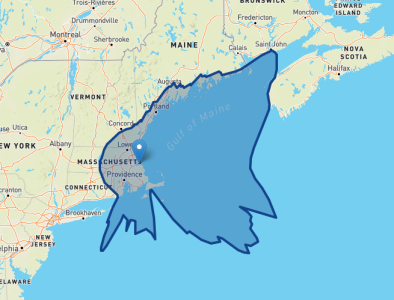
WBZ uses a directional antenna 24/7 Here is their predicted 0.5 millivolt daytime ground wave coverage
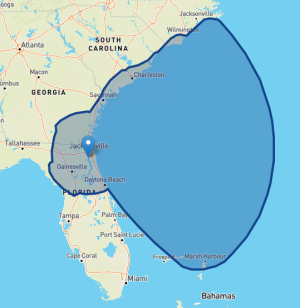
Here is WOKV predicted 0.5 millivolt ground wave coverage.
Some of you may know this as the Mighty 690 WAPE The Big Ape.
Here is what a directional antenna can do over salt water. And this station (KTNQ) is located about 20 miles inland.
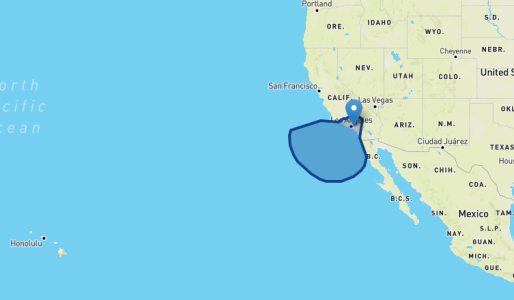
The above images are public information produced by the FCC
I have no doubt while in a boat on the ocean at great distance, David heard WBZ
WBZ uses a directional antenna 24/7 Here is their predicted 0.5 millivolt daytime ground wave coverage
Here is WOKV predicted 0.5 millivolt ground wave coverage.
Some of you may know this as the Mighty 690 WAPE The Big Ape.
Here is what a directional antenna can do over salt water. And this station (KTNQ) is located about 20 miles inland.
The above images are public information produced by the FCC
Last edited:
Correction: "Specifically, this station is predicted to produce 0.85 millivolts at 621 miles out to sea."
Last edited:

And I'm sure the sealife appreciates it. Turning expensive utility power into radio waves where there is no human population.Correction: "Specifically, this station is predicted to produce 0.85 millivolts at 621 miles out to sea."
Ocean water also has a much higher ground conductivity than any other form of land, I think 5000. That helps to conduct AM radio waves much further than any other source.
Routinely I get AM stations from Miami on my dial during the daytime in Charleston, SC, about 400 miles or so. A Cuban station on 570 comes in frequently all over the East Coast of the US south of Cape Hatteras. Cape Hatteras probably has the best AM reception of any location on the East Coast.
You can hear WBZ there daytime, along with WOKV, and occasionally WIOD from Miami on 610. Also very low wattage graveyard signals from New York and New Jersey come in down there as well. Atlantic City, NJ on 1400 and 1450 carry hundreds of miles with only 1000 watts.
Routinely I get AM stations from Miami on my dial during the daytime in Charleston, SC, about 400 miles or so. A Cuban station on 570 comes in frequently all over the East Coast of the US south of Cape Hatteras. Cape Hatteras probably has the best AM reception of any location on the East Coast.
You can hear WBZ there daytime, along with WOKV, and occasionally WIOD from Miami on 610. Also very low wattage graveyard signals from New York and New Jersey come in down there as well. Atlantic City, NJ on 1400 and 1450 carry hundreds of miles with only 1000 watts.

Here is what a directional antenna can do over salt water. And this station (KTNQ) is located about 20 miles inland.
View attachment 6510
The above images are public information produced by the FCC
In the 1970s, shortly after getting the night pattern authorization, KTNQ used to get phone calls from listeners in Hawaii. There was even a promo at one point.

I mean its not entirely over ocean, and the fact its 2 towers are pointed right at me with an estimated ERP of 125KW in the main lobe... but this is KFBK 2300 miles away from me:
 drive.google.com
This is pretty normal, every night reception
KFBK 1530 Sacramento, CA 640pm Thu Oct 19, 2023.MP3
drive.google.com
This is pretty normal, every night reception
Paul- Do you think your night reception of KFBK is skywave?
Do you hear radio stations located in California when the sun is above the horizon at your location in McGrath?
To what (if any) extent does "midnight sun" and lack of it result in interesting skywave propagation at your location?
I realize your location has partial midnight sun, but nonetheless you have long nights in winter.
The earth surface could impact skywave propagation from KFBK to you if the path is more than one "hop".
The "bounce" location would almost certainly be the ocean surface.
From Google Earth and photos of the site, KFBK probably has an effective ground plane for the antennas.
I recognize some of you may think a ground plane is not necessary for this antenna system.
I think an interesting question about KFBK is why didn't they build a "conventional" Franklin antenna?
Or maybe they did, but with a different feed and tuning arrangement.
For all the interesting engineering talk about KFBK, I have not yet seen a schematic diagram or photos with useful detail of the specifics. Nor have I read an account of the specifics that seems fully credible, such as in first person.
Thus, at this time I see KFBK antenna and transmitter site as a beautiful example of brilliant engineers doing it their way, with resources available to them out west. Very creative, and probably getting the job done as well (or even better) than more conventional approaches.
btw- a number of Class A clear channel radio stations use or have used sectionalization or atypical feed methods to manipulate vertical elevation pattern of the antenna. Most of the time this may have been done because of a limitation on achievable tower height. Some took the sawzall approach...
Do you hear radio stations located in California when the sun is above the horizon at your location in McGrath?
To what (if any) extent does "midnight sun" and lack of it result in interesting skywave propagation at your location?
I realize your location has partial midnight sun, but nonetheless you have long nights in winter.
The earth surface could impact skywave propagation from KFBK to you if the path is more than one "hop".
The "bounce" location would almost certainly be the ocean surface.
From Google Earth and photos of the site, KFBK probably has an effective ground plane for the antennas.
I recognize some of you may think a ground plane is not necessary for this antenna system.
I think an interesting question about KFBK is why didn't they build a "conventional" Franklin antenna?
Or maybe they did, but with a different feed and tuning arrangement.
For all the interesting engineering talk about KFBK, I have not yet seen a schematic diagram or photos with useful detail of the specifics. Nor have I read an account of the specifics that seems fully credible, such as in first person.
Thus, at this time I see KFBK antenna and transmitter site as a beautiful example of brilliant engineers doing it their way, with resources available to them out west. Very creative, and probably getting the job done as well (or even better) than more conventional approaches.
btw- a number of Class A clear channel radio stations use or have used sectionalization or atypical feed methods to manipulate vertical elevation pattern of the antenna. Most of the time this may have been done because of a limitation on achievable tower height. Some took the sawzall approach...
Last edited:
Paul- Do you think your night reception of KFBK is skywave?
Do you hear radio stations located in California when the sun is above the horizon at your location in McGrath?
To what (if any) extent does "midnight sun" and lack of it result in interesting skywave propagation at your location?
I realize your location has partial midnight sun, but nonetheless you have long nights in winter.
The earth surface could impact skywave propagation from KFBK to you if the path is more than one "hop".
The "bounce" location would almost certainly be the ocean surface.
From Google Earth and photos of the site, KFBK probably has an effective ground plane for the antennas.
I recognize some of you may think a ground plane is not necessary for this antenna system.
I think an interesting question about KFBK is why didn't they build a "conventional" Franklin antenna?
Or maybe they did, but with a different feed and tuning arrangement.
For all the interesting engineering talk about KFBK, I have not yet seen a schematic diagram or photos with useful detail of the specifics. Nor have I read an account of the specifics that seems fully credible, such as in first person.
Thus, at this time I see KFBK antenna and transmitter site as a beautiful example of brilliant engineers doing it their way, with resources available to them out west. Very creative, and probably getting the job done as well (or even better) than more conventional approaches.
btw- a number of Class A clear channel radio stations use or have used sectionalization or atypical feed methods to manipulate vertical elevation pattern of the antenna. Most of the time this may have been done because of a limitation on achievable tower height. Some took the sawzall approach...
I am not sure it's skywave and im not sure it isnt..... because what you heard in that clip is very normal and common. It will be solid like that for minutes and mintues at a time and only momentarily fade down and come right back up/
AM Skip of any consequence really requires comp[lete darkness here. Sometimes when CX is good, stuff from Japan and Asia will still trickle in after sunrise but die off quickly.
I am not sure it's skywave and im not sure it isnt..... because what you heard in that clip is very normal and common. It will be solid like that for minutes and mintues at a time and only momentarily fade down and come right back up/
AM Skip of any consequence really requires comp[lete darkness here. Sometimes when CX is good, stuff from Japan and Asia will still trickle in after sunrise but die off quickly.
I got very clean reception of KFBK in Cooke City, Montana on a car radio back in 2017. And I used to listen to them in Phoenix driving home from work at iHeart there. It's a monster signal.

It's almost 20 years old now, but here's my visit to KFBK.
It is a true Franklin, half-wave over half-wave with no conventional ground system.
It is a true Franklin, half-wave over half-wave with no conventional ground system.
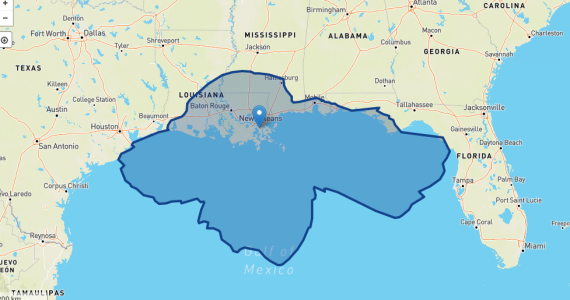
WWL is a broad cardiod directional pattern 24/7 oriented north. In Florida south of Tampa WWL signal will be much lower, compared to the Gulf coast along the Florida panhandle.
Another aspect of this is presence of local signals. At my location near the Chesapeake Bay I might be able to hear WBZ faintly during the day if there was not a local day time station on the frequency.
Here is the WWL contour map of the 0.5 mV. You can clearly see effect of the directional pattern over the open sea. WWL directional pattern is perfect, resulting in a fantastic signal.
Another aspect of this is presence of local signals. At my location near the Chesapeake Bay I might be able to hear WBZ faintly during the day if there was not a local day time station on the frequency.
Here is the WWL contour map of the 0.5 mV. You can clearly see effect of the directional pattern over the open sea. WWL directional pattern is perfect, resulting in a fantastic signal.
I picked up KFBK from a site near Scammon Bay Alaska in the mid 70s when I was in the military. It is 190 miles south of Nome.
I'm about 350 miles SE of Nome
I apologize for my comments about KFBK antenna feed method and ground system.
KFBK antenna is a Franklin antenna.
Charles Samuel Franklin's patent for the antenna describes radiation characteristics of an aerial of different wave lengths excited electrostatically from the end.
Execution of Franklin's design concept is left to those who build it.
Therefore it was inappropriate for me to comment on how a Franklin Antenna is built.
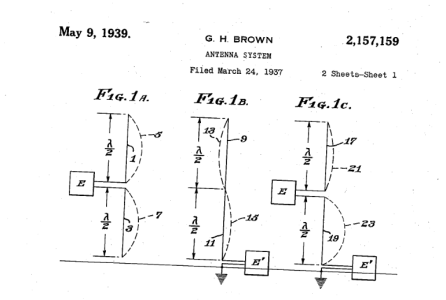
George H Brown's patent shows aspects of manipulating phase in a stacked vertical antenna:
Given that the patent is a public US government document, pasted below is a diagram from George Brown's patent that shows aspects of feed system and current distribution of a full-wave vertical antenna:
KFBK antenna is a Franklin antenna.
Charles Samuel Franklin's patent for the antenna describes radiation characteristics of an aerial of different wave lengths excited electrostatically from the end.
Execution of Franklin's design concept is left to those who build it.
Therefore it was inappropriate for me to comment on how a Franklin Antenna is built.
George H Brown's patent shows aspects of manipulating phase in a stacked vertical antenna:
Given that the patent is a public US government document, pasted below is a diagram from George Brown's patent that shows aspects of feed system and current distribution of a full-wave vertical antenna:
Last edited:
- Status
- This thread has been closed due to inactivity. You can create a new thread to discuss this topic.