• Get involved.
    We want your input!
    Apply for Membership and join the conversations about everything related to broadcasting.

    After we receive your registration, a moderator will review it. After your registration is approved, you will be permitted to post.
    If you use a disposable or false email address, your registration will be rejected.

    After your membership is approved, please take a minute to tell us a little bit about yourself.
    https://www.radiodiscussions.com/forums/introduce-yourself.1088/

    Thanks in advance and have fun!
    RadioDiscussions Administrators

50,000 watt AM daytime distance over ocean

Scott, I was wrong for thinking that way. My ego prevailed when I wrote that.
It is the builders choice how the design concept is executed.
There are many ways to get a job done.
 
If you go on the Sundre, Alberta Kiwi SDR at night, you can hear WBZ Boston almost as clear as a local.

I have picked up JOQR 1134 Tokyo in Seattle.
 
If you go on the Sundre, Alberta Kiwi SDR at night, you can hear WBZ Boston almost as clear as a local.

I have picked up JOQR 1134 Tokyo in Seattle.
WBZ comes in like a local in Portland, Maine because of the salt path. I remember when the Lubec SDR was briefly online a few years ago, it was the same case there.
Re. WWL, their signal over the Gulf into Panama City Beach was my first lesson in saltwater propagation, although I didn't know it until a few years later. My home in League City, Texas was about seven miles west of Galveston Bay, but what was left of WWL was enough to be listenable at my place. A blaster at night, of course.
On that note, has anyone noticed if groundwave/skywave cancellation is more severe in these locations where saltwater enhances the groundwater? That's one scenario I've never experienced or tried to experience for that matter.
 
Xale57 responding to your question about Bermuda:

I don't have much more to say, because WBZ, WFAN, WCBS, WABC, WOR, etc. signals cross land on the path to Bermuda. WBZ and WOR are directional.

btw- WBZ is a "textbook" cardiod, with reduced effective radiated power due east out to sea. This is not a mistake, because the power is redirected west towards land, resulting in a fantastic signal for WBZ.

You can go to FCC online public inspection files and view coverage maps. These are the maps I posted earlier in this thread.

Home - FCC Public Inspection Files

Predicted AM coverage contours are seen on many internet sites. Just be aware of the signal level value of the contours you are seeing.

schmave- I heard groundwave-skywave cancellation on WWL in Pensacola Florida on a visit to the area decades ago.
It was a "pull the car over to the side of the road" moment. This is why in earlier times, some clear channel stations were focused on adjusting antenna vertical elevation pattern to minimize groundwave-skywave cancellation in communities located in the area where this can happen.

This fits in with the Franklin antenna subject, because the Franklin antenna makes gain by modifying the vertical elevation pattern.
Just like a multi bay FM antenna. That is, these antennas are directional antennas in the vertical elevation plane.

Thus, KFBK antenna is directional in azimuth (horizontal) and elevation (vertical). This concentration of the signal results in huge coverage, and our fascination and admiration.

 
Last edited:
When I was in Florida, I could hear KTRH Houston in the daytime from 775 miles away on Honeymoon Island on the Gulf.

It's in the background of WYGM Orlando and you can hear their station ID at 11 to 12 seconds in to the video.

This was in the summer too.


When I grew up in New Jersey. WBZ Boston came in well daytime at the shore but would vanish as soon as you drove inland.
 
Last edited:
This was my attempt to hear WCBS in the daytime from Daytona beach.

The station you hear was WZAB from south Florida but there was the fluttering sound which means co channel interference from some weaker station.

 
This was my attempt to hear WCBS in the daytime from Daytona beach.

The station you hear was WZAB from south Florida but there was the fluttering sound which means co channel interference from some weaker station.

Sounds like there was a thunderstorm going on somewhere at the time
 
In response to OP's question. WWL in New Orleans makes it to the west coast of Florida, 400-500 miles away but it seems to be barely there, watching AM bandscans

I was raised on the west coast of Florida and I used to be able to receive WWL with a very listenable signal in the daytime. The only issue was nulling out local 860 WGUL. I also used to hear 50,000 watt 1060 WNOE during the daytime. This was in the ‘80s and ‘90s. I understand that station has changed call letters since then.
 
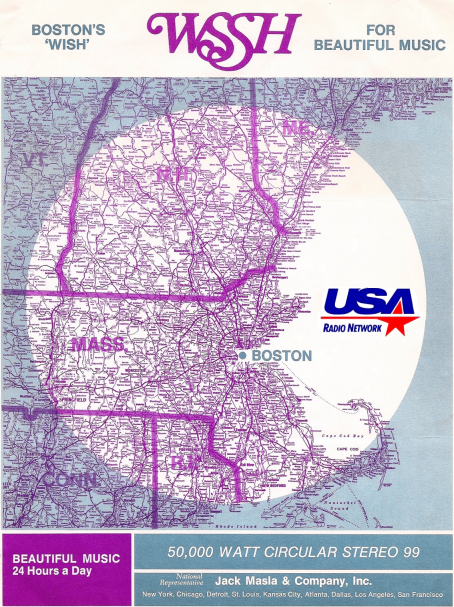
Back in Nov. 1994, I picked up WSSH Boston (also 50 kW, 1510 AM) here in Southern Germany. First I thought it's R Exitosa from Venezuela, because of the Spanish language and LA music. But at 1:04 in the MP3, the station identified as WSSH Boston ('Nueva Inglaterra').

https://www.risikoanalyse.com/dx/mwdx_wssh_boston_1510_khz_1994.mp3

Perhaps a px for the Latin Community there?

Another day I heard it again with announcements regarding the 'USA Radio Network' (1:09 WSSH mentioned).

https://www.risikoanalyse.com/dx/mwdx_wssh_boston_1510_khz_1994_2.mp3

Equipment was a Grundig Satellit 2000 rx with loop antenna.

wssh_boston2.png
 
Last edited:
That WCBS clip was recorded at 5 PM in the middle of January. Sunset is around 5 PM at that time of year. It's doubtful that could be heard at noon during the Summer
 
That WCBS clip was recorded at 5 PM in the middle of January. Sunset is around 5 PM at that time of year. It's doubtful that could be heard at noon during the Summer

Somewhat doubtful but not unheard of..... there are guys along the coastal carolinas and MAss who hear the 1kw graveyarders from NJ middle of the day, early afternoons sometimes
 
Status
This thread has been closed due to inactivity. You can create a new thread to discuss this topic.


Back
Top Bottom