• Get involved.
    We want your input!
    Apply for Membership and join the conversations about everything related to broadcasting.

    After we receive your registration, a moderator will review it. After your registration is approved, you will be permitted to post.
    If you use a disposable or false email address, your registration will be rejected.

    After your membership is approved, please take a minute to tell us a little bit about yourself.
    https://www.radiodiscussions.com/forums/introduce-yourself.1088/

    Thanks in advance and have fun!
    RadioDiscussions Administrators

550 AM reception

I've received 4 different stations on 550 AM here in central Texas, in the northeast Austin, TX, suburbs.

Day and night, it's usually KTSA San Antonio, but surprisingly, the station is usually unimpressively weak on my Grundig Yachtboy 400. It's a real disappointment, considering its low dial position and how most other stations in that frequency region beam out loads of power.

I see from Radio Locator that the station's main night signal ends just south of Austin, so an explanation for the weakness.

At night, KTSA is so weak that it's allowed me to receive KTRS St. Louis and even XHEPL, Ciudad Cuautémoc, Chihuahua, MX, 578 miles.

KTRS has been very weak, but strong enough to hear about St. Louis locations in ads and traffic, etc.

These are occasional, not regular, catches.

Have never received KCRS in Midland, Texas, but keep trying. I am in the station's distant range.

KFRM in Clay Center, Kansas, is a rare catch. I felt lucky to receive it the other morning, in the dark just before dawn. Heard it long enough to recognize the farm programming and its calls. Amazing because its nighttime signal is 110 watts, compared to its 5,000 watts days. Perhaps it had shifted to day.

Nighttime signals
The estimate shows KTSA as dominant for this region, but KTRS STL and the MX stations sometimes sneak in.
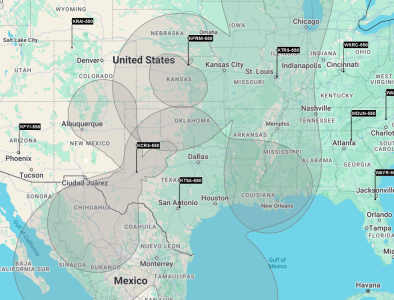
1737504466785.png
 
Is it okay to mention other stations?


Just outside the blue circle on the west side, I have heard WAME in Statesville which is also 500 watts.


Look how far the blue circle for WAME goes inside the coverage area of WIOZ. No one bothered to consider WIOZ when coming up with that range.

WAYR Jacksonville FL reaches Myrtle Beach. It is 5000 watts. That's just outside the blue circle for WAME.


That map doesn't even bother with a lot of the area covered in SC.

I wish I had paid more attention farther inland to see whether I was picking up WAYR or WIOZ.
 
I wish I had paid more attention farther inland to see whether I was picking up WAYR or WIOZ.
Boy, do I have radio regrets as well.
In jr. high in 1974-75, lived in Forest City, Arkansas, an hour west of Memphis TN.
WHBQ-560 and WMPS 790 were big Top 40 AMs.

Moving to rural central Kansas the next year, radio there wasn't anything exciting at all like just those 2 Memphis stations.

I use to have dreams where I was listening to one of those stations. Announcers were not at all as exciting and the music on the rural stations wasn't designed for teens, of course.

I can only recall hearing 2 other stations that time: a high AM (1300-1490) in Wynne, AR, and "FM 100," WMC-FM in Memphis. As a teen, I likely didn't care about anything but Top 40.
 
Look how far the blue circle for WAME goes inside the coverage area of WIOZ. No one bothered to consider WIOZ when coming up with that range.
It's amazing the FCC didn't take the overlapping coverage into consideration. I'm amazed how close 2 550s are here in Texas (San Antonio and Midland).
....

That map doesn't even bother with a lot of the area covered in SC.
None of the online maps are entirely accurate. But they're better than the ones only showing radio/TV market counties. I prefer contour.
 
Just outside the blue circle on the west side, I have heard WAME in Statesville which is also 500 watts.
Remember, that nearly all daytime listening will occur inside the inner, red contour. This is constantly proven in radio ratings, where there is little evidence of listening outside very strong signal areas today.
 
I've received 4 different stations on 550 AM here in central Texas, in the northeast Austin, TX, suburbs.

Day and night, it's usually KTSA San Antonio, but surprisingly, the station is usually unimpressively weak on my Grundig Yachtboy 400. It's a real disappointment, considering its low dial position and how most other stations in that frequency region beam out loads of power.

I see from Radio Locator that the station's main night signal ends just south of Austin, so an explanation for the weakness.

At night, KTSA is so weak that it's allowed me to receive KTRS St. Louis and even XHEPL, Ciudad Cuautémoc, Chihuahua, MX, 578 miles.

KTRS has been very weak, but strong enough to hear about St. Louis locations in ads and traffic, etc.

These are occasional, not regular, catches.

Have never received KCRS in Midland, Texas, but keep trying. I am in the station's distant range.

KFRM in Clay Center, Kansas, is a rare catch. I felt lucky to receive it the other morning, in the dark just before dawn. Heard it long enough to recognize the farm programming and its calls. Amazing because its nighttime signal is 110 watts, compared to its 5,000 watts days. Perhaps it had shifted to day.

Nighttime signals
The estimate shows KTSA as dominant for this region, but KTRS STL and the MX stations sometimes sneak in.

View attachment 8448
Please.... these are not coverage maps. They are intended to show things like protection requirements and directional "proportions".
 
I remember being underwhelmed with KTSA's signal when I worked in west Houston about 15 years ago. Not surprisingly, KLVI next door on 560 had (and probably still has) a stronger signal just because it's considerably closer, but I remember thinking with that ground conductivity and dial position, I thought KTSA would be stronger when it hit the Houston area.
I don't remember it being much of a factor at all where I lived on the Friendswood-League City border.
 
I was tuned into a TEST broadcast one eve, pre-announced and all. The usual snippets of music, thuds, hyphenated oaths, etc.
Thing is: the TEST was from an internet station (Top Shelf Oldies) QTHed in San Diego. Chatters still on line for it included a few DXers.
We listened and commented in the usual chat/oldies fashion .... relaying useful and useless things we were hearing.
I was wondering why there was an occasional C&W station bleeding through for a minute or so. The guy conducting the TEST had no clue. A few questioned my hearing. Thankfully, somebody ELSE then asked why he was hearing Country songs.
It was even from a station that doesn't play MUSIC anymore, let along Country.
Scouts honor; earphones over my heart. KTSA.
 
I remember being underwhelmed with KTSA's signal when I worked in west Houston about 15 years ago. Not surprisingly, KLVI next door on 560 had (and probably still has) a stronger signal just because it's considerably closer, but I remember thinking with that ground conductivity and dial position, I thought KTSA would be stronger when it hit the Houston area.
I don't remember it being much of a factor at all where I lived on the Friendswood-League City border.
Most of KTSA & KLVI signals go over the Gulf at night, however at night since the AM bandwidth was cut in half some years ago at my QTH in Orange County KTSA owns 550. KTSA should have been rather strong in West Houston
 
Someone has been posting in one of the Facebook DX groups from Columbus, Ohio pretty much daily about 550 and whether or not KTRS was being heard. It would seem that KTRS was on day pattern at night most of December. It seems to have corrected itself.
I mostly get WDUN in Gainesville GA
 
Re KLVI and KTSA - I'm on the west side of Houston. KLVI is close to local strength here (100 miles away) during the day, but are somewhat diminished at night. KTSA is fairly weak but listenable during the day (170 miles away). At night they're still dominant with the radio turned the right way, but are easily nullable.
 
Re KLVI and KTSA - I'm on the west side of Houston. KLVI is close to local strength here (100 miles away) during the day, but are somewhat diminished at night. KTSA is fairly weak but listenable during the day (170 miles away). At night they're still dominant with the radio turned the right way, but are easily nullable.
That's consistent with what I remember from central Houston (Montrose) nearly 40 years ago.
 
Remember, that nearly all daytime listening will occur inside the inner, red contour. This is constantly proven in radio ratings, where there is little evidence of listening outside very strong signal areas today.
Yes, but I'm referring to where I listen and you know I'm not as picky about signal quality.
 
Someone has been posting in one of the Facebook DX groups from Columbus, Ohio pretty much daily about 550 and whether or not KTRS was being heard. It would seem that KTRS was on day pattern at night most of December. It seems to have corrected itself.
I mostly get WDUN in Gainesville GA

I've never heard it here. Wish I would have stumbled down to 550 to catch it but I don't go much below 660 at night if I'm switching around in the car.
I have heard WKRC more at night, albeit very weak, the past year or so than ever before in the Columbus area. It's solid daytime but once you get up toward Mansfield, it tangles with WGR and WGR wins out rather quickly the closer you get to Cleveland.
 
Yes, but I'm referring to where I listen and you know I'm not as picky about signal quality.
I totally agree with you and I do the same. As a life-long AM DXer, I love hearing stations where they are unusual or unexpected. But we are, what, two out of tens of thousands?

Heck, I even got up at 2 AM on a number of Monday mornings to move my station, HCRM, from 570 to 565 so DXers in other countries could get a station from Ecuador. Years later, I moved HSCP 590 to 595 khz for a few hours for DXers to try for. And I moved HCFV from 810 to 805 for the same reason. Today, I would not get up at 2 AM on a Monday morning for anything except an early flight to Europe or Australia or the like. :sleep:
 
I totally agree with you and I do the same. As a life-long AM DXer, I love hearing stations where they are unusual or unexpected. But we are, what, two out of tens of thousands?
Same for the TV guide listings collectors.
https://radiodiscussions.com/threads/tv-guide-editions-and-online-resources.771652/

Am not really into that, but like recalling the old TV listings, which said things like "For programs on 8-McCook, see 3-Wichita." "...For translators 70 Hays, 71 Russell, 72 somewhere, see 10-Wichita ..." etc.

Maybe even fewer in that avocation, compared to hobbyists who, say, collect railroad, bus or air timetables, or train/planespotters etc.

1737748439924.jpeg
 
I've never heard it here. Wish I would have stumbled down to 550 to catch it but I don't go much below 660 at night if I'm switching around in the car.
I have heard WKRC more at night, albeit very weak, the past year or so than ever before in the Columbus area. It's solid daytime but once you get up toward Mansfield, it tangles with WGR and WGR wins out rather quickly the closer you get to Cleveland.
I used to hear WDUN when I would go to the mountains.

When I would go to Winston-Salem and it was close to dark as I was going home, I had trouble hearing WAME. I don't even remember whether it was country or standards at the time. WKRC kept me from hearing it.

My father used to take me along when he would visit his aunt in the nursing home. We went to the library and I would look at the Myrtle Beach paper. Even after his aunt passed away we continued to go to that library and the mall. I kept on going by myself until the pandemic. Now that my cousin has retired, I occasionally go to see him but he doesn't mind driving to someplace where I can meet him closer to where I live.
 
WKRC has a decent signal in the Columbus area purely because of the dial position, which seems to overcome whatever null they throw toward Buffalo. It's not a deep null, but they definitely do not send the power our way that they send north up I-75 or in some other directions. I would have no problem listening in the car except they air very little I could not hear elsewhere, save some Xavier basketball games.
 
WKRC has a decent signal in the Columbus area purely because of the dial position, which seems to overcome whatever null they throw toward Buffalo. It's not a deep null, but they definitely do not send the power our way that they send north up I-75 or in some other directions. I would have no problem listening in the car except they air very little I could not hear elsewhere, save some Xavier basketball games.
Back in the late 70s/early 80s when WKRC was an adult contemporary station with a lot of oldies with some talk, I regularly listened in the Celina/St. Marys area, even to the 1kW night signal.
 
Status
This thread has been closed due to inactivity. You can create a new thread to discuss this topic.


Back
Top Bottom