• Get involved.
    We want your input!
    Apply for Membership and join the conversations about everything related to broadcasting.

    After we receive your registration, a moderator will review it. After your registration is approved, you will be permitted to post.
    If you use a disposable or false email address, your registration will be rejected.

    After your membership is approved, please take a minute to tell us a little bit about yourself.
    https://www.radiodiscussions.com/forums/introduce-yourself.1088/

    Thanks in advance and have fun!
    RadioDiscussions Administrators

66 WNBC/97.1 FM

Attachments

  • Cap_ 2025-05-29 23.26.23.jpg
    Cap_ 2025-05-29 23.26.23.jpg
    114.7 KB · Views: 6
Last edited:
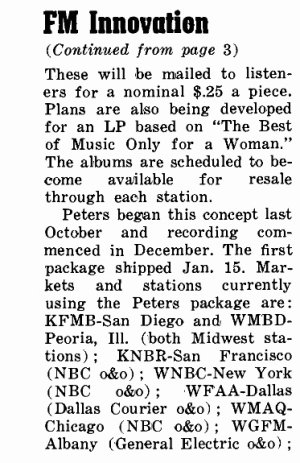
The article has a link in it to David's site. You had to click on a couple of links, but I found it. The link is posted below. I have also attached a screenshot of the part of the article that mentions WNBC-FM.


Oh.

Sorry, but I interpreted your post as meaning the link was to the actual article on WNBC-FM. Now that I know what I was supposed to be looking for ...

Apparently this was the format that got dumped in Peters' home market of San Diego in favor of B-100.
 
The 2023 article gives credit to Ed Peters for inventing "Easy Listening." Not exactly true. The format had been around since the 50s. Peters tried to update it a little. It didn't last long on WNBC-FM. From what I could tell, the writer basically rewrote the Record World article.
 
NBC also used WNBC-FM to broadcast baseball in the early and mid 70s. The famous Game 6 of the 1975 World Series (Carlton Fisk’s waving the ball fair HR) only aired on WNWS 97.1.

In 1970 and 1971, WNBC-FM broadcast New York Mets games because the signal of flagship station WJRZ-970 (which became WWDJ during the 1971 season) did an inadequate job covering the entire NYC market -- particularly Long Island (WGLI-1290/Babylon also broadcast the games). Guy LeBow did the pre- and post-game shows on WNBC-FM in 1970; in 1971, Marv Albert did the pre- and post-game shows on WNBC-FM. [Both years, the pre- and post-game shows were handled by Bob Brown on WJRZ/WWDJ, and Barry Landers on WGLI.]
 
Oh.

Sorry, but I interpreted your post as meaning the link was to the actual article on WNBC-FM. Now that I know what I was supposed to be looking for ...

Apparently this was the format that got dumped in Peters' home market of San Diego in favor of B-100.
It was actually my fault for not reading through the article. I ended doing a bit more research and found the link to the original article which did mention WNBC-
FM. I'll try to be more careful and read through all the way before posting...
 
I found that video on YouTube. Yes I hear him give an ID for both AM & FM. Very surprised to hear that. Perhaps they only simulcast him and then went to the Rock Pile format for the rest of the day. I don't know.

I believe that is correct. They simulcast Imus and went to the Rock Pile after that.
 
I believe that is correct. They simulcast Imus and went to the Rock Pile after that.
I was a Rock Pile listener in those days. After being a fan of WABC with its frequent DJ talk ups and numerous commercials, I liked sometimes listening to The Rock Pile because it had none of those things. IIRC, there were no commercials. I guess WNBC-FM didn't have a sales staff. The FM ran the same commercials as Imus during morning drive and it played the commercial within the NBC News on the hour. But that's it.

The Rock Pile was just the current Top 40, no recurrents or gold that I remember. Nobody announced the songs, no weather inserts. Just recorded liners reminding us we were listening to The Rock Pile. One had some fun. "There are piles of laundry, piles of dirty dishes. There's even actor Denver Pyle. But you're listening to The Rock Pile."

Eventually NBC switched the station to automated beautiful music for a short time, then NIS debuted in 1975.

When NIS was near it's end, NBC switched the station to "Movin' Easy 97.1 WYNY." It was a Soft Rock format competing with 92.3 WKTU "The Mellow 92." The music was mostly AOR but only the softer tracks from the singer-songwriters. No Carpenters or Anne Murray. Just soft songs from Rock artists with DJs such as Bree Bushaw, Herb Barry and Mitch Lebe, who's still doing overnight weekend news on WINS to this day. He had been a newscaster on WNWS and made the transition to DJ on "Movin' Easy 97.1 WYNY."
 
Hmmm. Perhaps for a short period of time. 97.1 was owned by NBC from appx 1947 to 1988. It had several formats including classical and all news. For some brief periods it might have simulcast the AM, but all simulcasts ended in the mid-60s by order of the FCC. So they did a light rock format for a while before switching to news, then back to light rock, and finally country. In 1988, the country format on 97.1 moved to 103.5, and the Hot format replaced it.
When I lived in New York, end of 1979 to mid-1988, NBC had developed WYNY into a strong AC station, with known air personalities who included Bruce Bradley, Dan Daniel and Steve O'Brien among others. During the first several years, the market had no CHR station so WYNY was the closest format to Top 40. When Z100 signed on in 1983, WYNY lost some audience, and the station started to lose its way in the mid-80's.
 
I never knew until this morning that 660 WNBC was ever Simulcast on 97.1 FM
I listened to a 1969 aircheck of Jack Spector and some NBC Monitor hours from that year and they were a simulcast. By this time, you had separate programming on WPLJ (perhaps still WABC-FM at the time}, WOR-FM, WCBS-FM, and WNEW-FM. WNBC-FM may have been late to the "separate programming" game and that may have been part of the problem. Nothing stuck on 97.1 until WYNY came along.
 
I listened to a 1969 aircheck of Jack Spector and some NBC Monitor hours from that year and they were a simulcast. By this time, you had separate programming on WPLJ (perhaps still WABC-FM at the time}, WOR-FM, WCBS-FM, and WNEW-FM. WNBC-FM may have been late to the "separate programming" game and that may have been part of the problem. Nothing stuck on 97.1 until WYNY came along.
That's a good question. Did these major NYC AM stations wait until they were forced by the FCC to give new programming on their FM stations? Or did they start before being required? I didn't have an FM radio until after the FCC rules went into effect. But I think they had all switched by 1968.

As Seltzer says, WABC-FM began airing different programming on 95.5, mostly progressive rock. WOR-FM tried a Top 40 format. WCBS-FM went with an automated easy listening format "The Young Sound." WNEW-FM first went with an all-female staff but still with the MOR playlist heard on the AM station, eventually switching to progressive rock. WPAT-FM began "shadowcasting." It still played the same commercials and same tapes of beautiful music as the AM but not at the same time. And WQXR, as other classical stations around the U.S. like KFAC Los Angeles and WGMS Washington, got a waiver from the FCC to continue simulcasting.
 
Did these major NYC AM stations wait until they were forced by the FCC to give new programming on their FM stations? Or did they start before being required?

The original programming on FM was either classical music (WQXR and WNCN) or beautiful music (WRFM or WPAT). The audience for FM was mainly audiophiles because there was no FM in cars and very few portables. The FM technology was trademarked and owned by the Armstrong estate and electronics manufacturers had to pay a royalty to install it in devices. FM radios also needed outboard antennas, so they weren't as portable as AM radios. However in 1965, the FM patent ran out, the Armstrong family chose not to renew, and the FCC made the non-duplication rule for FM.

As a result, a lot of co-owned FM stations in NYC had to come up with original programming for their FMs. It would take a few years for the audience to discover the programming, as FM radios became more available for consumers.
 
There is an aircheck on You Tube. It's from 1969 featuring Jack Sterling. And WNBC AM and FM were simulcasting that morning. If you listen to any of the hours from the Monitor Tribute pages, you will find some hours where they were simulcasting around the same time.
 
That's a good question. Did these major NYC AM stations wait until they were forced by the FCC to give new programming on their FM stations? Or did they start before being required? I didn't have an FM radio until after the FCC rules went into effect. But I think they had all switched by 1968.
Remember, many of those stations signed on in the 1946-1949 period when the current FM band opened. They tried different formats for a decade or more, and made no progress. It was not until the earlier 60's that FM showed some life (expiration of patents that kept radio manufactures from offering cheap sets and the introduction of FM stereo).

After trying for many years, some turned in their licenses, and by 1960 there were about a third fewer FMs than in 1950.

Many of the rest started simulcasting, hoping some value would come of the station but not wanting to give them up to a competitor, either.

Daytimers did not have to switch their FM formats. A few stations got variances, and the rule was more limited in smaller markets.
 
@K.M. Richards :

If I may, a time reference of sorts.
Not being a tech geek at all (as a DXer or a radio employee) I *did* manage to hang out with a few of both self-indulgences who were. Lee Abrams later would have called them the 'peer leaders' of social groups whom he always held in high regard when he put his format together.
The recall is one Long Island afternoon when WGLI's Roger Alan Wade was in their parking lot installing an under-dash analog FM radio in his Galaxie. Fellow jock Boss Bill Ross would come out, look at the wires and tools and sounds and say encouraging things like, "You KNOW that's not going to work, man.'
Rodj got it all to work. He was the first I knew who had an FM in the car that way.
The year was early 1968.
 
@K.M. Richards :

If I may, a time reference of sorts.
Not being a tech geek at all (as a DXer or a radio employee) I *did* manage to hang out with a few of both self-indulgences who were. Lee Abrams later would have called them the 'peer leaders' of social groups whom he always held in high regard when he put his format together.
The recall is one Long Island afternoon when WGLI's Roger Alan Wade was in their parking lot installing an under-dash analog FM radio in his Galaxie. Fellow jock Boss Bill Ross would come out, look at the wires and tools and sounds and say encouraging things like, "You KNOW that's not going to work, man.'
Rodj got it all to work. He was the first I knew who had an FM in the car that way.
The year was early 1968.
Heck, most of the cars I bought [used] when I started driving back in the mid 70s had only AM radios. Wasn't until late 70s when I finally installed one of those underdash FM stereo converters and that was only because the hip, happening TOP 40 station at the time was on FM and most of the AMs were beginning to flip to talk/sports or some other ungodly music format. [Station management: "Hey, I know how we can get our listeners back. We'll go back to the future and play a "Music of your Life" type format!" Me: "What? You wanna go back to a format where most of the listeners have one foot in the grave and the other half are yelling 'What's he singing? I can't understand the words!' because the batteries in their hearing aids are dead."]


Back
Top Bottom