I listened to the entire clip. We often listen to and enjoy old records these days via stream, our collections or whatever, and that is fine, I love the music I grew up with and all, but hearing the long clip with the Boss radio presentation really takes you back to the place and time like noting else. It really makes you realize that back then, that was how we consumed most of this music, particularly Top 40. Only thing missing was a Tom Campell Cal Stereo spot!...back to the original post, I'm familiar with the aircheck...not sure that J.B. Stone barking "K-H-J!" every time he opens the mic while playing Donny and Marie at 47 rpm qualifies as "wonderful", but hey...

-
Get involved.
We want your input!
Apply for Membership and join the conversations about everything related to broadcasting.
After we receive your registration, a moderator will review it. After your registration is approved, you will be permitted to post.
If you use a disposable or false email address, your registration will be rejected.
After your membership is approved, please take a minute to tell us a little bit about yourself.
https://www.radiodiscussions.com/forums/introduce-yourself.1088/
Thanks in advance and have fun!
RadioDiscussions Administrators
You are using an out of date browser. It may not display this or other websites correctly.
You should upgrade or use an alternative browser.
You should upgrade or use an alternative browser.
93 KHJ Radio Aircheck
- Thread starter oldies76
- Start date

Not saying this was true on KHJ, but this was still an era of something that begins with P and ends with A.

That and a Cal Worthington and his dog Spot used cars ad, but I think those were only on TV! But yes, the Boss radio times were very special even carrying into the earlier years of KRTH, never to be duplicated, but thankfully remembered and available to access.I listened to the entire clip. We often listen to and enjoy old records these days via stream, our collections or whatever, and that is fine, I love the music I grew up with and all, but hearing the long clip with the Boss radio presentation really takes you back to the place and time like noting else. It really makes you realize that back then, that was how we consumed most of this music, particularly Top 40. Only thing missing was a Tom Campell Cal Stereo spot!

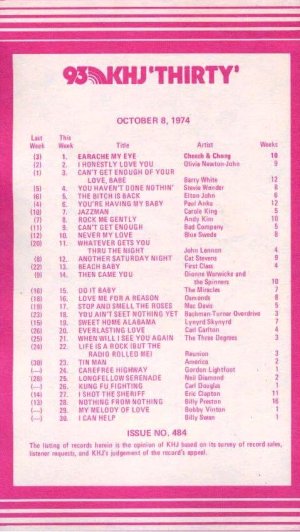
Your original question is both impossible and easy to answer, Oldies.My original question to you was, did KHJ actually air that song frequently enough and how did it reach #1 on the 30? In other words, was there sufficient airplay to warrant its peak position on that survey? Was Cheech & Chong on regular rotation on KHJ, like any other song that was popular on the survey that month?
Impossible because:
* I was up in San Luis Obispo, out of KHJ's signal range, during the entire run of "Earache My Eye".
* KHJ didn't publicly disclose number of spins per week or rotations, so we can't go back and research that.
* Chart position has no correlation to spins. Even if chart numbers were a scientific blend of sales and requests, you could, as a programmer, choose to play the number one record less often than the other 29. Most of the time, that would be counter-productive---your listeners want to hear the biggest hit records---but you could.
Easy because:
KHJ told us, from the very first Boss 30 in 1965, what its' methodology was. Right down there at the bottom of the survey:
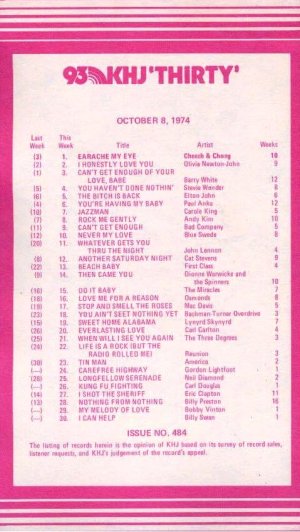
The words "the opinion of KHJ" and "KHJ's judgement of the record's appeal" allow for a whole lot of leeway.
Attachments
Let me address this one sideways.Not saying this was true on KHJ, but this was still an era of something that begins with P and ends with A.
Gerry Peterson was the Program Director at KHJ at the time we're discussing. He was later known as Gerry Cagle when he programmed KFRC in San Francisco. He wrote a novel about major-market program director who took drugs and money for airplay and for "paper adds" (putting records on the playlist but not on the air). Every detail of the PD fit Gerry's own bio, and the DJ names are mixtures of air names and real names of the people he worked with in both L.A. and San Francisco.
The novel is called "Payola!"
Payola!: Cagle, Gerry: 9780828319256: Amazon.com: Books
A bit more telling was at the 1991 25th Anniversary reunion for KFRC. The backdrop up on stage was a glittery curtain with 45 RPM records attached to it.
Les Garland, KFRC's PD from 1977-1980, and Cagle's immediate predecessor, walks up to the podium to make his remarks, gestures over his shoulder to the curtain and says: "Hey, Cagle! Three grand a pop!"
And a postscript:
There are three generally-acknowledged timelines for "Boss" when talking about KHJ.
One is 1965 to June 1969, when the original PD, Ron Jacobs was there. After he left, successor Jim O'Brien removed references like "Boss Angeles" and "Boss Radio". The only things remaining were "Boss Jocks", used sparingly, and the "Boss 30."
The other is 1965 to April 1971, when Ted Atkins ended use of "Boss Jock" and the "Boss 30" became simply the "KHJ Thirty", beginning with the April 28, 1971 issue. "Boss" was never used again in that way on KHJ air.
And the third, last-dog-is-hung, outer limit is 1965 to May of 1973, when Bill Drake left RKO.
The aircheck at the beginning of this thread is a product of Paul Drew and Gerry Cagle---and is a lot closer to what Buzz Bennett was doing at KCBQ in 1971 than anything in KHJ's "Boss" era.
It comes from a moment when KHJ had become very much just another radio station, apart from Charlie Van Dyke in morning drive---a situation Van Dyke fixed the following year when he became program director. The only two survivors under Van Dyke---Machine Gun Kelly and J.B. Stone---both of whom stopped barking the call letters and started saying them.
There are three generally-acknowledged timelines for "Boss" when talking about KHJ.
One is 1965 to June 1969, when the original PD, Ron Jacobs was there. After he left, successor Jim O'Brien removed references like "Boss Angeles" and "Boss Radio". The only things remaining were "Boss Jocks", used sparingly, and the "Boss 30."
The other is 1965 to April 1971, when Ted Atkins ended use of "Boss Jock" and the "Boss 30" became simply the "KHJ Thirty", beginning with the April 28, 1971 issue. "Boss" was never used again in that way on KHJ air.
And the third, last-dog-is-hung, outer limit is 1965 to May of 1973, when Bill Drake left RKO.
The aircheck at the beginning of this thread is a product of Paul Drew and Gerry Cagle---and is a lot closer to what Buzz Bennett was doing at KCBQ in 1971 than anything in KHJ's "Boss" era.
It comes from a moment when KHJ had become very much just another radio station, apart from Charlie Van Dyke in morning drive---a situation Van Dyke fixed the following year when he became program director. The only two survivors under Van Dyke---Machine Gun Kelly and J.B. Stone---both of whom stopped barking the call letters and started saying them.
KHJ told us, from the very first Boss 30 in 1965, what its' methodology was. Right down there at the bottom of the survey:
That would explain it thank you. Your postscript also sums it up nicely. Prior to July 1965 and before the Boss era, what was KHJ known as? I see there are pre 1965 surveys listed on Las Solanas, going as far back as 1956 and has the station listed as “top 40”.
I can't tell you much, but I have heard one brief aircheck of the pre-Drake era, and it had a young sounding guy giving an extended weather forecast (humidity, barometric pressure, etc).. At one point Steve Allen and Jayne Meadows hosted morningsThat would explain it thank you. Your postscript also sums it up nicely. Prior to July 1965 and before the Boss era, what was KHJ known as? I see there are pre 1965 surveys listed on Las Solanas, going as far back as 1956 and has the station listed as “top 40”.
KHJ went through a lot of changes over the years. They were the Mutual affiliate and as late as the late 50s, their schedule was a mix of local programs and network ones. By 1960-61, they tried being a straightforward MOR, got no traction against KMPC, then attempted a Top 40 in 1963.That would sum it up, thank you. Prior to July 1965 and before the Boss era, what was KHJ known as? I see there are pre 1965 surveys listed on Las Solanas, going as far back as 1956 and has the station listed as “top 40”.
In 1964, they went back to MOR, but with extended interview shows from people like Robert Q. Lewis, Michael Jackson and (literally weeks before the flip to Boss Radio) Jayne Meadows & Steve Allen.
That didn't work either and RKO hired a new GM in February of '65 who thought he had free rein to fix it, so he planned a head-on attack on KMPC with high-profile personalities, fired Lewis, Jackson, Jayne & Steve and signed a contract with Dan Sorkin from WIND, Chicago.
Trouble was, RKO was already talking with Bill Drake and planned to tell the GM, who they didn't think would do stuff without telling them first, when they had the deal done.
They told him, he told them about Sorkin, quit on the spot because he didn't want to be GM of a Top 40 station, and they promoted the Sales Manager, Ken DeVaney, to GM. Sorkin wasn't a Top 40 jock by any stretch of the imagination, so they honored his contract by sending him to San Francisco (he hadn't even left Chicago yet) and KFRC, to replace Van Amburg.
Sorkin was so good that when RKO gave KFRC to Drake less than a year later, KSFO was eager to have him.
No idea who the young-sounding guy was---although Geoff Edwards did do mornings there before going to KFI in 1964.I can't tell you much, but I have heard one brief aircheck of the pre-Drake era, and it had a young sounding guy giving an extended weather forecast (humidity, barometric pressure, etc).. At one point Steve Allen and Jayne Meadows hosted mornings
Jayne and Steve (that was the actually billing of the show) did an hour from 10-11 a.m., live from their home in Encino, and tape exists:
Mixcloud
And from the year before, 1964, Paul Compton's weekend show:
I can remember the fun fact that Roger Christian was prohibited from playing the Beach Boys on his KHJ show unless the song had reached the top 10, since he wrote the lyrics to some of them.Let me address this one sideways.
Gerry Peterson was the Program Director at KHJ at the time we're discussing. He was later known as Gerry Cagle when he programmed KFRC in San Francisco. He wrote a novel about major-market program director who took drugs and money for airplay and for "paper adds" (putting records on the playlist but not on the air). Every detail of the PD fit Gerry's own bio, and the DJ names are mixtures of air names and real names of the people he worked with in both L.A. and San Francisco.
The novel is called "Payola!"
Payola!: Cagle, Gerry: 9780828319256: Amazon.com: Books
A bit more telling was at the 1991 25th Anniversary reunion for KFRC. The backdrop up on stage was a glittery curtain with 45 RPM records attached to it.
Les Garland, KFRC's PD from 1977-1980, and Cagle's immediate predecessor, walks up to the podium to make his remarks, gestures over his shoulder to the curtain and says: "Hey, Cagle! Three grand a pop!"
Christian only lasted about four months and only one Beach Boys record, California Girls, made KHJ's chart during that time. That one was written by Brian Wilson and Mike Love. I suspect that story may have been true when he was at KFWB (which was the era when most of his collaborations with The Beach Boys were on the chart) and the legend somehow got attached to KHJ.I can remember the fun fact that Roger Christian was prohibited from playing the Beach Boys on his KHJ show unless the song had reached the top 10, since he wrote the lyrics to some of them.
I love this thread because it does review a very historic period of radio history. But keep in mind future generations will have little interest in this period just as most of us have little interest in 40’s and 50’s radio. To use an aged old slogan, time marches on. What is perceived as important today won’t be tomorrow. That said, shotgun jingles were the best!
Last edited:
I think people hold on to anything nostalgic if there’s a connection to something they’ve enjoyed throughout time. Boss radio is associated with Rock and Roll, Motown and the British Invasion. Future generations may not have as much interest, but there will always be those folks that’ll wanna find out the origins of great Southern California radio broadcasting.I love this thread because it does review a very historic period of radio history. But keep in mind future generations will have little interest in this period just as most of us have little interest in 40’s and 50’s radio. To use an aged old slogan, time marches on. What is perceived as important today won’t be tomorrow. That said, shotgun jingles were the best!

KHJ with Jacobs and Drake began 14 years after Top 40 began, about 10 years after Rock 'n Roll "officially began, four or five years after Motown started printing hits and more than a year into the British Invasion.I think people hold on to anything nostalgic if there’s a connection to something they’ve enjoyed throughout time. Boss radio is associated with Rock and Roll, Motown and the British Invasion.
KHJ simply cleaned up a clutter-laden format on two competitors with very short jingles, highly compacted jock talk and aggressive imaging and contesting.
After KHJ made its splash, about six months later I flew up to LA and spent two days in a motel near the airport (I was too young to rent a car and had a foreign driver license) taking notes and taping on my Philips 3" little reel to reel recorder.
I discovered that KHJ was nothing new... but it was considerably better than the existing Top 40 model. I got home and edited all my PAMS jingles to be shorter, made sure the jocks knew when they would close the mike before they opened it and designed simpler contests with exciting prizes.
People think KHJ was about the music format. It was actually about having enormously talented jocks who made up a team of very tight, precise talents that had both personality and stationality. Too many people think Jacobs and Drake shut the jocks down... actually, they made them faster, leaner and more exciting.Future generations may not have as much interest, but there will always be those folks that’ll wanna find out the origins of great Southern California radio broadcasting.
KHJ with Jacobs and Drake began 14 years after Top 40 began, about 10 years after Rock 'n Roll "officially began, four or five years after Motown started printing hits and more than a year into the British Invasion.
KHJ simply cleaned up a clutter-laden format on two competitors with very short jingles, highly compacted jock talk and aggressive imaging and contesting.
After KHJ made its splash, about six months later I flew up to LA and spent two days in a motel near the airport (I was too young to rent a car and had a foreign driver license) taking notes and taping on my Philips 3" little reel to reel recorder.
I discovered that KHJ was nothing new... but it was considerably better than the existing Top 40 model. I got home and edited all my PAMS jingles to be shorter, made sure the jocks knew when they would close the mike before they opened it and designed simpler contests with exciting prizes.
People think KHJ was about the music format. It was actually about having enormously talented jocks who made up a team of very tight, precise talents that had both personality and stationality. Too many people think Jacobs and Drake shut the jocks down... actually, they made them faster, leaner and more exciting.
Exactly. In fact, KHJ went on the air April 27, 1965 for its "Sneak Preview" using KFWB's chart for that week...and continued to use their chart for two months before finally releasing the first KHJ Boss 30 on July 9.
Beyond what David notes above, which is the best and most concise distillation you'll ever see, what allowed Drake to become legendary in a way that other successful programmers of the era didn't quite match, was that Drake's deal with a then-desperate KHJ included several guarantees:
*The GM oversaw sales. Period. Programming was Drake's area. Drake reported to the President of RKO General Broadcasting and literally no one else.
*The only person who could talk to a jock about his performance was the Program Director. The only person who could talk to the PD about his or a jock's performance were Bernie Torres, Bill Watson or Bill Drake.
This gave Drake complete control and insulated programming from sales and management pressures. And when KHJ turned into a raging success, RKO was only too happy to give Drake the same guarantees at KFRC, WRKO, CKLW, WOR-FM and WHBQ.
The consistency became the hallmark.
And because RKO was desperate in the beginning, Drake's financial deal included a cut of not just the profits but bonuses for percentage increases that were all but guaranteed, since the stations had nowhere to go but up. And that RKO money set Drake up to continue to be a name in the business when the inevitable parting of the ways came in 1973.
...and when that happened, when Paul Drew was promoted from Program Director of KHJ to National Program Director of RKO---his deal included NONE of the guarantees of Drake's deal. He had to run interference between management, sales and programming as if the Drake arrangement had never happened.
There is no doubt KHJ changed the radio scene in LA. The Drake format was modern and then copied. Within about 7 years AM top 40’s we’re copying it, or at worst, trying to do something similar. In Seattle KING AM was a copycat. I am sure there are many other examples. Radio has always been somewhat a copycat industry.
I truly value the compliment. Remember, I was 19 and owned my own Top 40 station so I could do whatever I wanted with no interference.Beyond what David notes above, which is the best and most concise distillation you'll ever see,
I did, at that adolescent age, understand that to program effectively the PD had to be given an interference free zone. The 60's and 70's were the time of managers who were mostly sellers, complete with the glow-in-the-dark loud suits and a totally "WKRP" mentality.what allowed Drake to become legendary in a way that other successful programmers of the era didn't quite match, was that Drake's deal with a then-desperate KHJ included several guarantees:
*The GM oversaw sales. Period. Programming was Drake's area. Drake reported to the President of RKO General Broadcasting and literally no one else.
When I moved on to one of the Mooney stations in 1970, I found that outside interference with my PD and myself was harmful. So when the national PD for Mooney came to visit, we made sure he had a great time in a beachfront hotel, was taken to the nicest restaurants and, consequently, left us to programming.
A few readers here will know who that national PD was...
Mooney's WUNO became #1 with an inferior 1320 on the dial signal, even though our competitor was powerful WKAQ on 580... consulted by Mike Joseph... who was doing his prototype of Hot Hits. We countered by being very entertaining with lots of fun contests and listener involvement... the opposite of ultra-sterile presentations.
It is very hard to keep managers out of programming even if they have never done a format clock or put little round colored stickers on carts... or set up Selector or MusicMaster. That is why the advent of real call-out research in the later 70's and music testing in the opening years of the 80's was so beneficial: the PD could show the GM what the listener wanted and, politely, say GFYS....and when that happened, when Paul Drew was promoted from Program Director of KHJ to National Program Director of RKO---his deal included NONE of the guarantees of Drake's deal. He had to run interference between management, sales and programming as if the Drake arrangement had never happened.
But in the 60's and 70's, going to an NAB convention was to enter a stampeding herd of Tarleks and Carlsons along with a quieter batch of engineers with pocket protectors. PDs went to Billboard and Gavin and Hamilton meetings which tended, still, to be one toke over the line themselves. Talk about bygone days!
Last edited:
And the problem was that most PDs and managers did not understand the execution of KHJ at all. So most imitations missed several of the key elements. It was not about talking less and using short jingles. It was about speed and flow.There is no doubt KHJ changed the radio scene in LA. The Drake format was modern and then copied. Within about 7 years AM top 40’s we’re copying it, or at worst, trying to do something similar. In Seattle KING AM was a copycat. I am sure there are many other examples. Radio has always been somewhat a copycat industry.
Within 7 years, it was all but over. The Fake Drakes were thick on the ground by '66 and '67---one to two years after KHJ's launch.There is no doubt KHJ changed the radio scene in LA. The Drake format was modern and then copied. Within about 7 years AM top 40’s we’re copying it, or at worst, trying to do something similar. In Seattle KING AM was a copycat. I am sure there are many other examples. Radio has always been somewhat a copycat industry.
Seven years would be '72, and at that point, stations were trying to clone KCBQ.
- Status
- This thread has been closed due to inactivity. You can create a new thread to discuss this topic.