• Get involved.
    We want your input!
    Apply for Membership and join the conversations about everything related to broadcasting.

    After we receive your registration, a moderator will review it. After your registration is approved, you will be permitted to post.
    If you use a disposable or false email address, your registration will be rejected.

    After your membership is approved, please take a minute to tell us a little bit about yourself.
    https://www.radiodiscussions.com/forums/introduce-yourself.1088/

    Thanks in advance and have fun!
    RadioDiscussions Administrators

93 KHJ Radio Aircheck

When I visited LA with family in ‘77, KRLA sounded pretty weak IMO. Just seemed a bit lost. This was the period of 10Q, a somewhat short lived but great sounding station. But KHJ still sounded very good.

In ‘77, KRLA was several lifetimes away from the station that had competed against Drake-era KHJ.

In fall 1971, Shadoe Stevens was named PD and took them essentially album rock. He and that approach lasted about a year.

Sixties-era KRLA jock/PD Reb Foster came in to try to right the ship with a risky attempt at predicting the hits—-“Future Rock”. It lasted three or four months.

In the spring of ‘73, KRLA went AC with two-man shows. They could only afford three of them (six jocks total), so the shows were live for 12 hours and then played back for 12 hours.

A few months later, that was scrapped and the whole station automated. Johnny Hayes and Evan Haning were the only voices.

In late 1976, former KHJ jock Billy Pearl and business partner Tom Greenleigh took over KRLA’s programming. It was still automated, but the music was focused and they were giving away money on the street. They beat KHJ in the winter ‘76/‘77 Arbitron, were hired away by K-100, where Bill Drake’s contract had just expired and KRLA slunk again into obscurity. And Pearl and Greenleigh flopped at K-100.
 
Fall of '69, and KRLA makes a comeback---best numbers in years:

View attachment 4354

But KRLA's management blows up the PD, KRLA falls to a 4.0 in the fall of '70 and it's all downhill from there.

Still, that's four and a half years of, with the exception of fall '68, KRLA putting up a credible fight.
What is the most fascinating here is the huge number for KGFJ with its R&B format on a 1 kw day / 250 watt night signal broadcast from a "flat top" horizontal antenna on top of a building in downtown LA! Andn worth noting is the relatively high share for KALI, which has nearly as limited a signal as KGFJ.

This points out how Pulse and Hooper showed "inner city" stations to do so well because, in this case, any telephone exchange that was a toll call from central LA did not get sampled. Back then, that was a significant cost consideration because dozens of calls had to be made to find a willing and demographically acceptable respondent and the phone charges could be very significant.
 
Last edited:
M Hagerty, Thanks for that history. I was 18 and didn’t know much about the industry. But I could tell when a station sounded good and when it didn’t. December 1977 wasn’t a good sound on KRLA IMO. I remember thinking Seattle stations sounded much better! But in hindsight radio was more important in cities like Seattle than LA with many more entertainment options. Funny how age makes you wiser!
 
Last edited:
M Hagerty, Thanks for that history. I was 18 and didn’t know much about the industry. But I could tell when a station sounded good and when it didn’t. December 1977 wasn’t a good sound on KRLA IMO. I remember thinking Seattle stations sounded much better! But in hindsight radio was more important in cities like Seattle than LA with many more entertainment options. Funny how age makes you wiser!
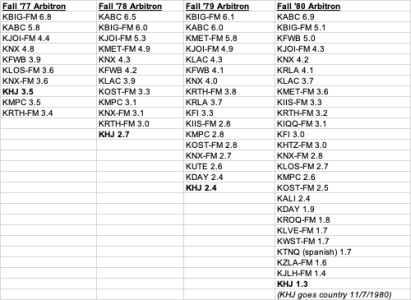
By December of 1977, the stations that mattered in L.A. Top 40 were KHJ, KFI, KTNQ and KIIS-FM. K-100 was floundering. All that really happened after that was attrition---KIIS-FM going disco in '78, KTNQ going Spanish in July of 1979, KHJ going Country in November of 1980. That left KFI and K-100 until KIIS's rebirth in 1982.
 
Yes, thanks for that. I traveled with parents to Chicago and LA frequently in my teens. No contest, Chicago radio was so much better than LA. Again I think the overall distractions of LA made radio less important. Chicago stations were big and bold. LA stations seemed cute, but not bold in any way. The period I am referring to is 1976-1984.
 
By December of 1977, the stations that mattered in L.A. Top 40 were KHJ, KFI, KTNQ and KIIS-FM. K-100 was floundering. All that really happened after that was attrition---KIIS-FM going disco in '78, KTNQ going Spanish in July of 1979, KHJ going Country in November of 1980. That left KFI and K-100 until KIIS's rebirth in 1982
With KRTH playing currents in ‘77-‘84 were they a factor as well? Or were they just too AC to really provide competition?
 
Yes, thanks for that. I traveled with parents to Chicago and LA frequently in my teens. No contest, Chicago radio was so much better than LA. Again I think the overall distractions of LA made radio less important. Chicago stations were big and bold. LA stations seemed cute, but not bold in any way. The period I am referring to is 1976-1984.
Two very different towns with very different vibes.
 
With KRTH playing currents in ‘77-‘84 were they a factor as well? Or were they just too AC to really provide competition?

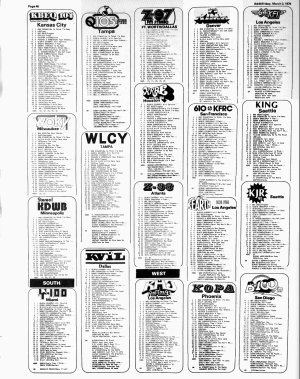
Thanks for the reminder. KRTH absolutely was a factor. R&R refused to believe RKO's claim that KRTH was AC and listed them---along with KHJ---in their West Coast Parallel One stations for CHR:

Screenshot 2023-02-22 at 5.56.34 AM.jpg


I'd absolutely argue that KRTH was as much a factor in KHJ's demise as KMET. They likely siphoned off young adult females in roughly the same numbers as KMET did young adult males.

1677074545760.png
 
What is the most fascinating here is the huge number for KGFJ with its R&B format on a 1 kw day / 250 watt night signal broadcast from a "flat top" horizontal antenna on top of a building in downtown LA! Andn worth noting is the relatively high share for KALI, which has nearly as limited a signal as KGFJ.

This points out how Pulse and Hooper showed "inner city" stations to do so well because, in this case, any telephone exchange that was a toll call from central LA did not get sampled. Back then, that was a significant cost consideration because dozens of calls had to be made to find a willing and demographically acceptable respondent and the phone charges could be very significant.

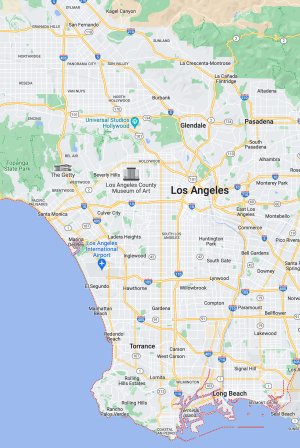
I think we often forget how far AM could travel back when the noise floor was very low. And, really, at the time, all you needed was to cover this:

Screenshot 2023-02-22 at 7.44.47 AM.jpg

Back then, even KGIL (1260), with its stick in the triangle between the 5, 210 and 118 freeways, threw a listenable signal into Long Beach. I don't know if I ever tuned in KGFJ (1230) down in Long Beach, but given that the antenna was on La Brea south of Wilshire (a little south of the icon for the Los Angeles County Museum of Art), I don't see why it couldn't be done.

I never tried to tune in KALI, but 5,000 watts at 1430 with the stick just east of Alhambra and the bulk of the Spanish-speaking population of the time on the east side of town---that makes sense to me.
 
Last edited:
Wasn't KABC #1 for a time in the 70's and 80's? The same KABC we're discussing in that other thread? The one Cumulus has on life support (to quote myself)? Wasn't KHJ #1 in the latter half of the 60's? Back then the noise floor was very limited and lower power stations could travel a distance and get adequate, or superior, ratings if they had good programming, reasonable promotion and a community-service orientation. Home PC's and routers, CFL's and LED lighting, switching power supplies and a bunch of other noisy equipment that ignored the FCC interference rules all conspired to destroy the quality of AM reception. Even though most listeners couldn't articulate why they no longer wanted to listen to AM stations, they figured out that they didn't any more.

Death by 10,000 paper cuts, murder on the amplitude modulated express. (Any other cliches I've missed?) The victim, like Generalissimo Franco, is still dead.
 
Wasn't KABC #1 for a time in the 70's and 80's? The same KABC we're discussing in that other thread? The one Cumulus has on life support (to quote myself)? Wasn't KHJ #1 in the latter half of the 60's? Back then the noise floor was very limited and lower power stations could travel a distance and get adequate, or superior, ratings if they had good programming, reasonable promotion and a community-service orientation. Home PC's and routers, CFL's and LED lighting, switching power supplies and a bunch of other noisy equipment that ignored the FCC interference rules all conspired to destroy the quality of AM reception. Even though most listeners couldn't articulate why they no longer wanted to listen to AM stations, they figured out that they didn't any more.

Death by 10,000 paper cuts, murder on the amplitude modulated express. (Any other cliches I've missed?) The victim, like Generalissimo Franco, is still dead.
KHJ and KABC were the only #1 stations from 1966 to 1977, when KBIG topped them both. KABC stayed in the top two until 1988.

Those are 6+ numbers, though, and by the end KABC was skewing quite old. Even before the noise floor, migration to FM in Los Angeles was a big factor. By 1983, the only AM stations doing well playing music were KMPC and KPRZ, playing standards. Anything else where the same music could be found on FM was dead or close to it.
 
KHJ and KABC were the only #1 stations from 1966 to 1977, when KBIG topped them both. KABC stayed in the top two until 1988.
KFI tied for #1 a few times in that span as well, and had four outright #1s, and KFWB managed a tie for #1 in Oct/Nov '73... but yes, KABC (16 #1s) and KHJ (19 #1s) absolutely dominated LA in the late 60s into the late 70s.
 
Anything else where the same music could be found on FM was dead or close to it.
That would explain the demise of XTRA 690 by ‘84 now that KIIS was in full swing. By the way, thanks for those parallel charts. I’ve scoured radio & records getting that chart data for KRTH for a project of mine.
 
That would explain the demise of XTRA 690 by ‘84 now that KIIS was in full swing.
Yeah, and XTRA had to look at two markets---L.A. and San Diego. Their ratings were always better in SD, and Orange County breakouts (which I don't have or know where to find) might have shown them doing very well down there, too.

The Mighty 690's best L.A. book was a 2.4 in the fall of 1981. That was before KIIS-FM really figured it out, but among stations playing contemporary hit music, it was:

KRTH: 3.1
KRLA (which was at the peak of its "HitRadio 11" format before essentially going Gold): 2.8
KIQQ: 2.5
XTRA: 2.4
KFI: 2.2
KIIS-FM: 2.1

By fall of '82, it was a very different landscape. KRLA had gone Gold:

KIIS-FM: 4.4
KIQQ: 3.1
KRTH: 2.6
KFI: 2.3
XTRA: 1.8

And in fall of '83, KIIS was on fire, and KNX-FM had flipped to KKHR:

KIIS-FM: 8.1
KIQQ 2.6
KRTH: 2.6
KFI: 1.9
KKHR: 1.6
XTRA: 1.0

XTRA had fallen below a 1.0 by the time they flipped to XTRA Gold.

In San Diego, it was a little different. Fewer CHRs and AM was a bit more viable. Here's fall of 1981:

B-100: 4.5
XTRA: 3.0

Fall 1982, XTRA ties B-100:

B-100: 4.2
XTRA: 4.2

Fall 1983, B-100 has gone AC and KS-103 has jumped in as a CHR:

KS-103: 3.5
XTRA: 2.7 (that doesn't look bad, but it's 15th place)

In San Diego, XTRA never fell below a 2, but clearly, their sales model was regional and depended on a lot of L.A./O.C. business that their L.A. numbers couldn't deliver. XTRA Gold aimed for some of that, but they were careful to build a better sales base in San Diego for that format.
 
Yeah, and XTRA had to look at two markets---L.A. and San Diego. Their ratings were always better in SD, and Orange County breakouts (which I don't have or know where to find) might have shown them doing very well down there, too.
OC (Anaheim), which was surveyed as a separate embedded market from 1976 to 1994, was typically dominated by KBIG, KMET and starting in '83, KIIS. XETRA's best Top 40 showing there was also in the Fall '81, with a 2.8.
 
Last edited:
Yeah, and XTRA had to look at two markets---L.A. and San Diego. Their ratings were always better in SD, and Orange County breakouts (which I don't have or know where to find) might have shown them doing very well down there, too.

The Mighty 690's best L.A. book was a 2.4 in the fall of 1981. That was before KIIS-FM really figured it out, but among stations playing contemporary hit music, it was:

KRTH: 3.1
KRLA (which was at the peak of its "HitRadio 11" format before essentially going Gold): 2.8
KIQQ: 2.5
XTRA: 2.4
KFI: 2.2
KIIS-FM: 2.1

By fall of '82, it was a very different landscape. KRLA had gone Gold:

KIIS-FM: 4.4
KIQQ: 3.1
KRTH: 2.6
KFI: 2.3
XTRA: 1.8

And in fall of '83, KIIS was on fire, and KNX-FM had flipped to KKHR:

KIIS-FM: 8.1
KIQQ 2.6
KRTH: 2.6
KFI: 1.9
KKHR: 1.6
XTRA: 1.0

XTRA had fallen below a 1.0 by the time they flipped to XTRA Gold.

In San Diego, it was a little different. Fewer CHRs and AM was a bit more viable. Here's fall of 1981:

B-100: 4.5
XTRA: 3.0

Fall 1982, XTRA ties B-100:

B-100: 4.2
XTRA: 4.2

Fall 1983, B-100 has gone AC and KS-103 has jumped in as a CHR:

KS-103: 3.5
XTRA: 2.7 (that doesn't look bad, but it's 15th place)

In San Diego, XTRA never fell below a 2, but clearly, their sales model was regional and depended on a lot of L.A./O.C. business that their L.A. numbers couldn't deliver. XTRA Gold aimed for some of that, but they were careful to build a better sales base in San Diego for that format.
I always manage to zone KWST being CHR during this period (as did most of L.A.) They had a 0.8 in Fall '81, and by fall of '82 had gone AC as KMGG. So in its best L.A. book, XTRA beat KFI, KIIS-FM and KWST.
 
Thanks for the reminder. KRTH absolutely was a factor. R&R refused to believe RKO's claim that KRTH was AC and listed them---along with KHJ---in their West Coast Parallel One stations for CHR:

View attachment 4357


I'd absolutely argue that KRTH was as much a factor in KHJ's demise as KMET. They likely siphoned off young adult females in roughly the same numbers as KMET did young adult males.

View attachment 4358
Where did you find all this information, including the graphic of all the record surveys? Did it come from David's World Radio History? It's very interesting. Thank you.
 
Where did you find all this information, including the graphic of all the record surveys? Did it come from David's World Radio History? It's very interesting. Thank you.
The ratings are things I've cobbled together from various trade publications and ratings digests at WorldRadioHistory. The older ratings (pre-1975) are things that I ran across 15 or 20 years ago and thankfully put in a spreadsheet. And yes, the graphic of all the surveys was a weekly feature of R&R (Radio & Records) at the time---and WorldRadioHistory has a remarkable, if not yet complete, set of issues.
 
By December of 1977, the stations that mattered in L.A. Top 40 were KHJ, KFI, KTNQ and KIIS-FM. K-100 was floundering. All that really happened after that was attrition---KIIS-FM going disco in '78, KTNQ going Spanish in July of 1979, KHJ going Country in November of 1980. That left KFI and K-100 until KIIS's rebirth in 1982.
Michael... can you share insights on KEZY 1190 at that time as part of the mix of the area's Top 40s? While it was an OC based station, it earned share in LA County too in the 1960s and 1970s when it was a rocking well produced hit machine with robust ad sales success.
 
By December of 1977, the stations that mattered in L.A. Top 40 were KHJ, KFI, KTNQ and KIIS-FM. K-100 was floundering. All that really happened after that was attrition---KIIS-FM going disco in '78, KTNQ going Spanish in July of 1979, KHJ going Country in November of 1980. That left KFI and K-100 until KIIS's rebirth in 1982.
What about KHTZ 97.1 and KWST 105.9? Both had short-lived efforts to occupy the Top 40 lane in that era too. Especially KHTZ, which was the direct descendant of KTNQ, but morphed away from Top 40 all too rapidly IMO.
 
Status
This thread has been closed due to inactivity. You can create a new thread to discuss this topic.


Back
Top Bottom