• Get involved.
    We want your input!
    Apply for Membership and join the conversations about everything related to broadcasting.

    After we receive your registration, a moderator will review it. After your registration is approved, you will be permitted to post.
    If you use a disposable or false email address, your registration will be rejected.

    After your membership is approved, please take a minute to tell us a little bit about yourself.
    https://www.radiodiscussions.com/forums/introduce-yourself.1088/

    Thanks in advance and have fun!
    RadioDiscussions Administrators

93 KHJ Radio Aircheck

I prefer the longer album versions on many songs as well, “Baker Street” and “Beginnings” included. If you listen to the latest KHJ upload by Retro Radio Joe from early 1970 with The Real Don Steele, you can actually hear an edited “Whole Lotta Love”. First time ever hearing that version, just 3 minutes I believe.

Radio edit from Atlantic Records.

 
Last edited:
There is always a risk of tune-out for longer songs. But my non-programmer mind fights this fervently. “Beginnings” is a great example. As a listener I want to hear the full version.
Oh yeah, those horns and brass just make up that masterpiece. Cutting out that entire middle portion and the minute or so ending is just murder to a great piece of music.
 
...and this is where Paul Drew ultimately had it wrong.

The two old-think issues with long records:

1) Some of the audience won't like it and the longer it takes for them to hear the next record, which they may like, the greater the odds they'll tune to the competition.

2) Longer records mean fewer opportunities to play two or three records between commercial breaks, which heightens the perception that the station plays more commercials.

But...

1) What we learned during that period was that the only people who wanted to hear edited versions of long songs like "Beginnings" were people who didn't like those songs and wanted them over quicker. The people who did like them wanted to hear the whole thing.

2) Editing all your records to 3:30 or less---or the majority of them---just meant, to most listeners, that you played more music, but the music was a mix of garbage and butchered great songs.

This became more pronounced as:

1) People began to share more of their listening time between Top 40 and FM album rock stations.

2) Singles sales began to decline (they peaked in 1974 and fell off rapidly after that), meaning that most people who spent their own money on a song were buying the album and expected to hear that version (album sales eclipsed singles sales in 1969 and kept climbing while singles sales went into freefall six years later).

Within three years of Paul Drew's not-quite-ultimatum from the RKO stations, successful Top 40s (like B-100 in San Diego) were saying things like "the whole thing, straight off the album!" as a selling proposition to their audience.
 
Last edited:
I could start a whole another subject of “paper adds” but will save that for another day. Hint; it was disgraceful. We called it the lunar rotation.
Just for clarity:

"Paper Adds" and "lunar rotation" (also known as "Pluto rotation") were two different things.

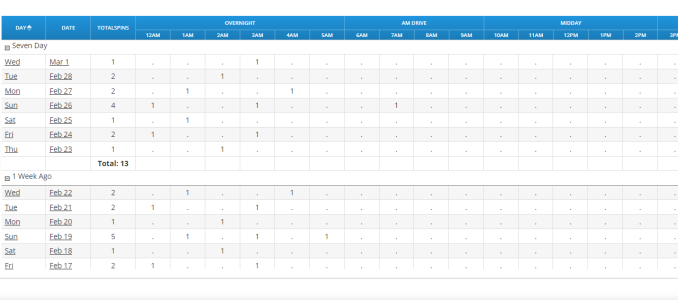
"Paper Adds" were when you listed a song on the playlist and weren't playing it at all.

"Lunar/Pluto rotation" was adding a song so that it came up less frequently than your lowest normal rotation. So if you had a category (say, recurrents) that was every 16 hours, a lunar/pluto rotation might be anything north of that (likely 22 or 23 hours, keeping it within a single daypart over the course of a week).

The only legitimate use of that might be the rare case of a record that you were specifically trying to showcase to an audience (adults in morning drive, adult women in middays), in which case, it really was dayparting. But burying a record in overnights only just so the promo person could report the add to their boss was absolutely problematic and something I wouldn't do.
 
But...

1) What we learned during that period was that the only people who wanted to hear edited versions of long songs like "Beginnings" were people who didn't like those songs and wanted them over quicker. The people who did like them wanted to hear the whole thing.

2) Editing all your records to 3:30 or less---or the majority of them---just meant, to most listeners, that you played more music, but the music was a mix of garbage and butchered great songs.
Not always. When I did the first all-salsa FM station ever in Puerto Rico, we were facing lots of long cuts. Like many jazz recordings that had an instrumental "jam" in them, many salsa tunes had a "descarga" (literally, an "unloading") that made them sometimes well over 6 or 7 minutes long.

Fortunately, I brought in a PD who had perfect pitch and was even an often-called side man for recordings. We had about 45 days or so between deciding on the format and going live with it, and he spent 8 to 10 hours a day with tape and blade making the songs "jam-less". Because of his music abilities, we even had the original artists later admire how the edits had been done and called them "seamless".

Doing that added at least 5 additional song slots per hour, so with an 8 minute commercial limit we got 14 to 15 songs into every hour. It made the pacing much faster.

Listeners never complained. Not once. In the 30-station market, though, the highest we ever got was a 42 share.
 
Not always. When I did the first all-salsa FM station ever in Puerto Rico, we were facing lots of long cuts. Like many jazz recordings that had an instrumental "jam" in them, many salsa tunes had a "descarga" (literally, an "unloading") that made them sometimes well over 6 or 7 minutes long.

Fortunately, I brought in a PD who had perfect pitch and was even an often-called side man for recordings. We had about 45 days or so between deciding on the format and going live with it, and he spent 8 to 10 hours a day with tape and blade making the songs "jam-less". Because of his music abilities, we even had the original artists later admire how the edits had been done and called them "seamless".

Doing that added at least 5 additional song slots per hour, so with an 8 minute commercial limit we got 14 to 15 songs into every hour. It made the pacing much faster.

Listeners never complained. Not once. In the 30-station market, though, the highest we ever got was a 42 share.
David, I think there were a lot of differences between a Salsa format in Puerto Rico and Top 40 in the United States.

There are several formats where the audience would tolerate edits during the timeframe I'm talking about----Adult Contemporary, certainly. Oldies, absolutely (as recently as ten years ago, guys on this board would bitch about oldies stations playing the album version instead of the butchered 45s they were used to). Country, very likely.

But a key point in the evolution of Top 40 in the mid-late 70s in the US was finding that you were dealing with an increasingly album-aware audience whose acceptance of "45 versions" was ebbing fast.
 
Last edited:
David, I think there were a lot of differences between a Salsa format in Puerto Rico and Top 40 in the United States.

There are several formats where the audience would tolerate edits during the timeframe I'm talking about----Adult Contemporary, certainly. Oldies, absolutely (as recently as ten years ago, guys on this board would bitch about oldies stations playing the album version instead of the butchered 45s they were used to).

But a key point in the evolution of Top 40 in the mid-late 70s in the US was finding that you were dealing with an increasingly album-aware audience whose acceptance of "45 versions" was ebbing fast.
Salsa, in the later 60's, 70's, 80's and early 90's at least, was the Top´40 or pop music of Puerto Rico. And nearly all sales was albums, with few 45 releases being made at all. So the core audience knew the music.

Even Mike Joseph's San Juan more conventional Top 40 station, WKAQ, played around 30% or so salsa. Their solution was not to even play songs that were "too long"... so they missed nearly half the real hits. That ended up biting them viciously as they lost half their audience when my all-salsa station hit.

But when we did the format... about the same time as disco was peaking... we knew that club frequenters knew about the long versions of disco songs but were very accepting of shorter versions on the radio. A lot had to do with how good the short version was and whether it took the core elements and preserved them.

Of course, some stations took "Suite: Judy Blue Eyes" and faded the final half after 30 seconds, failing to understand that some of us listened to the first third of the song to hear the "la-la-lah, la-la-lahla-lahla" over an over and thus destroyed it. I was lucky in having a Juliard grad who knew the music well enough to actually have played on some of the hit songs, and I am not sure if we could have done it otherwise.
 
David, I think there were a lot of differences between a Salsa format in Puerto Rico and Top 40 in the United States.

There are several formats where the audience would tolerate edits during the timeframe I'm talking about----Adult Contemporary, certainly. Oldies, absolutely (as recently as ten years ago, guys on this board would bitch about oldies stations playing the album version instead of the butchered 45s they were used to). Country, very likely.

But a key point in the evolution of Top 40 in the mid-late 70s in the US was finding that you were dealing with an increasingly album-aware audience whose acceptance of "45 versions" was ebbing fast.
In the 60's and 70's, in general, how many minutes of commercials were there in an average hour on a big Top40 station on a daytime weekday? To my ears, it sounded like "a lot" of advertising. For morning and afternoon drive time shows, it seemed like a commercial was played after each song.
Every Top 40 station in L.A. advertised "more music" on their station, and that slogan was a staple of KHJ's identity. It seemed like maybe 8 or 9 songs an hour. Guess that one would have to go back and look at the station logs. ( Just my opinion). -D.
 
In the 60's and 70's, in general, how many minutes of commercials were there in an average hour on a big Top40 station on a daytime weekday? To my ears, it sounded like "a lot" of advertising. For morning and afternoon drive time shows, it seemed like a commercial was played after each song.
Every Top 40 station in L.A. advertised "more music" on their station, and that slogan was a staple of KHJ's identity. It seemed like maybe 8 or 9 songs an hour. Guess that one would have to go back and look at the station logs. ( Just my opinion). -D.

KFWB and KRLA maxed out at 18 minutes per hour, including commercials within newscasts. That was pretty much the industry standard, and the one followed by more established stations like KFI, KNX and KMPC.

Beginning in 1965, KHJ under Bill Drake had a firm commercial policy: No more than 14 minutes per hour, no commercial break lasting longer than 70 seconds and no commercial break with more than three commercials in it. So, you could have a 60-second and a ten-second spot, or two 30s and a 10, but not a 60 and a 30, and not a 30 and four 10s.

If you take 60 minutes and subtract those 14 minutes of commercials, you're at 46 minutes. If your songs are three minutes long, on average, and you allow for a little wiggle room for jingles, weather and the like, that's 15 records in an hour.

Mornings were a different animal on KHJ, with eight-minute newscasts at :40 and Robert W. or Charlie Tuna's phone bits. They were probably playing ten records an hour. Lohman and Barkley at KFI, Dick Whittinghill at KMPC and Dick Whittington at KGIL were probably playing six.

In an hour that had the limit---14 minutes of spots at no more than 70 seconds per break (and not all hours were always sold out), that required 12 commercial breaks.

In 1971, Ted Atkins, KHJ's Program Director, with Drake's approval, went to two-minute commercial breaks. Again, no more than three commercials in the break, so you could do two 60s, a 60 and two 30s, but not four 30s. The hourly maximum remained 14 minutes, so the number of commercial breaks in an hour dropped to seven from 12.

That worked for a while, but ultimately the lower spotloads of stations like KLOS and KMET forced top 40s (including KHJ and KKDJ) into a phase where they touted "Up to 52 minutes of music an hour")---meaning they'd cut the spot load to eight minutes, in four two-minute clusters.

 
But here is the deal back in the 80’s and 90’s. Paper adds were built in to the equation. Simply because those adds were usually just as good as others. Nobody did any inspections of this. How could they? Lying or changing facts on airplay was rampant during this period. It really was just a game. Not for everyone but for most. Corrupt? Probably.
 
But here is the deal back in the 80’s and 90’s. Paper adds were built in to the equation. Simply because those adds were usually just as good as others. Nobody did any inspections of this. How could they? Lying or changing facts on airplay was rampant during this period. It really was just a game. Not for everyone but for most.
I can't speak to the 80s and 90s because I'd moved on to TV news. I would be surprised if it were rampant, however, as one major market PD got canned for the practice in 1984. I would expect that to have had a chilling effect.
 
Perhaps not rampant, but really hard to enforce.
Not sure why that would be. Stations were put on notice by the NAB in mid-'85 that stations reporting records they weren't playing could be in violation of the federal wire fraud statute.

https://worldradiohistory.com/hd2/I...-Page-0010.pdf#search="paper adds wire fraud"

Between the legal department and logger tapes, I think it would be quite easy to determine if your PD was doing paper adds and I can't imagine a reputable broadcaster who'd want the legal liability of not acting on that information.
 
Top40 radio stations that reported to various to national charts were golden. It was definitely a mostly corrupt system. Most played by the rules. As in reputable broadcaster? But as in life there are some bad actors.
 
Last edited:
Status
This thread has been closed due to inactivity. You can create a new thread to discuss this topic.


Back
Top Bottom