WMIT 106.9
Oh, I didn't know that's what they went by, these days, BRB, that is. Frankly, didn't know who owned 'MIT, that's probably why LOL.

WMIT 106.9
Also WAVO and its translator in Rock Hill, and another translator in Concord which they don't need because based on my experience WMIT blasts into Concord like it was a local station. Rock Hill has a country station at 107.1.
I don't. It's an extremely well constructed application that follows all of the FCC's rules, even the very complicated "Rural Radio" and grandfathering rules.
In a nutshell, if a pair of stations both existed prior to the 1964 adoption of the FCC's current class and spacing protocol, and if their facilities back then were close enough that they became short-spaced with the adoption of the 1964 rules, they get a "get out of jail free" card in which NO spacing restrictions apply to them, so long as they're second- or third-adjacent. So when WKBC-FM says it's pre-64 grandfathered to 96.9 and 97.9, that's *all* they need to say, because section 73.213 of the rules says there are NO spacing restrictions that apply to those stations.
It's complex stuff. There are maybe 15 or 20 consulting firms that fully understand how to comply with these rules, and WKBC-FM used one of them.
What are the "problems" you think you see with the application that these firms presumably missed?
my first thought was there is no way to tell who'll buy it, and therefore what they'll program on it.
they're moving 97.3, not WKBC-FM.
For instance: 100.9 isn't WABZ, WKKT isn't WDBM, WHQC isn't WOHS, and WOSF isn't WAGY. but WXRC is still WXRC. so there's that.
The move-ins are getting to be a bit much. Soon every FM within 150 miles of Charlotte will identify with Charlotte. So much for “Hometown Radio”. How many stations can the Charlotte market support?
Like I said, I’m not an engineer and I don’t know how a lot of it works from a technical aspect.I don't. It's an extremely well constructed application that follows all of the FCC's rules, even the very complicated "Rural Radio" and grandfathering rules.
In a nutshell, if a pair of stations both existed prior to the 1964 adoption of the FCC's current class and spacing protocol, and if their facilities back then were close enough that they became short-spaced with the adoption of the 1964 rules, they get a "get out of jail free" card in which NO spacing restrictions apply to them, so long as they're second- or third-adjacent. So when WKBC-FM says it's pre-64 grandfathered to 96.9 and 97.9, that's *all* they need to say, because section 73.213 of the rules says there are NO spacing restrictions that apply to those stations.
It's complex stuff. There are maybe 15 or 20 consulting firms that fully understand how to comply with these rules, and WKBC-FM used one of them.
What are the "problems" you think you see with the application that these firms presumably missed?
When I arrived in Charlotte September 1981 97.9 WPEG licensed to Concord had a tall tower on US 29 just North of Charlotte. How tall I don't recall, they of course moved to a taller tower at some point. 96.9 Was WLVV (Love 97) featuring an Adult Contemporary format. Even though it was in Statesville WLVV had a decent signal in Charlotte. In 1985 96.9 went Country as WLVK and moved studios to Charlotte and went to whatever tower they use today.Thanks for the rundown, Scott. I know 97.9 has been around for ages, but was 96.9 around that long ago?
When I arrived in Charlotte September 1981 97.9 WPEG licensed to Concord had a tall tower on US 29 just North of Charlotte. How tall I don't recall, they of course moved to a taller tower at some point. 96.9 Was WLVV (Love 97) featuring an Adult Contemporary format. Even though it was in Statesville WLVV had a decent signal in Charlotte. In 1985 96.9 went Country as WLVK and moved studios to Charlotte and went to whatever tower they use today.
99.7 was WRKB-FM on a short tower in Kannapolis. They rocked for awhile as Z-100 before finally also going om a tall tower and becomming WRFX The Fox. 106.5 WRDX Salisbury came later first running a Beach Music format later moving to a tall tower and becoming WEND "The End". 96.1 was WXIK doing top 40 before also boosting it's signal and for many years it was oldies Magic 96 WWMG now Hits 96.1.
Charlotte would have very few FM stations if not for all the move ins. All the iHeart stations in Charlotte are move-ins, not that it matters.
 ) My aunt and uncle, who lived in the Burlington metro, used to listen to 'RDX, when it played Beach and I thought I was the only one who remembered 'XIK, licensed to Shelby LOL. Re: 'RDX, I remember one Newyears morning, hearing them mention that their AM station, WSTP (I believe it was) was celebrating their Fiftieth Anniversary on the air that coming year, maybe 1989. Everybody wants to capitalize on the big market, but the big market can only handle so much, spots (sales) and spaces (stations).
I used to work very close to the 100.9 tower in Matthews, and couldn’t pick up 101.9 at my desk due to interference which is a fifth adjacent channel. I’m not an engineer, but I don’t see how you can have 2 frequencies that close together and not have a problem.
I looked through the application, and they talk about interference with WQMG and WCOS (which they’re not currently short spaced with now, but will be if approved) but only mention that they’re “grandfathered” when talking about WKKT and WPEG.
I see a lot of problems with the application.
I can add some details to this. WPEG's tower (not all that tall, but not short) was in Concord and it was on US 29. It was and I believe still is licensed to Concord. The power was increased to 20,000 watts at some point and it had a good signal throughout the market. Then it was increased to 50,000 watts. I don't remember when, but I do remember down in Monroe the Black kids were blasting it when we had to take laundry to a laundromat for some reason. I know we had a washer and dryer. I remember hearing "Jump" by Van Halen when that was popular in 1984. What was being called "urban contemporary" then was like rhythmic CHR today. I don't remember when the station went up to 100,000 watts.When I arrived in Charlotte September 1981 97.9 WPEG licensed to Concord had a tall tower on US 29 just North of Charlotte. How tall I don't recall, they of course moved to a taller tower at some point. 96.9 Was WLVV (Love 97) featuring an Adult Contemporary format. Even though it was in Statesville WLVV had a decent signal in Charlotte. In 1985 96.9 went Country as WLVK and moved studios to Charlotte and went to whatever tower they use today.
99.7 was WRKB-FM on a short tower in Kannapolis. They rocked for awhile as Z-100 before finally also going om a tall tower and becomming WRFX The Fox. 106.5 WRDX Salisbury came later first running a Beach Music format later moving to a tall tower and becoming WEND "The End". 96.1 was WXIK doing top 40 before also boosting it's signal and for many years it was oldies Magic 96 WWMG now Hits 96.1.
Charlotte would have very few FM stations if not for all the move ins. All the iHeart stations in Charlotte are move-ins, not that it matters.
I can add some details to this. WPEG's tower (not all that tall, but not short) was in Concord and it was on US 29. It was and I believe still is licensed to Concord. The power was increased to 20,000 watts at some point and it had a good signal throughout the market. Then it was increased to 50,000 watts. I don't remember when, but I do remember down in Monroe the Black kids were blasting it when we had to take laundry to a laundromat for some reason. I know we had a washer and dryer. I remember hearing "Jump" by Van Halen when that was popular in 1984. What was being called "urban contemporary" then was like rhythmic CHR today. I don't remember when the station went up to 100,000 watts.
WLVV was WOOO but in 1981 it built a "directional antenna" north of Charlotte, probably in Iredell County, and increased its signal to 100,000 watts. It was an easy listening station calling itself "Love 97, Mellow Radio" and commercials showed a woman dancing on a beach. I never heard it when it was still easy listening, but it had more vocals than WEZC according to the newspaper. By the time I was a student at UNCC, it was soft adult contemporary with nearly all vocals. I was surprised because that's not how they promoted it. REO Speedwagon certainly wasn't "easy listening" but that's as loud as it got, and it was mostly really soft. The signal was not as good as they wanted so they built another tower near Lake Norman and that improved things, but with WQMG at 97.1 in Greensboro, I think they had to keep the signal directional. That tower was made even taller around the time they switched to country.
Z-100 increased to 50,000 watts and then 100,000 but it took them a while to move to a taller tower. I don't remember when, but they had to deal with WMAG at 99.5 in Greensboro which was 100,000 watts and located on WFMY's 2000-foot tower. There used to be a tower off NC 150 in the Mooresville area but it's not there any longer. That must have been theirs. The format wasn't technically rock but it started out as an adult-leaning Top 40 when I was still in college in the early 80s and then started rocking harder, and even describing its music as "rock" even though it was still Top 40. Then in 1986 it became The Fox shortly after WXRC 95.7 became the first album rock station to truly cover Charlotte since WROQ went top 40 several years earlier. Y-102.9 was also rock, but didn't have a good signal in Charlotte. The Fox built a tower near UNCC where there were already 3 TV towers.
WRDX just covered Rowan County and I first heard it when it was Top 40 "Radio 15", apparently simulcasting 1490 WSTP. In the mid-80s it increased its signal to 100,000 watts and there was a tall tower in the Cleveland area of Rowan County. I think it was country but it switched to adult contemporary, and at some point Billboard magazine wrote about it because it had such an unusual format. It was adult contemporary and played some currents but it went back many decades playing gold, much of it "beach music". When it was moved to Charlotte and became WEND The End in 1995, the format switched to alternative rock and the Salisbury Post had pages and pages of people objecting to the loss of "beach music". The signal could be heard in Winston-Salem as well as it could in Charlotte, and some of Greensboro, which had a college station that caused interference. At some point the tower was moved closer to China Grove. I've always wondered why they didn't get to use the old WRFX tower but maybe at that time they weren't co-owned and WRFX didn't want anyone else to have the tower, which was gone around that time.
I remember WXIK which was listed as "adult contemporary" in Broadcasting Yearbook but its format was as unusual as that of WRDX. It was more of a harder rock station, though, with a lot of gold. Then I remember the station moving to a taller tower and stunting with all different formats in 1987. I particularly liked the beautiful music format. Then they finally revealed the real format "Magic 96.1", which was gold-based adult contemporary, a lot like K-104.7 a few years ago, but in the 80s, that meant 60s and 70s. And I remember a caller asking about Motown and the DJ saying "There is Motown ALL OVER this format!" The station once known as 61 Big WAYS may have been doing oldies at that point but then they switched to adult standards during the day and talk at night. Somewhere along the line the 50s replaced the 70s on Magic.
) 'RDX could sure be heard right outside Greensboro, like a local, to my ears anyway. Was 'XIK, 'OHS's FM?I think so.Wow, Chimp, thanks for another History lesson. First place I ever heard Power 98, as they called it, was Camp Dogwood in Sherrills Ford, especially in the speedboats on Lake Norman.
I think so.
I first became aware of Power 98 in college when the guys in the next room liked it. It had been a disco station, but I don't know what it was at that time. I don't think it was a Black station and they weren't Black. Mostly they ... well, it could have been one of them and not the other ... liked Molly Hatchet, which was Southern rock.
I think WXIK was co-owned with WOHS.
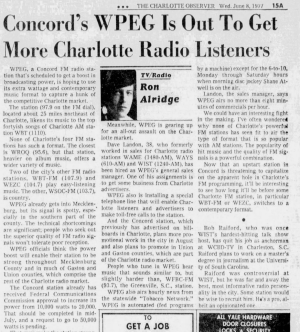
WPEG's initial upgrade - June 1977
View attachment 11941
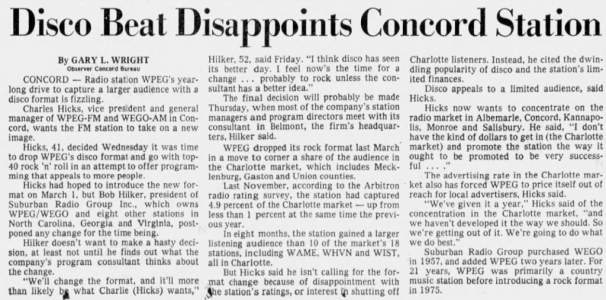
Shift from Disco to what would eventually be "urban contemporary" - Feb. 1980:
View attachment 11942

Like I said, I’m not an engineer and I don’t know how a lot of it works from a technical aspect.
The problem that I think the firm didn’t address is having two second adjacent frequencies on the same tower will cause interference issues. As someone else stated, this will be the first time that is attempted in the US.
I also understand that some stations are grandfathered, but it is my understanding that only certain changes are allowed before a station will lose that status. For example, I think that KBC adding a station new short space with WCOS that didn’t exist pre 1964 could be an issue.
I‘m a fan of the change and hope Radio One does attempt to buy it. We don’t need another religious station, and all the other corporate owners are maxed out. I just see some common sense issues with the application. Who knows? Trump’s FCC is pretty lax. Maybe it’ll slide through without much scrutiny.
i know so little about this, but i can see that they've done (as you told us) their due diligence. i do have a question. it appears that they've constructed the application to fit the location of the mooresville tower. are there any other locations (either with an existing tower or not) that would give more charlotte market coverage? for example, if the application was for the wbtv tower, it would have included a corresponding reduction in power to protect wcos, but would that location give better coverage over the market? or would the wcos protection have to be pretty equal no matter where the tower was located? theoretically, approximately how far could they move the tower south from its present location and keep their 100kw? or would even one mile cause wcos interference?so adamant on this particular point - the reason this application will get approved is all about regulatory consistency
WKKT (96.9) went on the air as WDBM-FM in 1961 from 212 Signal Hill Dr, Statesville; WPEG (97.9) went on the air in 1962.Thanks for the rundown, Scott. I know 97.9 has been around for ages, but was 96.9 around that long ago?