• Get involved.
    We want your input!
    Apply for Membership and join the conversations about everything related to broadcasting.

    After we receive your registration, a moderator will review it. After your registration is approved, you will be permitted to post.
    If you use a disposable or false email address, your registration will be rejected.

    After your membership is approved, please take a minute to tell us a little bit about yourself.
    https://www.radiodiscussions.com/forums/introduce-yourself.1088/

    Thanks in advance and have fun!
    RadioDiscussions Administrators

Aircheck: Ecos del Torbes Venezuela Spring 1980

A few weeks ago I had a chance to digitize some short wave stations I recorded a long time ago. One of the earliest stations I heard on 60 meters was "Ecos del Torbes," based in San Cristobal, Venezuela. On 4980 kHz, the station was easily heard in the evenings and early mornings in the midwest.

Here is a recording I made of Ecos del Torbes from the spring of 1980. I would like to know the exact date I recorded this, but my Spanish is not that proficient. On the second half of this recording there is a brief newscast sponsored by "Andes Motors." If I knew the headlines, I could possibly get the date this aircheck was made. I would appreciate any help that could be provided here.

The recording is 192/44.1 and can be found at these links:

http://www.4shared.com/mp3/a-gL3cUmba/01-Ecos_Del_Torbes_Spring_1980.html

http://www.4shared.com/mp3/9UlhrJgtba/02-Ecos_Del_Torbes_Spring_1980.html
 
Great stuff! Tried to listen to the headlines but could only make out one: the European Parliament demonstrates solidarity with US and threatens to suspend diplomatic relations with Iran.
 
Radio Barquisimeto on 4990 also put in a strong signal up here. The tropical band was a lot of fun to listen to, even if you didn't understand the languages. It was full of fascinating Latin American and African music every night.
 
Radio Barquisimeto on 4990 also put in a strong signal up here. The tropical band was a lot of fun to listen to, even if you didn't understand the languages. It was full of fascinating Latin American and African music every night.

Interestingly, that band began a slow death in the 60's in Latin America. As more an more towns got local AM stations, the short wave operations became less viable. As radio advertising became more and more based on ratings, ad agencies found that the larger cities reported virtually no shortwave listening at all.

I saw the raw tally sheets for ratings in Ecuador of the cities of Cuenca, Guayaquil and Quito, and there was no tropical band listening at all, despite the country having many such stations.

Based on that, in 1966 when I acquired HCSP in San Pedro de Amaguaña with the intent to move it to Quito, I kept only the AM license for 595 kHz and turned in the 3 mHz band shortwave license and dismantled the transmitter for parts. Even then it seemed impossible to visualize making a profit with a tropical band station.
 
Great stuff! Tried to listen to the headlines but could only make out one: the European Parliament demonstrates solidarity with US and threatens to suspend diplomatic relations with Iran.

Yes, I heard the same thing and the news story was general enough to not be datable. Then, after the car dealer commercial, the local news produced nothing I could track via Google; the online files of the principal Venezuelan dailies don't go back that far or are in a state if disorganization due to the current crisis there.


Interestingly, that band began a slow death in the 60's in Latin America. As more an more towns got local AM stations, the short wave operations became less viable. As radio advertising became more and more based on ratings, ad agencies found that the larger cities reported virtually no shortwave listening at all.

I saw the raw tally sheets for ratings in Ecuador of the cities of Cuenca, Guayaquil and Quito, and there was no tropical band listening at all, despite the country having many such stations.

Their salespeople should have solicited English-language advertising from Kenwood, Yaesu, Drake and other shortwave receiver manufacturers, along with producers/distributors of antennas, books on radio, hobby magazines and the like, who'd have a 100 percent receptive audience of geeky SWLs out there ready to buy!!!
 
I'm not sure that would have been effective unless they did a DX show. I do remember an English language ID usually 11pm AST or thereabouts, right after the Spanish ID. When I would listen to "Lo Que Esta Noche Recuerda", a host named Salvador Miranda would greet and respond to letters from "Los Venezolanos en el Exterior", often in the U.S.

Brandy Martel....now that's an advertiser I do remember.
 
Last edited:
Their salespeople should have solicited English-language advertising from Kenwood, Yaesu, Drake and other shortwave receiver manufacturers, along with producers/distributors of antennas, books on radio, hobby magazines and the like, who'd have a 100 percent receptive audience of geeky SWLs out there ready to buy!!!

Even in the golden age of shortwave (roughly 1945-90), there were probably only a few hundred SWLs at any given time who were in the market to buy new gear, and most of those bought from advertisers in the ham and SWL magazines. Ham and shortwave rigs last for years, sometimes decades. And since those stations were considered domestic broadcasters, why would they have targeted anything to the English-speaking world?
 
Even in the golden age of shortwave (roughly 1945-90), there were probably only a few hundred SWLs at any given time who were in the market to buy new gear, and most of those bought from advertisers in the ham and SWL magazines. Ham and shortwave rigs last for years, sometimes decades. And since those stations were considered domestic broadcasters, why would they have targeted anything to the English-speaking world?

It was intended as an exaggeration so ridiculous that folks wouldn't take it seriously. Sorry. I failed to remember one of the basic rules of the internet:: the big JUST KIDDING that must accompany posts such as that.
 
It was intended as an exaggeration so ridiculous that folks wouldn't take it seriously. Sorry. I failed to remember one of the basic rules of the internet:: the big JUST KIDDING that must accompany posts such as that.

I was about to snark back when I realized that!

I wonder how an Icom or JRD commercial in English would have sounded at 5 AM on that station whose FM I cancelled during the "Allin p'unchaj " Kichua language show aimed at indigenous population groups in Pichincha and adjacent provinces?
 
I seem to remember Ecos del Torbes brokering out some time in the evening on 4980; it might have been to an anti-Castro group (ironic with what happened later)
 
I don't know what brought Ecos del Torbes to mind the other day, but I discovered that their AM 780 signal was no longer listed on MW List, and in checking out their Facebook, they apparently left the air in July 2019, and at least at that time were trying to solicit Venezuelans living abroad to donate to a U.S. bank to get the signal back on the air. They apparently are updating the website and Facebook with new audio including "El Mundo Al Dia" headlines (with the same open they used on 4980 and 780 in the 70s). Troubled country, and apparently a troubled radio station.
 
Interestingly, that band began a slow death in the 60's in Latin America. As more an more towns got local AM stations, the short wave operations became less viable.
Activity on the tropical bands was still quite robust in the mid to late 1960s (my early years of listening to shortwave) and Venezuela was a major presence. Ecos del Torbes was one of the easiest stations to receive. The slow thinning of tropical band stations became noticeable in the early 1970s and the decline was pretty steady after that.

Solar storms that would wipe out reception along northern signal paths (such as European or Asian reception) would often result in excellent conditions for hearing Latin American stations. It was quite bizarre to find the "usual" stations missing yet receiving all sorts of Spanish and Portuguese language broadcasters that were not normally heard, and with surprisingly good strength.

Domestic broadcasters were always the most fascinating aspect of shortwave, as they provided a better look into the music, lifestyle and culture of a country, as opposed to international services produced for an external audience.

A sign of how times have changed: A couple of years ago I was up late scanning the 60 meter band, and was checking out Rádio Clube do Pará in Belém, Brazil on 4885 kHz (yes, there are still a few tropical band stations left.) The signal was poor but listenable, enjoyable music. I had the thought: do they have a webstream? Looked up their website in the WRTH, and with my very limited Portuguese found the "listen live" button. And I was treated to clear, crisp, full fidelity audio from the station, as if I was sitting in their control room. That's how you enjoy Latin American stations in the 21st Century!
 
Activity on the tropical bands was still quite robust in the mid to late 1960s (my early years of listening to shortwave) and Venezuela was a major presence. Ecos del Torbes was one of the easiest stations to receive. The slow thinning of tropical band stations became noticeable in the early 1970s and the decline was pretty steady after that.

Solar storms that would wipe out reception along northern signal paths (such as European or Asian reception) would often result in excellent conditions for hearing Latin American stations. It was quite bizarre to find the "usual" stations missing yet receiving all sorts of Spanish and Portuguese language broadcasters that were not normally heard, and with surprisingly good strength.

Domestic broadcasters were always the most fascinating aspect of shortwave, as they provided a better look into the music, lifestyle and culture of a country, as opposed to international services produced for an external audience.

A sign of how times have changed: A couple of years ago I was up late scanning the 60 meter band, and was checking out Rádio Clube do Pará in Belém, Brazil on 4885 kHz (yes, there are still a few tropical band stations left.) The signal was poor but listenable, enjoyable music. I had the thought: do they have a webstream? Looked up their website in the WRTH, and with my very limited Portuguese found the "listen live" button. And I was treated to clear, crisp, full fidelity audio from the station, as if I was sitting in their control room. That's how you enjoy Latin American stations in the 21st Century!
That's one way. The closest one can get to the experience of listening to the Tropical Bands in the 70s is tuning the Bonaire SDR and listening to medium wave (there are other SDRs in Brazil, Argentina and other places in South America. I also remember the Africans coming in around 4:30pm on winter afternoons.

I don't know exactly when Ecos del Torbes discontinued shortwave (I never was able to DX the 1kW on 49 meters), but imaging on YouTube from their daily newscasts as late as 2019 (after they had also signed off the AM), still mentioned both YVOC on 4980 and YVSC in the 49 mb. Weird.)
Anyway, this organization is off over the air radio completely at this point.
 
Activity on the tropical bands was still quite robust in the mid to late 1960s (my early years of listening to shortwave) and Venezuela was a major presence. Ecos del Torbes was one of the easiest stations to receive. The slow thinning of tropical band stations became noticeable in the early 1970s and the decline was pretty steady after that.
Much depended on the country. As I mentioned previously, I acquired a MW/SW station licensed well outside Quito, Ecuador, around 1967. I moved the AM in to Quito, changing the frequency from 595 to 590 and decided to return the shortwave license as by that time I could not see that service as being profitable.

In nations like Colombia and Ecuador, easy licensing allowed even small towns to have a local MW station and the need for shortwave was reduced. By the mid-60's practically no new SW stations were being licensed in Latin America, and the existing ones gradually fell away. In many cases, owners kept them running until the transmitter finally could not be maintained and then they closed them.

In much of rural Ecuador, Perú and Bolivia those SW stations obtained much of their revenue from messages and greetings paid for by listeners. Those could range from "Attention on the Porvenir Ranch in the El Puyo District, Province of Tungurahua: The boss is arriving in town on the noon bus. Send a donkey to town to pick him up" to greetings on each person's Saints day. A station could make a good income just on that.

Even into the 70's, particularly in Perú and Bolivia, there were still "local" stations that were only on Short Wave. Some of them, eventually, skipped AM and went directly to FM later on.
 
Did anyone catch the part where I said the medium wave station on 780 was off the air? The station was soliciting donations to return the medium wave station to the air. Ecos del Torbes apparently exists online only and possibly just with on-demand news.
 
Did anyone catch the part where I said the medium wave station on 780 was off the air? The station was soliciting donations to return the medium wave station to the air. Ecos del Torbes apparently exists online only and possibly just with on-demand news.
The situation in Venezuela is so bad that stations can't get parts for their transmitters and studio equipment as they can't get dollars and the exchange rate is so extreme that, even if they could, they can't afford the costs.

Many stations are off the air, others running low power, and many have been closed by the government for news content they did not approve of.
 
I don't know exactly when Ecos del Torbes discontinued shortwave (I never was able to DX the 1kW on 49 meters), but imaging on YouTube from their daily newscasts as late as 2019 (after they had also signed off the AM), still mentioned both YVOC on 4980 and YVSC in the 49 mb. Weird.)

If I remember right the shortwave was discontinued around 2003. Until then Ecos del Torbes used to be the easiest way to hear Venezuela on shortwave.

Back in late 1970's and 1980's when I did most of my shortwave DXing it would be possible to hear several Venezuelan stations on the 90 and 60 meter bands, with Ecos del Torbes usually being the most dominant. Going back to my shortwave logbook I counted 22 different shortwave stations from Venezuela heard in Chicago including Radio Nacional on 9540, Radio Barquisimeto on 4990, Radio Rumbos on 4970, Radio Yaracuy on 4940, Radio Juventud on 4900, Radio Valera on 4840, Radio Mara on on 3275. Even the Venezuelan time signal station YVTO could be logged on 5000 kHz despite WWV.

One interesting fact about Ecos del Torbes is that in 1980's they were also relaying the Cuban clandestine La Voz del CID on 4980 kHz.

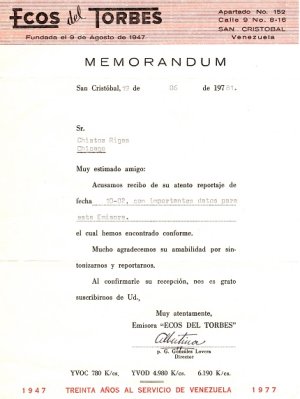
Here is a picture of a QSL letter I received from Ecos del Torbes:
 

Attachments

  • EcosDelTorbes.jpg
    EcosDelTorbes.jpg
    63.6 KB · Views: 8
Last edited:
If I remember right the shortwave was discontinued around 2003. Until then Ecos del Torbes used to be the easiest way to hear Venezuela on shortwave.

Back in late 1970's and 1980's when I did most of my shortwave DXing it would be possible to hear several Venezuelan stations on the 90 and 60 meter bands, with Ecos del Torbes usually being the most dominant. Going back to my shortwave logbook I counted 22 different shortwave stations from Venezuela heard in Chicago including Radio Nacional on 9540, Radio Barquisimeto on 4990, Radio Rumbos on 4970, Radio Yaracuy on 4940, Radio Juventud on 4900, Radio Valera on 4840, Radio Mara on on 3275. Even the Venezuelan time signal station YVTO could be logged on 5000 kHz despite WWV.

One interesting fact about Ecos del Torbes is that in 1980's they were also relaying the Cuban clandestine La Voz del CID on 4980 kHz.

Here is a picture of a QSL letter I received from Ecos del Torbes:
I remember that.
 
Apparently, a DX club arranged for an Ecos del Torbes anniversary show to be broadcast on Jeff White's WRMI in 1995. Here's the aircheck. Some in English.
 
Status
This thread has been closed due to inactivity. You can create a new thread to discuss this topic.


Back
Top Bottom