• Get involved.
    We want your input!
    Apply for Membership and join the conversations about everything related to broadcasting.

    After we receive your registration, a moderator will review it. After your registration is approved, you will be permitted to post.
    If you use a disposable or false email address, your registration will be rejected.

    After your membership is approved, please take a minute to tell us a little bit about yourself.
    https://www.radiodiscussions.com/forums/introduce-yourself.1088/

    Thanks in advance and have fun!
    RadioDiscussions Administrators

Alabama Public Television may drop PBS programming

Here's a serious question: How much longer does Alabama continue to pay for and own these stations?

Honestly, I think that depends on what the state is able to do with alternative programming. I'm not actually sure how much independence the Alabama Educational Television Authority has from government meddling. I'd like to believe it's completely independent, but in this state? It wouldn't surprise me if the governor's office had some major influence available. I could see them continuing to fund the network (about $11 million a year, as I understand it) if it became a GOP mouthpiece. If there's guaranteed independence of the board then I could also see them winding down funding and breaking the network off to be sold off after discontinuing PBS.

Maybe we'd get lucky a few of the sites would be sold off to some new nonprofit to continue PBS programming anew, but the rest would probably wind up being TBN, Daystar or other religious mouthpieces.
 
Honestly, I think that depends on what the state is able to do with alternative programming. I'm not actually sure how much independence the Alabama Educational Television Authority has from government meddling. I'd like to believe it's completely independent, but in this state? It wouldn't surprise me if the governor's office had some major influence available. I could see them continuing to fund the network (about $11 million a year, as I understand it) if it became a GOP mouthpiece. If there's guaranteed independence of the board then I could also see them winding down funding and breaking the network off to be sold off after discontinuing PBS.

Maybe we'd get lucky a few of the sites would be sold off to some new nonprofit to continue PBS programming anew, but the rest would probably wind up being TBN, Daystar or other religious mouthpieces.

I have to wonder what kind of nonprofit in Alabama would have deep enough pockets to start buying and running TV stations.

And would broadcasters such as TBN or Daystar be able to gain noncommercial licenses? As I understand it, their stations are, at least legally, commercial ones, whether they run any advertising or not.
 
They're not nonprofits, but Auburn and/or the University of Alabama could probably raise the money to do it.

Maybe. As you know, Penn State just did a deal with WHYY to operate its TV & radio properties.

State colleges are also experiencing funding cuts tied to the closing of the Dept of Education.
 
And would broadcasters such as TBN or Daystar be able to gain noncommercial licenses? As I understand it, their stations are, at least legally, commercial ones, whether they run any advertising or not.
Although most TBN stations operate on commercial channel allocations, they do have a number of non-comms under their Community Educational Television subsidiary, such as KETH in Houston.


Daystar operates mostly as a non-comm, though they have been in trouble with the FCC in the past for pushing boundaries. In DFW the Daystar station (KDTN) was once a secondary PBS affiliate for the market. Here in Houston their KLTJ operates on a non-comm allocation.

It is very possible that some of the current APT licenses could wind up with either Daystar or TBN should either network see them as a coverage upgrade from current facilities. There are other religious broadcasters that could certainly be in the mix as well.
 
One other thing, when the statewide public TV networks were founded, the main purpose in so doing, or at least one of the main purposes, was to provide classroom instruction during the school day for pupils whose schools often lacked the resources to bring in specialized education, indeed, they were often called "[State Name] Educational Television" or something similar. The state networks of Kentucky and South Carolina still bill themselves that way, though in South Carolina, it is shortened to "SCETV", and the Kentucky network simply goes as "KET", I'm not sure if the longer title is ever used anymore in the latter case. With a handful of possible exceptions, public TV stations no longer offer such instructional programming, at least not with any regularity.
True too at one point that is until schools (all levels from preschool to college) decided to focus on putting their educational content going to the internet. Today whenever we bring up Public media in its current state we talk about providing reliable news content and investigative journalism especially for them to remain relevant to donors and viewers. For Alabama specifically how will they get reliable news content if Alabama Public Television loses their affiliation with PBS. Also how will they get donors if they remove the national content from PBS especially Frontline and Newshour the ones that get targeted the most when the CPB funding is brought up.
 
True too at one point that is until schools (all levels from preschool to college) decided to focus on putting their educational content going to the internet.
Having regularly scheduled instructional programming on public TV stations is an outmoded concept. When I was homeschooling my son, very often, instead of attempting to teach a class myself, I'd just go out on YouTube and find something relevant to the class instead. There are many young math whizzes who make excellent instructional videos, and can succinctly and clearly explain complex math concepts that I struggled to convey. And it's all free and available on demand.
 
Having regularly scheduled instructional programming on public TV stations is an outmoded concept. When I was homeschooling my son, very often, instead of attempting to teach a class myself, I'd just go out on YouTube and find something relevant to the class instead. There are many young math whizzes who make excellent instructional videos, and can succinctly and clearly explain complex math concepts that I struggled to convey. And it's all free and available on demand.
Many PBS stations offer a streaming platform to schools with on-demand videos keyed to education standards that teachers could get credentials for. Certainly more flexible than the old method of having school AV departments videotape programs off the instructional TV feed. With the loss of CPB, Ready to Learn grants, Annenberg, etc., I would expect many of those streaming platforms to go away or shift to state education departments or school consortiums.
 
Many PBS stations offer a streaming platform to schools with on-demand videos keyed to education standards that teachers could get credentials for. Certainly more flexible than the old method of having school AV departments videotape programs off the instructional TV feed.
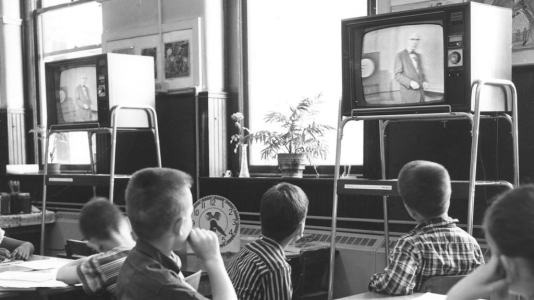
We weren't even that fancy, VCRs didn't exist when I was in grade school. KET sent out a classroom schedule and you watched the show when it was on, on one of those big institutional black-and-white sets with the continuous UHF tuner and a loop antenna on the back, up on a tall wheeled cart. They put me in charge of the tuning and adjusting the antenna because I knew how to do it.
 
Many PBS stations offer a streaming platform to schools with on-demand videos keyed to education standards that teachers could get credentials for. Certainly more flexible than the old method of having school AV departments videotape programs off the instructional TV feed. With the loss of CPB, Ready to Learn grants, Annenberg, etc., I would expect many of those streaming platforms to go away or shift to state education departments or school consortiums.

Yes sadly Annenberg Learner is going away in 2026. I remember at one point Annenberg got their funding from CPB and local PBS stations for their instructional programming. It’s a combination of two things that have taken place in the past 20 years from educational foundations, Schools from Preschool to College all moved their educational content to their own systems or to YouTube. Places like Khan Academy, Coursera have provided educational content directly on their websites. Another one is that the affiliates of PBS have put more emphasis on investigative journalism both local and national via documentaries like PBS Frontline and news programming like PBS Newshour and BBC News when it came to keeping their non-profit status and showing why public media is still important to citizens when it came to CPB funding and donations.


The governor of Alabama has put a hold on dropping PBS until there's a public survey and a plan for alternative programming:

Good for now and also what will this alternate programming be if APT loses their affiliation with PBS? In some places when a PBS station loses their affiliation they get their content from American Public Television or local programming outside of prime time hours, kids programming from PBS and PBS Newshour. Most notable one is KPJK Santa Rosa, California.


Good for now and also what will this alternate programming be if APT loses their affiliation with PBS? In some places when a PBS station loses their affiliation they get their content from American Public Television or local programming outside of prime time hours, kids programming from PBS and PBS Newshour. Most notable one is KPJK Santa Rosa, California.


Does APT have the resources to be able to afford programming from American Public Television?

I have to think that pledge drives would be a pretty difficult sell, "no, you won't be getting any PBS programming, but there's all this great stuff from American Public Television...". As I noted upthread, spillover PBS from adjacent states is very limited, and doesn't reach Birmingham or Montgomery, the two largest metro areas. The Mobile area would be in similar straits with the loss of PBS programming from Pensacola.

I suppose PBS could furnish a geofenced national feed for Alabama, on their website or via OTT services such as Roku, but a lot of people wouldn't want to have to do all that, to get PBS programming. At the end of the day, it's still a PITA to have to flip from OTA/cable/satellite to another means of delivery, wade through menus, and so on.
 
I believe PBS is not allowed (under its charter) to bypass local stations and do a direct to consumer system.
But doesn't PBS have a national feed for cable and satellite providers, where there is no local PBS station? Or would that be considered as something other than "direct to consumer" (i.e., the provider being a sort of intermediary)?
 
But doesn't PBS have a national feed for cable and satellite providers, where there is no local PBS station? Or would that be considered as something other than "direct to consumer" (i.e., the provider being a sort of intermediary)?

The latter. They need an intermediary.


Back
Top Bottom