• Get involved.
    We want your input!
    Apply for Membership and join the conversations about everything related to broadcasting.

    After we receive your registration, a moderator will review it. After your registration is approved, you will be permitted to post.
    If you use a disposable or false email address, your registration will be rejected.

    After your membership is approved, please take a minute to tell us a little bit about yourself.
    https://www.radiodiscussions.com/forums/introduce-yourself.1088/

    Thanks in advance and have fun!
    RadioDiscussions Administrators

Alaska AM DX

The
What is daytime AM (and FM) reception like?
I know Alaska has many different areas, with only a relatively few cities, like Juneau, Anchorage, Fairbanks, etc., but what would reception be like on the Aleutian Islands and North Pole areas?

How is reception in the Arctic?
Do ships receive AM signals day and night in the Arctic?

Theres only two signals in my town, and thats all i hear on FM. I dont pay attention to daytime AM, as ive said before.
 
I suspect that 680 KBRW is pretty decent throughout most of the Beaufort Sea, and some of the Artic Ocean during the daytime, and then of course at night those ships probably get Europeans, Asians, and North Americans because of the high propagation levels out there (at least by skywave). I don't know for sure what the islands are like, probably 620 KGTL, 560 KVOK, and a few Anchorage stations coming in weakly.
What is daytime AM (and FM) reception like?
I know Alaska has many different areas, with only a relatively few cities, like Juneau, Anchorage, Fairbanks, etc., but what would reception be like on the Aleutian Islands and North Pole areas?

How is reception in the Arctic?
Do ships receive AM signals day and night in the Arctic?
 
I suspect that 680 KBRW is pretty decent throughout most of the Beaufort Sea, and some of the Artic Ocean during the daytime, and then of course at night those ships probably get Europeans, Asians, and North Americans because of the high propagation levels out there (at least by skywave). I don't know for sure what the islands are like, probably 620 KGTL, 560 KVOK, and a few Anchorage stations coming in weakly.

KVOK is long gone.

Those in the arctic north countries do get 680 KBRW very regularly
 
Remember that Barrow is 71 degrees N. Any wisp of solar activity destroys AM propagation up there. Paul knows. I wonder what KBRW's coverage map looks like. Do they get into remote villages, Prudhoe Bay (think 'Ice Road Truckers'), etc.?
 
Remember that Barrow is 71 degrees N. Any wisp of solar activity destroys AM propagation up there. Paul knows. I wonder what KBRW's coverage map looks like. Do they get into remote villages, Prudhoe Bay (think 'Ice Road Truckers'), etc.?
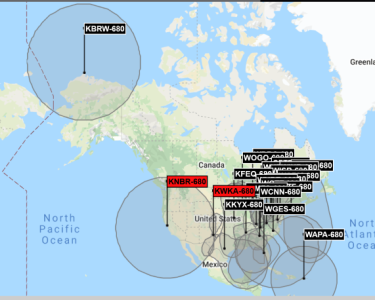
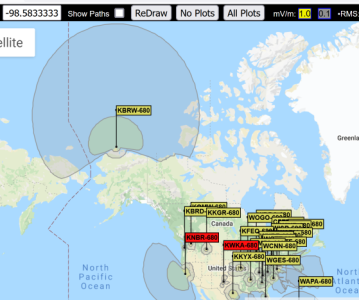
I will mostly leave this to @SomeRadioGuy (Paul), but both radio-locator.com and nf8m.com have useful daytime-contours for KBRW, and nf8m also has KBRW's approximate skywave contour. Looking at those two sources, Prudhoe Bay misses out on daytime reception, however Ocean water is a tricky substance, so with a decent AM antenna, KBRW might come to shore.
 
Looks like KBRW's daytime is mostly the Arctic Ocean, plus the coastal areas, while its nighttime is about half of Alaska, plus the Arctic.

DAY

Screenshot 2022-01-07 162846-.png
 
NIGHT looks like undirectional
KBRW's, daytime should be non-directional too, however the presence of salt water definitely favors any signal to the north, hence it looks directional.
 
Looks like KBRW's daytime is mostly the Arctic Ocean, plus the coastal areas, while its nighttime is about half of Alaska, plus the Arctic.

DAY

View attachment 2490
Again, you are interpreting those maps as "coverage" maps. They are, if anything, indications of protected contours. But mostly, they are scaled to large sizes so that the low power stations don't become tiny little dots on the map.

Those are not useful coverage maps.

I will continue to give examples. Look at WAPA in San Juan. The map here shows it reaching the eastern half of Cuba. In fact, it only reliably covers the Northeastern third of Puerto Rico with a usable, clear signal. It does not reach the western areas or the southwestern 2/3 of the Island well. It does not cover any part of Haiti or the Dominican Republic, despite the map showing total coverage of Hispaniola.

Please stop referrring to the patterns on these maps as "coverage" when no station indicated gets a usable signal in about 90% of the territory shown on the map.
 
Again, you are interpreting those maps as "coverage" maps. They are, if anything, indications of protected contours. But mostly, they are scaled to large sizes so that the low power stations don't become tiny little dots on the map.

Those are not useful coverage maps.

I will continue to give examples. Look at WAPA in San Juan. The map here shows it reaching the eastern half of Cuba. In fact, it only reliably covers the Northeastern third of Puerto Rico with a usable, clear signal. It does not reach the western areas or the southwestern 2/3 of the Island well. It does not cover any part of Haiti or the Dominican Republic, despite the map showing total coverage of Hispaniola.

Please stop referrring to the patterns on these maps as "coverage" when no station indicated gets a usable signal in about 90% of the territory shown on the map.
To expand on this, these maps are meant for Dxers, and/or people who have a top-of the line car radio, and definitely not what the average person will experience. Despite the fact that there's a mountain in the middle of PR, and it has a lot of wetlands in the west, it still seems odd that a 10kw on 680 can't travel the approximate 90 miles from San Juan to Yauco or Ponce. I would guess PR has about 1.75 mV/m of ground conductivity, right?
 
Looks like KBRW's daytime is mostly the Arctic Ocean, plus the coastal areas, while its nighttime is about half of Alaska, plus the Arctic.

DAY

View attachment 2490


KBRW is non directional... it goes farther into the arctic at night because its dark

But by vitue of little electrical noise and no AM's within 300 miles, KBRW covers alot of ground inland too
 
Sheesh, with that type of daytime pattern, Santa Claus is probably a regular listener of KBRW. But how well do they make it into North Pole, *Alaska* at night?
 
Sheesh, with that type of daytime pattern, Santa Claus is probably a regular listener of KBRW. But how well do they make it into North Pole, *Alaska* at night?
The day operation has no pattern... the map takes into account the higher conductivity of salt water compared to the land mass.
 
Sheesh, with that type of daytime pattern, Santa Claus is probably a regular listener of KBRW. But how well do they make it into North Pole, *Alaska* at night?

I wish i could tell you for sure but my guess.. is... its possible, based on my expeirience here in MxGrath.

At night, I can hear several of the Kenai/Soldotna stations like a local.. i can hear some of the anchorage stations like a local and theyre 250-300 miles away.

I can hear 250 watt KLAM 1450 Cordova surprisingly well quite regularly and theyre about 300-350 miles away
 
Again, you are interpreting those maps as "coverage" maps. They are, if anything, indications of protected contours. But mostly, they are scaled to large sizes so that the low power stations don't become tiny little dots on the map.

Those are not useful coverage maps.

I will continue to give examples. Look at WAPA in San Juan. The map here shows it reaching the eastern half of Cuba. In fact, it only reliably covers the Northeastern third of Puerto Rico with a usable, clear signal. It does not reach the western areas or the southwestern 2/3 of the Island well. It does not cover any part of Haiti or the Dominican Republic, despite the map showing total coverage of Hispaniola.

Please stop referrring to the patterns on these maps as "coverage" when no station indicated gets a usable signal in about 90% of the territory shown on the map.
If you closely at my posts, I never said the term "coverage," though I did elsewhere.
 
Night DX Thu Jan 14, 2022

CJRB 1220 Bossievan, MB with classical music

KTGE 1570 Salinas, CA with Spanish music

KGA 1510 Spokane, WA with some kind of call in talk show

“W1440” CJKR Wetaskawin, AB pounding in with oldies and classic hits

KSJX 1500 with Vietnamese talk and a song that sounded a lot like a Vietnamese re-sing of “love potion #9” by the searchers

KBRO 1490 Bremerton, WA presumed with Spanish talk that appeared to have matched the La estacion stream

KCVr 1570 Lodi, CA tentative with Punjab/ Hindi talk.


And not really Dx, but the 1600 from Blaine WA is slamming in like it’s 20 miles down the road not 1200 <----- That is NORMAL behavior .. for many many minutes at a time, almost nightly. This is my "Bellweather" station.... this being weak as snot is a damn good indicator the rest of the band will be useless and nearly 100 percent true every time i find 1600 KVRI weak, the rest of the band is GARBAGE.
 
Nice work Paul.
How often do you get KSTP and KXEL up there in the frigid cold of AK? Have they been logged yet? If CJRB 1220 often makes it in, I'd think other stuff from the upper Midwest (+ WCCO, WHO, maybe a Chicago station) would also make the trip. But I'm sure for WBBM's sake, Nome is a problem on 780...

Oh, and good luck tonight with KQKD! I know KRKO-1380 shoots most of the pattern towards you. Hopefully, there will be a few seconds of quiet and/or some quieter commercials that will enable a sweep/CW burst.
 
Nice work Paul.
How often do you get KSTP and KXEL up there in the frigid cold of AK? Have they been logged yet? If CJRB 1220 often makes it in, I'd think other stuff from the upper Midwest (+ WCCO, WHO, maybe a Chicago station) would also make the trip. But I'm sure for WBBM's sake, Nome is a problem on 780...

Oh, and good luck tonight with KQKD! I know KRKO-1380 shoots most of the pattern towards you. Hopefully, there will be a few seconds of quiet and/or some quieter commercials that will enable a sweep/CW burst.

I've heard KKOH over KNOM a few times, Denver and Tacoma over KICY once or twice.

1040 is blanketed by Funny 1040 Vancouver.

KSTP visits but not often.. its usually vietnamese KSJX.

I've heard one chicago station... WYLL 1160
 
Nice work Paul.
How often do you get KSTP and KXEL up there in the frigid cold of AK? Have they been logged yet? If CJRB 1220 often makes it in, I'd think other stuff from the upper Midwest (+ WCCO, WHO, maybe a Chicago station) would also make the trip. But I'm sure for WBBM's sake, Nome is a problem on 780...

Oh, and good luck tonight with KQKD! I know KRKO-1380 shoots most of the pattern towards you. Hopefully, there will be a few seconds of quiet and/or some quieter commercials that will enable a sweep/CW burst.
KNOM is prominent on the Kaneohe, Hawaii SDR this time of year. WBBM often over rides KKOH on that receiver, but not in early and mid winter.
 
Status
This thread has been closed due to inactivity. You can create a new thread to discuss this topic.


Back
Top Bottom