The references are to the FM, though. They aren't advertising the AM.I believe he's talkin' about the AM.

-
Get involved.
We want your input!
Apply for Membership and join the conversations about everything related to broadcasting.
After we receive your registration, a moderator will review it. After your registration is approved, you will be permitted to post.
If you use a disposable or false email address, your registration will be rejected.
After your membership is approved, please take a minute to tell us a little bit about yourself.
https://www.radiodiscussions.com/forums/introduce-yourself.1088/
Thanks in advance and have fun!
RadioDiscussions Administrators
You are using an out of date browser. It may not display this or other websites correctly.
You should upgrade or use an alternative browser.
You should upgrade or use an alternative browser.
AM 1110 Off The Air?
- Thread starter DToTheJ
- Start date
The references are to the FM, though. They aren't advertising the AM.
Yeah, that's right, but I believe the guy was talking about the AM, wherever that post is.

Miami and New York too! What an awesome signal.At my place in Maryland I might have a better signal than parts of the Charlotte market! I believe I could hear WBT on a rusty razor blade and a piece of string

Yea, Those AM Towers are in a Great Location, with a Unique Diamond-Shaped Design, known as Blaw-Knox towers, are used by just a few other AM stations (such as WSM 650 in Nashville, and WLW 700 in Cincinatti). I wonder if that design helps with improvent for the best propagation & potential reach of their signal (such as specific tower height for signal wavelength).
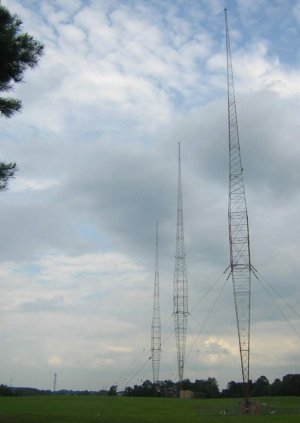
Here's a picture of the WBT site in 2007.
Here's a picture of the WBT site in 2007.
Attachments
@ScottFybush will be the absolute authority here. I have been told the main advantage of the Blaw-Knox design would be that it throws out a superior skywave. Which was an advantage for the clear channel stations of old, but not so much once the main focus was on ground wave. Another advantage is that there are fewer guy wires and the guys that DO exist are attached fairly low on the tower so as to minimize the guys causing problems with the signal. As local and regional stations started filling in all of the gaps around the country post WW2, skywave became less of a desired phenomenon and groundwave was (and still is) the focus. I suspect they are also more expensive to build than a simple stick.Yea, Those AM Towers are in a Great Location, with a Unique Diamond-Shaped Design, known as Blaw-Knox towers, are used by just a few other AM stations (such as WSM 650 in Nashville, and WLW 700 in Cincinatti). I wonder if that design helps with improvent for the best propagation & potential reach of their signal (such as specific tower height for signal wavelength).
Here's a picture of the WBT site in 2007.
If they were maximizing the signal in a meaningful way, there would have been more than 10 of them constructed in the US.I wonder if that design helps with improvent for the best propagation & potential reach of their signal (such as specific tower height for signal wavelength).
All of the diamond Blaw-Knox towers in the US were built 1930-1935, not counting restoration from Hurricane Hugo. Many significant stations built their transmitters years after after WSM and WLW, but still in an era when distant AM reception was important.
If it the diamond tower remained unmatched technology, you'd think someone would have built one after 1935. WLS/Chicago comes to mind as a station that built their transmitter in the late 30s, with hopes of reaching farmers across the Great Lakes region. But by then, even Blaw-Knox themselves were marketing uniform cross-section towers in their magazine advertisements.
IMHO the construction cost would be extraordinary because you are building basically 2 structures. The bottom part would be sections that would be difficult if no impossible to "jack" up like conventional tower sections now. Then a couple of hundred feet up you have to build a free standing structure that all the sections have to be lifted around the base middle or just stick built at height that most likely would require skilled iron workers. It might be easier to just weld cut pieces of steel in place as you go.
Another consideration would be the ceramic insulator at the base of the tower will have to take a lot of extra weight.
Another consideration would be the ceramic insulator at the base of the tower will have to take a lot of extra weight.